

Studies on Olive Oil and Social Responsibility
The olive oil industry is more than just agriculture - it impacts jobs, traditions, and economies worldwide. Here's what you need to know:
- Economic Impact: Olive oil production generates billions annually. Tunisia's sector contributes over $1.5 billion, while Spain's PDO programs added $157.51 million in 2022.
- Challenges for Small Farmers: 94.8% of EU farms are family-run, facing high costs and strict regulations. Producer Organizations and certifications like PDO help them compete.
- Women's Role: Women are gaining formal roles in olive oil production. In Morocco, 29% of cooperative members are women, with initiatives boosting their participation and leadership.
- Sustainability Practices: Certifications like PDO and Social Life Cycle Assessments ensure ethical labor and community benefits while preserving farming methods.
- Case Study: Big Horn Olive Oil supports responsible sourcing and prioritizes product quality, benefiting farmers and communities.
The olive oil industry is evolving, addressing labor rights, economic stability, and ethical practices to support workers and regions globally.
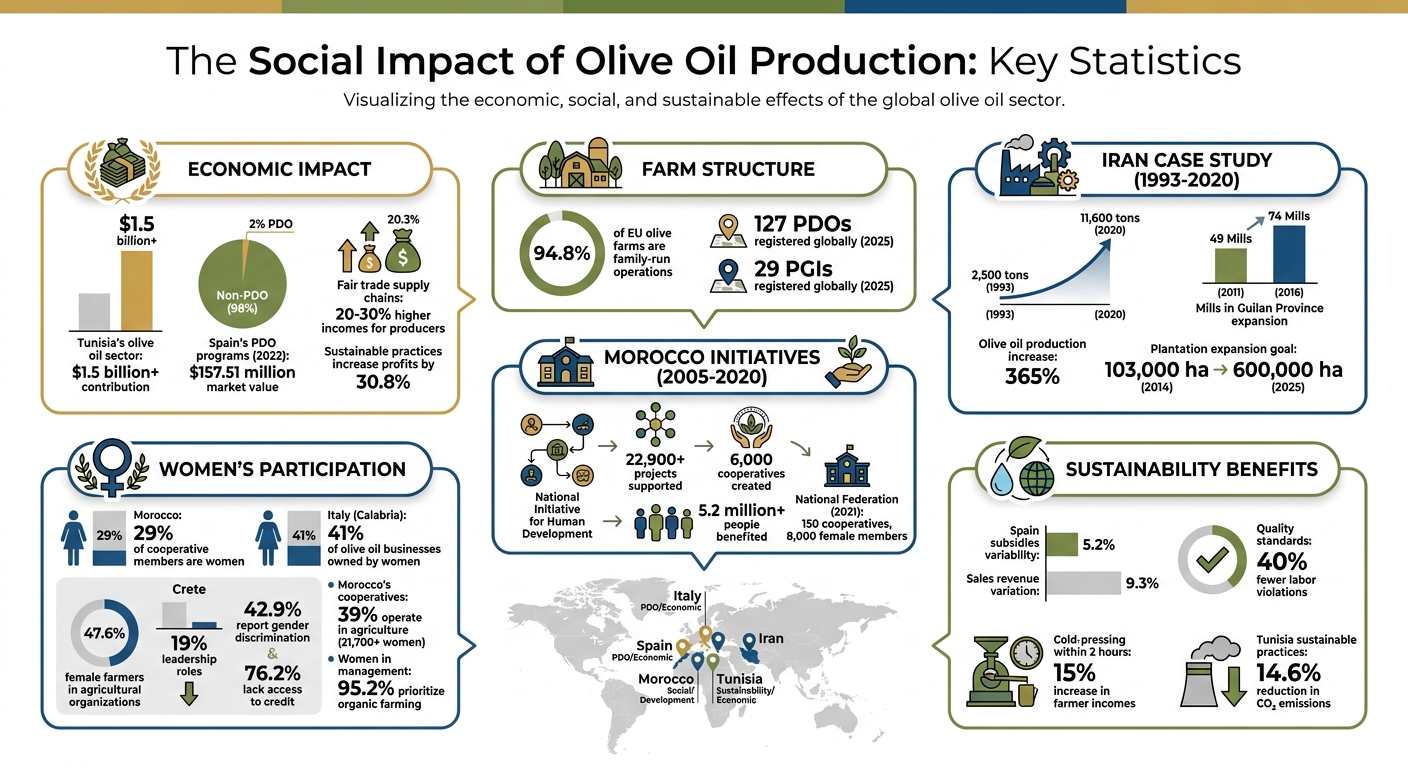
Global Olive Oil Industry Social Impact: Key Statistics and Economic Data
How Olive Oil Production Supports Local Communities
Olive oil production plays a key role in boosting the economies of rural areas, especially where job opportunities are limited. This industry not only employs agricultural workers but also supports various roles throughout the supply chain. For many regions where agriculture is the backbone of the economy, olive oil production provides a critical source of income.
Take Iran's example: in 1993, the government introduced the "Expansion of Olive Cultivation Plan" to uplift rural economies. By 2020, this initiative led to a staggering 365% increase in olive oil production, jumping from 2,500 to 11,600 tons. Alongside this, processing infrastructure saw significant growth - just in Guilan Province, the number of mills rose from 49 in 2011 to 74 by 2016. Looking ahead, the government aims to expand olive plantations from 103,000 hectares in 2014 to 600,000 hectares by 2025. These efforts not only strengthen regional economies but also support the preservation of traditional farming practices.
Maintaining Traditional Farming Methods
Traditional olive farming is more than just an agricultural method - it’s a reflection of centuries-old craftsmanship passed down through generations. These practices help preserve cultural heritage while contributing to the local economy in various ways. Beyond farming, olive oil production supports industries like transportation, packaging, marketing, and even oleotourism, where visitors explore historic production sites and boost local hospitality businesses.
Traditional olive groves, as perennial crops, also offer environmental benefits. They help conserve soil, protect biodiversity, and reduce erosion. However, maintaining these time-honored methods isn’t easy. In Spain, stable subsidies (with only a 5.2% variability) provide a dependable safety net for farmers, offsetting the more unpredictable fluctuations in sales revenue (9.3% variation). Supporting these practices not only safeguards cultural traditions but also strengthens the economic stability of small-scale farmers.
Economic Benefits for Small Farmers
For small-scale farmers, challenges like high transaction costs, limited access to funding, and strict safety standards can make it tough to stay competitive. Joining Producer Organizations helps these farmers gain stability and improve their bargaining power.
Certification programs are another game-changer. For instance, in Spain, Protected Designation of Origin (PDO) olive oils reached a market value of $157.51 million in 2022. These certifications allow smaller producers to sell their products at premium prices without needing to invest in costly private branding. Organic farming offers an additional opportunity. While organic groves often yield less, subsidies like those provided by the EU’s Common Agricultural Policy (CAP) help level the playing field. According to Agricultural and Food Economics:
"CAP subsidies are shown to be an effective instrument for promoting the conversion to organic farming in olive groves since they cancel out the differences in profitability between these two production systems."
– Agricultural and Food Economics
With these types of support, small farmers can thrive while contributing to the broader economy.
sbb-itb-4066b8e
Gender Equality in Olive Oil Production
Women have always played a key role in olive oil production, but their contributions are shifting from unpaid labor to formal economic roles. Agricultural cooperatives are at the heart of this transformation, helping women achieve financial independence and greater control over their work. Promoting gender equality in this field not only improves social well-being but also strengthens community resilience.
In Morocco, for example, women account for 29% of cooperative members, with 14% involved in women-only cooperatives. Of these, 39% operate in agriculture, representing over 21,700 women. Meanwhile, in Italy’s Calabria region, women own about 41% of olive oil businesses. Morocco's National Initiative for Human Development, launched between 2005 and 2020, supported over 22,900 projects, including 6,000 cooperatives. This initiative benefited more than 5.2 million people, enabling rural women to transition into formal economic activities. These developments highlight the growing influence of women in the olive oil industry and set the stage for a deeper look at their leadership and economic contributions.
Women in Management Positions
While participation is increasing, leadership opportunities remain limited. In Crete, for instance, 47.6% of female olive farmers are members of agricultural organizations, but only 19% hold leadership roles. Even more troubling, 42.9% of these women report facing gender discrimination.
Efforts to address these challenges are underway. Morocco’s Green Morocco Plan, implemented from 2008 to 2020, modernized agricultural practices and included women through technical training and financial incentives. In March 2021, Morocco launched the National Federation of Women in the Argan Sector, representing eight provinces, 150 cooperatives, and 8,000 female members. This federation combats exploitative practices and works to protect women’s access to natural resources. Women in leadership roles often advocate for sustainable farming methods - in some areas, 95.2% of women in management prioritize organic farming, driven by environmental concerns rather than just economic motives.
Although leadership barriers persist, these initiatives show that progress is possible, especially when women gain access to tools and platforms that amplify their voices.
Economic Impact on Women Workers
Achieving financial independence is still a significant hurdle for many women. In Crete, 76.2% of female olive farmers lack access to credit or savings programs. Without land ownership, securing loans becomes nearly impossible due to a lack of collateral. These limitations restrict their ability to invest in resources like equipment, training, or business expansion.
Cooperatives offer a way forward, providing women with training, resources, and governance opportunities. These platforms help women transition from passive participants to active decision-makers, influencing both household finances and community leadership. In 2022, Morocco introduced the "Mourafaka" program, which offers post-creation support for women’s cooperatives. This includes technical assistance and financial aid to help new cooperatives stabilize and grow. Such programs also aim to address the dual burden women face - balancing unpaid domestic responsibilities with professional commitments. By empowering women economically, these initiatives not only improve individual livelihoods but also contribute to the long-term stability of olive oil-producing communities.
Certification Programs and Social Standards
Building on earlier discussions about the benefits for communities and economies, certification programs play an important role in promoting ethical practices in olive oil production. These systems help ensure that production aligns with fair labor standards and supports local community growth. They go beyond focusing solely on environmental factors, addressing issues like fair wages, worker safety, and community-based initiatives. As consumers become more conscious of these issues, producers are increasingly adopting frameworks to demonstrate their commitment to responsible production.
The European Union's Geographical Indications system, which includes Protected Designation of Origin (PDO) and Protected Geographical Indication (PGI) labels, now incorporates social sustainability elements. By 2025, there are 127 PDOs and 29 PGIs registered for olive oil globally. On May 13, 2024, the EU introduced Regulation (EU) 2024/1143, allowing producers to officially integrate social sustainability practices into their product specifications. This regulation requires certified olive oils to adhere to standards that address labor rights, community heritage, and ethical production methods.
However, adoption of these certifications remains limited. For instance, in Spain, the largest olive oil producer in the world, only 2% of production carries a PDO label. This low adoption rate highlights the untapped potential for incorporating social sustainability into olive oil production.
Voluntary Sustainability Standards
Voluntary certification programs act as market-driven tools, rewarding producers who meet higher social and ethical benchmarks. These programs focus on areas like labor rights, workplace safety, and community development. For smaller producers, certification can provide much-needed visibility and credibility, enabling them to secure premium pricing without relying on large-scale branding.
For example, PDO certification requires that every step of production - harvesting, processing, and packaging - takes place within a specific region. This protects traditional practices while also supporting local jobs. PGI certification, on the other hand, is slightly less restrictive, requiring only one stage of production to occur within the designated area. Both certifications help preserve cultural traditions while ensuring fair treatment of workers and economic benefits for local communities.
The EU's updated framework also encourages producers to publish voluntary sustainability reports, which can help enhance transparency and build consumer trust. These reports shed light on how producers address social issues, such as maintaining safe working conditions and contributing to community programs.
Social Life Cycle Assessment Methods
In addition to voluntary standards, tools like Social Life Cycle Assessment (S-LCA) provide concrete data on the social impacts of production. S-LCA takes a systematic approach to evaluate how olive oil production affects workers and communities throughout the entire process. Unlike environmental assessments that focus on emissions or resource use, S-LCA looks at social factors like human rights, working conditions, cultural preservation, and community well-being.
"Social life cycle assessment (S-LCA) has been established as one of the most effective methodologies for assessing the social implications of products throughout their life cycles."
- Behzad Safeie-Noghlbari, Researcher
In March 2024, researcher Behzad Safeie-Noghlbari applied the S-LCA methodology to the olive oil industry in Roudbar County, Guilan Province, Iran. The study involved 263 participants from five groups - factory managers, employees, orchard owners, orchard workers, and community members. While overall social conditions were rated "almost adequate", orchard workers highlighted concerns about working conditions and the lack of community development as areas needing immediate attention. This type of analysis pinpoints "social hotspots" where efforts should be focused.
S-LCA follows four main phases: defining goals and scope, conducting inventory analysis, assessing impacts, and interpreting results. Researchers are increasingly moving away from subjective, scale-based assessments toward impact-based evaluations. These newer methods emphasize measurable outcomes like actual wages, workplace safety incidents, and health impacts.
Big Horn Olive Oil's Social Responsibility Practices
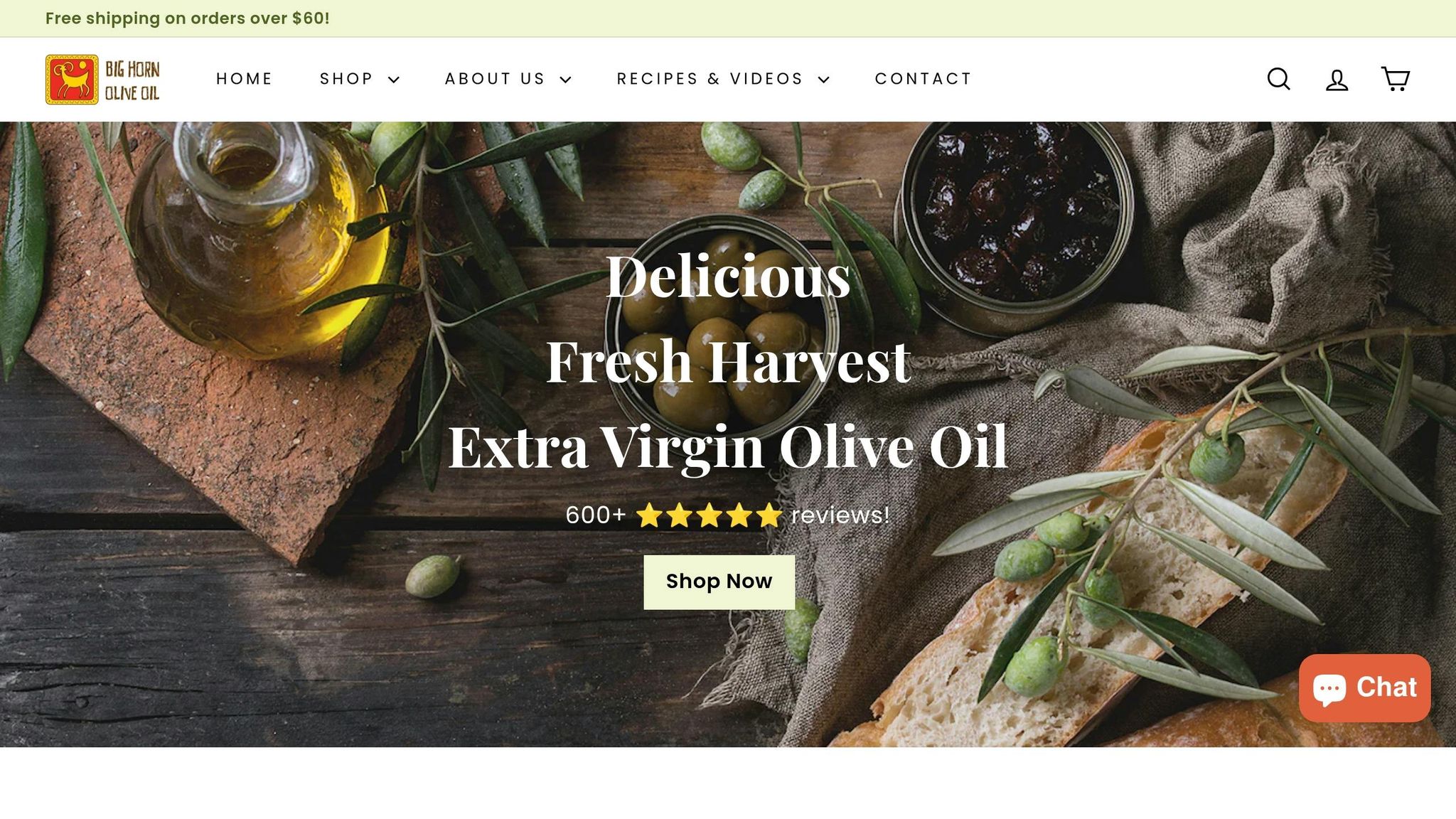
Big Horn Olive Oil integrates established certification frameworks and social sustainability principles into its operations. Research on social responsibility in olive oil production underscores the importance of ethical sourcing and maintaining high quality. Big Horn Olive Oil embodies these values by carefully selecting suppliers and adhering to strict freshness standards. While the company doesn't hold formal fair trade certifications, its sourcing practices align with voluntary sustainability standards previously discussed.
Sourcing and Fair Trade Methods
Big Horn Olive Oil sources ultra-premium extra virgin olive oils from producers committed to responsible practices. Studies reveal that fair trade olive oil supply chains can lead to 20–30% higher incomes for producers, a goal reflected in Big Horn Olive Oil's sourcing strategy. Additionally, the company's balsamic vinegars are sourced from traditional producers in Modena, Italy, supporting the preservation of artisanal methods and economic stability in the region.
By partnering with suppliers who prioritize ethical labor practices, Big Horn Olive Oil contributes to a broader industry shift toward social sustainability. Research shows that farms adhering to strict quality standards report 40% fewer labor violations. The company’s supplier selection process ensures fair compensation reaches the communities involved in production, reinforcing its commitment to ethical practices.
These efforts go hand-in-hand with the company’s dedication to maintaining product quality and freshness.
Quality and Freshness Standards
Big Horn Olive Oil is deeply committed to preserving the integrity of its products. By cold-pressing olives within 2 hours of harvest, the company not only preserves essential polyphenols but also minimizes waste - a process linked to up to a 15% increase in farmer incomes.
The company ensures its olive oil is fresh within 3 months of harvest, delivering products at their peak quality. These stringent freshness standards encourage producers to maintain high-quality practices, which often result in reinvestments into local communities. This approach highlights how a focus on quality can align with social responsibility principles, even without formal certification programs, as shown in recent industry studies.
Conclusion
Studies highlight how responsible olive oil production positively impacts communities, workers, and regional economies. Spain's PDO certification schemes are a prime example, showing how these programs contribute to economic stability. In 2022 alone, the certified olive oil market generated millions of dollars. Choosing ethically sourced olive oil supports fair wages, improves working conditions, and helps preserve traditional Mediterranean farming methods that have sustained rural areas for generations.
In Tunisia's Henchir Chaal region, research from January 2026 revealed that sustainable practices cut transport-related CO2 emissions by 14.6% and increased profits by 30.8% through waste valorization. These findings highlight how environmental and social responsibility can create advantages that benefit the entire supply chain.
"Environmental constraints, when architecturally embedded, define opportunity spaces for competitive advantage rather than performance limitations." – Majdi Argoubi and Khaled Mili, Researchers
Companies like Big Horn Olive Oil exemplify these principles. Their dedication to sourcing from responsible producers and maintaining strict freshness standards ensures that their practices not only deliver high-quality products but also reinvest value into farming communities. By cold-pressing olives within 2 hours of harvest and guaranteeing delivery to customers within 3 months, they combine quality with a commitment to community well-being.
The measurable results - job creation, improved incomes, and thriving rural communities - demonstrate the far-reaching impact of responsible olive oil production. These efforts go beyond individual purchasing decisions, shaping a more sustainable future for olive oil-producing regions.
FAQs
How can I tell if an olive oil brand supports fair labor?
When evaluating whether an olive oil brand supports fair labor, start by checking how transparent they are about their sourcing practices. Ethical brands often highlight key factors like fair wages, safe working conditions, and community support for workers.
Certifications can also serve as helpful indicators. Labels such as Fairtrade or PDO (Protected Designation of Origin) suggest the brand follows ethical labor standards.
It's also a good idea to dig into the brand’s policies. Look for companies that offer traceability in their supply chain. This means they can show exactly where their olives are harvested and processed, ensuring fair labor practices are upheld throughout the production process.
What’s the difference between PDO and PGI on olive oil labels?
PDO (Protected Designation of Origin) ensures that every single step of the production process - growing, processing, and packaging - takes place in a specific region. This guarantees full traceability and a strong connection to that area.
On the other hand, PGI (Protected Geographical Indication) offers more flexibility. While it still ties the product to a geographic origin, it allows at least one stage of production to happen outside the designated region.
In short, PDO has stricter guidelines, while PGI allows for a broader regional association. Both certifications aim to preserve the quality and heritage of the product but differ in their levels of restriction.
How does fresher olive oil help farming communities?
Fresher olive oil plays a role in bolstering farming communities by offering consistent rural employment throughout the year. From cultivating olives to bottling the final product, the entire production process creates jobs, supports local economies, and provides steady livelihoods for workers.