

Sustainability in Olive Oil: Key Certifications Explained
Most olive oil labels answer only one question, not all of them. If I want to read a bottle fast, here’s the simple rule: Organic tells me about farming inputs, Carbon Footprint and Water Footprint tell me about measured impact, and PDO/PGI tell me where the oil comes from.
Here’s the short version:
- USDA Organic / EU Organic: no synthetic pesticides or fertilizers; olive groves usually need 36 months before they can be sold as organic.
- Carbon Footprint: tracks greenhouse gas emissions across the product life cycle.
- Water Footprint: looks at rainwater, irrigation water, and water tied to pollution.
- EPD: a verified report with life-cycle data; more common in business documents than on store shelves.
- PDO / PGI: origin and traceability seals, not direct proof of low emissions or low water use.
A few numbers stand out:
- Europe has about 5.1 million hectares of olive groves, about 49% of the global olive-growing area.
- In conventional olive farming, synthetic fertilizer can account for 81% to 87% of climate-change and acidification impact.
- In irrigated systems, blue water can make up 74% to 77% of the total water footprint.
- Packaging can account for up to 60% of the total impact of 1 liter of olive oil.
- Shoppers in one 2025 study were willing to pay about $7.89 per liter more for organic EVOO, about $7.24 per liter more for a local low-impact brand, and about $5.56 per liter more for PDO olive oil.
Approximate conversions from euro values, based on mid-2026 exchange levels.
If I’m standing in a U.S. store, the takeaway is simple: <u>don’t treat every seal as the same kind of proof</u>. Some labels speak to farming rules. Some speak to measured emissions or water use. Some speak to place. That single difference changes what the bottle is actually telling me.
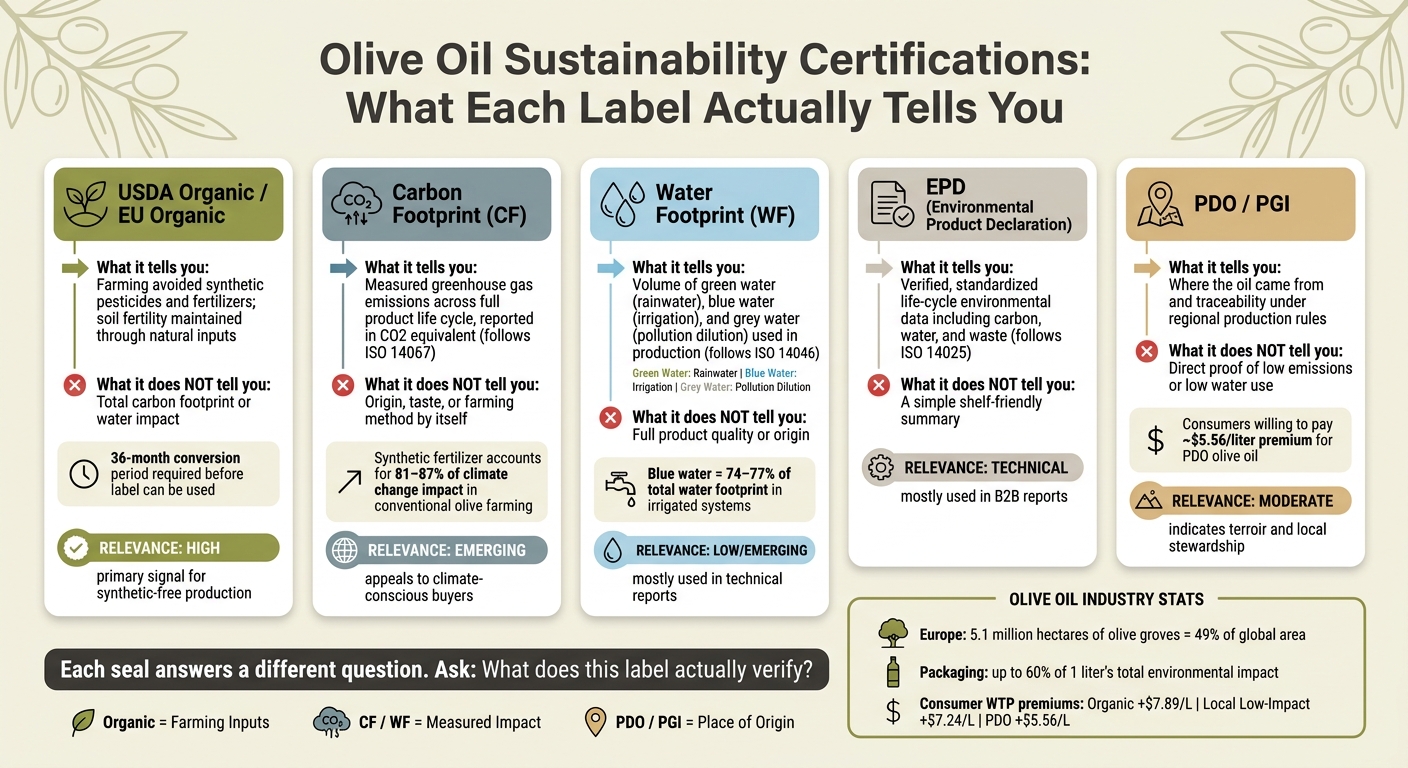
Olive Oil Sustainability Certifications Compared: What Each Label Actually Tells You
How Pompeian Achieved Sustainably Grown® Certified Olive Oil
sbb-itb-4066b8e
Quick Comparison
| Label | What it tells me | What it does not tell me |
|---|---|---|
| USDA Organic / EU Organic | Farming avoided synthetic chemicals and followed organic rules | Total carbon or water impact |
| Carbon Footprint | Measured greenhouse gas emissions | Origin, taste, or farming method by itself |
| Water Footprint | Water use and pollution tied to production | Full product quality or origin |
| EPD | Verified life-cycle data in a standard format | A simple shelf-friendly summary |
| PDO / PGI | Where the oil came from and traceability rules | Direct proof of low emissions or low water use |
So if I want to shop smarter, I should ask one plain question: What does this seal verify?
Main Sustainability Certifications and Standards in Olive Oil
Not all olive oil labels mean the same thing. Some focus on how olives are farmed. Others measure carbon emissions or water use. And PDO and PGI are mostly about origin and quality. That distinction matters, because a seal can look reassuring while only telling you one piece of the story.
Organic Certification
Organic is the label most shoppers know best. In the U.S., the main consumer-facing seal is USDA Organic. It applies to the farming stage and sets rules such as no synthetic pesticides, no synthetic fertilizers, and a focus on soil fertility through crop rotation, green manure, and natural inputs like animal manures and crop residues.
If you're buying imported olive oil, you may also see the EU organic “leaf” logo. That seal follows the same organic rules.
There’s also a timing issue that many buyers never hear about. Olive trees are perennial crops, so moving from conventional farming to certified organic farming usually takes a 36-month conversion period before the producer can use the organic label. Three years is a long commitment, which helps show why organic certification is a big move for growers.
Still, organic doesn’t answer every question. It does not tell you how low-impact the product is overall. If you want information on emissions or water use, you need other types of labels.
Farm-Level and Olive-Sector Sustainability Programs
Outside organic, some programs try to measure impact more directly. Two common examples are Carbon Footprint (CF) and Water Footprint (WF).
A Carbon Footprint label follows ISO 14067. It tracks greenhouse gas emissions across a product’s life cycle and reports them in CO₂ equivalent. In plain English, it’s asking: how much climate-related pollution came from making and moving this oil?
A Water Footprint label follows ISO 14046. It looks at three kinds of water use:
- Green water: rainwater absorbed by crops
- Blue water: surface water and groundwater used for irrigation
- Grey water: freshwater needed to dilute pollutants
You may also come across EPDs. These are third-party verified, LCA-based reports that present standardized environmental impacts. They’re more common in technical or B2B settings than on retail shelves.
That’s a big difference from PDO and PGI. Those labels are about traceable origin, not measured environmental performance.
Quality and Origin Seals With Sustainability Links
PDO (Protected Designation of Origin) and PGI (Protected Geographical Indication) are not sustainability certifications. They are origin and quality seals. Their link to sustainability is more indirect: they can help protect local cultivars, landscapes, and traceability.
A PDO seal tells you where an oil came from and how it was made under regional rules. What it does not do, by itself, is verify environmental metrics like carbon emissions or water use unless that specific PDO’s product rules say so.
Here’s a quick side-by-side view for U.S. shoppers:
| Certification | Scope | Key Criteria | Verification | Relevance for U.S. Shoppers |
|---|---|---|---|---|
| Organic (USDA/EU) | Farm level | No synthetic chemicals; soil fertility | Third-party audit (ISO/IEC 17065) | High - primary signal for synthetic-free production |
| Carbon Footprint (CF) | Full life cycle | GHG emissions (CO₂-e) | LCA-based; ISO 14067 | Emerging - appeals to climate-conscious buyers |
| Water Footprint (WF) | Farm & mill | Volume of fresh water used and polluted | ISO 14046 standards | Low/Emerging - mostly used in technical reports |
| EPD | Full environmental profile | Standardized LCA data (carbon, water, waste) | Independently verified; ISO 14025 | Technical - mostly used in B2B reports |
| PDO / PGI | Regional / supply chain | Specific region; production steps tied to place | Regulatory council audits for traceability | Moderate - indicates terroir and local stewardship |
Each seal answers a different question. Organic speaks to farming inputs. CF and WF measure impact. EPDs package LCA data into a standard report. PDO and PGI tell you where the oil comes from and how that origin is protected.
What Research Shows About Farm and Environmental Impacts
Outcomes in Certified Olive Groves
Research points in the same direction: certified organic and sustainably managed groves often have lower impacts than conventional systems. But the size of the gain depends on what you measure. That’s why a label can hint at better farm practices while still masking very different on-the-ground results.
Greenhouse gas emissions are a good example. In conventional olive systems, synthetic nitrogen is one of the main sources of emissions. One study found that fertilizer use alone accounts for 81% to 87% of climate change and acidification impacts in conventional olive farming. Organic systems skip synthetic nitrogen, which cuts climate impact by about 4% and acidification by as much as 40% compared with conventional farming.
Soil health tells a more direct story. When growers use cover crops and leave pruning residues on the ground, soil organic carbon, or SOC, goes up in measurable ways. Well-managed groves can even become net carbon sinks at 1.7 tons of carbon per hectare per year. Another study of Mediterranean olive systems found that an agronomically sustainable orchard sequestered 15.45 metric tons of CO₂ per hectare annually.
Water use and biodiversity are less simple. Traditional rain-fed groves depend almost entirely on rainfall. Intensive irrigated systems, by contrast, rely much more on surface water and groundwater. In those systems, blue water can make up 74% to 77% of the total water footprint. At the same time, efficient irrigation can cut some impacts per unit of oil because higher yields spread the environmental load across more output.
| Indicator | Organic / Sustainable | Conventional / Intensive |
|---|---|---|
| GHG emissions | Lower; can become a net carbon sink with sustainable practices | Higher; driven by synthetic inputs |
| Water use | Mostly rainwater; low blue water demand | High blue water demand; up to 77% of total water footprint |
| Soil effects | Higher soil organic carbon and microbial activity | Greater risk of erosion and degradation |
| Biodiversity | Higher; supports biodiversity | Lower; intensive practices can harm wildlife |
| Yield | Lower; often needs price premiums or subsidies to offset | Higher; optimized for volume |
| Certification cost | Higher; audits and compliance add to production costs | Lower; no third-party audit requirements |
One more twist: packaging can account for up to 60% of a liter’s total environmental impact. In plain terms, the bottle on the shelf can matter almost as much as what happened in the grove.
Economic Effects and Adoption Barriers for Producers
Better farm outcomes don’t mean certification is easy to get.
Small olive farms often have a hard time taking on the cost of audits, paperwork, and farm upgrades. In Italy, production costs are about €3.95 per kilogram of oil, or about 1.5 times higher than in Spain, Greece, or Portugal. When margins are already tight, those extra certification costs can feel like one more weight on the scale.
The business case is mixed, too. Organic groves are usually less productive than conventional ones, so growers often need either higher prices or subsidy support to keep the numbers working. Research published in Agricultural and Food Economics found that EU Common Agricultural Policy (CAP) subsidies can narrow the profitability gap between organic and conventional olive farming.
PDO can also help smaller mills earn premiums through a shared regional identity. For smaller producers, that shared identity can support better pricing and help them stand out in a crowded market. It also shapes which sustainability labels make it to store shelves and how convincing they seem to shoppers.
How Certifications Influence Consumer Choice
Label Recognition, Trust, and Confusion
Farm-level differences only matter if shoppers can spot the label and believe it. At the shelf, recognition shapes trust. Organic tends to signal environmental responsibility, while PDO/PGI points to origin and local development.
But there’s a catch. When bottles carry too many claims at once, the message can get muddy. Stacked labels often lead to confusion and skepticism. Carbon Footprint claims are a good example. Many shoppers still don’t know how to read them or what they mean in day-to-day terms.
Simple visual signals usually do more work than dense wording. The EU organic leaf logo or a PDO seal can build trust faster than technical copy. If a claim needs a long explanation, it often loses some of its pull.
Willingness to Pay for Sustainable Olive Oil
Recognition also shapes what people will spend. Research gives us hard numbers for how much these labels can add in buyers’ eyes. A 2025 study found that consumers were willing to pay a surcharge of about €7.35 per liter for organic EVOO, €6.74 per liter for a sustainably produced local brand, and €5.18 per liter for PDO certification.
Here’s how the three main certification types compare across recognition, trust, and willingness to pay:
| Label | Label Recognition | Consumer Trust | Willingness to Pay |
|---|---|---|---|
| Organic | High | High; tied to environmental responsibility and consumer health | High; often the top-valued production attribute |
| PDO / PGI | High | High; linked to tradition and origin | High; can exceed organic WTP in specific regions |
| Carbon Footprint | Low to Moderate | Mixed; often causes confusion | Low to Moderate; varies by country |
When organic and PDO appear together, shoppers often read them as overlapping signals instead of two separate bonuses. So the combined premium can be lower than the total of each label on its own.
What This Means for Premium EVOO Shoppers
For premium EVOO shoppers, certifications work as claims buyers can’t verify just by tasting. That makes third-party seals especially helpful. Researchers even describe a shopper segment called "Guarantee Seekers" - people who use origin and brand as shortcuts for quality so they feel less risk when buying.
Consumer education also matters. It helps shoppers read organic claims more accurately and trust them more. That helps explain why label clarity matters so much at the point of sale.
Conclusion: How to Read Sustainability Claims on Olive Oil Labels
Olive oil labels don’t all do the same job. Some check how olives were grown, some track emissions, and some confirm where the oil came from. That matters, because each seal answers a different question you might have as a shopper.
Key Points to Remember
Organic certification covers farming inputs, not the full impact of a product. It does not tell you the oil’s carbon or water footprint.
PDO and PGI seals confirm origin, which helps with traceability and local identity. But they do not directly measure climate or water impact. A PDO seal tells you where the oil came from, not its measured footprint.
Claims like “eco-friendly” or “sustainable” don’t say much on their own unless a recognized third-party seal backs them up. If you want a fuller picture, look for oils with third-party certifications instead of plain text claims, such as USDA Organic or EU Organic, or another recognized third-party seal.
More labels can also make things murky. So here’s the simplest shelf test: ask what the label actually verifies. When labels compete, trust the ones you understand. Read the seal, not the slogan.
FAQs
Which label matters most to me?
It depends on what you care about most as a buyer.
If you want purity, freshness, and sensory quality, look for official seals like COOC or IOC. If origin and time-tested production methods matter more, go with PDO or PGI. And if farming methods and synthetic inputs are your top concern, check for the USDA Organic seal.
Taken together, these certifications help confirm what’s in the bottle and help guard against fraud.
Can one bottle have multiple certifications?
Yes. A single bottle of extra virgin olive oil can carry more than one certification, such as PDO, organic, and carbon footprint labels.
Each label points to a different standard. One may speak to origin, another to farming methods, and another to emissions tied to production. Put together, they can signal quality and help build consumer trust.
That said, there’s a limit. When a bottle carries too many labels - especially three or more - shoppers may feel confused or overloaded with information.
Are unverified sustainability claims trustworthy?
Generally, no. Terms like eco-friendly, natural, and sustainably grown are often unregulated, so brands can use them without showing proof. Research suggests many green claims are exaggerated or false.
Claims about sustainability should come with clear proof. That can include third-party audits, documented tracking systems like ISO 22005:2007, and open, batch-specific data.