

Thermal vs. Spectroscopic Olive Oil Analysis
EVOO fraud is a growing concern, with cheaper oils often mixed in to deceive buyers. To combat this, thermal and spectroscopic methods now offer faster, more precise ways to test olive oil quality. Here's what you need to know:
- Thermal Analysis: Measures temperature-driven physical changes like melting and crystallization. Tools like Differential Scanning Calorimetry (DSC) detect adulteration levels as low as 1%, making this method highly reliable for assessing oil purity.
- Spectroscopic Analysis: Focuses on the molecular structure of oils using light-based techniques like FTIR and Raman spectroscopy. These methods identify chemical markers of impurities and achieve classification accuracy rates of up to 100%.
Quick Comparison
| Feature | Thermal Analysis (DSC) | Spectroscopic Analysis (FTIR, Raman) |
|---|---|---|
| Sensitivity | Detects 1–13% adulteration | Identifies molecular impurities below 10% |
| Data Processing | Minimal processing needed | Requires preprocessing (e.g., smoothing) |
| Accuracy (R²) | ~0.93 | ~0.97 |
| Primary Focus | Physical properties (melting profiles) | Chemical properties (molecular bonds) |
Using both techniques together ensures thorough testing, combining chemical and physical insights to verify EVOO quality. This dual approach is especially useful for producers aiming to meet the highest standards.
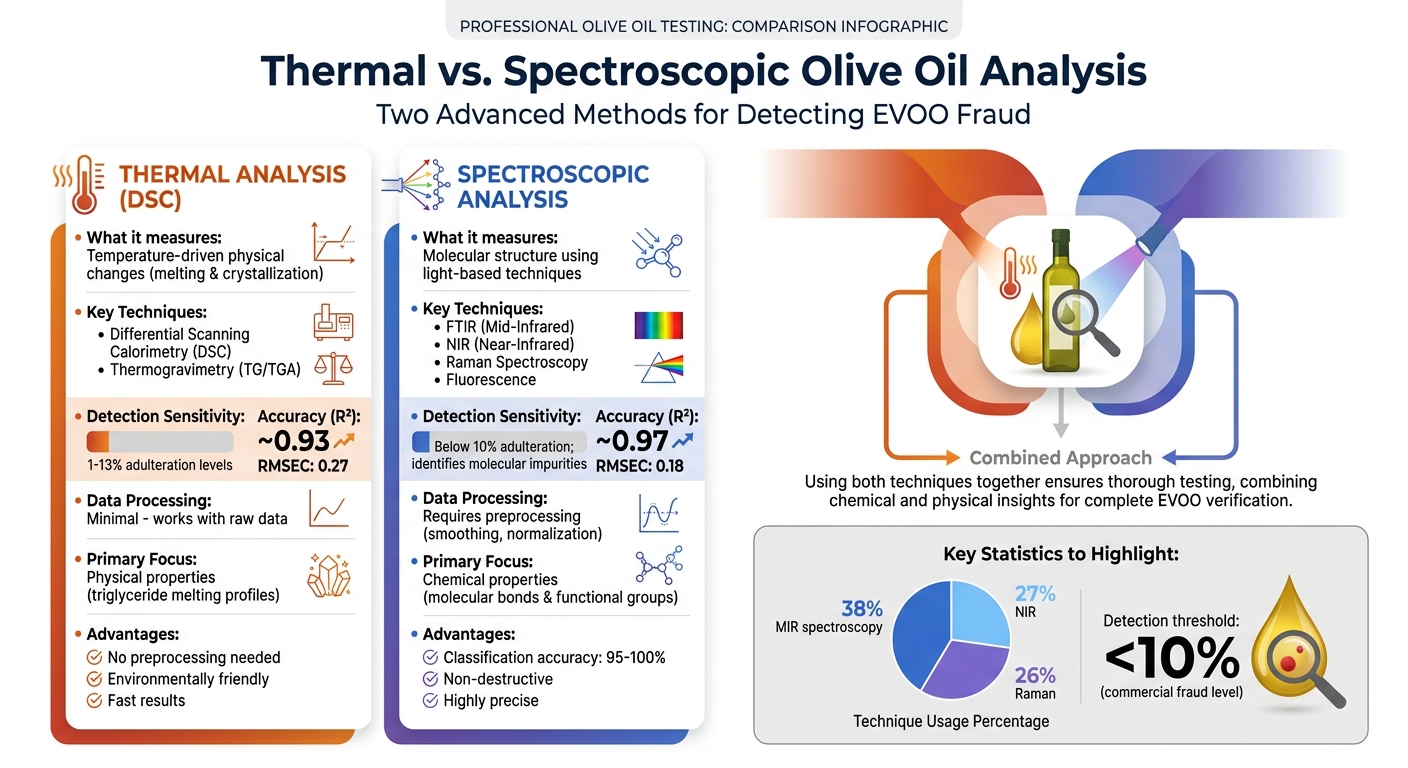
Thermal vs Spectroscopic Olive Oil Analysis Methods Comparison
Olive Oil Analysis with the TANGO-T FT-NIR Spectrometer
sbb-itb-4066b8e
Thermal Analysis Techniques
Thermal analysis evaluates olive oil by examining how it reacts to temperature changes. The two main methods used - Differential Scanning Calorimetry (DSC) and Thermogravimetry (TG/TGA) - allow for the assessment of oil composition without using harsh chemicals or requiring extensive preparation. These methods are considered environmentally friendly because they avoid hazardous solvents and don't need sample pretreatment.
DSC measures heat flow during triglyceride phase changes, creating distinct thermal profiles for different fatty acid compositions. For example, if an adulterant like sunflower oil or palm olein is added to extra virgin olive oil (EVOO), the heating and cooling curves shift in predictable ways. This makes DSC a powerful tool for detecting adulteration, even at levels as low as 1% to 13%, which is critical for verifying EVOO's purity.
"The melting behaviors of the highly unsaturated and saturated triglycerides were the primary factors for the differences observed in the heating thermograms of VOO and other vegetable oils." – European Food Research and Technology
Thermogravimetry, on the other hand, tracks mass loss during heating to detect oxidation patterns. Oxidation changes the chemical structure of triglycerides, and TG captures these transformations by monitoring mass loss during thermal decomposition. Together, DSC and TG provide complementary insights, offering a thorough thermal profile of EVOO to confirm its quality and authenticity.
Thermal Stability Testing
DSC's capabilities extend to thermal stability testing, which identifies specific signals that indicate adulteration. Key signal shifts occur during the cooling phase, particularly between 25°F and 0°F (exothermic signal changes) and between -26°F and -65°F (exothermic peak onset). In studies, DSC demonstrated impressive accuracy with a coefficient of determination (R²) of 0.93 and a root mean square error of calibration (RMSEC) of 0.27 - achieving this without any preprocessing of data. This sets it apart from methods like FTIR, which often require additional steps like smoothing, normalization, and derivatization to reach similar levels of precision.
Thermal Conductivity Measurements
Thermal conductivity measurements add another layer of analysis, helping to distinguish between pure and adulterated EVOO. Changes in oil composition directly impact thermal properties, making it possible to identify specific adulterants such as sunflower oil, palm olein, cottonseed oil, refined hazelnut oil, and high oleic sunflower oil. Each adulterant produces unique variations in melting and crystallization behaviors due to differences in fatty acid and triglyceride structures.
"Thermal analysis (TA) provides useful information about the thermal behavior of the samples as affected by oxidation." – Stefano Vecchio Ciprioti, Dipartimento di Scienze di Base ed Applicate per l'Ingegneria, Sapienza Università di Roma
This method also evaluates oxidative stability by observing how heat exposure impacts the oil's physical properties over time. High-quality, fresh EVOO shows consistent thermal behavior, while degraded or adulterated samples exhibit irregular patterns. For producers focused on maintaining Ultra Premium standards - like Big Horn Olive Oil - thermal conductivity testing offers a quick, non-destructive way to ensure each batch meets strict quality requirements.
Spectroscopic Analysis Techniques
Spectroscopic methods analyze the unique molecular structure of EVOO by studying how it interacts with light. These techniques focus on detecting functional groups like C–H, O–H, and C=O through molecular vibrations and light scattering. While thermal analysis examines physical changes, spectroscopy dives into the chemical details that define EVOO's quality, making it particularly effective for spotting even tiny impurities.
When paired with chemometric tools like Partial Least Squares (PLS) regression, these methods can classify adulteration with accuracy rates between 95% and 100%. For example, a study conducted in June 2025 at the Izmir Institute of Technology utilized FTIR spectroscopy on 64 samples from Turkey's Ayvalık, Edremit, and Milas regions (2021–2023), achieving an impressive R² of 0.97 and RMSEC of 0.18 for detecting adulteration - outperforming Differential Scanning Calorimetry (DSC).
"Vibrational spectroscopy techniques, such as infrared (IR) and Raman spectroscopy, have emerged as effective tools for rapidly and non-destructively analyzing edible oils." – Banu Ozen, Professor, Izmir Institute of Technology
Between 2019 and 2023, 38% of edible oil authentication studies focused on mid-infrared (MIR) spectroscopy, followed by near-infrared (NIR) at 27% and Raman spectroscopy at 26%. For producers aiming to maintain Ultra Premium standards - like Big Horn Olive Oil - these quick, non-destructive methods provide a reliable way to confirm quality and purity.
Infrared Spectroscopy
Infrared spectroscopy is a fast way to identify structural details using ATR (Attenuated Total Reflectance) mode. Mid-infrared (MIR) spectroscopy, operating in the 4,000–400 cm⁻¹ range, captures fundamental vibrations of functional groups. Meanwhile, near-infrared (NIR) spectroscopy, covering 780–2,500 nm, measures overtones and combination bands, making it ideal for analyzing complex matrices. The fingerprint region (1,500–650 cm⁻¹) is especially valuable, as each oil produces a distinctive spectral pattern. Even minor alterations - like the addition of lower-quality seed oils - can be detected.
Both MIR and NIR are non-destructive and require minimal sample preparation compared to traditional methods like chromatography. This efficiency is especially beneficial for Ultra Premium EVOO producers like Big Horn Olive Oil, allowing them to verify authenticity without compromising the product.
Raman and Fluorescence Spectroscopy
Raman spectroscopy uses inelastic scattering of laser light to probe molecular vibrations and rotations. It is particularly effective for detecting molecular symmetry and works well in environments with water interference. Operating in the 50–4,000 cm⁻¹ range, it excels at identifying functional groups like cis-double bonds and ester groups, which are key markers of high-quality EVOO.
"SERS has the capability to substantially amplify the Raman scattering signal from the analyzed sample... This enhancement potential positions SERS as a promising approach for rapid and highly sensitive analysis of trace components in intricate food samples." – Banu Ozen, Cagri Cavdaroglu, and Figen Tokatli
Surface-Enhanced Raman Spectroscopy (SERS) takes this a step further by amplifying scattering signals, making it possible to detect even trace amounts of adulterants. Handheld Raman devices have shown average sensitivity of 98.4% and specificity of 99.6% for differentiating EVOO brands, making them practical for on-site quality checks.
Fluorescence spectroscopy, operating in the UV-visible range, is another powerful tool. It is highly sensitive to impurities and pigments, allowing it to identify low-quality oils, like pomace oil, in EVOO without the need for sample pretreatment. By analyzing specific pigments and oxidation products, fluorescence spectroscopy can achieve over 90% accuracy in detecting adulterated oil mixtures. For producers like Big Horn Olive Oil, this method ensures their EVOO meets strict quality standards.
Photoluminescence Spectroscopy
Photoluminescence spectroscopy shifts the focus from vibrational to electronic characteristics, offering another layer of precision. This method detects electronic transitions when molecules absorb light and emit it at different wavelengths. It is particularly effective at identifying trace impurities by highlighting specific pigments and oxidation products that signal adulteration or degradation.
In the visible absorption spectrum (400–800 nm), this technique can detect olive oil adulteration at levels below 10%, which is critical for maintaining commercial quality. Results are fast, making it ideal for high-volume testing. However, because fluorescence signals can change over time due to oxidation, it's best to test fresh samples for accurate results. For producers dedicated to delivering Ultra Premium EVOO - like Big Horn Olive Oil - photoluminescence spectroscopy offers a quick, non-invasive way to guarantee purity and freshness in every batch.
Thermal vs. Spectroscopic Methods: Direct Comparison
Choosing the right analytical method for olive oil testing often comes down to finding the right balance between accuracy and practicality. Both thermal and spectroscopic methods provide faster and more environmentally friendly alternatives to traditional chromatographic techniques, which are not only time-consuming but also labor-intensive and generate significant chemical waste. Each method shines in specific scenarios, making the choice highly dependent on testing priorities.
Spectroscopic methods, such as FTIR, demonstrate impressive performance with an R² of 0.97 (RMSEC = 0.18), compared to DSC's R² of 0.93 (RMSEC = 0.27). A standout feature of DSC is its ability to work effectively with raw data, eliminating the need for complex preprocessing.
When paired with chemometric tools, spectroscopic techniques achieve classification rates as high as 95–100%, whereas DSC excels in detecting adulterant levels ranging from ~1% to 13%. However, a notable limitation is the sample-specific nature of these models. Variations in geographical origin, climate, and olive variety can significantly impact their applicability.
"Establishing a universally valid method for detecting adulteration in virgin olive oil (VOO) using fast detection techniques is challenging because various secondary factors, such as geographical region, meteorological conditions, and olive variety, influence the minor chemical properties." – European Food Research and Technology
For producers, like Big Horn Olive Oil, the decision often hinges on whether speed and precision outweigh the simplicity of data handling.
Comparison Table
| Feature | Spectroscopic Analysis (FTIR, Raman, Fluorescence) | Thermal Analysis (DSC) |
|---|---|---|
| Detection Sensitivity | Extremely high; classification rates of 95–100% | High; detects adulterant levels from ~1% to 13% |
| Equipment Requirements | Spectrophotometers (FTIR, Raman, Fluorescence) with chemometric software | Differential Scanning Calorimeter with nitrogen purge |
| Data Processing | Requires significant preprocessing (e.g., smoothing, normalization) | Minimal processing; raw thermograms suffice |
| Cost-Effectiveness | Low operating costs due to minimal chemical use, though equipment is expensive | Moderate costs with less chemical waste compared to chromatography |
| Accuracy (R²) | Approximately 0.97 (FTIR fingerprint region) | Approximately 0.93 |
| Example Application | Identifying adulteration via molecular vibration analysis in seed oils | Authenticating extra virgin olive oil by analyzing triglyceride melting profiles |
Using Both Methods Together
Bringing thermal and spectroscopic techniques together creates a powerful combination, using both the chemical profiles and physical behaviors of olive oil components to ensure authenticity. Spectroscopic methods, like FTIR, focus on analyzing the bonds and functional groups in fatty acids. Meanwhile, thermal techniques, such as Differential Scanning Calorimetry (DSC), monitor how these molecules behave as they melt and crystallize. This dual approach tackles challenges like environmental variability - factors such as harvest season, location, and olive variety can affect results when using just one method. By integrating both, you get models that are far more resistant to these inconsistencies.
This synergy also simplifies the analytical process. While spectroscopic data often needs significant preprocessing, DSC can deliver high accuracy (R² of 0.93) directly from raw thermograms. This means DSC can confirm spectroscopic findings without requiring extra steps, saving time and effort.
Using both methods together also broadens detection capabilities. Spectroscopic techniques excel at pinpointing specific chemical markers of seed oils by capturing shifts in molecular vibrations. On the other hand, thermal analysis identifies abnormalities in triglyceride melting profiles. Even when an adulterant closely mimics olive oil chemically, its unique thermal behavior exposes the fraud.
"Prioritizing methods that produce accurate results with minimal data preprocessing and resist variations in minor components of VOO will be more significant in this scientific field." – European Food Research and Technology
Conclusion
Thermal and spectroscopic methods have transformed how Extra Virgin Olive Oil (EVOO) authenticity is verified. Spectroscopic techniques like FTIR analyze the oil's chemical "fingerprint", pinpointing molecular bonds and functional groups with impressive accuracy. Meanwhile, thermal methods such as DSC monitor the melting and crystallization of triglycerides, delivering reliable results straight from raw data. Together, these tools can detect adulteration levels below 10% - the threshold where most commercial fraud occurs.
These methods are a game-changer, replacing traditional chromatographic techniques that are slow and wasteful with faster, non-destructive, and eco-friendly alternatives. When paired with chemometric tools like PCA and PLS regression, they achieve detection accuracy rates between 95% and 100% for identifying fraudulent oils.
This progress not only improves laboratory precision but also gives consumers more confidence in the EVOO they purchase. Adulteration - mixing EVOO with cheaper oils like sunflower, cottonseed, or palm olein - remains a significant issue. Advanced lab analysis is the only reliable way to uncover these deceptions.
That’s why sourcing from trusted suppliers is critical. Rigorous testing defines the Ultra Premium standard, ensuring every bottle meets the highest quality benchmarks. For example, Big Horn Olive Oil prioritizes strict quality controls, offering Ultra Premium EVOOs that are cold-pressed within two hours of harvest and shipped fresh within three months. Their dedication to transparency and internationally recognized standards guarantees authentic EVOO with all the health benefits and flavor you expect.
FAQs
Which test is best for my goal: detecting adulteration or measuring freshness?
Spectroscopic methods, such as FTIR spectroscopy, are excellent for detecting adulteration. They work quickly, don't damage the sample, and can pinpoint molecular changes caused by contaminants. When it comes to measuring freshness, thermal analysis techniques like ATR-FTIR are effective. These methods track chemical changes triggered by heating or oxidation. Use spectroscopic techniques to uncover fraud and thermal analysis to evaluate freshness or quality shifts related to storage.
How much do olive variety and origin affect DSC or FTIR results?
The type of olive and its origin play a big role in shaping results from Differential Scanning Calorimetry (DSC) and Fourier-Transform Infrared (FTIR) analysis. These factors directly influence the oil's molecular makeup, including its fatty acid composition and triglycerides, which in turn affect the spectral data. This variability becomes especially important when evaluating oil quality or spotting adulteration, as differences in olive sources can impact the reliability and interpretation of these testing methods.
Can handheld spectroscopy reliably verify EVOO on-site?
Handheld spectroscopy, such as portable Raman and vis-NIR techniques, offers a quick and non-invasive way to verify the authenticity of extra virgin olive oil (EVOO) on-site. These methods can detect adulteration levels rapidly without damaging the sample. Some devices are even capable of analyzing oil directly through the bottle, eliminating the need for sample removal. This technology holds potential for maintaining the quality and authenticity of EVOO effectively.