

Why Tocopherol Testing Matters for Olive Oil Quality
Tocopherols, a key component of Vitamin E, are powerful antioxidants naturally found in olive oil. They play a crucial role in maintaining flavor stability, extending shelf life, and boosting nutritional value. Testing tocopherol levels ensures olive oil's quality, authenticity, and health benefits, while also helping producers predict shelf life and meet industry standards. Here's why tocopherol testing is important:
- Preserves Quality: Tocopherols protect olive oil from oxidation, preserving its flavor and structure over time.
- Health Benefits: Higher tocopherol levels combat free radicals, supporting heart health and reducing oxidative stress.
- Authenticity Check: Testing confirms oil purity, ensuring it hasn't been mixed with refined oils.
- Shelf Life Prediction: Producers use tocopherol data to set accurate expiration dates and maintain product consistency.
Testing is done using High-Performance Liquid Chromatography (HPLC), a precise method that measures tocopherol levels individually. Proper storage - like dark bottles and cool conditions - helps retain these antioxidants. For consumers, this guarantees the health benefits they expect, while for producers, it ensures compliance with global quality standards.
Apollo Coratina Olive Oil Lab Test Analysis [Polyphenol + Tocopherol Review #1]
sbb-itb-4066b8e
Why Tocopherol Testing Is Necessary for Olive Oil Quality
Testing tocopherol levels plays a key role in verifying authenticity, predicting shelf life, and ensuring compliance with industry regulations. High tocopherol levels act as a "chemical fingerprint", confirming that an oil is genuinely Extra Virgin and free from adulteration with refined oils. This is because refining processes involving heat and chemical treatments significantly lower tocopherol concentrations. For brands and consumers alike, tocopherol testing is a critical safeguard against fraud, helping to maintain trust in product integrity.
In addition to confirming authenticity, tocopherol analysis helps producers predict how long their olive oil will remain fresh. By measuring these natural antioxidants, producers can calculate the Oxidative Stability Index (OSI) and set accurate "Best Before" dates. Regular monitoring also allows producers to blend oils from different harvests to achieve a consistent antioxidant profile and flavor, ensuring product reliability.
How Tocopherol Testing Works
Laboratories rely on High-Performance Liquid Chromatography (HPLC), the gold standard for tocopherol analysis in olive oil. This technique separates and measures all eight tocol vitamers (α-, β-, γ-, and δ-tocopherols and tocotrienols) individually, providing highly detailed results. As Anna-Maija Lampi from the University of Helsinki's Department of Food and Environmental Sciences explains:
"Since the biological activities and chemical properties of tocols differ from each other, it is important to be able to determine each vitamer separately."
The process uses fluorescence detection, which offers both high sensitivity and selectivity. The testing typically employs an excitation wavelength of 290–296 nm and an emission wavelength of 325–330 nm. During saponification, antioxidants like ascorbic acid or pyrogallol are often added to prevent tocols from breaking down under alkaline conditions.
This level of precision ensures reliable results, benefiting both consumers and producers.
Benefits of Tocopherol Testing for Consumers and Producers
For consumers, tocopherol testing ensures they receive olive oil with the advertised health benefits. Verified tocopherol levels confirm that the oil can help reduce oxidative stress and may even contribute to delaying degenerative conditions such as cardiovascular disease and cancer. Extra Virgin Olive Oil typically contains between 100 mg/kg and 300 mg/kg of tocopherols, while premium early-harvest oils often exceed these levels. Testing guarantees the antioxidant protection consumers expect.
For producers, regular tocopherol testing helps meet IOC and USDA standards. It confirms oil authenticity, ensures consistency across production runs, and maintains quality benchmarks. Producers are advised to conduct baseline testing immediately after extraction to establish initial quality levels. Using HPLC with fluorescence detection provides the most accurate results. This systematic approach not only protects brand reputation but also fosters consumer trust through verifiable quality assurance.
Industry Standards for Olive Oil Tocopherol Levels
Best Practices for Preserving Tocopherols in Olive Oil
Industry standards play a crucial role in defining the quality benchmarks for olive oil, particularly when it comes to maintaining its antioxidant properties and overall integrity.
Recommended Tocopherol Levels in Extra Virgin Olive Oil
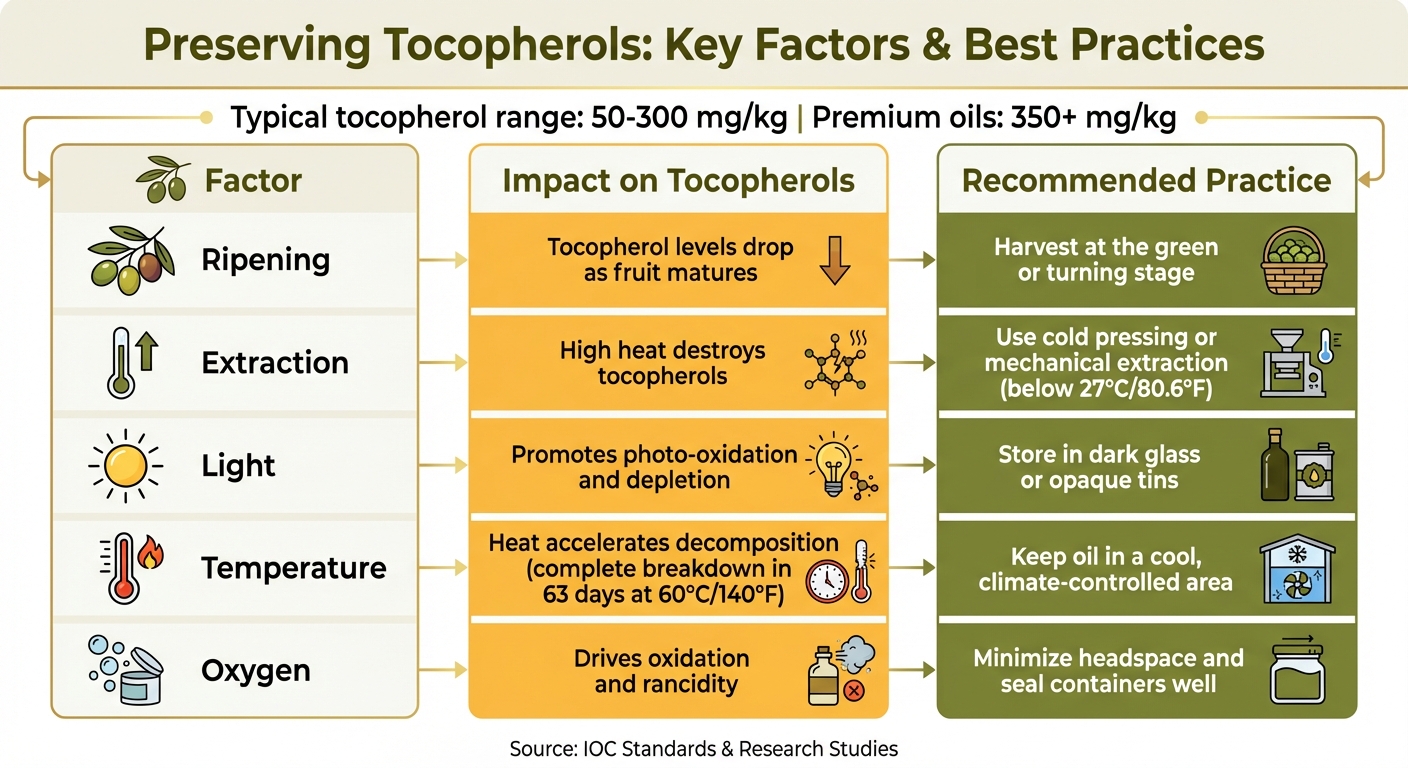
The International Olive Council (IOC) is the leading authority that sets global standards for olive oil quality and purity. While tocopherol levels aren't strict pass/fail criteria like sterols or fatty acids, they are vital indicators of an oil's antioxidant strength and stability. Typically, virgin olive oil contains total tocopherol levels ranging from 50 mg/kg to 300 mg/kg. However, premium or "functional" olive oils - those marketed for their added health benefits - often boast tocopherol levels exceeding 350 mg/kg. A 2025 study analyzing 48 varieties of Apulian olives revealed tocopherol levels ranging from about 100 mg/kg to nearly 500 mg/kg.
Harvesting and Storage Practices to Preserve Tocopherols
Preserving tocopherol levels requires careful handling during both harvesting and storage. Timing is critical - tocopherol levels decline as olives ripen, so harvesting at the green or turning stage ensures higher antioxidant content. Additionally, research indicates that olives harvested during drier years yield oils with higher tocopherol concentrations compared to those grown in wetter conditions.
Cold pressing is another key factor, as it helps retain tocopherols by keeping extraction temperatures below 27°C (80.6°F). Delayed extraction or the use of bruised olives can increase acidity and lead to tocopherol degradation.
Proper storage conditions are equally important. Using dark glass bottles or opaque tins protects the oil from light, which can deplete tocopherols through photo-oxidation. While chlorophyll in olive oil acts as an antioxidant in darkness, exposure to light turns it into a pro-oxidant, accelerating tocopherol loss. Temperature control is essential, too - studies show that alpha-tocopherol can completely break down within 63 days at 140°F (60°C). Minimizing oxygen exposure is another critical step; filling containers almost completely reduces headspace, slowing the oxidative processes that degrade tocopherols.
The table below outlines the key factors and best practices for preserving tocopherols:
| Factor | Impact on Tocopherols | Recommended Practice |
|---|---|---|
| Ripening | Tocopherol levels drop as fruit matures | Harvest at the green or turning stage |
| Extraction | High heat destroys tocopherols | Use cold pressing or mechanical extraction |
| Light | Promotes photo-oxidation and depletion | Store in dark glass or opaque tins |
| Temperature | Heat accelerates decomposition | Keep oil in a cool, climate-controlled area |
| Oxygen | Drives oxidation and rancidity | Minimize headspace and seal containers well |
Big Horn Olive Oil's Approach to Quality Assurance
Big Horn Olive Oil takes quality assurance seriously, going beyond industry norms to maintain high tocopherol levels. From harvest to packaging, the company enforces strict sourcing and testing protocols to ensure its olive oil meets exceptional standards.
Sourcing and Testing for Freshness and Quality
The process starts with selecting only the top 5% of harvests, ensuring the finest olives are used. To lock in freshness and optimal tocopherol levels, olives are processed within 2–3 hours of harvest, and every batch undergoes independent third-party HPLC (High-Performance Liquid Chromatography) testing. Unlike methods that involve heat or chemicals, Big Horn relies exclusively on mechanical extraction, preserving the tocopherol content.
To further guarantee quality, the company enforces strict rules: no oil can be older than 14 months from harvest, and estate-produced traceability is required for each cultivar. According to experts from the International Olive Council, HPLC testing is critical for verifying authenticity and quality, with tocopherol levels above 200 ppm indicating strong antioxidant properties.
Big Horn also packages its olive oil in dark green bottles, a thoughtful step to prevent tocopherol degradation caused by light exposure. These measures not only ensure freshness but also maximize the health benefits for consumers.
Health Benefits of Tocopherol-Rich Olive Oil
Tocopherols, a form of vitamin E, are powerful antioxidants that combat oxidative stress, reduce inflammation, and promote heart health. Big Horn’s Extra Virgin Olive Oil, often surpassing 300 mg/kg of tocopherols, delivers these benefits in abundance. Combined with polyphenols, these antioxidants offer anti-aging properties, improved cholesterol levels, and comprehensive cardiovascular protection. By prioritizing tocopherol preservation through careful sourcing and processing, Big Horn Olive Oil ensures its products provide a wide range of health benefits while maintaining the integrity of its olive oil.
Conclusion: The Role of Tocopherol Testing in Olive Oil Quality
Tocopherol testing using high-performance liquid chromatography (HPLC) plays an essential role in evaluating the quality of extra virgin olive oil. Alongside tests for free acidity and peroxide value, HPLC offers a thorough way to verify olive oil's authenticity and overall quality. Standards set by organizations like the USDA and Codex limit added α-tocopherol in refined oils to 200 mg/kg. Authentic extra virgin olive oil, however, relies entirely on its naturally occurring tocopherols.
Olive oil rich in tocopherols provides notable health advantages, such as promoting heart health, reducing inflammation, and guarding against oxidative stress. These benefits are amplified when combined with polyphenols.
Take Big Horn Olive Oil as an example. Their dedication to quality shines through their meticulous processes - harvesting and processing olives within two hours using mechanical extraction methods to preserve tocopherol levels. Additionally, their commitment to independent HPLC testing ensures that every batch meets verified standards for antioxidant strength and authenticity. This attention to detail not only maintains high quality but also builds consumer trust in the product's authenticity.
FAQs
What tocopherol level is considered “high” in extra virgin olive oil?
Extra virgin olive oil with a "high" tocopherol level usually contains more than 3 mg per 100 g. Some olive varieties, like those from the Hojiblanca cultivar, stand out for their higher vitamin E content. This not only enhances the oil's overall quality but also adds to its health benefits.
Can I test tocopherols at home, or is lab testing required?
Testing tocopherols at home isn't something you can easily do. It requires advanced laboratory techniques like HPLC (High-Performance Liquid Chromatography) or near-infrared spectroscopy, which are handled by trained professionals. These methods are crucial for delivering precise measurements and determining the tocopherol content in olive oil accurately.
How can I keep tocopherols from breaking down after I open the bottle?
To keep tocopherols intact, store olive oil in a cool, dark spot, away from heat sources and direct sunlight. Make sure the bottle is tightly sealed to minimize oxygen exposure, and opt for dark or opaque bottles to shield the oil from light. Avoid exposing the oil to high temperatures during storage or use. Following these steps helps preserve the antioxidant qualities of tocopherols and ensures the oil retains its quality after opening.