

Top 5 Tools for Olive Oil Traceability
Olive oil fraud is a growing problem, but technology offers solutions. From DNA markers to blockchain, today's traceability tools ensure olive oil quality and origin. Here's a quick look at five leading systems that help producers fight fraud and meet consumer demand for transparency:
- Biotagging by Reply: Uses DNA markers to verify oil authenticity and prevent tampering.
- SIMO Digital System: Blockchain-based tracking with Digital Food Product Passports for real-time data.
- REMOA Platform: Combines IoT sensors and blockchain to monitor every production step.
- SIAN Network: Italy’s regulatory-backed system with DNA checks and fraud alerts.
- NYIOOC Certification: Focuses on chemical and sensory analysis for premium product verification.
These tools protect brands, maintain quality, and build trust with consumers. Below, we’ll dive into how each system works and why they’re changing the olive oil industry.
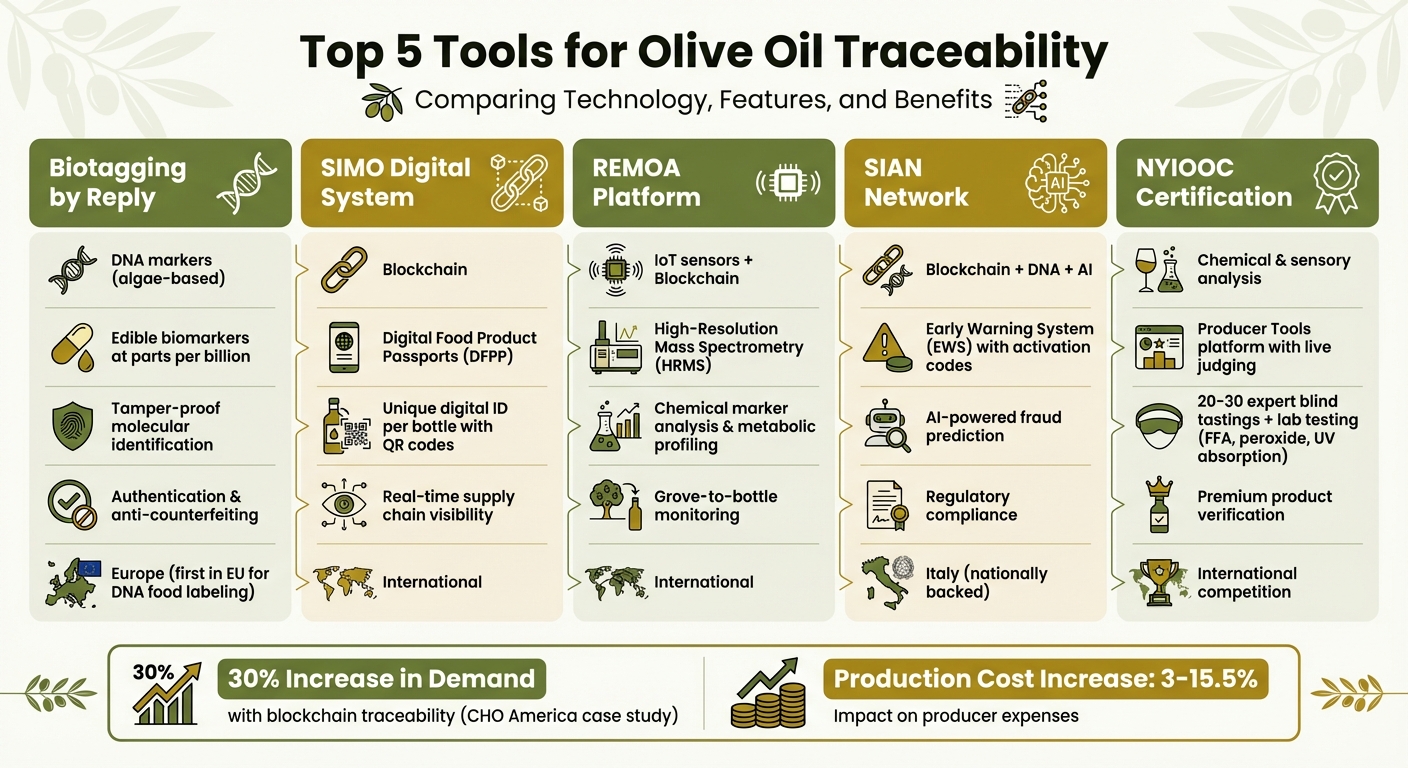
Comparison of 5 Leading Olive Oil Traceability Systems and Technologies
DNA fingerprinting to validate authenticity of PDO and PGI extra-virgin #OliveOil
sbb-itb-4066b8e
1. Biotagging and Advanced Traceability by Reply
Reply's Advanced Traceability system introduces a cutting-edge method for verifying olive oil authenticity by embedding DNA-based markers directly into the product. Unlike traditional labels, which can be tampered with or counterfeited, this approach uses biological substances - specifically algae DNA - at incredibly low concentrations (parts per billion). These markers are completely edible, tasteless, and odorless, so they don’t alter the oil’s flavor or nutritional value. This innovative step strengthens fraud prevention and enhances supply chain operations.
"The Biotag is like an invisible, indelible, univocal and non-manipulable dye – because it is much more complex from a computational point of view than a traditional barcode – which minimises the risks of counterfeiting." – Reply
Fraud Prevention and Transparency
Reply stands as the first company in Europe to explore DNA-based labeling in the food industry. This system addresses common fraud methods, such as diluting high-quality olive oil with cheaper oils, adding artificial coloring agents like chlorophyll or beta-carotene, or mixing in processing waste. By confirming the product’s authenticity, the technology ensures consumers get exactly what they pay for.
In a proof-of-concept project, a Consortium of Organic Extra Virgin Olive Oil Producers in Lazio, Italy, tested this technology by washing harvested olives with a water-based solution containing the DNA marker. Later, specialized equipment verified the marker’s presence, confirming its authorized use in the production process. Beyond combating fraud, this system integrates seamlessly into the broader supply chain.
Integration with Supply Chain Monitoring
This technology offers a full hardware and software framework to track olive oil from harvest to bottling. Producers apply the DNA marker during early stages, like pre-harvest or the initial washing process. Detection equipment then verifies the marker in the final product, identifying any dilution or contamination. This creates a continuous stream of traceability data, providing real-time insights into the supply chain.
Verification of Origin and Quality
For premium producers, such as Big Horn Olive Oil, this system delivers undeniable proof of quality and origin. The DNA markers act as molecular data carriers, offering instant verification through specialized equipment. Their complexity makes them nearly impossible to replicate, offering a far more secure alternative to traditional certificates.
2. SIMO Digital Traceability System
The SIMO Digital Traceability System uses blockchain technology to create a secure, unchangeable record of every step in the olive oil production process. From the moment olives are harvested to when the oil is bottled, every stage is recorded, closing off opportunities for fraud within the supply chain. This detailed tracking provides instant access to production data.
Real-Time Data Access
Through Digital Food Product Passports (DFPP), the system captures and logs details at every stage. These passports document orchard genetic profiles and harvest specifics, giving producers a real-time view of their operations. This visibility helps them pinpoint bottlenecks or quality issues as they arise. For premium brands like Big Horn Olive Oil, this ensures that only top-quality oil reaches customers.
Fraud Prevention and Transparency
Each bottle of olive oil is assigned a unique, verifiable digital ID. This ID, accessible via a QR code, allows consumers to instantly check details like the olive's origin and harvest date, all without needing special tools. Because blockchain technology secures these records, the system guarantees transparency and builds trust across the entire supply chain.
Verification of Origin and Quality
By documenting orchard genetic profiles and harvest data, SIMO ensures each bottle’s origin and quality can be verified with reliable data that aligns with international standards.
3. REMOA Platform for Supply Chain Monitoring
The REMOA (Remote Monitoring and Audit) platform combines IoT sensors with blockchain technology to track olive oil from grove to bottle. It captures data from every stage - farming, harvesting, production, and packaging - creating a secure, tamper-proof record that follows the oil through the entire supply chain. This system provides both producers and consumers with a clear picture of the product's journey.
Real-Time Data Access
The REMOA platform offers instant insights into production conditions by linking quality control sensors directly to blockchain networks. Events across the production cycle - like farming and harvesting - are recorded in real time. This immediate access allows producers to monitor conditions without delays, which is especially valuable for premium brands like Big Horn Olive Oil. By ensuring strict quality control at every step, producers can consistently deliver the standards their customers expect.
Fraud Prevention and Transparency
To combat fraud, REMOA incorporates High-Resolution Mass Spectrometry (MRMS) to analyze chemical markers that verify authenticity and quality. Through untargeted metabolic profiling, the system identifies key markers and flags any adulteration. This advanced method catches fraud that simpler techniques might overlook, while its fast analysis ensures the verification process doesn’t slow down operations.
Integration with Supply Chain Monitoring
Each bottle of olive oil is assigned a unique identifier, often a QR code, that links to its certified production history. This feature consolidates all production data into a single, verifiable record. Both auditors and consumers can scan the code to trace the oil’s journey - from the orchard where the olives were grown to the exact date and location of bottling. This level of traceability builds trust and ensures transparency for everyone involved.
4. SIAN Traceability Network
Italy's SIAN system leverages blockchain and sensor technologies to ensure olive oil traceability, backed by regulatory standards. Managed by CREA, SIAN monitors the journey of olive oil from the grove to distribution. By connecting farms, mills, and distributors, it creates a detailed record of the production process across Italy. To kick off operations like marking trees or harvesting, an activation code is required, ensuring that every step is documented right from the start.
Fraud Prevention and Transparency
At the mill, SIAN uses DNA technology to confirm that the oil in storage aligns with the declared olive batches. This tamper-evident setup makes substitutions nearly impossible. Additionally, an AI-powered Early Warning System (EWS) predicts potential fraud risks and alerts food safety authorities before issues arise. Together, these tools create a robust system that significantly reduces the chances of fraudulent products entering the market.
Integration with Supply Chain Monitoring
SIAN doesn’t just stop at fraud prevention - it also streamlines the flow of information. The system integrates with Italy’s national regulatory framework, incorporating Digital Food Product Passport (DFPP) features tailored to meet local compliance standards. This documentation follows the oil through every stage of its journey, providing inspectors and buyers with easy access to its complete history. For producers like Big Horn Olive Oil, this level of transparency reassures customers looking for proof of authenticity.
Verification of Origin and Quality
The activation code directly links olive trees to the final product, guaranteeing precise traceability. Genetic profiling adds another layer of verification, ensuring the oil's composition matches its stated origin and variety. For high-end producers, this system offers the transparency and credibility that quality-conscious buyers expect.
5. NYIOOC Certification and Traceability Verification

The New York International Olive Oil Competition (NYIOOC) stands out for its rigorous certification process and real-time traceability tools, ensuring only top-tier olive oils earn recognition. At the heart of this system is the Producer Tools platform, a secure web application that centralizes brand details, chemical analysis results, and historical data for competition participants. This platform is not just a tool - it's a mandatory system that serves as the official record for the world's largest olive oil competition.
Real-Time Data Access
The Producer Tools platform offers producers a streamlined dashboard to manage every aspect of their participation. Producers can track sample shipments, view live judging results as soon as they’re available, and update brand information - all through a secure interface. Another standout feature is the integration with the Official Guide to the World's Best Olive Oils, where producer profiles connect directly to retail locations and other key details. This seamless access to real-time data plays a critical role in preventing fraud and maintaining transparency.
Fraud Prevention and Transparency
NYIOOC employs a thorough verification process to uphold its standards. A panel of 20–30 expert judges conducts blind sensory evaluations to assess flavor profiles and identify any defects. Beyond sensory testing, producers must submit laboratory results for critical parameters like free fatty acidity (FFA), peroxide value, and UV absorption (K232, K270) to meet international chemical benchmarks. All award winners are listed in a public database on bestoliveoils.org, allowing anyone to verify claims about a product’s quality. For producers such as Big Horn Olive Oil, this independent verification adds undeniable credibility, meeting the expectations of quality-conscious consumers.
Verification of Origin and Quality
Producers are required to submit documentation that traces each oil back to its origin, ensuring a clear link between the product and its geographical source. Combining this origin verification with both sensory and chemical analysis creates a robust traceability framework. Producers must keep their Producer Tools profiles up to date so consumers and distributors can verify details instantly. Additional features, like tourism listings and retail outlet information, enhance the connection between the physical product and its digital presence. NYIOOC’s commitment to transparency and authenticity through digital verification helps premium producers maintain their reputations in a competitive market.
Conclusion
Traceability tools are reshaping the olive oil industry, offering a level of transparency and security that traditional paper-based systems simply can't match. By integrating blockchain technology, DNA authentication, and IoT sensors, the industry now has access to a tamper-proof system that tracks every step of the supply chain.
This advanced tracking system brings clear advantages. Producers can verify the authenticity of their products and justify premium pricing. Regulatory authorities benefit from faster, more efficient verification processes, eliminating the need for slow, lab-based methods. And for consumers, tools like QR codes and Digital Food Product Passports provide instant access to detailed product histories, replacing uncertainty with solid, data-driven trust. A great example is CHO America's use of IBM's Food Trust blockchain for their Terra Delyssa brand. This system allowed consumers to instantly verify the origins of their olive oil, leading to a 30% increase in demand during the pandemic.
"There's a growing desire among consumers to know where their food comes from and an increased business motivation to optimize processes with better supply insights." - Raj Rao, General Manager, IBM Blockchain Platforms
While full traceability systems can increase production costs by 3–15.5%, research shows that consumers are often willing to pay more for this level of transparency. For brands like Big Horn Olive Oil, these systems reinforce the quality and openness that their customers value.
These platforms are driving a major shift in the industry, prioritizing real-time data and trust. Producers who embrace these tools now are not only safeguarding their products but also meeting the growing demand for transparency and accountability in today's market.
FAQs
Which traceability tool is best for small olive oil producers?
The NFC-based EVO-NFC system, featured in IEEE research, offers a practical solution for small olive oil producers. This system leverages smartphone NFC technology throughout the supply chain, simplifying traceability in a way that's both affordable and easy to use. It empowers small farms to maintain food safety standards and connect directly with consumers, all without needing extensive resources or complicated setups.
Do QR codes really prove an olive oil is authentic?
Yes, QR codes can play a key role in verifying the authenticity of olive oil by giving consumers access to detailed traceability information. These codes often provide insights into the harvest location, production methods, and other essential details. By simply scanning the QR code, buyers can check the product's origin and quality, helping ensure they are getting genuine olive oil they can trust.
How much does full traceability add to the cost per bottle?
Adding full traceability usually costs an additional $0.10 to $0.20 per bottle, though the exact figure varies based on the technology chosen and the scale of the rollout. While this might seem like a minor expense, it plays a big role in boosting transparency and building trust throughout the supply chain.