

Top Transparency Initiatives in Olive Oil
Olive oil fraud is a growing problem, costing the industry $1.6 billion annually and misleading consumers about quality and health benefits. Fortunately, new transparency initiatives are tackling this issue by offering tools to verify oil quality, origin, and freshness before purchase. These efforts rely on certifications, lab tests, DNA analysis, and more to ensure you get what you pay for.
Key Highlights:
- Big Horn Olive Oil: Provides lab reports, harvest dates, and QR codes for real-time quality checks.
- EU Olive Oil Observatory: Centralizes data on production, pricing, and market trends to improve clarity.
- NAOOA Certified Seal: Uses random in-store testing to verify purity and enforce stricter quality standards.
- Olive Oil Standards Act (2026): Mandates national labeling and grading standards in the U.S. for better consumer confidence.
- Watson DNA Traceability: Matches DNA markers from olives to bottles, ensuring grove-to-bottle integrity.
- USDA Quality Monitoring: Enforces federal standards for olive oil classifications and ensures rigorous testing.
- International Olive Council (IOC): Shares global data, promotes olive oil education, and tracks market trends.
These initiatives help you identify high-quality olive oils, avoid fraudulent products, and enjoy the full health benefits of genuine extra virgin olive oil.
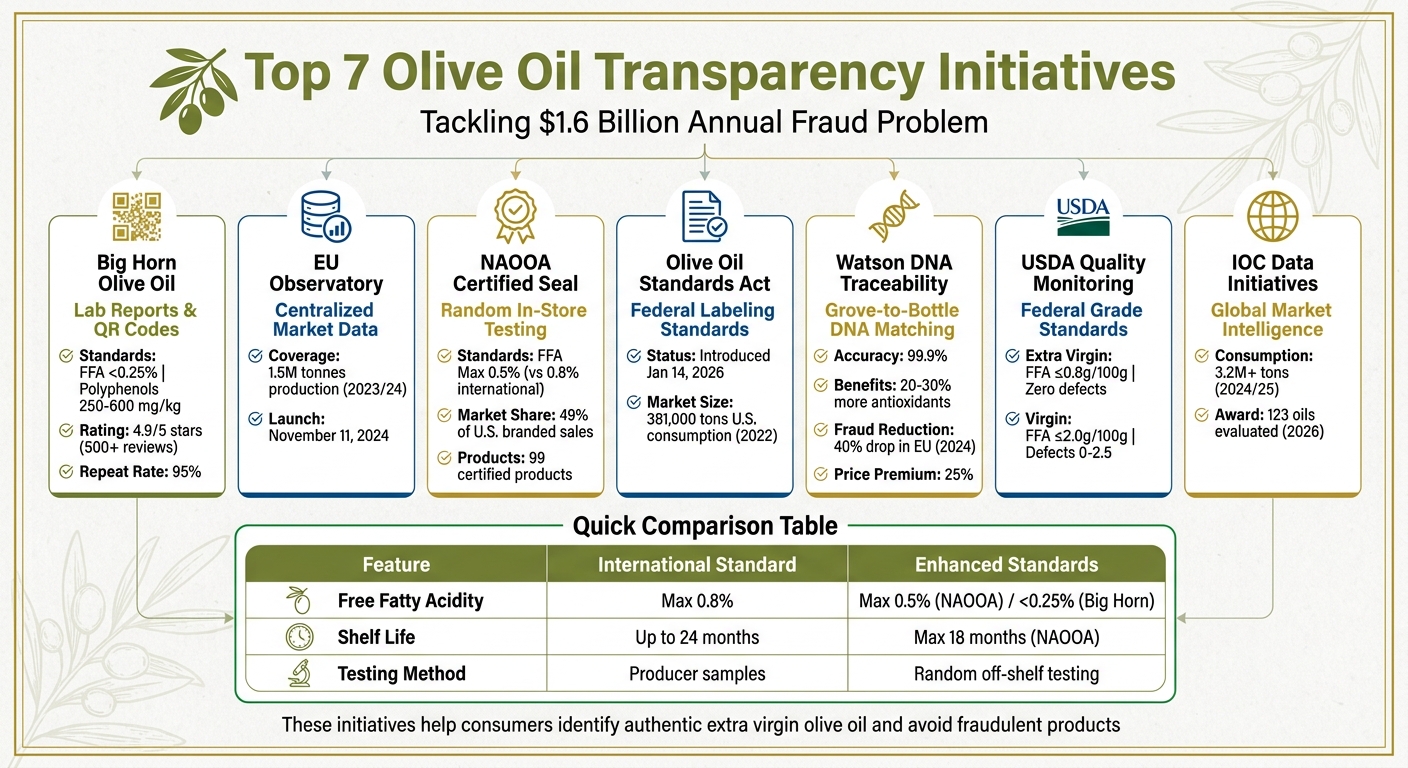
Olive Oil Transparency Initiatives Comparison Chart
1. Big Horn Olive Oil
Commitment to Transparency
Big Horn Olive Oil takes transparency seriously, offering batch-specific lab reports directly on its website and product labels. These reports include key details like the harvest date, confirmation that olives were cold-pressed within two hours, and precise sourcing information. To make it even easier for consumers, a QR code on the packaging provides instant access to real-time lab data. This data includes polyphenol levels, free fatty acidity (kept below 0.25%), and peroxide values.
The company is certified by the Olive Oil Times Education Fund under the Certified Ultra Premium Extra Virgin Olive Oil program. This means Big Horn undergoes strict annual testing, including blind sensory evaluations (where it consistently scores above 80 out of 100) and rigorous chemical assessments. For example, its oils maintain free fatty acidity below 0.25% and UV absorbance K232 under 1.85 - standards that go well beyond the requirements for regular extra virgin olive oil. These efforts ensure that consumers have access to high-quality, trustworthy products.
Consumer Benefits
Big Horn empowers consumers with tools to verify quality for themselves. Through an online dashboard, buyers can check polyphenol levels (ranging from 250 to 600 mg/kg) and confirm harvest dates, guaranteeing they are purchasing oils that are less than a year old. This focus on freshness ensures oils are packed with natural antioxidants, which are known to support heart health and reduce inflammation.
The brand's third-party verification process also addresses widespread olive oil fraud, giving customers peace of mind about the authenticity of what they’re buying. This dedication to quality and transparency has earned Big Horn glowing reviews, boasting a 4.9 out of 5 rating on Google Reviews from over 500 customers. One verified reviewer in 2024 highlighted their appreciation for the "lab results and harvest dates printed on every bottle."
Impact on the Olive Oil Industry
Big Horn Olive Oil’s practices are reshaping industry standards. By making lab data and sourcing information readily available, the company has raised the bar for transparency, earning consumer trust in the process. Its 4.9/5 Google rating and impressive 95% repeat customer rate reflect this success. Additionally, Big Horn’s educational efforts have shifted consumer preferences toward verified, fresh oils, encouraging the industry to adopt stricter quality measures.
sbb-itb-4066b8e
2. EU Olive Oil and Table Olives Market Observatory
Commitment to Transparency
On November 11, 2024, the European Commission introduced the EU Olive Oil and Table Olives Market Observatory in Brussels. This initiative aims to bring greater clarity to the global olive oil market by centralizing key data on production, stocks, and pricing. Stakeholders across the supply chain can access this information, creating a space where experts collaborate to tackle industry challenges.
Consumer Benefits
For consumers, this effort offers much-needed clarity, especially during periods of market uncertainty. The observatory's data helps people understand price changes and make more informed choices. For instance, it reports that EU olive oil production for the 2023/24 marketing year reached 1.5 million tonnes. However, extreme weather conditions contributed to record-high prices. By making this kind of information widely available, the observatory supports EU campaigns that promote the exceptional quality of European agricultural products.
Impact on the Olive Oil Industry
The observatory isn't just for consumers - it also brings critical benefits to the olive oil industry. By providing easy access to data, it encourages a more proactive and informed approach to managing climate-related challenges and market instability. Supported by the Common Agricultural Policy (CAP), the observatory equips the sector with tools for income support, research into sustainability, and strategies for adapting to climate change. These efforts strengthen the industry's ability to navigate challenges, further solidifying the EU's position as the leading global producer, consumer, and exporter of olive oil.
Our Seals of Certification that you can look for on every bottle
3. NAOOA Certified Seal
The NAOOA Certified Seal brings a new level of trust to the olive oil industry by verifying product purity through rigorous, independent testing.
Commitment to Transparency
The North American Olive Oil Association (NAOOA) Certified Seal is the only program in the U.S. that uses random, in-store testing to ensure product quality. Instead of relying on samples provided by producers, the NAOOA purchases products directly from retail shelves for independent testing. This process directly addresses consumer concerns about olive oil purity and authenticity.
In March 2026, the NAOOA introduced stricter requirements that go beyond international standards. These include limiting free fatty acidity to a maximum of 0.5% (compared to the international limit of 0.8%) and requiring a "best if used by" date no more than 18 months after bottling. NAOOA Executive Director Joseph R. Profaci highlighted the program's success:
"Nearly half the market has chosen to participate in the only seal program in the U.S. that involves regular random off-the-shelf testing. That validates what we've known for years – transparency builds trust."
This thorough approach not only reassures consumers but also strengthens their confidence in the olive oil they purchase.
Consumer Benefits
The NAOOA Certified Seal stands as a trusted marker of authentic olive oil, free from dilution with cheaper seed oils. With over 250,000 visits annually to the program's webpage, consumers increasingly rely on this certification to identify reliable products. A 2024 study of 190 samples from the top 15 brands, covering 85% of the U.S. market, revealed no cases of adulteration. By early 2026, olive oil was present in 50.9% of U.S. households, and the NAOOA Certified Seal appeared on 49% of branded olive oil sales.
Verification and Certification Processes
The NAOOA certification process includes multiple layers of quality control. Bottling facilities must undergo mandatory third-party audits and meet strict quality standards. In 2026, the organization introduced a quality tracking database to monitor performance trends year over year, helping companies and retailers improve supply chain management.
| Feature | International Standard | NAOOA Certified Standard |
|---|---|---|
| Free Fatty Acidity (FFA) | Max 0.8% | Max 0.5% |
| Shelf Life Limit | Up to 24 months | Max 18 months from bottling |
| Testing Method | Producer-submitted samples common elsewhere | Random off-the-shelf testing |
| Facility Audits | Not always required | Mandatory third-party audits |
These higher standards are evident in both the certification process and the program's growing market presence. By 2025, the program included 99 products, including store brands, and expanded into Canada with plans for further international reach.
Impact on the Olive Oil Industry
The NAOOA program has raised the bar for olive oil quality in the U.S. market by exceeding international standards. The stricter 0.5% free fatty acidity requirement aligns with a petition jointly filed with the American Olive Oil Producers' Association to the FDA, showcasing how industry-led initiatives can drive progress. As Profaci stated:
"Consumer confidence is the foundation of growth in our industry... we have a responsibility to ensure every bottle delivers what the consumer expects."
4. Olive Oil Standards Act
Commitment to Transparency
The Olive Oil Standards Act represents a significant step toward ensuring clarity and integrity in the olive oil market. Introduced on January 14, 2026, this bipartisan legislation directs the FDA to establish a national standard of identity and uniform grading for olive oil. The goal? To clearly distinguish authentic extra virgin and virgin olive oils from lower-grade products and to enforce accurate labeling practices. Unlike voluntary certifications, this act mandates compliance across all olive oil products, bolstering consumer confidence.
Congressman David Valadao underscored the importance of this initiative, stating:
"Establishing clear identity and grade standards protects consumers from misleading labels and ensures fair competition for domestic producers".
The FDA must report its progress on implementing these standards to Congress within 120 days.
Consumer Benefits
For American households, this legislation ensures confidence in purchasing genuine extra virgin olive oil. With the U.S. consuming 381,000 tons of olive oil in 2022, the need for accurate labeling is more critical than ever. Representative Josh Harder highlighted its value, saying:
"This common sense bill gives shoppers the transparency they need to buy local and keep their families healthy".
By empowering the FDA to crack down on misleading products, the act safeguards the quality and health benefits associated with authentic extra virgin olive oil. Kimberly Houlding, President and CEO of the American Olive Oil Producers Association, emphasized:
"When enacted, it will ensure that what is on the label is in the bottle and that the health benefits and value of extra virgin olive oil are preserved for all".
These measures not only protect consumers but also contribute to industry stability and fair competition.
Impact on the Olive Oil Industry
The act’s uniform grading standards provide a fair playing field for domestic producers, particularly in olive-growing regions like California's San Joaquin County, where olives rank as the fourth largest fruit commodity. By ensuring accurate product information and fair competition, the legislation empowers consumers to make informed decisions while supporting domestic olive oil producers.
5. Watson DNA-Based Traceability
Commitment to Transparency
Watson DNA-Based Traceability takes olive oil authentication to the next level with cutting-edge DNA analysis. Developed by Watson Inc., this system matches the DNA markers of olives with the final bottled product, ensuring a verified grove-to-bottle journey. Each product gets a unique DNA fingerprint, which consumers can easily check using QR codes on the packaging or through mobile apps. All this data is securely stored in a blockchain database for added reliability. By offering a science-backed verification process, this technology addresses the lack of transparency in global olive oil supply chains, making sure that the label reflects the true contents of the bottle.
Consumer Benefits
For U.S. consumers, DNA traceability offers peace of mind by confirming product authenticity. It ensures that extra virgin olive oil is genuinely extra virgin and verifies varietals like Greece’s Koroneiki or Italy’s Frantoio. These DNA-traced oils also contain 20–30% more antioxidants, enhancing the anti-inflammatory benefits many consumers look for. In a 2023 pilot program with Italian producer Monini, Watson traced 10,000 liters of Frantoio olive oil. The results? A 5% adulteration rate in untraced batches was uncovered, and sales increased by 15%, driven by greater consumer trust.
Verification and Certification Processes
The process begins with sampling olives directly from the grove. Laboratories sequence these samples, creating secure DNA profiles. At the bottling stage, new samples are tested to ensure they match the original DNA fingerprint. This method achieves 99.9% accuracy, validated by ISO-accredited third-party audits. Once verified, products are issued QR-code certificates that allow instant consumer verification. Brands like Cobram Estate in Australia and California Olive Ranch in the U.S. have embraced this technology, though it does add $0.50–$1.00 to production costs per bottle.
Impact on the Olive Oil Industry
Watson's DNA technology is already making waves in the olive oil market. Fraud claims among participating brands in the EU dropped by 40% in 2024, and DNA-traced oils now command a 25% price premium. Dr. Paul Vossen of UC Davis likens this innovation to the trust established by wine appellations, saying:
"revolutionizes trust, akin to wine appellations".
Currently, DNA traceability is used for 5% of premium extra virgin olive oils, with projections suggesting this could rise to 15% by 2027. The 2024 partnership between Watson and the NAOOA to integrate certification in the U.S. highlights growing industry adoption. Additionally, the technology has influenced updates to EU Regulation 2022/2038, which now requires traceability measures for premium producers.
6. USDA Quality Monitoring Program
Commitment to Transparency
The USDA Quality Monitoring Program sets clear federal standards for olive oil classifications, including U.S. Extra Virgin, Virgin, Refined, and Olive-Pomace Oils. This program operates within a detailed verification system, which includes official Certification Manuals, Sampling Manuals, and Technical Procedures Manuals. These resources ensure consistent and reliable inspection processes. Every evaluation is documented on the SC-364-39 Score Sheet, making the entire process open and transparent for consumers to trust.
Consumer Benefits
USDA grading provides a straightforward way to ensure quality, thanks to its reliance on federal standards. For instance, U.S. Extra Virgin Olive Oil must have a free fatty acid content of no more than 0.8 grams per 100 grams. It also needs to pass a sensory evaluation showing zero defects and a positive fruitiness profile. This clear labeling system helps consumers easily distinguish top-tier oils from lower-grade options like Olive-Pomace Oil. Such clarity ensures buyers know exactly what they’re getting.
Verification and Certification Processes
The program uses both chemical analysis and sensory testing to confirm olive oil quality. Lab tests ensure that U.S. Extra Virgin Olive Oil contains no more than 0.8 grams of free fatty acids per 100 grams, while U.S. Virgin Olive Oil may contain up to 2.0 grams per 100 grams. Sensory evaluations are just as rigorous - U.S. Extra Virgin must show no defects and positive fruitiness, while U.S. Virgin allows defects ranging from zero to 2.5. For refined oils, alpha-tocopherol levels are limited to 200 mg/kg to verify proper processing.
Impact on the Olive Oil Industry
The USDA grading system establishes a federal benchmark that holds domestic producers to high standards. By enforcing strict criteria, it prevents grade inflation and ensures only qualified oils receive premium classifications. Oils with defect medians between 2.5 and 6.0 are labeled as "U.S. Virgin Olive Oil Not Fit For Human Consumption Without Further Processing" (Lampante). These oils are designated for refining or industrial purposes, maintaining the integrity of consumer-grade products.
7. International Olive Council Data Initiatives

Commitment to Transparency
The International Olive Council (IOC), the only intergovernmental organization dedicated to olive oil and table olives, provides open access to its Statistics Dashboard. This tool offers a wealth of information, including global economic data, production statistics, and monthly market analyses, giving stakeholders a clear view of the industry's landscape.
From April 14–17, 2026, the IOC held the 26th Mario Solinas Quality Award in Madrid. During this event, an international jury assessed 123 extra virgin olive oils, establishing a global benchmark for quality. These efforts not only refine industry standards but also deliver practical advantages to consumers.
Consumer Benefits
The IOC goes beyond transparency by actively educating consumers. Through the Olive Health Information System (OHIS) - created in partnership with the University of Navarra - it shares weekly scientific research summaries in English, French, and Spanish. For instance, in April 2026, the system highlighted olive oil's role in reducing risks associated with cardiovascular diseases and other chronic health conditions.
To further promote olive oil's benefits, the IOC collaborates with The Culinary Institute of America on the "Olive Oil and the Plant-Forward Kitchen" program. This initiative equips chefs and food professionals with the skills to integrate olive oil into health-conscious, plant-based menus. Additionally, the World Catalogue of Olive Varieties educates consumers by showcasing the distinct traits of various olive types, enhancing their understanding and appreciation of these products.
Impact on the Olive Oil Industry
The IOC's data initiatives also shed light on significant market trends, influencing industry practices. For example, global olive oil consumption reached over 3.2 million tons during the 2024/25 crop year - almost double the amount consumed in 1990/91. Meanwhile, the European Union's share of global consumption dropped from over 70% in 2004/05 to around 45%, as demand surged in markets outside the EU. Similarly, table olive consumption exceeded 3 million tons, with Egypt's consumption skyrocketing from 11,000 tons in 1990/91 to 540,000 tons in 2024/25.
The IOC also supports sustainable production through its Sustainability Portal, developed with the University of Jaén. This platform provides tools and research to promote responsible practices. By tracking extra virgin olive oil prices at origin - such as $442 per 220 lbs in Jaén, Spain, and $706 per 220 lbs in Bari, Italy, as of early 2026 - the IOC enhances transparency for producers and buyers alike.
Conclusion
From lab-tested reports to DNA verification, consumers now have tools to better understand what they’re buying. However, olive oil transparency faces challenges, as current regulations permit labels like "Product of Italy" to include oils blended from various countries. Thankfully, new legislation and advanced traceability technologies are stepping in to ensure labels more accurately represent the oil's true origin and quality.
These advancements simplify the process for consumers to confirm authenticity. For example, real-time data now allows buyers to verify product details, such as harvest dates - an essential factor since polyphenol levels can drop by over 50% within a year of storage. Single-origin oils from specific estates also provide a clear trail of traceability, giving buyers peace of mind.
Historically, complex supply chains have made it easier for fraud to occur. Simplifying these chains is a critical step toward reducing such risks. With these frameworks in place, the industry moves closer to a future where every bottle’s authenticity is beyond doubt.
For consumers, these measures have a direct impact on purchasing decisions. By checking harvest dates, reviewing analysis certificates, and choosing single-origin oils in glass bottles, buyers can make informed choices that protect their investment. Together, these transparency efforts are reshaping the olive oil industry, creating a system rooted in quality and trust while actively deterring fraud.
FAQs
What lab numbers should I check to spot real extra virgin olive oil?
To check the authenticity and quality of extra virgin olive oil, focus on key lab values like free fatty acids (ideally at or below 0.8%), peroxide value, and UV absorbency (K232 and K270). These chemical markers are essential for verifying the oil meets extra virgin standards.
How can I use a QR code to verify an olive oil’s harvest date and freshness?
Scan the QR code on the bottle using your smartphone to uncover details such as the harvest date, origin, and results of quality tests. Pay close attention to the harvest month and year - this gives a much clearer picture of freshness compared to a simple "best by" date. The information is typically stored securely, offering transparency and verifying both the oil's authenticity and its freshness.
Does DNA traceability prove an olive oil’s origin and varietal?
Yes, DNA traceability helps verify an olive oil’s origin and variety by examining its genetic markers. This method pinpoints specific olive cultivars and confirms their geographic source, guaranteeing both the oil's origin and quality.