

Traceability in Olive Oil: Linking to Biodiversity
Why does traceability matter in olive oil production? It ensures every bottle can be linked back to its grove, protecting ecosystems and supporting biodiversity. Advanced methods like DNA testing, GPS tracking, and blockchain technology verify farming practices, prevent fraud, and promote sustainable olive farming.
Key takeaways:
- Biodiversity protection: Traceability confirms olives come from existing groves, avoiding habitat destruction.
- Consumer trust: Tools like QR codes and blockchain let buyers verify origins and farming methods.
- Economic impact: Producers adopting these methods can charge higher prices, with some seeing a 15–25% sales boost.
- Examples: Projects like LIFE Olivares Vivos (Spain) and Decapolis Food Guard (Jordan) showcase how technology benefits biodiversity and profits.
Traceability is transforming olive oil, balancing quality, transparency, and ecological preservation. Your purchase choices directly support these efforts.
How Traceability Supports Biodiversity in Olive Oil Production
Documenting the Journey from Grove to Bottle
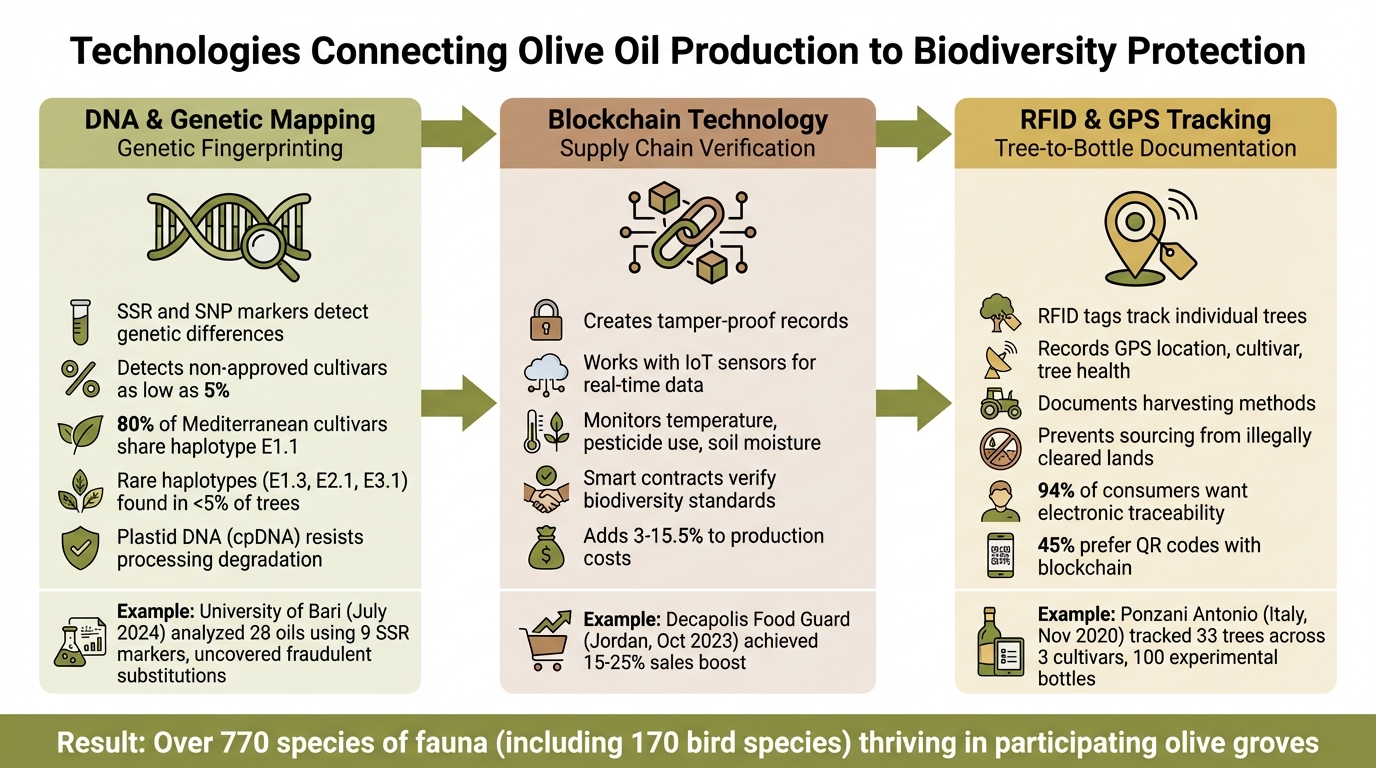
Modern traceability systems meticulously track the journey of olives from individual trees to the final bottle. For instance, RFID tags attached to tree trunks capture essential details like the cultivar, GPS location, and tree health, creating a seamless "tree-to-bottle" record. A notable example comes from November 2020, when Ponzani Antonio in Montorio Romano, Italy, piloted an electronic traceability system on 33 trees spanning three cultivars. This system logged GPS coordinates, harvesting methods, and the ripeness of olives. All this data was uploaded via the Infoliva app to a blockchain-compatible database, giving consumers the ability to verify the origins and farming practices of 100 experimental bottles, each holding 500 mL (about 17 fl oz).
Farmers can also use digital tools to document whether harvesting is done manually, semi-mechanized, or fully mechanized. Each method has unique effects on soil health and local wildlife, making this information crucial for sustainable farming. This level of documentation not only ensures product authenticity but also supports broader efforts to safeguard ecosystems.
Preventing Habitat Destruction
Traceability systems go beyond documentation - they actively help prevent habitat destruction. By linking each crate of olives to a GPS-tagged tree, these systems ensure sourcing from established groves rather than illegally cleared or protected lands. Advanced molecular techniques, like SSR and SNP markers, further verify the presence of local or traditional olive cultivars. This helps avoid the dominance of global monocultures, which can threaten habitats. DNA testing even detects non-approved cultivars in quantities as low as 5%, ensuring the preservation of genetic diversity.
"The proposed TTS could not only provide guarantees to the final consumer but could also direct the farmer towards precision farming management."
– Simona Violino, Researcher, CREA
Blockchain technology adds another layer of transparency by creating tamper-proof records of farming practices. From organic certifications to agronomic details, it verifies environmental claims and reinforces the connection between quality assurance and environmental stewardship. These combined efforts highlight how traceability plays a key role in protecting biodiversity while maintaining the integrity of olive oil production.
Why Not All Olive Oils Are the Same! | Inside Terra Delyssa’s Sustainable Process
Technologies That Connect Production to Biodiversity Outcomes
How Traceability Technologies Protect Olive Oil Biodiversity
DNA and Genetic Mapping
DNA testing acts like a genetic fingerprint for olive oil, offering a reliable way to protect native varieties from being replaced by cheaper imports. What makes DNA markers so effective is their stability - they aren’t influenced by weather, soil conditions, or processing methods, making them ideal for verifying the true origins of olive oil.
Two key technologies power this verification process: Simple Sequence Repeats (SSRs) and Single Nucleotide Polymorphisms (SNPs). These molecular markers are capable of detecting even the smallest genetic differences, helping to distinguish local cultivars from globally common varieties. For instance, in July 2024, researchers at the University of Bari analyzed 28 commercial extra virgin olive oils using nine olive-specific SSR markers. Their investigation uncovered that several samples contained varieties from countries not listed on the label, exposing fraudulent substitutions of native cultivars.
Rare genetic traits, such as "private alleles" (found in less than 1% of a population), provide another layer of precision. These alleles can pinpoint oils to specific regions and unique local germplasms. For example, while 80% of Mediterranean olive cultivars share a common genetic signature (haplotype E1.1), rare haplotypes like E1.3, E2.1, and E3.1 appear in under 5% of trees. These rare markers act as strong indicators of local biodiversity.
Plastid DNA (cpDNA) adds further forensic traceability. Since it’s maternally inherited, it avoids contamination from pollinator varieties, and its circular structure resists degradation during oil processing. In an August 2013 study in Andalusia, Spain, researchers used nine plastid DNA markers to fingerprint 15 Mediterranean cultivars. Their work identified a rare haplotype (E2.3) unique to the 'Lechín de Sevilla' variety and local wild trees, creating a molecular safeguard against mixing with common varieties like 'Arbequina'.
"DNA-based molecular markers are indeed the best choice for traceability purposes, since they are not dependent on the environmental and processing conditions, unlike other chemical analyses based on metabolites detection." – Pérez-Jiménez et al., Researchers
Building on this molecular precision, blockchain technology now complements DNA testing by securing supply chain data and ensuring that environmental claims accurately reflect real-world practices.
Blockchain for Supply Chain Verification
Blockchain creates a tamper-proof record of every transaction in the supply chain. Unlike traditional databases controlled by one central authority, blockchain distributes information across a network of computers, making it more secure and transparent.
This system works hand-in-hand with Internet of Things (IoT) sensors, which capture real-time data on farming practices. These sensors monitor factors like temperature, pesticide use, and soil moisture, feeding the data directly to the blockchain. Smart contracts then automatically verify whether farming practices meet biodiversity standards before certification.
A practical example of this technology in action comes from October 2023, when the Decapolis Company in Amman, Jordan, introduced its Decapolis Food Guard platform at an olive mill. This blockchain system tracked olives from their arrival - recording details like weight, type, and source - through the processing stages. Tamper-proof labels on containers ensured the integrity of the data. The results were tangible: the mill owner reported a 15–25% boost in sales and improved export opportunities to the European Union.
However, implementing such systems comes with costs. Depending on the size of the farm and the yield of the trees, a full traceability system can add between 3% and 15.5% to total production costs. Despite this, the increased precision in farming operations can offset these expenses, thanks to better efficiency and higher market prices for products that prioritize biodiversity.
sbb-itb-4066b8e
Financial Benefits of Biodiversity Certification
Sustainable practices not only protect biodiversity but also create real market value, as demonstrated by the financial advantages tied to biodiversity certifications.
Higher Prices for Biodiversity-Certified Products
Producers with certifications can often command higher prices for their products. Take Italian extra virgin olive oil, for instance. In October 2020, it sold for about $4.82 per kilogram (roughly €4.05/kg), compared to $2.98/kg in Spain and $2.72/kg in Tunisia. Certifications like PDO (Protected Designation of Origin) and PGI (Protected Geographical Indication) justify these premiums by verifying the product’s origin and traditional production methods.
Even though Italian olive oil production costs around $4.70 per kilogram - 1.5 times higher than in Spain or Greece - these certifications ensure producers can remain profitable by supporting higher pricing. As Luca Lombardo from Università Cattolica del Sacro Cuore explains:
"Sustainability certifications [are] a lasting driver of value creation." – Luca Lombardo, Researcher, Università Cattolica del Sacro Cuore
Beyond premium pricing, carbon credit markets offer another financial opportunity. In May 2025, the International Olive Council introduced the "Carbon Balance" project, allowing olive growers to generate and sell carbon credits by using groves as carbon sinks. Within just 24 hours, over 1,000 hectares across more than 10 countries were submitted for participation.
These financial incentives are more than theoretical - they’re already being realized through innovative projects across the globe.
Case Studies: Producers Restoring Biodiversity
Real-world examples highlight how biodiversity-focused practices translate into economic and environmental gains.
In Montorio Romano, Italy, the Ponzani Antonio project, led by researchers Simona Violino and Federico Pallottino in November 2020, proved that sustainability can be economically viable. Despite production costs increasing by 3–15.5%, the project’s approach boosted competitiveness at a consortium level and helped prevent fraud.
Another standout example is Villa Filippo Berio, managed by the Salov Group since 1990. Situated in Italy’s Migliarino, San Rossore Natural Park, this 75-hectare olive grove with 22,500 trees has been part of a biodiversity-focused initiative in collaboration with the National Research Council (CNR). By planting 52 specific olive varieties to combat climate change and using electronic sensors to monitor the Olive Fly, they’ve reduced chemical intervention costs while improving oil quality.
On the Greek island of Lesvos, EVO3 Olive Farms takes a similar approach. Their organic extra virgin olive oil production prioritizes sustainable farming practices that protect local species and bees. This commitment to biodiversity has allowed them to carve out a niche in the market, supplying high-end chefs and gift suppliers with premium organic and infused oils.
These cases demonstrate how biodiversity certification and traceability can lead to both environmental progress and financial rewards for producers. At Big Horn Olive Oil, we’re proud to embrace these sustainable practices, which uphold the ultra-premium quality of our extra virgin olive oils.
How Consumers Drive Biodiversity Protection Through Purchasing Choices
The olive oil you choose to buy has a direct impact on biodiversity. As we've seen, traceability connects every step of olive oil production to the protection of natural ecosystems. When you demand transparency, producers are pushed to adopt methods that prioritize biodiversity, as markets now value environmental responsibility just as much as quality.
This shift isn't just about marketing - it’s a fundamental change in how producers operate. They understand that linking biodiversity to profitability is essential. Your willingness to pay for products that offer added value encourages them to implement restoration efforts that support native plants and animals. José Eugenio Gutiérrez from the LIFE Olivares Vivos Project sums it up perfectly:
"Without profitability there is no sustainability, so it was important for the olive groves' biodiversity to be tied to their profitability." – José Eugenio Gutiérrez, LIFE Olivares Vivos Project Coordinator
The numbers back this up. A survey of over 3,600 consumers in Germany, Denmark, Spain, and the UK played a key role in developing sales strategies for biodiversity-certified olive oils. By late 2020, around 450 olive growers had shown interest in obtaining the Olivares Vivos biodiversity certification - a clear response to growing consumer demand.
Using Digital Tools to Check Environmental Impact
Technology makes it easier than ever to verify the environmental impact of the olive oil you buy. Tools like QR codes, NFC tags, and blockchain systems provide instant access to detailed production data, from the grove where the olives were grown to the harvest methods used.
Research highlights that 94% of consumers want electronic traceability for olive oil, and 45% prefer QR codes paired with blockchain verification for added security.
To use these tools, look for bottles with QR codes or NFC tags. Scanning them with your smartphone connects you to platforms that document the oil's journey - from tree to bottle. These systems ensure the data is secure, so you can trust environmental claims.
For even more assurance, choose oils with PDO (Protected Designation of Origin) or PGI (Protected Geographical Indication) seals. These certifications from the European Commission guarantee strict adherence to geographical and production standards, helping to protect local agricultural ecosystems. Some advanced systems even use DNA-based authentication to confirm the specific olive varieties, further supporting the preservation of genetic diversity.
These digital tools empower you to back brands that are genuinely committed to biodiversity.
Supporting Biodiversity-Focused Brands
When you choose brands that prioritize the environment, you're directly funding efforts to restore biodiversity. The IUCN underscores this point:
"Improving traceability and transparency enables informed decision-making and helps hold producers, investors, and buyers accountable." – IUCN
Look for certifications like the "Olivares Vivos" seal, which guarantees that the oil comes from groves where native flora and fauna have been scientifically restored. The LIFE Olivares Vivos project found over 770 species of fauna - including 170 bird species and 60 kinds of ants - thriving in participating olive groves.
At Big Horn Olive Oil, we commit to these sustainable practices to ensure the ultra-premium quality of our extra virgin olive oils. By supporting brands that offer transparency through digital tools and recognized certifications, you're making a choice that benefits far more than your meals. As Ramzi Belkhodja from CIHEAM Zaragoza explains:
"By choosing olive oil, [consumers] are not only making a healthier choice for their well-being, but also supporting a more sustainable agricultural system, which protects the environment and promotes rural development." – Ramzi Belkhodja, Coordinator of Plant Production, Health and Improvement, CIHEAM Zaragoza
Your choices make biodiversity a realistic and profitable goal for producers.
Conclusion
Traceability systems create a direct connection from the olive grove to your kitchen, ensuring farming practices that nurture biodiversity and sustain the environment. By incorporating tools like RFID tags, DNA mapping, and blockchain verification, producers aren't just tracking olives - they're showcasing their commitment to safeguarding native species, protecting local cultivars, and managing resources efficiently. The success of the LIFE Olivares Vivos project proves this approach works: in just three years, participating groves experienced notable increases in wildlife.
The financial aspect adds another layer of motivation. While traceability can increase production costs by 3%–15.5%, consumers are willing to pay a 17.8% premium for olive oils with verified environmental claims. This makes biodiversity-friendly practices not just ethical, but profitable.
"The proposed TTS could not only provide guarantees to the final consumer but could also direct the farmer towards precision farming management." – Simona Violino, Researcher, CREA
These economic incentives emphasize the importance of traceability across the olive oil industry. Producers must prioritize transparency, while consumers play their part by verifying claims and supporting brands that focus on ecological responsibility. At Big Horn Olive Oil, we believe every bottle represents a choice - a choice that can either help preserve or harm the ecosystems that nurture olive trees.
As traceability becomes the norm, the industry faces increasing regulatory and environmental pressures. The tools to meet these challenges are already available, consumer demand is clear, and the environmental benefits are undeniable. What’s left is the collective effort to scale these systems and reward producers who are actively working to protect biodiversity for generations to come.
FAQs
How does traceability in olive oil production help protect biodiversity?
Traceability in olive oil production links every bottle back to its original orchard and the specific olive variety used. This ensures that farming practices adhere to environmentally responsible standards. By doing so, it helps maintain the genetic diversity of olive trees and safeguards the ecosystems where they thrive.
By requiring producers to follow eco-friendly methods, traceability encourages healthier environments and contributes to ongoing conservation efforts. It plays a crucial role in aligning olive oil production with worldwide goals for sustainability.
How is technology used to guarantee the traceability and authenticity of olive oil?
Modern technology is transforming how we ensure the quality and origin of olive oil. Tools like blockchain systems and IoT platforms make it possible to track every step of the supply chain, offering a level of transparency and accountability that benefits both producers and consumers. On top of that, scientific methods such as DNA-based molecular markers, metabolomic profiling, and phenolic fingerprinting are used to verify the oil's purity and trace its origins.
These advancements do more than just protect consumers - they also push producers toward environmentally responsible practices, which can help preserve biodiversity. By selecting olive oils from reliable providers like Big Horn Olive Oil, you’re not just getting a fresh, high-quality product - you’re supporting efforts that prioritize sustainability and care for the planet.
What are the economic advantages of implementing traceability in olive oil production?
Traceability in olive oil production offers producers a range of economic advantages. By meticulously monitoring every stage - from the olive grove to the final bottle - producers can confidently prove the origin and quality of their extra virgin olive oil (EVOO). This transparency not only strengthens consumer trust but also supports premium pricing and opens doors to niche markets that prioritize products with protected origins.
It also serves as a safeguard against risks like fraud or expensive recalls by making it easier to pinpoint and address any issues quickly. This can help lower insurance premiums and improve eligibility for export markets that demand transparent supply chains. Moreover, highlighting practices like reducing carbon emissions resonates with environmentally conscious U.S. consumers. This can justify higher price tags while building long-term brand loyalty.