

Guide to Traceability in Olive Oil
If you pay premium prices for olive oil, you should be able to check where it came from, when it was harvested, how it was milled, and what tests back it up. That’s the core idea of traceability.
I’d sum it up like this: traceability links each bottle to a batch record that covers the grove, harvest date, mill data, lab results, bottling, and shipping. That matters because more than 40% of edible oil samples in one 2023 study were adulterated, and 68% of buyers said adulteration is their top concern.
Here’s what I’d want to see before buying:
- Harvest date
- Region or grove
- Batch or lot ID
- Lab results like free acidity, peroxide value, and polyphenols
- Bottling data
- Importer or shipping record for imported oils
- QR code or NFC access to the batch page
A strong setup also helps the seller. Digital records can cut recall tracing time by 73%, and products with clear provenance data may support prices 15% to 25% higher.
If I put it in plain English: traceability is the proof behind the label, not just the story on it.
How to spot high quality olive oil - Do This With Yours
sbb-itb-4066b8e
How Olive Oil Traceability Works from Harvest to Bottle
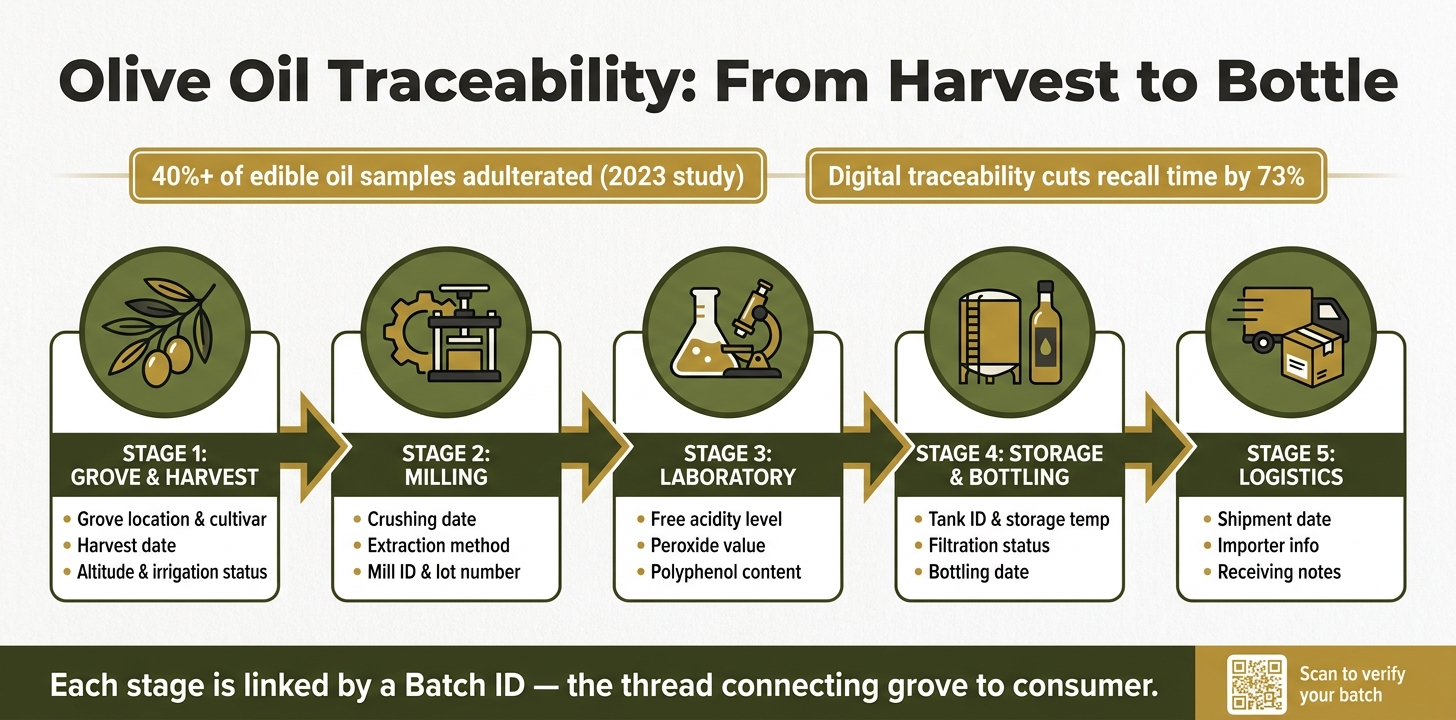
Olive Oil Traceability: From Harvest to Bottle
Traceability is a batch record that follows olive oil from harvest to delivery. In plain English, it’s the paper trail, or digital trail, that stays with a batch the whole way through.
A solid traceability system links five stages: grove and harvest, milling, storage, bottling, and logistics. At each step, specific details are recorded and tied to a batch ID. That batch ID is what connects the full record from start to finish.
The Core Data Recorded for Each Batch
Every useful traceability record starts with the same base data. Here’s the minimum dataset across the supply chain:
| Stage | Key Records | Why It Matters |
|---|---|---|
| Grove & Harvest | Grove location, cultivar, harvest date, altitude, irrigation status | Supports "single estate" or early harvest claims |
| Milling | Crushing date, extraction method, mill ID, lot number | Verifies extraction method and freshness timing |
| Laboratory | Free acidity, peroxide value, polyphenol content | Helps confirm extra virgin status |
| Storage & Bottling | Tank ID, storage temperature, filtration status, bottling date | Tracks product identity through packaging |
| Logistics | Shipment date, importer info, receiving notes | Supports chain of custody for imported oils |
Free acidity, peroxide value, and polyphenol content are core quality markers for each batch. These numbers help show what’s in the oil and whether it meets extra virgin standards. Show these results with the batch date in MM/DD/YYYY format.
Harvest and milling dates should always appear together. Why? Because the time between picking and crushing says a lot about likely sensory quality. When olives sit too long before crushing, they start to break down. A solid traceability record makes that gap easy to see instead of burying it in separate files or spreadsheets.
The hard part usually isn’t collecting the data. It’s keeping every record attached to the right batch in a format people can scan, check, and use without a headache.
Regulations and Standards That Support Recordkeeping
Imported oils need records that back up origin and custody claims. That means including importer details, shipment references, customs documents, and receiving notes. If any of that is missing, the chain of custody gets fuzzy fast.
PDO and PGI are origin labels tied to a named region and production method. For those claims to hold up, each certificate version and expiry date should be linked to the batch, not just the brand.
That record becomes far more useful when digital tools make it easy to scan, search, and share.
Digital Tools That Make Olive Oil Traceability Usable
Digital systems pull batch records into one place and make them simple to share across the supply chain. QR codes and NFC tags give shoppers an easy way to open that record on a phone, so the page needs to load fast and work well on mobile. From there, the job is pretty simple: present the data in a way people can scan in seconds.
QR Codes, NFC Tags, and Mobile-Friendly Product Records
A QR code on a bottle can take consumers straight to origin details for that batch, including the cooperative, harvest date, and bottling data. When the label is done well, claims become easy to check almost right away.
On an ecommerce product page, that same record should sit right next to the bottle listing. Shoppers should be able to see the harvest month and year, free acidity, and polyphenol levels for that exact batch, plus short plain-English notes on what those numbers say about freshness and quality. Add tasting notes and pairing suggestions, and the page starts doing more than just listing facts.
The main design idea here is layered transparency: give casual shoppers a clean summary first, then let more detail open up for people who want lab sheets and certificates.
That same record should also sync across ecommerce, ERP, and retailer systems.
Cloud Systems, APIs, and Blockchain-Backed Records
Cloud databases work as the central hub. Farm data, mill records, and lab results all feed into one source of truth instead of being scattered across separate spreadsheets. If a harvest date or lab result changes in the main database, an API can push that update to the ecommerce product page, ERP systems, and retailer feeds so records stay aligned.
Blockchain adds a layer of permanence on top. The best way to think about it is as a tamper-evident ledger: once a record is written, it can’t be deleted or quietly changed. That said, blockchain does not fix bad source data. If the wrong information goes in, the system will preserve the wrong information just as well.
Once records are centralized, the hard part shifts to data accuracy and who gets access to what.
Data Accuracy, Security, and Privacy
One of the biggest risks in any traceability setup is human error at data entry. A mistyped lot number or a missing harvest date can break the connection between a bottle and its source record. Digital systems help prevent that with controls like required fields, dropdowns for standard values, and date validation that blocks inconsistent entries before they’re saved.
Security also depends on audit trails. Each time a record is created or changed, the system should log who made the change, when it happened, what changed, and why. That makes tampering easier to spot and makes accountability much clearer. For day-to-day use, role-based access means warehouse staff can view shipping records without being able to edit lab results.
A smart move for any team handling premium olive oil records is to assign clear data owners by area. For example:
- One owner for harvest data
- One owner for lab results
- One owner for certifications
Designing Consumer-Friendly Traceability Experiences
Once the batch record exists, the interface has to do one job well: turn that record into proof a shopper can check in seconds.
A traceability database doesn't mean much if people can't read it quickly on a phone. That's the core idea here. The shopper view and the producer view should feel different, but they need to stay tied to the same batch record.
What a Traceability Page Should Show First
A traceability page should answer three questions right away:
- Where did this oil come from?
- When was it harvested?
- What verifies it?
Everything else should sit below that first layer. Show the summary first, then let people open more detail if they want it.
The page should move from fast verification to deeper detail:
| Information Layer | What to Show |
|---|---|
| Immediate Verification | Country/region of origin, harvest date (month/year), batch/lot ID |
| Quality Data | Free acidity levels, polyphenol count, organic or PDO/PGI certifications |
| How to Use It | Intensity scale (Mild/Medium/Robust), tasting notes, pairing recipes |
| Storage After Opening | Storage instructions (keep cool/dark), use-by window after opening |
Plain English matters here. If you show "0.2% free acidity" with no explanation, most shoppers won't know what to do with it. A short note helps: low acidity points to fresh fruit and careful processing. Harvest date also carries more weight than a best-before date because it shows freshness at pressing.
QR-Only vs. QR Plus NFC: A Side-by-Side Comparison
Both options can link to the same full batch record. The gap is in convenience, security, and cost.
| Feature | QR-Only | QR + NFC |
|---|---|---|
| Ease of Use | Very familiar; requires camera scan | Extremely easy; tap access with QR fallback |
| Implementation Complexity | Lower; standard printing process | Higher; requires physical tag integration |
| Scan or Tap Convenience | Requires camera scan | Tap-and-go access with QR fallback |
| Security Features | Limited; codes can be easily copied | Higher; supports chip-based verification |
| Consumer Friction | Moderate | Low |
| Cost | Low; negligible per-unit cost | Higher; NFC chips and insertion add cost |
QR-only is the simpler and lower-cost path. QR + NFC adds a smoother tap experience and stronger verification. NFC fits best when tighter authentication is the goal.
What Internal Dashboards Need for Producers and Quality Teams
The same clarity that helps shoppers should show up in the internal dashboard too.
Producers need a back-office dashboard that catches problems before shoppers ever see them. Missing-data alerts matter a lot here. If a lot record is incomplete, the system should flag it before a batch ships. If a harvest date or lab result is missing, that record shouldn't go live until it's complete.
The dashboard should also let teams trace a batch from grove to bottle and back again. That means quality teams can move in both directions: from a grove lot to every bottle it filled, or from a customer complaint back to the source record.
Lab data and sensor data should flow straight into the batch record instead of living in a separate spreadsheet. For Big Horn Olive Oil, that keeps label claims, batch records, and ecommerce pages in sync.
These interface choices make traceability more than a database entry. They turn it into trust, quality control, and better conversion.
Benefits of Traceability for Quality, Trust, and Ecommerce Growth
Traceability turns batch data into something people can use: proof for shoppers and evidence for producers. When the system is simple to access and easy to understand, the payoff shows up fast in buyer trust and sales.
Benefits for Consumers Buying Premium EVOO
Online shoppers can't pick up the bottle, read the label in person, or judge the oil before buying. That’s where traceability steps in. A batch page that shows lab results, harvest date, and processing temperature gives people proof instead of marketing copy. And that matters, because adulteration is still one of the biggest worries for olive oil buyers.
That same record helps protect the brand, too. If an oil was cold-pressed within hours of harvest, traceability gives the producer a clear way to back up that freshness claim. A harvest date says far more than a best-by date when freshness is the main reason someone is willing to pay more.
Benefits for Producers, Retailers, and Ecommerce Operations
Traceability doesn’t just help the customer side. It also helps with operations, recalls, and pricing. Digital systems cut the time needed to isolate a batch during a recall by 73% compared to paper-based systems. In practice, that can mean hours instead of days when a quality issue shows up.
The same batch records used on the customer-facing page can also support higher pricing. Brands with verifiable provenance data can command prices 15–25% higher in premium retail channels.
That’s why traceability needs to work in two ways at once: as proof and as the interface people use to check that proof.
Conclusion: Key Elements of a Trustworthy Olive Oil Traceability System
A trustworthy traceability system depends on complete records, usable digital tools, clear interfaces, and business value that can be measured. When those parts work together, shoppers can buy with confidence, and producers can stand behind every bottle.
FAQs
How can I verify a batch ID?
Use the producer’s digital tools, such as a QR code or online traceability platform, to check the batch ID.
Scanning the bottle’s QR code can show details like origin, harvest date, production process, quality test results, and records such as filtration details or lab certificates.
What lab results matter most in olive oil?
The most important lab results confirm quality, origin, and Extra Virgin grade. The main checks include free fatty acidity (FFA), peroxide value, and UV absorption readings such as K232 and K270.
Labs may also report polyphenol content, sterolic profiles, and other markers that show oxidation or adulteration. When you pair those numbers with sensory evaluation, they help confirm purity, freshness, and compliance with international standards.
Is a QR code enough to prove authenticity?
No. A QR code by itself does not prove a product is authentic.
It needs backup from clear, verifiable data, such as:
- harvest dates
- origin
- lab test results
- blockchain records
- DNA verification
Those details give you something concrete to check, which helps confirm the product’s authenticity.