

USDA Organic Certification for Olive Oil
If you want to know whether an olive oil is USDA organic, check 3 things first: the USDA Organic seal, the certifier statement, and the USDA Organic Integrity Database listing.
Here’s the short version: USDA Organic tells you how the olives were grown, handled, stored, and tracked. It does not mean the oil is extra virgin. And extra virgin does not mean the oil is organic. Those are 2 separate claims.
Before I trust a bottle, I look for:
- No prohibited substances for 3 years on the land before the first organic harvest
- Third-party certification by a USDA-accredited certifier
- Separation from nonorganic oil during milling, storage, and bottling
- Records kept for at least 5 years
- Correct label category: 100% Organic, Organic, Made With Organic, or under 70%
- Database proof that the company is currently certified for olive oil
A few numbers matter here:
- 3 years: land must be free from prohibited substances before harvest can be sold as organic
- 95% to 100%: range that can use the USDA Organic seal
- 70%: minimum for a “made with organic” claim
- 75%: cost-share reimbursement rate for eligible certification costs
- $750: max reimbursement per certification scope per program year
- 5 years: record retention period
If I had to sum up the whole article in one line, it would be this: USDA organic olive oil is about verified production rules and paper trail, not taste grade.
| Claim | What it tells me | What it does not tell me |
|---|---|---|
| USDA Organic | The olives and oil met USDA organic rules and were checked by a certifier | That the oil is extra virgin |
| Extra Virgin | The oil met grade standards for quality | That the olives were organically grown |
If a bottle says organic but has no certifier statement and the database does not match, I would skip it.
USDA Organic Standards and Label Categories for Olive Oil
The USDA Organic seal follows National Organic Program (NOP) rules for farming, processing, and labeling. For olive oil, those rules cover the entire chain: the grove, the mill, and the label all have to line up.
Farming and Processing Rules Behind the USDA Organic Seal
At the farm level, organic olive growing means no prohibited synthetic pesticides or fertilizers, no GMOs, no sewage sludge, and no ionizing radiation. Instead, growers use approved methods like cover crops, compost, mulching, mechanical weed control, and biological pest management. Every input used in the grove has to appear on the USDA list of allowed materials and also be approved by the certifier.
The processing side is just as strict. Organic olive oil has to stay separate from nonorganic oil at every step: receiving, milling, storage, filtration, bottling, and shipping. In plain terms, that means dedicated tanks or tanks cleaned thoroughly, written sanitation procedures, lot separation, and records that trace the oil back to certified organic olives. Preventing contamination and keeping clear traceability records sit at the heart of NOP rules.
100% Organic, Organic, and Made With Organic: Label Categories Explained
The NOP allows four organic label categories. For olive oil, the differences come down to how much of the product is certified organic and whether the USDA seal can appear on the package.
| Label Category | Required Organic Content | USDA Seal Allowed | What It Means for Olive Oil |
|---|---|---|---|
| 100% Organic | 100% certified organic ingredients (excluding water and salt) | Yes | Applies to single-ingredient olive oil made only from certified organic olives. |
| Organic | At least 95% certified organic ingredients (excluding water and salt) | Yes | Applies to single-ingredient olive oil or infused oils that still meet the 95% threshold, with any nonorganic ingredients allowed only if they comply with the National List. |
| Made With Organic | At least 70% certified organic ingredients (excluding water and salt) | No | Applies to flavored or infused oils that do not reach the 95% threshold; the label may name up to three organic ingredients or food groups. |
| Less Than 70% Organic | Below 70% | No | No front-panel organic claim is allowed; organic ingredients may be noted only in the ingredient list. |
Plain olive oil is the easy case. Infused oils are where things get trickier, because the added ingredients also have to count toward the organic threshold.
Where to Find Organic Proof on the Label
Once you know the rules, the label becomes much easier to read. There are three places worth checking.
The first is the USDA Organic seal. It appears only on products in the 95% to 100% organic range.
The second is the certifier statement, usually printed on the back or side panel near the bottler or distributor info. It often reads Certified organic by [Name of certifying agent]. Any product making an organic claim needs this statement, even when the USDA seal is missing from the front.
The third is the ingredient list. For a single-ingredient bottle, it should say organic olive oil. For flavored oils, each organic ingredient should be marked as organic in the list, either with the word itself or with a symbol such as an asterisk tied to a note.
If a bottle uses the word organic in its product name or marketing but shows no USDA seal and no certifier statement, don't treat that as a certified organic claim.
sbb-itb-4066b8e
Production Requirements for Certified Organic Olive Oil
Organic Olive Grove Requirements
Those label claims start in the grove, then carry through the mill and bottling line. USDA says the land must be managed without prohibited substances for 3 years before the first organic harvest. During that transition period, growers still have to follow organic practices, but they can't sell the crop as organic yet. They also need to track inputs and field work in an Organic System Plan (OSP).
Organic fertility is built from the ground up. That usually means using cover crops, compost, mulches, allowed mineral amendments, and soil tests to build soil organic matter and biological activity. Weed control, without synthetic herbicides, often comes down to mowing, cultivation, grazing, and mulching.
Pest control starts with prevention first. In practice, that means pruning for airflow, picking adapted varieties, monitoring pest pressure, and using approved controls only when needed. Growers also need buffer zones to cut down drift from neighboring conventional farms. And yes, the paperwork matters just as much as the fieldwork: inputs, spray records, harvest logs, and maps all need to be ready for inspection.
Mill, Storage, and Bottling Controls
Once the grove qualifies, handlers have to keep the oil separate through processing and packaging. The mill, storage site, and bottler must all operate under an approved Organic System Plan.
Organic and conventional product must stay segregated during receiving, crushing, storage, and bottling. Many mills handle this by running organic lots first after a documented clean-out, or by setting aside certain timeslots for organic processing. If equipment is shared, the facility has to do a thorough clean-out with allowed cleaning agents, then rinse well so no residues stay in contact with the organic product. Cleaning logs should note the date, equipment, method, materials, and operator.
Records also need to trace each bottle back to its grove and support mass-balance checks. That means keeping supplier certificates, receiving logs, batch records, tank logs, bottling records, and sales records on-site for at least 5 years. The paper trail should show that the amount of organic oil sold does not go past what could have been made from certified inputs.
How Flavored and Infused Oils Fit the Rules
Blends and infusions add one more layer of review: every ingredient has to fit USDA organic rules. Flavored and infused oils are multi-ingredient products, so every agricultural ingredient must be certified organic to count toward the organic percentage. For example, if a lemon-infused oil uses organic extra virgin olive oil but includes a non-organic lemon flavoring that is not on the National List, that lemon ingredient does not count as organic content.
Approved non-agricultural ingredients and processing aids must be specifically allowed under USDA rules (7 CFR §205.605) and listed in the operation's OSP. If an agricultural ingredient is commercially available in organic form, that organic version must be used.
Keep current organic certificates and product specs for every ingredient. When suppliers or formulas change, those records need to be updated too.
These controls set up the application, inspection, and annual renewal steps that come next.
Step-by-Step USDA Organic Certification Process for Olive Oil Producers
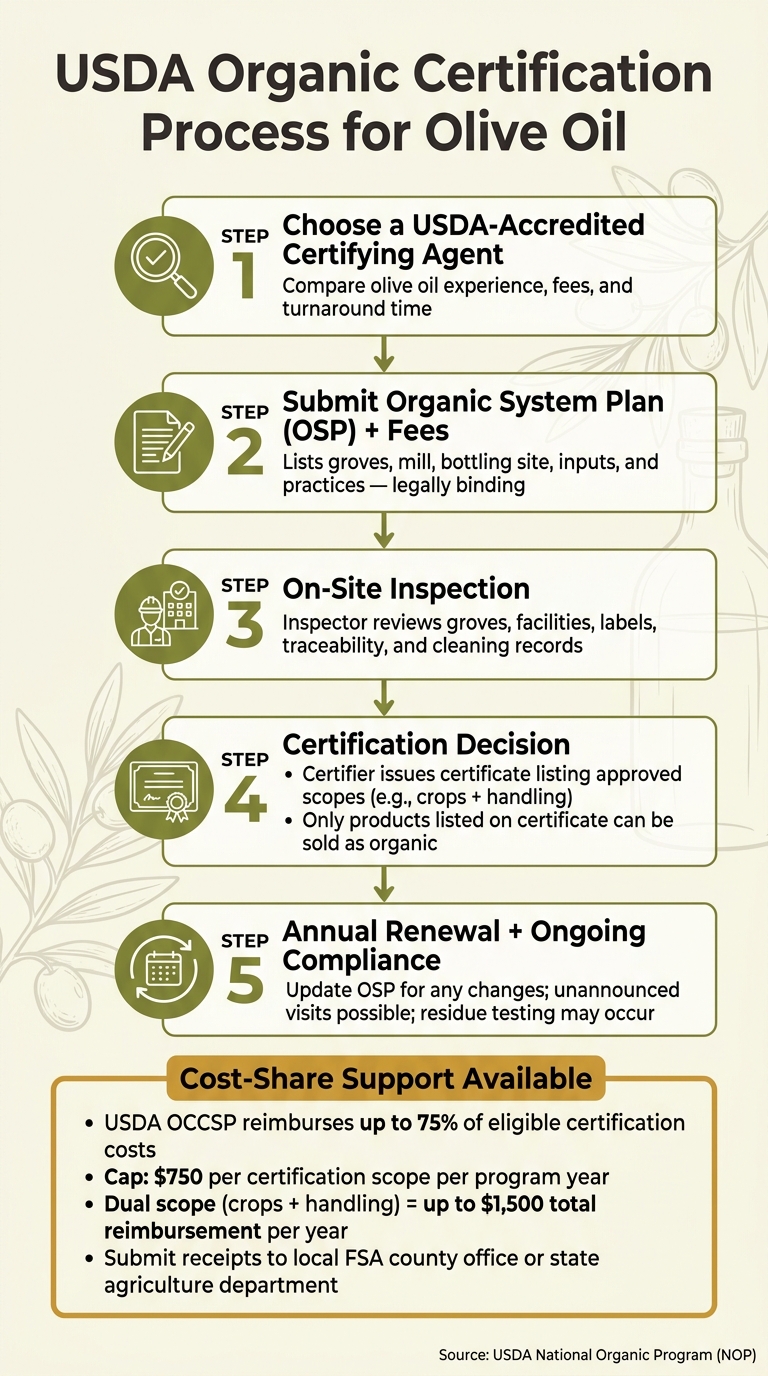
USDA Organic Certification Process for Olive Oil Producers
Once your production controls are set, the next move is certification. This is the process that lets an olive oil producer use the USDA organic seal. USDA certification follows five steps: choose a certifier, submit an OSP and fees, complete inspection, receive review, and renew each year. For olive oil operations, that usually means the grove and the handling facility are both part of the review.
Application, Organic System Plan, and Inspection
Start by choosing a USDA-accredited certifying agent. Private, state, and foreign certifiers can all operate under the National Organic Program (NOP). When you're weighing options, look at their olive oil and processed food experience, fee setup, and usual turnaround time.
After that, submit your Organic System Plan (OSP). The OSP lists your groves, mill, bottling site, inputs, and the practices used for each scope. USDA treats this as a legally binding document, so the details need to be correct.
Once the certifier reviews the application and OSP, an inspector comes on-site. The inspection covers the groves, facilities, labels, and traceability and cleaning records to make sure the operation matches the OSP. If everything lines up, the certifier moves to final review.
Certification Decision, Annual Renewal, and Ongoing Compliance
After the inspection, the inspector sends a report and support documents to the certifying agent for final compliance review. If the operation meets USDA rules, the certifier issues an organic certificate that lists the operation's name, certifier, effective date, approved scopes, and the products approved under each scope.
For an olive oil business, that can mean organic olives under crops and organic extra virgin olive oil under handling. Only products listed on the certificate can be sold as organic.
Certification doesn't last forever. If something changes, the OSP has to be updated. Operations also need annual inspections and current records to keep organic status. Unannounced site visits can happen too, and inspectors may collect samples to test for prohibited residues.
It helps to stay ahead of renewal deadlines and update the OSP any time the operation changes. Certification also comes with recurring fees, though some of that cost may be paid back through cost-share support.
Certification Costs and Cost-Share Support
Certification usually comes with a few separate charges. Application and admin fees are often paid up front. Inspection and travel fees usually come after the site visit. Annual certification fees return each renewal cycle. In states with their own organic programs, such as California, there may also be separate state program fees.
Those costs pay for the verification behind the label. For certified producers and handlers, USDA's Organic Certification Cost Share Program (OCCSP) can reimburse up to 75% of eligible certification costs, with a cap of $750 per certification scope per program year. If an olive oil operation is certified in both crops and handling, it may qualify for up to $1,500 in total reimbursement per year, assuming both scopes are eligible.
To apply, send proof of current certification, receipts for eligible fees paid during the relevant fiscal year, and the required tax documents to your local FSA county office or state agriculture department.
| Cost Element | What It Covers | When It Is Paid | Notes for Olive Oil Operations |
|---|---|---|---|
| Application & Administrative Fee | Initial application review and OSP processing | At time of application | Separate OSP sections may be needed for grove (crops) and mill/bottling (handling) scopes |
| Inspection Fee | Inspector time during the on-site visit | Billed after inspection | Mills with complex equipment or multiple locations may incur higher costs |
| Inspector Travel & Per Diem | Travel to groves and processing facilities | Invoiced with inspection fees | Rural olive groves can add significant travel costs |
| Annual Certification Fee | Ongoing certification, label review, and OSP updates | Due once per year at renewal | Plan for this during the annual renewal cycle |
| State Organic Program Fee | Participation in state-level organic programs | Per state schedule | Applies in states with separate organic programs, such as California |
| Sales-based program fees | Based on organic sales volume or SKU count | Periodically throughout the year | Operations with many flavored oil SKUs or higher sales volume should model these costs |
Keep receipts and invoices for each eligible expense so you have the paperwork needed for cost-share reimbursement. Once certification is active, the label and the certificate are the fastest ways to check the claim.
How to Verify Organic Claims and Key Takeaways
How Consumers Can Verify a USDA Organic Olive Oil
Once you know the production rules and certification steps, the fastest way to check an organic claim is simple: look at the bottle, then check the public record.
Start with the label. Look for the USDA Organic seal when that product category can use it, and check for the certifier statement on the information panel. If that certifier statement is missing, that's a red flag. And because certification can change, it's smart to check both the package and the public record before you buy.
Next, search the brand or company name in the USDA Organic Integrity Database (OID). It's free and open to the public. Make sure the operation is currently certified, confirm that the certifying agent matches the one named on the bottle, and check that olive oil appears in the certified product scope. In plain English: use the label as a quick filter, then use the database to confirm the details.
Words like natural, pure, and cold-pressed are not organic claims. They don't replace third-party certification, and they don't prove that a product meets USDA organic rules.
If the label and the database don't line up, don't trust the front label by itself.
| What to Check | Where to Find It | What It Confirms |
|---|---|---|
| USDA Organic seal | Front label, when the product category allows it | The product is certified organic and may display the USDA seal |
| Certifier statement naming the certifying agent | Information panel, near the handler/distributor information | A USDA-accredited certifier reviewed the operation |
| Certifier name match | OID listing vs. bottle statement | The label and public record align |
| Certification status in OID | USDA Organic Integrity Database | The operation is currently certified |
| Olive oil in certified product scope | OID operation profile | Olive oil is included in the certification |
Conclusion: What to Remember When Buying Organic Olive Oil
USDA organic certification and olive oil grade are two different things. A bottle can be extra virgin without being organic. It can also be organic without being extra virgin. Organic certification is about how the olives were grown and handled.
For single-ingredient olive oil, the ingredient list should say organic olive oil.
If you're unsure, check the USDA Organic Integrity Database. If the bottle and the record don't match, walk away from the purchase.
FAQs
Does USDA Organic mean the olive oil is extra virgin?
No. USDA Organic means the olives were grown with organic farming methods, like no synthetic fertilizers or pesticides. It does not guarantee the separate chemical and sensory standards required for Extra Virgin.
An olive oil can be USDA Organic without being Extra Virgin, and it can be Extra Virgin without being USDA Organic. If you want both, check for both labels.
How can I verify an olive oil is really USDA organic?
Check the bottle for the official USDA Organic seal and wording that clearly says the product is USDA Organic certified.
You should also see the certifying agent listed on the label. If you want to double-check, look up the producer in the USDA’s Organic Integrity Database to confirm its certification status.
Can infused olive oils use the USDA Organic seal?
Yes - infused olive oils can use the USDA Organic seal, but only if they meet USDA labeling rules.
That seal is limited to products labeled “100 Percent Organic” or “Organic.”
“Organic” means the product contains at least 95% certified organic ingredients by weight, not counting water and salt. The package also has to show the certifying agent’s name.
Products labeled “Made with organic” with 70%–95% organic ingredients can’t use the seal.