

Volatile Compounds vs. Sensory Testing in EVOO
If you want to judge extra virgin olive oil well, you need both lab data and trained tasters. One method measures aroma compounds in the oil. The other checks whether people can smell and taste fruitiness or defects. Used together, they give a much better read on quality than either one alone.
Here’s the short version:
- Volatile compound analysis uses lab tools like GC-MS to measure aroma molecules
- Sensory testing uses a trained panel to score fruitiness, bitterness, pungency, and defects
- Panel results decide the legal grade: extra virgin, virgin, or lampante
- Lab tests can spot early changes before a defect is easy to smell
- Sensory panels can catch problems that chemistry alone may not sort out
- A UC Davis review of 260 olive oil samples found 141 failed sensory testing
- One study of 300+ virgin olive oils reported 84.0% correct classification when volatile screening was paired with panel review for uncertain samples
In simple terms: lab testing tells me what compounds are present. Sensory testing tells me how the oil comes across to people. That’s the main difference, and it matters if I’m checking shelf life, defects, batch consistency, or extra virgin status.
Finding the Best Extra Virgin Olive Oil - Dr. Tod Cooperman and Olive Oil Expert Nancy Ash
sbb-itb-4066b8e
Quick Comparison
| Method | What it checks | Best for | Main limit |
|---|---|---|---|
| Volatile compound analysis | Aroma molecules and defect markers | Early screening, storage checks, batch tracking | Lab data does not always match what people notice |
| Sensory testing | Smell, taste, mouthfeel, and defects | Legal grading and flavor judgment | Human panels take time and need calibration |
If I had to sum it up in one line, it would be this: <u>chemistry shows the signal, while tasters show the experience</u>. This dual approach ensures you receive only the highest quality fresh harvest extra virgin olive oil.
Volatile Compound Profiling: What the Chemistry Reveals
Lab analysis maps the oil’s volatile aroma profile: the compounds that evaporate at room temperature and hint at freshness or defects. These tests are instrument-based and highly reproducible. In practice, the clearest signals come from a small group of aroma compounds tied to fresh fruit notes and common flaws.
Key Aroma Markers Linked to Freshness and Defects
The green, grassy, and fruity character of high-quality EVOO comes mainly from C6 aldehydes, alcohols, and esters formed through the lipoxygenase (LOX) pathway when olives are crushed during milling. One of the main compounds is E-2-hexenal, which gives off fresh-cut grass, green apple, and leafy notes. In some monovarietal EVOOs, E-2-hexenal makes up much of the volatile profile. Another marker of freshness is Z-3-hexenal. It appears almost only in freshly milled oils and drops during storage.
Defective oils usually show a shifted volatile pattern, not just one single “bad” compound. Here are the main markers labs look for:
| Defect | Key Markers |
|---|---|
| Rancid | Hexanal, E-2-heptenal, nonanal, octanal, propanoic acid |
| Fusty/Muddy sediment | Octane, 3-methyl-1-butanol, ethanol, ethyl butanoate |
| Musty/Moldy | 1-octen-3-one, 1-octen-3-ol, 2-heptanone, 2-heptanol |
| Winey-Vinegary | Ethyl acetate and other fermentation esters |
Lab Methods Used to Measure EVOO Volatiles
Labs use GC-based methods to identify which compounds are present and how strong they are. HS-SPME/GC-MS is the main method for identifying individual volatiles. The International Olive Council (IOC) recognizes an official method, COI/T.20/Doc. No. 37/2024, for SPME-GC-FID/MS.
HS-GC-IMS works faster for screening, but it gives less structural detail than GC-MS. That’s why most quality programs focus on a short list of key VOCs instead of tracking dozens of compounds.
These markers can point to likely quality issues in the lab, but the panel test is still what shows whether tasters can actually detect them.
Sensory Testing: What Trained Tasters Detect
Lab tools map volatile compounds. Sensory panel testing checks the oil the old-fashioned way: through smell, taste, and mouthfeel. It’s the human read on the same aroma signals that chemistry tracks. And it’s the official method used to classify extra virgin olive oil by sensory properties.
Chemistry shows which compounds are there. The panel shows whether those compounds come across as quality or defect.
How the Official Panel Test Works
An official panel usually includes 8–12 trained tasters led by a panel leader. Each taster evaluates a coded sample on a 0–10 scale using standardized glassware, and does so independently. The panel leader controls the test conditions and records the results.
The scores focus on a set group of positive traits and defects. One detail matters here: classification is based on the median score, not the average.
Attributes That Determine EVOO Quality
In sensory terms, EVOO is judged by three positive attributes: fruitiness, bitterness, and pungency.
- Fruitiness covers fresh olive aromas, including notes like green grass, artichoke, apple, and nuts.
- Bitterness comes from green or turning-color olives and from higher phenolic content.
- Pungency is that peppery throat hit often tied to early-harvest oils and compounds such as oleocanthal.
For an oil to qualify as extra virgin, it must have a zero median defect score and a fruitiness score above zero. If defect scores climb, the oil drops to a lower grade.
Chemical limits don’t settle quality on their own. The next comparison shows where chemistry and trained tasters part ways.
Volatile Compounds vs. Sensory Testing: Differences, Strengths, and Limits
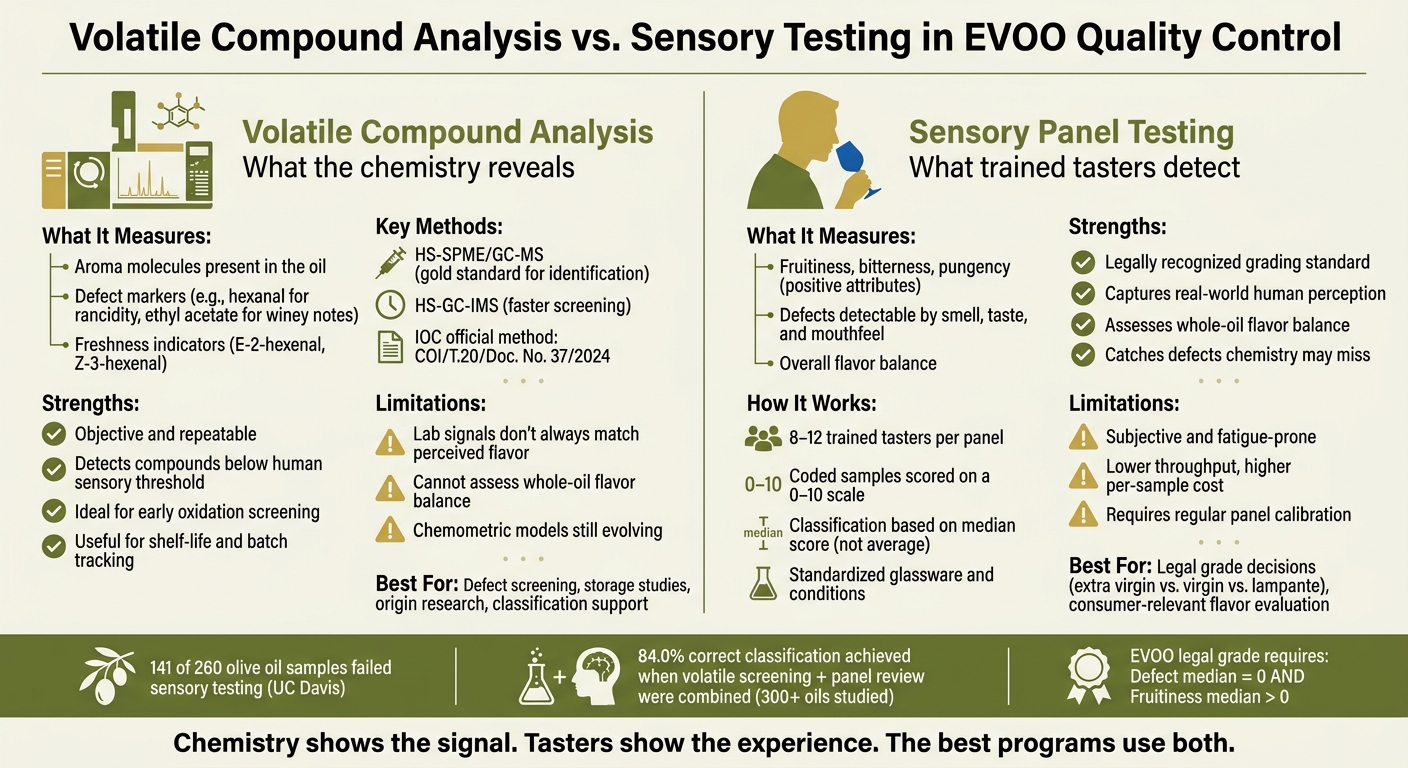
Volatile Compound Analysis vs. Sensory Testing in Extra Virgin Olive Oil
Both methods evaluate EVOO quality, but they answer different questions.
Volatile compound analysis asks which molecules are present and how much of each one is there. Sensory testing asks what a trained taster can actually smell and taste. And those answers don't always line up.
Objectivity vs. Human Perception
Instrumental analysis is objective and repeatable. Calibrated tools like GC–MS generate repeatable quantitative data that works well for classification models. That said, chemometric models can help classify oil quality, but they don't replace sensory perception.
The main difference isn't just what each method measures. It's how closely that measurement matches what a buyer will notice in the real world.
For example, GC–MS may detect a molecule that is still below the level a person can notice. On top of that, some defects come from combinations of compounds rather than a single signal. So chemistry tells you what is present, while sensory testing shows what people can actually detect.
Sensory panels also bring something instruments can't: a whole-oil judgment. A trained panel can assess overall flavor balance in a way lab data can't fully mirror. The downside is pretty plain. Panels take time, cost more per sample, can suffer from fatigue, and need regular calibration to keep scores in line.
Where Each Method Works Best
| Method | Strengths | Limitations | Best Use |
|---|---|---|---|
| Volatile Compound Analysis | Objective, repeatable, and able to detect compounds below sensory threshold | Lab signals do not always match perceived flavor, and models are still evolving | Defect screening, origin research, shelf-life studies, and classification support |
| Sensory Panel Testing | Captures real-world flavor balance and remains the legally recognized standard | Subjective, fatigue-prone, lower throughput, and higher per-sample cost | Legal grade decisions and consumer-relevant flavor evaluation |
Volatile profiling is especially useful for borderline samples, disputed results, and internal quality checks.
That's the gap between the two methods: one shows the chemical picture, and the other shows the human experience. In practice, the most dependable EVOO programs use both together.
Why the Best EVOO Programs Use Both Methods
Building on the chemistry-versus-panel split above, no single method gives you the full picture. Chemistry tells you what’s in the oil. Sensory testing tells you how it tastes. The best quality programs use both.
How Combined Testing Supports Freshness and Consistency
For premium oils built around freshness, this two-part approach helps keep batches steady from one run to the next. Volatile profiling sets a baseline for aroma, and sensory panels check whether each batch still fits that profile. If lab results show a shift in key freshness markers like E-2-hexenal or C6 aldehydes, the panel can confirm whether people can actually notice that change before the oil gets to customers.
That gap isn’t just theoretical. A UC Davis analysis of 260 olive oil samples found that 141 failed sensory testing, which shows that chemistry on its own can miss defective oils. At the same time, sensory panels can miss early oxidation before it becomes easy to notice. That’s where volatile profiling helps.
Research supports this mixed approach. A volatile-fingerprint screening study covering more than 300 virgin olive oils found that pairing volatile screening with panel review for uncertain samples achieved 84.0% correct classification of commercial quality categories.
Here’s the simple version:
- Sensory only: catches defects people can taste or smell, but can miss early chemical change.
- Volatile only: spots early change, but can’t tell you how that change lands with human senses.
- Combined: gives the strongest check on freshness and consistency.
Key Takeaways for Choosing High-Quality EVOO
Chemistry can flag early aroma shifts. Sensory testing can confirm whether those shifts change taste. When a producer or retailer uses both, you have a much better read on whether the oil is fresh, steady from batch to batch, and high quality.
For shoppers, a few signals matter more than fancy wording. Look for harvest dates, clear lab values, and mention of trained sensory evaluation. Those signs usually point to a program that checks oil from both angles instead of relying on just one.
FAQs
Why can’t lab testing alone confirm EVOO quality?
Lab testing alone can’t confirm EVOO quality. Chemical analysis can miss subtle sensory defects like rancidity, fustiness, or mustiness.
It does give objective data on purity and composition. But it can’t match the human ability to judge flavor, aroma, and mouthfeel. That’s the gap.
Some oils pass chemical standards and still fail sensory evaluation. So if you want the full picture, you need both methods.
When do volatile compounds show problems before tasters can?
Chemical tests can spot early signs of decline before human tasters notice anything is off. Tools like gas chromatography pick up specific markers at the parts-per-billion level, which gives teams an early warning that quality is starting to slip.
Take oxidation as an example. A shift in the ratio of 1,2-diacylglycerols to total DAGs can point to oxidation before it shows up on the palate. Chemical analysis can also find primary oxidation products before rancid flavors or odors appear.
How should buyers use lab data and sensory results together?
Buyers should use lab data and sensory results together when checking EVOO quality and authenticity.
Chemical tests help confirm purity, freshness, and compliance with formal standards. Trained sensory panels do something numbers alone can’t: they pick up flavor details and spot defects like rancidity or fermentation.
Put the two side by side, and you get a clearer read on the oil. One checks what the oil is. The other checks how the oil tastes and smells. Together, they help confirm that the EVOO meets quality standards and delivers a consistent, high-quality experience.