

Why Warm Olive Loads Lose Quality in Transit
Warm olives can start losing oil quality within hours of harvest. If fruit sits too long in deep, poorly ventilated bins, heat builds inside the load, oxygen drops, and fermentation can start before milling.
Here’s the short version:
- Heat inside the bin matters more than outside air
- Delays past about 4 hours can increase fermentation risk, especially with warm or damaged fruit
- Large, packed loads trap heat and limit airflow
- Damaged olives break down faster and are more likely to develop off-odors
- Warm transit can lead to lower fruitiness, lower phenolics, higher acidity, and more sensory defects
- The fix is simple: pick in cooler hours, keep bins shaded, use ventilated containers, avoid overfilling, and mill the same day
A few numbers stand out:
- Olives in poorly ventilated containers may begin anaerobic respiration in about 3 hours at 77°F
- At 95°F, that can happen in under 2 hours
- Respiration at 68°F is about 2x to 4x higher than at 41°F
- Loads above 50°F at the center deserve close attention at receiving
If I had to sum it up in one line, it’s this: cool fruit, shallow bins, good airflow, and short transit time give olives a much better shot at making clean, high-grade oil.
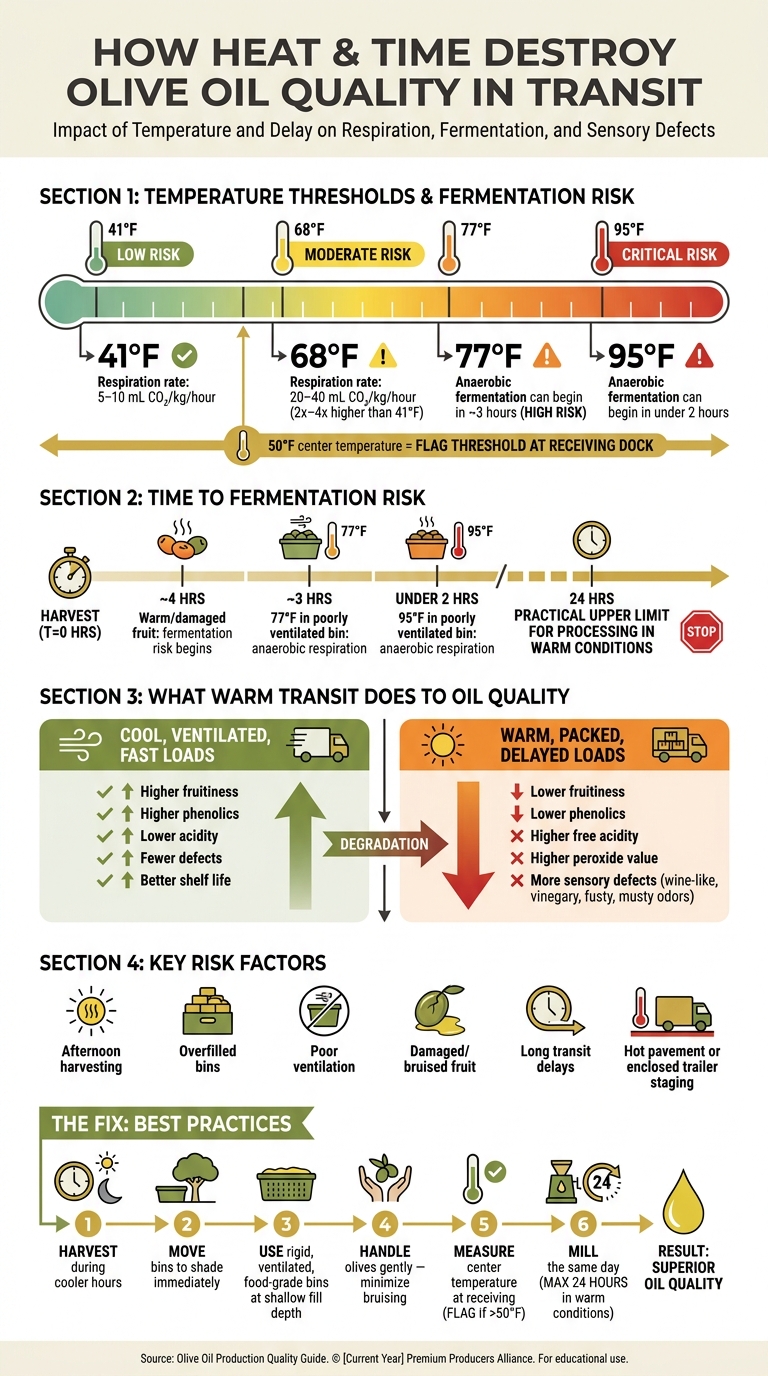
How Temperature & Time Destroy Olive Oil Quality in Transit
How heat builds inside olive bins during transit
Once olives go into bins, they don't stop changing. They keep respiring, which means they use oxygen and release carbon dioxide and heat. In a tightly packed bin, that heat gets stuck inside the fruit mass. Then the olives warm up, respiration speeds up, and even more heat builds. It's a feedback loop, and it can get out of hand fast.
The big point here is simple: internal fruit temperature drives deterioration during transit, not the air temperature around the bin. A load can look fine from the outside while the fruit inside is heating up and moving into risky territory. That rise in fruit temperature is what turns a routine haul into a quality problem.
Why the center of the load runs hotter than the surface
The olives near the outside of the bin get at least some contact with moving air. The olives in the center don't. Heat made in the middle has to move outward through layers of other fruit before it can escape. In a large, overfilled bin, that takes time, and the heat tends to stay trapped.
Research flags 400-kilogram containers as a risk point for heat buildup and fruit deterioration. One study found that olives in the inner part of a poorly ventilated container can begin anaerobic respiration in about 3 hours at 77°F and in less than 2 hours at 95°F. That's the point where fermentation risk starts climbing fast.
The American Oil Chemists' Society recommends using containers that allow air circulation to prevent temperature increases in the bottom layers. In practice, that means checking the temperature inside the load, not just the air outside the truck. If the middle of the bin is heating up, the risk is already building.
What worsens heat buildup during harvest
Some harvest conditions make this problem much worse. Afternoon picking, direct sunlight, and leaving loaded bins on hot pavement or inside a closed trailer all lead to the same outcome: fruit goes into the bin warm and keeps getting warmer.
Overfilling adds another layer of trouble. Deep, compressed fruit masses hold heat and limit airflow through the load. Bruised or crushed olives also break down faster and are more open to microbial activity, which increases the risk of localized fermentation and off-flavors. Rough handling isn't just a handling issue - it's a direct quality risk.
sbb-itb-4066b8e
How respiration leads to fermentation
That trapped heat matters because it speeds up respiration inside the load. After harvest, olives are still alive. They keep taking in oxygen and releasing carbon dioxide and heat. And as temperature goes up, that rate goes up too.
At 41°F, olives respire at about 5–10 mL of carbon dioxide per kilogram per hour. At 68°F, that jumps to about 20–40 mL/kg/hour. So a warm load doesn’t just show up warm. It can keep heating itself during the trip.
Respiration is normal; fermentation is the problem
Respiration by itself isn’t the issue. In a cool, ventilated bin that gets to the mill fast, it usually stays under control.
Trouble starts when oxygen can’t move through the load fast enough. In a dense, deep, poorly ventilated bin, olives in the middle use oxygen faster than outside air can replace it. Carbon dioxide starts to build, oxygen drops, and once oxygen falls to around 2% or lower, the fruit shifts from aerobic respiration to anaerobic fermentation.
That’s the point where off-flavors start to form. Sugars are converted into alcohols and carbon dioxide, and the oil can pick up defects that are hard to miss.
Wine-like, vinegary, sour, musty, or fusty odors signal fermentation.
A fusty defect is linked to olives that have gone through too much fermentation before milling. UC Davis specifically notes that olives held for extended periods can ferment and cause this fusty character in the finished oil. At the receiving dock, alcoholic, sour, vinegary, or musty smells shouldn’t be brushed off as “just olive smell.” They’re a warning sign.
Why damaged fruit breaks down faster in transit
Bruised or crushed olives fall apart faster in the bin. Once the cell structure is damaged, sugars and moisture leak out, and microorganisms get easier access to the inside of the fruit. It’s a bit like cracking a seal on food in storage: breakdown speeds up once the barrier is gone.
Pressure damage is often worst at the bottom of deep bins, where fruit gets compressed and airflow is weakest. That leads to faster deterioration, faster oxygen loss in the area around the damaged fruit, and a higher chance of anaerobic conditions.
Research also links mechanical damage and anaerobic respiration during transport to ethanol-related compounds in extracted oil, including fatty acid ethyl esters (FAEE), which can point to ethanol formation during fruit transport or storage. Damaged olives also tend to produce oils with higher acidity and lower oxidative stability. Even when that damage isn’t easy to see, the oil still shows it.
Why warm loads produce lower-quality olive oil
That damage ends up in the oil itself. You can see it in two places: how the oil smells and tastes and what lab tests show. When olives sit warm before milling, quality starts to slip fast.
What changes in aroma, flavor, and freshness
The first hit is sensory. Warm transit often leads to oils with weaker fruitiness, less fresh green aroma, and lower bitterness and pungency. Those traits are a big part of what makes extra virgin olive oil taste alive and fresh. They also tend to fade first when olives start to break down before milling.
Research on stored olives found that longer storage at around 68–77°F led to clear drops in fruitiness, green notes, bitterness, and pungency, while sensory defects increased. Another controlled study found that fruit held at 39°F (4°C) kept its quality, while warm fruit lost fruitiness and developed standard sensory defects.
The chemistry shifts too. Warm storage tends to increase free acidity and peroxide value while lowering phenolic content. Free acidity, peroxide value, and K232 went up, while antioxidants and pigments went down. In plain English, that means less stability, less shelf life, and less of the stuff that helps protect the oil.
Those sensory losses usually line up with the lab data. When the flavor drops, the numbers often tell the same story.
Cool, fast loads vs. warm, delayed loads
Temperature matters, but it doesn’t act alone. Time, ventilation, and load depth shape how fast the fruit declines.
Cool, ventilated loads that get to the mill fast tend to keep firmer fruit, lower the risk of fermentation, and hold onto more phenolics. Warm loads sitting in deep, packed bins push things the other way: more juice leakage, stronger off-notes, higher acidity, and weaker aroma.
It’s a bit like produce in the back of a hot car. The longer it sits, and the less air it gets, the worse it comes out.
Why freshness-focused brands care about harvest handling
Freshness-focused brands need olives to arrive cool, ventilated, and undamaged. If that part goes wrong, the mill starts with weaker fruit and has less room to protect quality.
That’s why tight receiving and rapid milling matter so much.
Steps to reduce damage before olives reach the mill
Bins hold heat, so the fix starts before transport. It starts at harvest.
Pick olives during the coolest practical part of the day. Then move filled bins into shade right away. Heat from hot pavement, direct sun, and enclosed trailers adds stress the fruit doesn't need.
Use rigid, ventilated, food-grade bins. Stay away from sealed boxes, plastic bags, and sacks. Keep bins shallow enough for air to move through the load. When bins are overfilled, the fruit at the bottom gets crushed, and airflow drops off fast. Handle olives gently from start to finish: keep drop heights low, don't throw fruit, and keep equipment clean. Bruised olives break down faster and are more likely to pick up off-flavors.
Process the load the same day. In warm conditions, treat 24 hours as the practical upper limit.
A receiving checklist for mill deliveries
Once the load reaches the mill, the job changes. At that point, it's less about prevention and more about triage.
Don't just check the surface temperature. Use a clean probe thermometer, insert it into the center of representative bins, and wait for the reading to settle. Flag loads above 50°F. Use 40–45°F only as a short-term holding target.
Time, temperature, damage, and odor need to be read together. A surface temperature of 68°F might seem acceptable at a glance. But if the center reads 90°F, transit took too long, the fruit is bruised, and there's a sour smell, that's a very different load. The table below shows the main fields to record at receiving:
| Checklist field | What to look for |
|---|---|
| Total time from harvest to mill | Long elapsed time increases fermentation risk |
| Surface temperature (°F) | Quick screen, but not the full picture |
| Center temperature (°F) | Most important single reading; flag if materially higher than surface |
| Container type and ventilation | Rigid and ventilated vs. sealed or bagged |
| Fill depth | Overfilled bins restrict airflow and crush bottom fruit |
| Sun or heat exposure | Was the load staged on hot pavement or in an enclosed trailer? |
| Bruising, leakage, or odor | Visible damage and fermentative smell signal priority milling |
Loads with high center temperatures, long delays, wet fruit, heavy bruising, or fermentative odors should move to the front of the milling queue. If a load is running hot, improve airflow and lower stack height. Do not seal the bins.
Conclusion: Keep olives cool, ventilated, and moving
The main issue is simple: respiration makes heat, dense bins trap it, and poor airflow pushes fruit toward fermentation. Every step in handling either adds risk or cuts it down.
The practical fix is straightforward: harvest when it's cool, shade the fruit at once, use rigid ventilated containers at the right fill depth, handle olives gently to limit bruising, measure the center of the load at delivery, and get fruit to the mill without extra delay. When those steps work together, the mill starts with better fruit - and better fruit gives the oil a real chance to reflect the quality that went into growing it.
For brands like Big Horn Olive Oil that prioritize freshness and ultra-premium quality, that chain of custody helps protect freshness from grove to mill.
FAQs
Why does the center of an olive bin get hotter than the outside?
The center gets hotter because olives keep respiring after harvest. They use oxygen and give off heat, carbon dioxide, and moisture.
In deep or poorly ventilated bins, that heat gets stuck in the middle instead of escaping. As the pile warms up, fermentation and oxidation move faster, which can reduce oil quality before the olives even reach the mill.
How can I tell if olives started fermenting in transit?
Inspect olives as soon as they arrive. Fermentation can start fast when heat builds up, moisture gets trapped, or the fruit is bruised in transit.
Check the load for physical damage or contamination, and document the batch condition in detail. If there were transport delays or temperature swings, flag the batch for immediate assessment. Fermentation and oxidation can speed up under those conditions.
What is the safest time limit before olives should be milled?
For the highest quality, olives should be milled within 2 to 4 hours of harvest. Some standards allow 24 to 48 hours, but once you get past those first few hours, the risk goes up. Oxidation can set in, fermentation can start, and olives can lose phenolic compounds along with other nutrients.
Big Horn Olive Oil puts freshness first by cold-pressing olives within 2 hours of harvest. That short window helps protect flavor and supports the oil’s health benefits.