

Why Olive Harvest Dates Change From Year to Year
Olive harvest follows fruit ripeness - not a fixed date. When I choose an oil, I check its harvest date and origin together: October in California and May in the Southern Hemisphere can both fit the local picking season.
Here’s what shifts the timing:
- The fruit: Bloom dates, variety, and crop size affect when olives are ready.
- The conditions: Heat, rain, frost, drought, and irrigation can change ripening or delay orchard access.
- The schedule: Crews, equipment, and mill openings determine when picking can happen.
I don’t treat earlier harvest as a quality score. It usually means a more bitter, peppery oil - not necessarily a better one. <u>Handling matters, too:</u> growers should aim to mill olives within 24 hours. For shopping, I look for the latest harvest available, follow storage directions, and keep the oil away from heat and light.
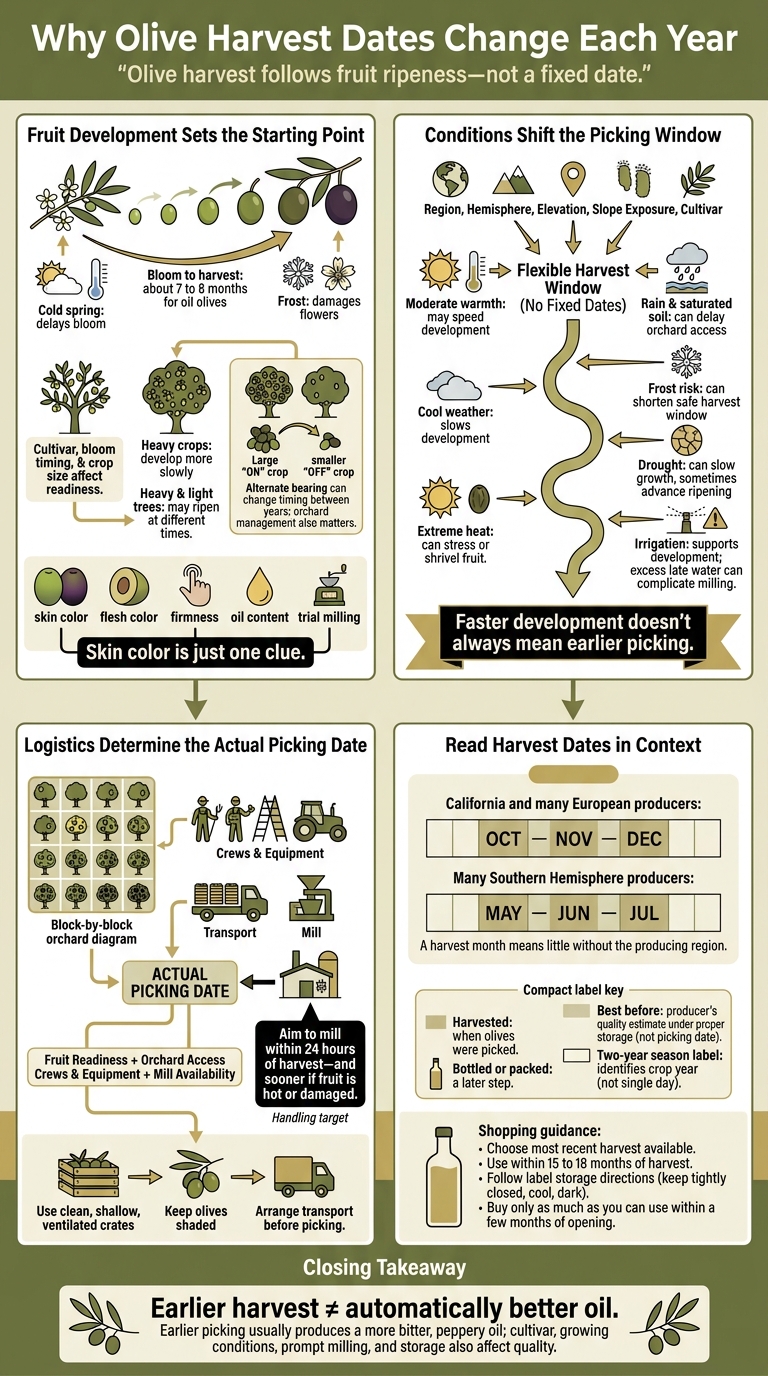
Why Olive Harvest Dates Change Each Year
Fruit Maturity, Crop Load, and Bloom Timing
How Growers Judge Olive Readiness
Skin color is just one clue. Growers also check cultivar, firmness, and oil content, and consider whether the olives are destined for oil or table use. A maturity index scores sampled olives by skin and flesh color, drawing samples from different trees and sun exposures.
Trial milling helps growers assess yield and flavor. Waiting longer may increase yield but lower phenolics, reducing bitterness, pepperiness, and stability. The best picking window balances yield, flavor, and fruit condition. Readiness can still vary by block because of crop load and bloom timing.
How Crop Load Affects Ripening
A heavily loaded tree spreads its water, sugars, and minerals among more olives. Its fruit may stay smaller and develop more slowly, especially during heavier crop years. Heavy and light trees in the same orchard may not ripen together, so growers should compare both before deciding the whole orchard is ready.
Olives can also show alternate bearing: a large “ON” crop followed by a smaller “OFF” crop. Heavy crops can limit new shoot growth and flowering opportunities the following spring. Pruning, nutrition, irrigation, and tree health all shape this cycle. That makes last year’s picking date a poor guide for this year and helps explain why harvest timing can differ within one orchard.
How Bloom Timing Affects Harvest
Flowering and fruit set start the fruit-development timeline. Cold spring weather can delay bloom, while frost can damage flowers and leave fewer olives to develop. Oil olives usually need about 7 to 8 months from bloom to harvest.
That’s a guide, not a fixed schedule. Growers track bloom dates, then reassess the fruit as summer weather, water supply, crop load, and their maturity target shape its progress. After bloom, weather and water supply determine how quickly the fruit finishes.
sbb-itb-4066b8e
Region, Weather, and Water Supply
Why Harvest Seasons Vary by Region
Harvest timing depends on the hemisphere, region, elevation, slope exposure, and cultivar. A harvest month means little without the producing region. Even when fruit is ready, labor availability and mill access can shift the picking date.
Growers start with local records, then check conditions in the current season.
| Factor | Typical effect on maturity or harvest | What growers monitor |
|---|---|---|
| Regional climate | Latitude, elevation, exposure, and cultivar shift harvest timing. | Local climate, cultivar, past maturity dates. |
| Temperature | Moderate warmth may speed development; cool weather slows it; extreme heat can stress trees. | Daily highs and lows, heat waves, fruit condition. |
| Rainfall | May delay picking by limiting orchard access. | Forecasts and orchard access. |
| Frost | Can damage fruit and shorten the safe harvest window. | Freeze forecasts and fruit injury. |
| Drought | Can slow fruit growth; sometimes advances ripening. | Tree stress, fruit drop, shriveling. |
| Irrigation | Supports development; excess late water can complicate milling. | Irrigation, crop stage, tree response. |
| Soil moisture | Dry soil increases stress; saturated soil can delay access. | Root-zone moisture, soil type, drainage. |
How Heat, Rain, and Frost Affect Picking
Faster development doesn't always mean earlier picking. Moderate warmth can bring maturity forward, while extreme heat and dry winds may stress or shrivel fruit. Rain can delay harvest for a simpler reason: machinery can't enter muddy ground, even when the olives are ready.
Frost risk or disease pressure during wet weather may prompt growers to pick sooner. Frost-damaged olives can deteriorate and become unsuitable for high-quality oil, so waiting for more ripeness may not be worth the risk. Before a storm or cold spell, growers weigh fruit health, orchard access, and how much safe picking time remains.
How Drought and Irrigation Affect Olives
Olive trees tolerate drought, but the crop still needs water. Severe water stress during flowering and fruit set can reduce yield. Later shortages can limit fruit growth and oil accumulation.
Growers check moisture at different depths in the root zone and adjust irrigation based on rainfall, soil drainage, and tree condition. They avoid heavy watering right up to harvest because too much late irrigation can increase fruit moisture and make milling harder. Irrigation cutbacks must suit the orchard, not a fixed calendar. Even ready fruit may have to wait if crews or mill time are limited.
Olive harvest: When and How to Harvest Olives for High Quality Products
Labor, Equipment, and Mill Scheduling
Fruit maturity helps determine when to harvest, but crew availability and mill access set the actual picking date.
Why Orchards Are Picked on Different Dates
Growers usually schedule harvest block by block because fruit ripens at different rates and access varies. They may pick an easy-to-reach block first and leave harder-to-reach fruit until conditions improve. Even ripe fruit may have to wait when crews or mills are booked.
Book mill time before picking. Confirm receiving hours and the minimum delivery size so olives can move quickly from orchard to mill. For each block, record maturity observations, expected yield, road access, equipment needs, and the preferred mill date. Match harvest volume to mill capacity to reduce the time fruit spends waiting after harvest.
Why Prompt Milling Matters
Picked olives spoil fast. They continue releasing heat and may soften or ferment while waiting. Bruising, deep heaps, and poor ventilation add to the risk. Aim to mill within 24 hours of harvest - and sooner if fruit is hot or damaged.
Use clean, shallow, ventilated crates and keep olives in the shade. Avoid sealed bags and tightly packed piles. Arrange transport before picking begins so fruit doesn't sit waiting for a truck. Prompt handling protects the olives’ aroma and limits fermentation defects.
What to Check on Olive Oil Labels
Harvest dates vary by season. The label is your fastest guide to how recently the oil was made and how to store it.
Why Earlier Harvest Does Not Always Mean Better Oil
An earlier harvest simply means the olives were picked sooner. It doesn’t guarantee fresher or better oil. Cultivar, growing conditions, and handling after harvest all affect quality. Even oils from the same region can have different harvest dates and quality levels.
Match flavor to the dish: robust oils suit beans, greens, grilled bread, and soups; milder oils suit baking and delicate foods.
Look for tasting notes and cultivar details when available. Harvest month alone won’t tell you how an oil tastes. To judge how recently it was made, the harvest date matters more than its color or packaging date.
How to Read Harvest Dates
Check the label for the exact harvest season, origin, and storage directions, along with the cultivar or blend and extra virgin grade. The date terms tell you different things: harvested means when the olives were picked; bottled or packed refers to a later step. Best before is the producer’s estimate of quality under proper storage - not the picking date. If there’s no harvest date, you have less information about the oil’s age, but that alone doesn’t mean poor quality.
Read the date together with the origin. California and many European producers commonly harvest from October through December. Many Southern Hemisphere producers harvest mainly from May through July. A two-year season label identifies the crop year, not a single picking day. Choose the most recent harvest available and use the oil within 15 to 18 months of harvest.
Follow the label’s storage directions. Keep the container tightly closed in a cool, dark place, away from heat and light. Buy only as much as you can use within a few months of opening. Dark glass and tins help block light, but neither protects oil left beside a hot stove.
Conclusion: Each Season Shapes the Harvest
Olive harvest dates vary because the fruit ripens differently each season.
For shoppers, prompt milling tells you more about freshness than the harvest date alone. Fruit that sits for days before milling can lose quality. Read the date alongside the harvest timing, milling speed, and how the oil was handled and stored.
FAQs
Does a later harvest signal growing problems?
Not always. In some regions, fruit naturally needs more time to ripen and develop specific flavors. But delays past peak maturity can point to problems with growing conditions or farm operations.
Fruit left on trees too long is more prone to pests, early fruit drop, and rot. Harvest delays can also increase oil acidity, reduce antioxidants, and lower overall quality. Harvesting late gives trees less time to recover before spring flowering, which may reduce future yields.
Can the same oil taste different each harvest?
Yes, the same olive oil can taste different from one harvest to the next. It’s a natural product, so each season’s weather, rainfall, and temperature strongly affect its flavor, aroma, and nutritional profile.
Even with the same olive variety, harvest timing matters. Picking olives early, mid-season, or late can greatly change the oil’s flavor - from bold and peppery to milder, buttery, or floral.
How can I check freshness without a harvest date?
Let your senses guide you. Warm a small amount of olive oil in your hand to release its aromas, then smell for notes of newly cut grass or herbs. Taste for fruitiness, bitterness, and a clear peppery finish - signs of high-quality oil that’s still at its best.
Big Horn Olive Oil’s ultra-premium extra virgin olive oils are cold-pressed shortly after harvest to preserve their delicate flavors and health-supporting antioxidants.