

How AI Tracks Olive Oil Origins
AI is transforming how olive oil's journey is verified - from grove to bottle - by creating detailed, data-driven records. It replaces error-prone manual methods with tools like OCR, IoT sensors, and blockchain to ensure accuracy and transparency. Here's what you need to know:
- Farm-Level Data: AI digitizes and organizes information like grove location, olive type, and harvest methods, even from handwritten notes.
- Milling & Processing: Tracks crushing dates, temperatures, and DNA markers to confirm oil origins and quality.
- Logistics & Bottling: Monitors shipping conditions (e.g., temperature, light) and ensures accurate labeling through real-time checks.
- Fraud Detection: Identifies inconsistencies using spectroscopy and genetic analysis, preventing common fraud like mislabeling or adulteration.
- Consumer Tools: QR codes let buyers verify details like harvest year, acidity levels, and lab results in seconds.
AI not only improves traceability but also builds trust by connecting every production detail to the final product. Producers like Big Horn Olive Oil use these systems to back their quality claims with verifiable evidence, ensuring confidence for consumers.
How AI Collects Data Across the Olive Oil Supply Chain
Data Collection at the Farm Level
AI-powered traceability begins well before olives are pressed into oil. At the farm level, these systems collect and organize a variety of data points - such as grove location, altitude, cultivar type, irrigation practices, and whether the olives were hand-picked or cultivated using regenerative methods. This data is then standardized into a digital format, making it easy to search and verify.
However, much of this information doesn’t start out as clean, digital data. Farmers often rely on handwritten harvest notes or scanned PDFs of intake sheets, which can be tough to process. AI steps in here, using Optical Character Recognition (OCR) and classification models to extract meaningful data from these unstructured sources. It even flags inconsistencies, like a milling date that’s somehow recorded before the harvest date.
AI goes beyond just digitizing documents. With niche-topic tagging, it highlights specific details that might otherwise be overlooked in manual records. Tags such as "mountain grove" or "low-yield lot" help craft a richer provenance narrative, which can be essential for supporting claims about premium products.
Tracking During Milling and Processing
Once the farm-level data is collected, AI shifts focus to the milling and processing stages. It tracks critical production details, including crushing dates, malaxation temperatures, filtration methods, storage tank IDs, and lab results. All of this information is digitized and connected to the corresponding batch.
One standout innovation here is portable DNA authentication. The Watson Project, led by the Institute of Biosciences and BioResources (Consiglio Nazionale delle Ricerche) in Italy and Greece, integrates AI with DNA testing at the mill itself. As the project explains:
"Using portable DNA technology, mill operators can instantly confirm that the oil in the storage tank really comes from the declared batches of olives."
AI also uses niche-topic tagging during this phase, identifying processing characteristics like "cold extracted", "stone mill", or "unfiltered." These details are crucial for distinguishing premium extra virgin olive oil (EVOO) from standard products.
Logistics and Bottling Data Integration
AI doesn’t stop at processing - it continues to ensure traceability through bottling and logistics. During bottling, computer vision systems check fill levels, cap integrity, and label alignment in real time, catching any quality issues before the bottles are shipped.
In transit, AI tracks environmental conditions such as temperature, light exposure, and oxygen levels using sensor data. These factors are critical because freshness is a key predictor of premium EVOO’s quality. If a shipment is exposed to extreme heat or spends too much time in a warehouse, AI flags the batch for priority handling or additional inspection.
All this data ties back to a single lot identity, creating what Daniel Mercer, Senior SEO Content Strategist, calls a "continuous chain of evidence":
"A well-designed provenance dashboard turns scattered records into a living trust layer, showing where the fruit was grown, how it was milled, tested, blended, packaged, and shipped."
The outcome? A supply chain where every detail - from grove altitude to shipping container temperature - is fully linked, auditable, and traceable to an individual bottle of olive oil.
sbb-itb-4066b8e
How AI Verifies Olive Oil Origins and Detects Fraud
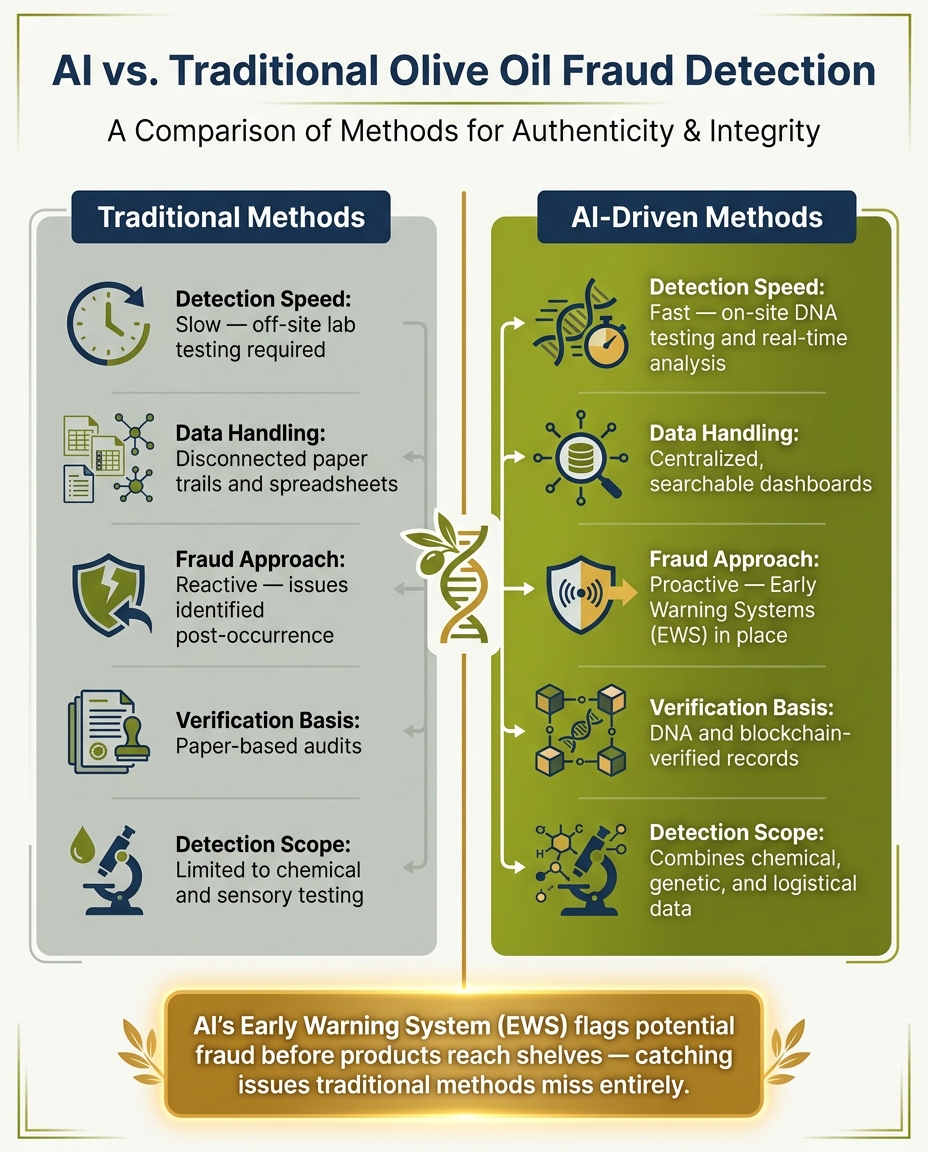
AI vs. Traditional Olive Oil Fraud Detection: Key Differences
AI Methods for Origin Verification
AI plays a critical role in ensuring that the contents of olive oil bottles match their labels, using advanced methods to prevent fraud. By analyzing data from farms, mills, and logistics, it verifies authenticity with precision.
One key tool is Spectroscopy AI, which examines spectral data and compares it to reference profiles. This process identifies adulteration, oxidation, or chemical inconsistencies in the oil. If the spectral signature deviates from what’s expected for the declared origin, the system flags it for further review. Another method, Portable DNA authentication, checks the olives’ genetic markers against the claimed harvest region and variety. This allows for on-site verification at production sites like mills. Together, these techniques provide a strong framework for confirming the authenticity of olive oil.
These methods also lay the groundwork for identifying specific fraud patterns within the industry.
How AI Spots Common Fraud Scenarios
Once origin verification is complete, AI dives deeper to detect fraud patterns. The olive oil industry has recurring fraud issues, such as blending premium extra virgin olive oil (EVOO) with cheaper oils, misrepresenting geographic origins, or labeling incorrect olive varieties.
To combat origin fraud, AI cross-references harvest data and genetic profiles with the claimed production region. For instance, if an oil is marketed as coming from a renowned Italian hillside grove but its DNA profile suggests otherwise, the system raises an alert.
"Traditional detection methods are slow, costly and mostly lab-based, fraud often stays hidden." - Watson Project
AI also scrutinizes premium claims using niche-topic tagging. Labels like "early harvest", "mountain grove", or "low-yield lot" are compared against machine-readable production records to ensure they align with actual data.
Fraud Detection: Traditional Methods vs. AI
Traditional fraud detection methods relied heavily on periodic lab tests, paper certificates, and sensory panels - processes that were slow and reactive. AI, on the other hand, integrates data from various sources and provides continuous, real-time monitoring, offering a more efficient and predictive solution.
| Feature | Traditional Methods | AI-Driven Methods |
|---|---|---|
| Detection Speed | Slow; off-site lab testing required | Fast; on-site DNA testing and real-time analysis |
| Data Handling | Disconnected paper trails and spreadsheets | Centralized, searchable dashboards |
| Fraud Approach | Reactive; issues identified post-occurrence | Proactive; Early Warning Systems (EWS) in place |
| Verification Basis | Paper-based audits | DNA and blockchain-verified records |
| Detection Scope | Limited to chemical and sensory testing | Combines chemical, genetic, and logistical data |
The Early Warning System (EWS) is a standout feature of AI-driven methods. This system analyzes both historical and real-time supply chain data, flagging potential fraud before products hit the shelves. By catching issues early, AI helps safeguard both consumers and producers.
"In olive oil, the most valuable AI tools do not just make a score. They explain why a batch was scored that way, what data supported the result and what action the user should take next." - Natural Olive
How Real-Time AI Analytics Improve Transparency
Real-Time Monitoring for Producers and Retailers
AI-powered provenance dashboards bring together data from mill logs, lab sheets, and shipping documents into a single, constantly updated system. This eliminates the hassle of tracking down paper records. These dashboards monitor essential details like grove location, harvest timing, milling dates, storage conditions, and packaging processes. They also flag any inconsistencies as they happen. Predictive tools take this a step further by analyzing factors like shipping routes, container temperatures, and warehouse delays to estimate quality changes and oxidation risks during transport. This system builds on existing traceability frameworks, ensuring that every bottle maintains its quality and authenticity.
"Trust becomes tangible when a buyer can verify an oil's origin, quality, and handling in seconds." - Daniel Mercer, Senior SEO Content Strategist
Consumer Transparency Through QR Codes
Producers aren’t the only ones benefiting from real-time monitoring - consumers gain access to verified production details too. QR-coded digital passports make AI insights accessible, offering a quick way for buyers to learn about an oil's journey. A simple scan reveals information like the harvest year, free acidity levels, peroxide values, polyphenol content, and even sensory notes like "peppery" or "grassy." These details are backed by independent lab certifications and precise harvest timestamps, letting consumers confirm an oil’s origin and quality in less than 10 seconds.
How Big Horn Olive Oil Uses AI for Consumer Trust
Big Horn Olive Oil provides a great example of how digital transparency builds trust. The company ensures its oils are cold-pressed within two hours of harvest - a claim verified by AI traceability. By integrating mill sensor data into a consumer-facing dashboard, Big Horn guarantees its oils never exceed critical temperature limits during extraction. Each digital lot record includes independent lab certificates confirming polyphenol levels and bottling dates for products like Coratina Extra Virgin Olive Oil and Picual Extra Virgin Olive Oil. This system turns freshness, one of Big Horn's standout qualities, into concrete, verifiable data that consumers can rely on.
Challenges and Future Directions for AI in Traceability
Current Challenges in AI Traceability
Even with advancements, applying AI to traceability comes with hurdles. A major issue is data fragmentation - provenance data often exists in scattered formats, making it tough for AI to create a clear and accurate view of a product's journey.
Another problem is the frequent errors caused by manual data entry at various points in the supply chain. Daniel Mercer, Senior SEO Content Strategist, highlights this concern:
"The biggest mistake is letting AI create confidence where the underlying data is weak."
High costs also pose a barrier, particularly for small-scale producers and cooperatives that can't afford sophisticated sensors or AI systems. Additionally, while transparency is essential, producers must navigate the tricky balance of sharing information without exposing sensitive details like supplier names, production volumes, or pricing.
Overcoming these obstacles is critical to unlocking the full potential of AI in traceability.
Future AI Developments for Olive Oil Traceability
The industry is shifting from basic barcode systems to Traceability 4.0, a smarter, automated framework that combines IoT sensors, AI analytics, and blockchain. This new system introduces five key layers - identity, sensing, intelligence, integrity, and interaction - to enhance the accuracy and transparency of tracking olive oil origins.
Here are some promising advancements that could redefine traceability:
- Automated document verification: AI can extract data from scanned documents like invoices, lab results, and handwritten harvest notes, mapping them to a unified format and reducing manual errors.
- Sensor fusion: Real-time data from environmental sensors - tracking factors like temperature, light, and oxygen - can integrate with AI to ensure oil quality is maintained during transit.
- Explainable AI (XAI): Future systems will allow producers to trace back specific claims to the exact data points that support them, ensuring transparency and trust. For example, if a lot is labeled "single estate" or "early harvest", the producer can review the reasoning behind that classification.
"AI in provenance must be explainable enough to survive scrutiny. If a model classifies a lot as 'single estate' or 'early harvest,' the producer should be able to see why that label was assigned." - Natural Olives
How Big Horn Olive Oil Can Apply Future AI Advances
For Big Horn Olive Oil, these innovations present exciting opportunities to enhance their existing traceability system. Their dedication to cold-pressing olives within two hours of harvest and delivering fresh oil within three months already provides a solid foundation of clean, time-stamped data - exactly what advanced AI systems need to deliver accurate results.
As AI-powered document classification improves, Big Horn could seamlessly digitize harvest notes and lab results, creating standardized records for products like their Coratina and Picual Extra Virgin Olive Oils. Looking further, predictive quality monitoring could analyze shipping conditions and routes, flagging potential oxidation risks before the oil reaches customers. These advancements would strengthen their traceability efforts, ensuring that their promise of freshness is backed by verifiable data.
Conclusion: AI's Role in Olive Oil Traceability
AI has transformed traceability from simple batch numbers and general claims into a detailed, data-driven process. By combining information like harvest schedules, milling records, lab analyses, and shipping details, AI creates a comprehensive, step-by-step record of olive oil production. This evolution not only ensures quality but also strengthens trust in the market.
The advantages extend beyond ethics - they’re also commercially impactful. Trust built on verifiable data adds value to both the product and the brand.
For producers like Big Horn Olive Oil, traceability isn’t just about meeting regulations - it’s a core feature of their product. Their focus on timely cold-pressing generates precise, timestamped data that supports full transparency. By linking this information to consumer-friendly tools, such as QR codes that provide access to lot-specific origin details and independent lab results, they turn claims of freshness into proven quality.
The foundation laid by today’s reliable data opens doors to even smarter traceability systems in the future. The path forward is clear: standardize data, integrate AI effectively, and keep human oversight in the loop. When done right, traceability doesn’t just guard against fraud - it supports premium pricing, fosters customer loyalty, and, as James Thornton, Senior SEO Content Strategist, explains, delivers value that goes far beyond automation:
"In food categories where provenance and freshness matter, the commercial payoff of AI is often less about 'automation' and more about reducing uncertainty at every stage of the buying journey."
For consumers, the key is to look for specific details - like batch codes, grove names, and certificate numbers - instead of vague promises. Thanks to AI, these specifics are now possible, and producers who adopt these practices are the ones worth trusting.
FAQs
What proof does AI use to confirm an olive oil’s origin?
AI can determine where olive oil comes from by examining its chemical makeup. Using advanced spectroscopy, it analyzes elements like phenolic compounds and sterols. This creates a distinct molecular profile, which helps confirm the oil’s origin and ensure its authenticity.
How can shoppers verify traceability with a QR code?
Shoppers can use their smartphones to scan a QR code and instantly access a secure digital record detailing the olive oil's journey. This record provides key information such as the product's origin, harvest dates, processing methods, quality certifications, and storage conditions. To ensure the data remains secure and trustworthy, many systems rely on blockchain technology, which prevents tampering and guarantees authenticity.
What are the biggest limits of AI traceability today?
AI traceability in olive oil production isn’t without its hurdles. For starters, data quality is a big deal. AI systems need clean, accurate, and complete data to function properly. If the data is messy or incomplete, the results can’t be trusted.
Then there’s the issue of interpretability. AI models often work like black boxes, which makes it hard for producers and regulators to fully understand how decisions are made. This lack of transparency can create skepticism or hesitation in adopting the technology.
And let’s not forget about security and costs. Safeguarding sensitive data is a must, but it’s no small task. On top of that, implementing AI can be expensive, which is a tough pill to swallow for smaller producers who may not have the same resources as larger companies.
To tackle these challenges, strong data management practices and tight security protocols are absolutely essential. Without them, it’s hard to make AI solutions reliable and accessible for everyone in the industry.