

Bajo Aragón Olive Oil: Historical Roots
Bajo Aragón Olive Oil is a premium extra virgin olive oil from northeastern Spain, holding PDO (Protected Designation of Origin) status since 2000. Known for its smooth, sweet flavor with almond notes, it primarily uses the Empeltre olive (80% minimum), complemented by Arbequina or Royal varieties. The oil’s golden hue and mild taste distinguish it from other oils.
Key Highlights:
- Geography: Produced in the Bajo Aragón region (Teruel and Zaragoza), characterized by a dry Mediterranean climate, limestone-rich soils, and the Cierzo wind.
- History: Olive cultivation dates back 3,000 years, influenced by Phoenicians, Greeks, Romans, and later Muslim farmers.
- Economic Role: Olive farming has supported rural families for generations, with 60% of farms still family-run.
- Modern Standards: PDO certification ensures strict quality controls, preserving traditional methods while incorporating modern practices.
Bajo Aragón olive oil is celebrated for its mild flavor, versatility, and rich history, making it a staple in Mediterranean cuisine and beyond.
Ancient Origins of Olive Cultivation in Bajo Aragón
How Phoenicians and Greeks Brought Olive Trees to Iberia
The story of olive cultivation in the Iberian Peninsula goes back about 3,000 years, starting with the arrival of Phoenician traders who introduced domesticated olive varieties to coastal areas. Before this, wild olives - known as oleasters - were already growing naturally across the Mediterranean and had been gathered by locals since the Neolithic period. However, these wild olives were unreliable for oil production due to their inconsistent yields. The Phoenicians, and later the Greeks, changed the game by bringing cultivated varieties specifically bred for higher oil yields and better quality.
These ancient traders also introduced "oriental" methods for producing olive oil, which local farmers quickly adapted to their own techniques. This fusion of knowledge laid the groundwork for early pre-industrial machinery in the region.
"The culture of the olive exceeded the eastern boundaries of the sea and expanded to the west... with the collaboration of humans and nature." - Generosa J. Calabrese
Local farmers took things a step further by crossbreeding imported olive varieties with native wild populations, creating hybrid trees better suited to the diverse landscapes of the Iberian Peninsula. Archaeological finds, such as the Pellicer D amphorae - modeled after Phoenician designs - provide tangible evidence of how deeply these trade networks influenced local production methods.
These early advancements paved the way for the Romans, who would later revolutionize olive cultivation in the region.
Roman Expansion of Olive Groves in the Ebro Valley
During Roman rule, olive cultivation expanded inland, particularly into the fertile Ebro Valley. The Romans, known for their organizational prowess, developed efficient land and river transport systems, allowing agricultural surpluses from inland groves to be transported quickly and cost-effectively to coastal ports. They also standardized containers like the Dressel 20 amphora, which was designed for easy stacking and river transport, further streamlining the process.
The Romans introduced the rotary mill, a major innovation that boosted production efficiency. By the 1st century AD, archaeological evidence reveals the presence of large-scale oil-pressing facilities in the region, showcasing how Rome industrialized what had previously been a smaller-scale, localized practice.
Even after the fall of Rome, olive cultivation in Bajo Aragón continued to evolve, adapting to the changing times.
Olive Cultivation Through the Medieval Period
With the decline of Roman influence, olive growing in Bajo Aragón adapted to new circumstances. During the era of Al-Andalus, Muslim farmers introduced advanced techniques, including animal-driven mills, portable hand presses, and sophisticated irrigation systems to maintain olive groves in arid conditions.
After the Christian Reconquista, the region saw a gradual shift in agricultural priorities. Olive cultivation expanded across the landscape, increasingly replacing cereal crops as the region began to specialize in olive oil production. By the 15th century, production had grown enough to support trade with France and neighboring Castile, signaling that Bajo Aragón’s olive oil had become a commercial product rather than just a local staple.
The oil was stored in large clay jars called tinajas, with towns like Calanda becoming well-known for producing these vessels using high-quality local clay. By this time, the Empeltre olive - the variety now synonymous with the Bajo Aragón PDO - was already a key player. Historical records from 1640 describe it as a "grafted" variety, indicating that its roots in the region go back even further.
sbb-itb-4066b8e
Olive Oil's Role in Bajo Aragón's Economy and Daily Life
How Olive Cultivation Supported Rural Families
In Bajo Aragón, olive cultivation has been a cornerstone of rural life. For many families, the olive harvest provided essential work during the winter when other crops were dormant, helping to address seasonal labor shortages.
Today, about 60% of farms in the region remain family-run, with many managing small plots of less than 2.5 hectares (approximately 6.2 acres). To reduce financial risks, these families often grew additional crops like almonds, cereals, and peaches, creating a more stable income stream.
Local governments also played a role by offering cash incentives for planting olive saplings. This support encouraged long-term grove management and created opportunities for generational wealth. By 1929, the town of Calaceite alone boasted 34 oil factories, generating an impressive annual income of 1,600,000 pesetas from olive production.
"The figure of the olive tree... has played an important role over the years in the development of the economy of this region, exerting a decisive influence on the life and customs of its peoples." - Olive Tree Seminar, 1983
This strong foundation in cultivation paved the way for advancements in olive oil processing.
Milling Practices and the Rise of Cooperatives
Processing olives in Bajo Aragón was historically a labor-intensive task. Early methods involved molinos de sangre ("blood mills"), where animals powered a heavy stone to crush the olives. The resulting paste was pressed using massive wooden beam presses, some as long as 66 feet, with counterweights weighing up to 6,600 pounds. One notable example is the Jaganta Mill in Castellote, Teruel, a 17th-century mill that remained operational with minimal changes until 1942.
A significant shift came in 1866 when French manufacturing techniques were introduced, improving the clarity and reducing the acidity of the region’s olive oil. By the early 20th century, electric power and metal hydraulic presses replaced the traditional animal-driven systems. Around this time, international buyers from cities like Marseille, Nice, and Genoa began purchasing high-quality oil directly from producers in Alcañiz.
The olive oil industry also saw advancements through collective efforts. On December 17, 1996, 11 founding members formed the Association for the Defense and Promotion of Bajo Aragón Olive Oil (A.D.A.B.A.). This group focused on joint purchasing, quality training, and promoting the region’s oils. Their work contributed to the establishment of the Protected Designation of Origin (PDO) "Aceite del Bajo Aragón" around 2000–2001, standardizing production across 77 municipalities in Teruel and Zaragoza.
Beyond production, olive oil became a vital part of daily life in the region.
The Many Uses of Olive Oil in Historical Bajo Aragón
In Bajo Aragón, olive oil was far more than a kitchen staple - it played a key role in various industries and daily activities.
One of its most prominent uses was in soap production. It was also essential for the fish canning industry and for preserving table olives through a process called aderezo. Additionally, olive oil had medicinal and cosmetic applications, a tradition rooted in practices from the Arabic period. José Antonio Benavente Serrano, an archaeologist and coordinator at the Taller de Arqueología de Alcañiz, highlighted this broader significance:
"It is about valuing the cultivation of the olive tree in Bajo Aragón from its origins to the present day, reviewing its different uses, which are not only culinary."
The olive oil economy also supported local trades, symbolizing protection and order in the community. From its historical uses to its role in shaping modern identity, olive oil remains a vital thread in the fabric of Bajo Aragón’s culture and economy, a legacy that continues to thrive.
PDO Status: Preserving History Through Modern Standards
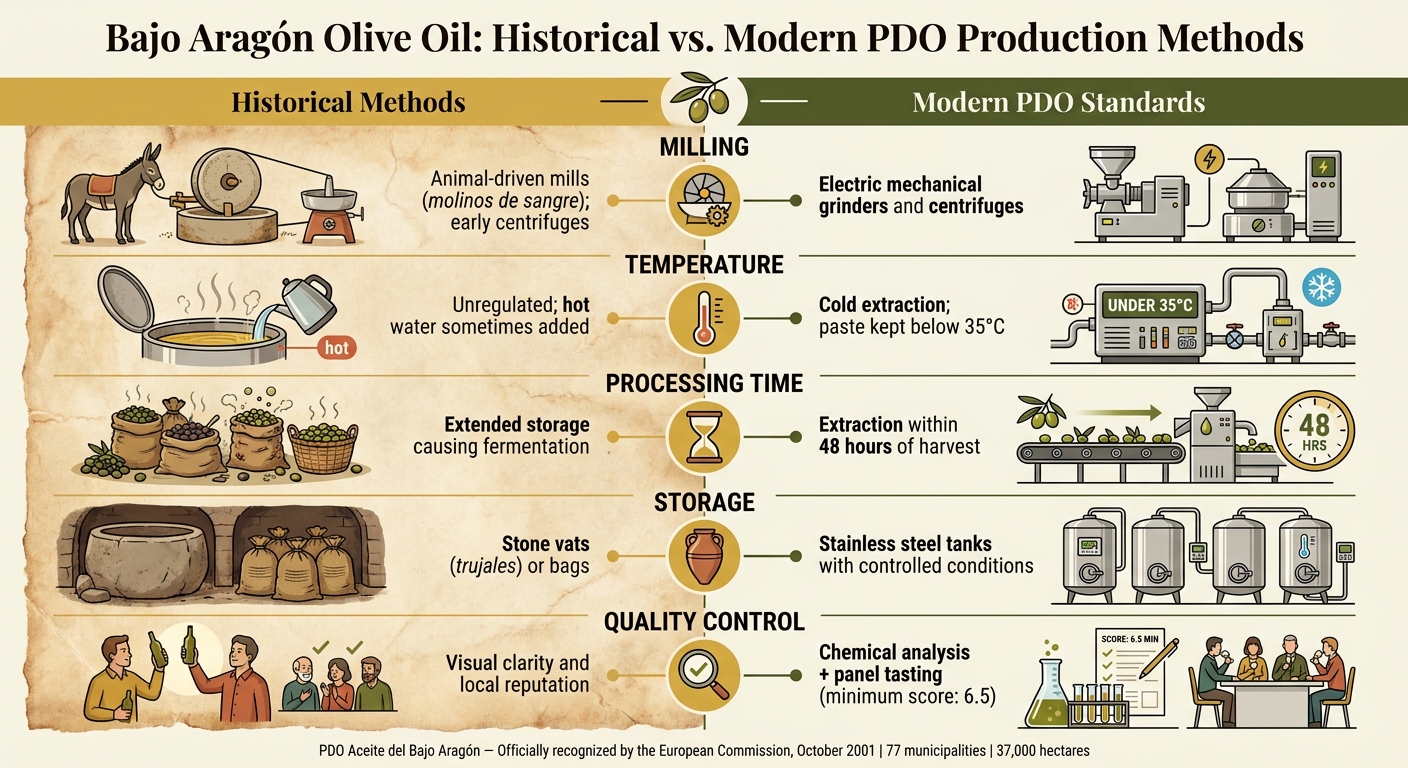
Bajo Aragón Olive Oil: Historical vs. Modern PDO Production Methods
Historical Grounds for PDO Recognition
The Aceite del Bajo Aragón PDO is rooted in centuries of tradition. The native Empeltre olive variety, described as "grafted olive trees", appeared in regional records as early as 1640. By 1918, the traditional hand-harvesting method known as ordeño - a gentle "milking" of the olive branches - was recognized as a quality standard in Alcañiz. These practices established a strong historical foundation for the PDO's legitimacy. Officially established in June 1999, it gained full recognition from the European Commission in October 2001. Today, the PDO protects 37,000 hectares across 77 municipalities in Teruel and Zaragoza - an area the Romans once called "oleum flumen" or "oil river". These historical practices have provided the basis for the modern quality standards upheld today.
Historical vs. Modern Production Methods
While the PDO preserves the essence of traditional olive oil production, it has modernized methods that once compromised quality. A significant shift involves processing time and temperature control. In the past, olives were stored for long periods before milling, which caused fermentation and higher acidity levels. Today, PDO standards require that extraction occurs within 48 hours of harvest.
| Feature | Historical Methods | Modern PDO Standards |
|---|---|---|
| Milling | Animal-driven mills; early centrifuges | Electric mechanical grinders and centrifuges |
| Temperature | Unregulated; hot water sometimes added | Cold extraction; paste kept below 35°C |
| Processing Time | Extended storage causing fermentation | Extraction within 48 hours |
| Storage | Stone vats (trujales) or bags | Stainless steel tanks with controlled conditions |
| Quality Control | Visual clarity and local reputation | Chemical analysis and panel tasting (min. score: 6.5) |
Despite these updates, the PDO maintains purely mechanical extraction methods, avoiding chemical solvents and high-heat treatments. This approach mirrors the hand-pressed beam mills used in earlier centuries. These refinements ensure that traditional practices coexist with modern quality assurance.
How Cooperatives and Family Mills Operate Today
Small-scale, family-run farms remain the backbone of the PDO, with 60% of farms managing plots under 6.2 acres (2.5 hectares). For these producers, the PDO framework provides essential support that would be difficult to achieve independently. Today, 28 registered companies and mills operate under the Regulatory Council, collectively managing the region's 37,000 hectares. This collaborative structure respects age-old traditions while ensuring strict quality control.
Every registered mill keeps detailed records to trace each bottle of oil back to its specific plot and harvest period. Oils must be bottled within the PDO's 77 municipalities, using approved containers - glass, ceramic, metal, or PET - no larger than 1.3 gallons (5 liters).
In October 2025, the Government of Aragon and the PDO Regulatory Council celebrated the PDO's 25th anniversary in Alcañiz. During the event, PDO President Alfredo Caldú and Director General Amparo Cuéllar announced a new collaboration to strengthen the official tasting panel, Panel de Cata de Aceite de Oliva Virgen de Aragón. This panel ensures that every certified oil meets the region's rigorous flavor and quality standards.
"Celebrar el 25 aniversario de la DOP Aceite del Bajo Aragón es recordar todo lo logrado por nuestros productores y equipos a lo largo de estos años, reafirmando nuestro compromiso con la calidad, la innovación y la sostenibilidad." - Amparo Cuéllar, Director General of Agri-Food Innovation and Promotion
Bajo Aragón Olive Oil's Legacy and Global Reach
Olive Oil in Aragonese Festivals and Food Traditions
In Bajo Aragón, olive oil isn't just a kitchen staple - it’s a cultural cornerstone. The annual Fiesta de la Almazara (Mill Festival) highlights this, rotating between towns each year to celebrate the region's deep-rooted oil traditions. It’s more than just a festival; it’s a way for communities to honor their shared heritage. Olive oil also takes center stage at major events like the Ham and Quality Teruel Foods Fairs and the Zaragoza Fair, showcasing its importance in the region’s identity and economy.
The traditions tied to olive oil go even further. During the harvest, workers would sing "oliveras" - traditional field songs like the plega de olivas - to keep their spirits high and maintain rhythm while working. Even today, olive branches are placed on windows and doors as symbols of protection, representing "order against chaos".
Flavor Profile and Use in the Kitchen
Bajo Aragón olive oil is celebrated for its mild and smooth character. The Empeltre variety, which makes up at least 80% of the region’s PDO-certified oil, produces a light, fluid oil with a natural sweetness and subtle fruity hints of almond and apple. What sets it apart is its complete lack of bitterness or harshness, making it a standout choice among olive oils. Its color, ranging from bright golden yellow to a rich "old gold", adds to its visual appeal.
This gentle flavor profile makes it incredibly versatile in the kitchen. It’s perfect as a finishing touch on salads or cold dishes and is equally prized for its low acidity (capped at 1.0%). Historically, it was often blended with more acidic oils from regions like Andalusia to create a balanced flavor. For U.S. home cooks who might find other olive oils too sharp or bitter, Bajo Aragón’s naturally sweet and mild taste is a fantastic option straight from the bottle. This distinctive profile has not only elevated local dishes but also helped establish its reputation worldwide.
Bringing Historical Olive Oil Styles to Today's Consumers
Bajo Aragón’s olive oil has a history of reaching beyond its borders. In the early 1900s, trading firms from Marseille, Nice, and Genoa sought out this oil in the Alcañiz market, drawn by its consistent quality and mild flavor. Fast forward to 2016, and certified sales hit 2,200,000 liters, with about 10% of all PDO Aceite del Bajo Aragón being exported internationally.
This growing global demand underscores the importance of preserving traditional production methods. Companies like Big Horn Olive Oil are committed to offering Ultra Premium Extra Virgin Olive Oils that stay true to these historical values. For consumers who care about authenticity and craftsmanship, this connection to the past makes all the difference.
Conclusion: The Lasting Impact of Bajo Aragón Olive Oil
Rooted in centuries of tradition, Bajo Aragón's olive oil stands as a testament to both cultural heritage and economic significance. Its foundation lies in the Empeltre olive, a native variety known for producing a naturally sweet, smooth oil with low acidity - an iconic feature of Mediterranean cuisine.
This legacy brought tangible economic benefits, attracting merchants from cities like Marseille, Nice, and Genoa, who set up warehouses in Alcañiz to access the oil's consistent quality. From small, family-operated farms to global recognition, Bajo Aragón olive oil has consistently upheld its reputation for excellence.
The PDO designation, officially recognized by the European Commission in October 2001, didn't establish this legacy - it safeguarded it. By ensuring adherence to traditional methods and maintaining high standards, the PDO certification guarantees that every bottle reflects the same distinctive qualities that have defined the region for generations.
For those who appreciate authentic flavors and a connection to history, Bajo Aragón olive oil provides a direct link to over 2,000 years of agricultural tradition. This rich heritage continues to shape the region's identity and influence its evolving story.
FAQs
What does the Bajo Aragón PDO label guarantee?
The Bajo Aragón PDO label ensures that the olive oil you’re getting is Extra Virgin and entirely produced, processed, and bottled within the region. This certification guarantees that only mechanical methods, such as grinding and pressing, are used to extract the oil, keeping its natural properties intact.
To meet the PDO standards, the oil must be made from at least 80% Empeltre olives, while Arbequina and Royal varieties are capped at 20%. This careful blend gives the oil its signature traits: a clear, golden-yellow hue and a smooth, mild flavor that’s incredibly pleasant to the palate.
How can I tell real Bajo Aragón oil from a non-PDO bottle?
To spot genuine Bajo Aragón olive oil, check for the Protected Designation of Origin (PDO) logo on the bottle. This guarantees the oil is Extra Virgin, crafted with at least 80% Empeltre olives, and originates from the designated region. The oil should have a clear appearance, a golden to deep gold hue, and a smooth, fluid taste with subtle almond undertones.
What foods pair best with mild Empeltre-based olive oil?
Mild Empeltre-based olive oil stands out for its smooth texture and sweet, nutty flavor, with subtle hints of almond and apple. Its gentle taste makes it an excellent choice for adding depth to dishes without dominating their flavors. It’s a fantastic match for salads, seafood, and baked goods, bringing a soft, fruity aroma to lighter recipes.