

Bouteillan Olive in Provence: Soil, Wind, Flavor
If you want the short answer: Provence changes Bouteillan oil through water stress, wind exposure, and pick date. In dry years or exposed sites, the oil often tastes greener and sharper. In warmer or more sheltered sites, and with a later pick, it usually turns softer and rounder.
I’d sum it up like this: soil controls water, the Mistral dries trees and ground, and ripeness shifts flavor. Bouteillan in Provence is not one fixed taste. It can move from grass, tomato leaf, green apple, and artichoke to pear, ripe almond, and softer fruit depending on the grove and the harvest window.
Here’s the whole article in plain English:
- Bouteillan is a Provençal olive variety tied to the Var and Haut-Var areas.
- Oil yield often falls around 15% to 25%, based on ripeness and soil moisture.
-
Soil type matters most when it changes rooting depth and water storage.
- Deep or fractured limestone can help roots reach water.
- Shallow stony soils tend to dry out sooner.
- Clay-limestone can hold more water, but heavy clay may slow drainage.
- The Mistral can top 62 mph (100 km/h) and may affect Provence for 90 to 130 days per year.
- Wind is a tradeoff: it dries the canopy after rain, but it also pulls more moisture from leaves and soil.
-
Harvest usually runs from late October into December.
- Earlier picks often mean greener, more bitter, more peppery oil.
- Later picks often mean rounder oil with pear-like notes and less bite.
- Growers watch fruit color, firmness, pit development, and shriveling before they pick.
-
Kitchen use follows style:
- Greener oils fit vegetables, beans, tomato dishes, and soups.
- Riper oils fit fish, shellfish, grains, mild cheese, and roasted vegetables.
My takeaway: Bouteillan reflects site conditions very clearly. Two bottles from the same part of Provence can taste quite different because of soil depth, slope, irrigation, wind exposure, and harvest date.
| Factor | Greener style | Rounder style |
|---|---|---|
| Site pattern | Cooler, drier, more exposed | Warmer, more sheltered |
| Soil water | Lower available moisture | More even moisture supply |
| Harvest time | Late October to early November | November to December |
| Common notes | Grass, tomato leaf, green apple, artichoke | Pear, ripe almond, softer fruit |
| Kitchen fit | Salads, legumes, grilled vegetables, soups | Fish, shellfish, grains, mild cheeses |
If you’re choosing a Bouteillan oil, I’d look at where it was grown, how exposed the grove was, and when the olives were picked. Those three details tell you a lot about what the bottle will taste like.
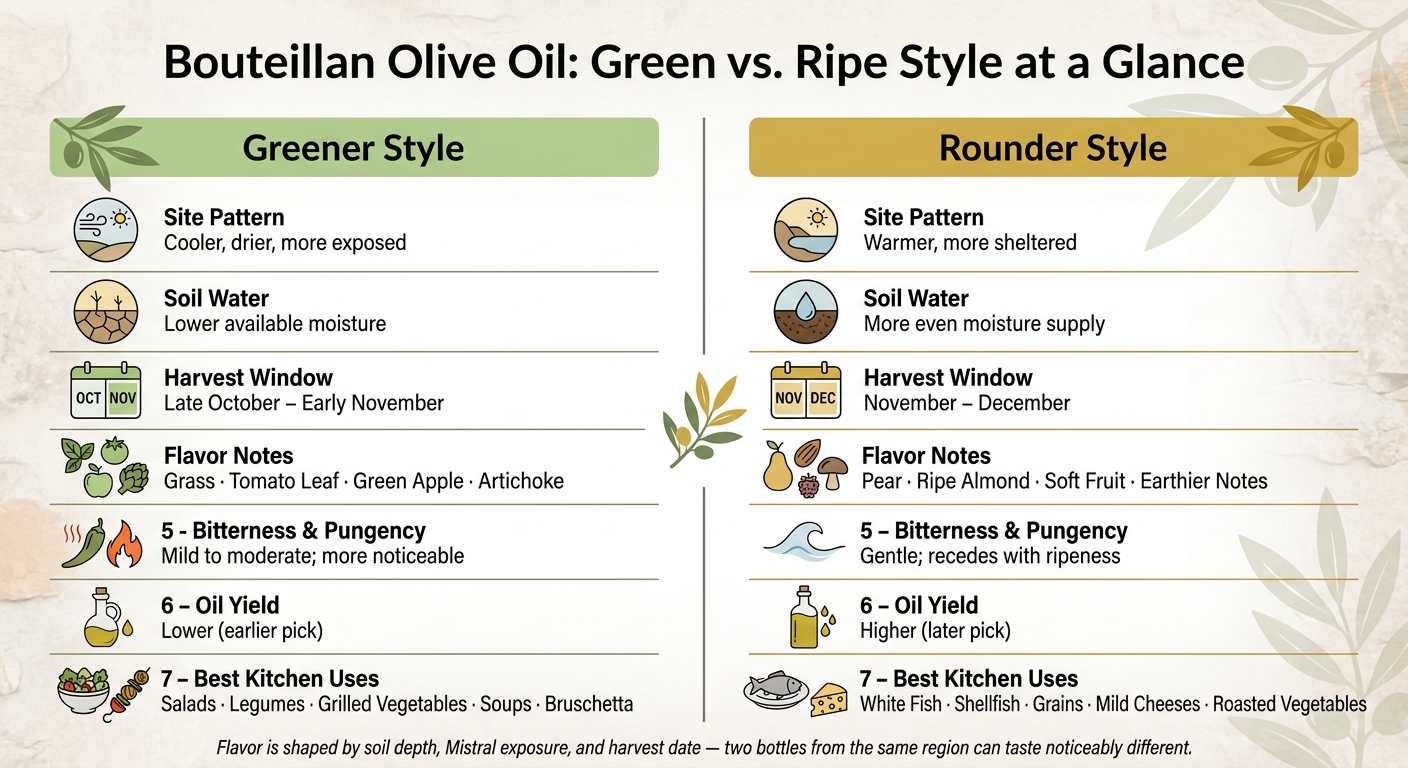
Bouteillan Olive Oil: Greener vs. Rounder Style Guide
AZUR & PREMIUM OLIVE OIL | Sustainable Olive Oils made by the sea | CHATEAU LÉOUBE
sbb-itb-4066b8e
Provençal Soils and What They Do to the Trees
Provence has several soil types, and Bouteillan doesn't act the same way in all of them. Groves may sit on limestone, clay-limestone, stony ground, or lower-slope alluvial and colluvial soils. Then you add slope, sun exposure, soil depth, ground cover, pruning, and irrigation, and the picture changes again. For Bouteillan, that can mean fruit development stays steady in one parcel and turns stressed in the next. Even neighboring blocks can behave very differently.
Limestone, Clay-Limestone, and Stony Ground
Limestone is common across Provence and often drains fast. When it's fractured or deep enough, roots can work their way down through cracks and crevices, helping trees tap into moisture during dry summers. Shallow limestone over bedrock is another story. Root space is limited, the soil dries sooner, and trees may show water stress earlier. So when people say "limestone", that alone doesn't tell you much. Depth and fracture patterns matter more.
Clay-limestone usually holds more water and nutrients than coarse, stony ground. That can help fruit development stay more even through summer. The trade-off is drainage. If the clay is heavy or compacted, water can linger too long, especially on flat land. On slopes or in parcels with good structure, clay-limestone tends to do better because water can move through the profile without sitting there.
Stony ground drains fast and warms up fast. That's good for cutting waterlogging risk. But stones also take up space that might otherwise hold fine soil, so the root zone stores less water. Shallow stony soils dry out quickly and can stress trees early. A deeper stony soil with a fine-earth matrix is a better setup: it still drains well, but it also keeps enough moisture in reserve to support fruit development.
Slope, sun exposure, and irrigation can change all of this in a hurry. A south- or southwest-facing stony slope may dry out faster than a cooler clay-limestone parcel, even though clay-limestone would usually hold more water. Ground cover, mulching, pruning, and weed control also shape how much water gets into the root zone and how long it stays there.
How Drainage and Moisture Shape Fruit Development
Drainage decides how long roots have access to oxygen and how fast water moves through soil after rain. That balance affects fruit size, tree vigor, and, in the end, oil style. The sweet spot is simple: enough air in the soil and enough stored water during the tree's active growth periods.
Olive trees are drought-tolerant, but they aren't drought-proof. One review notes that they can generally handle stress until roughly 70–75% of readily available soil water has been depleted, after which growth and fruit development are more noticeably affected. When water is short during cell enlargement, fruit size, flesh-to-pit ratio, and fruit number can all drop. Mature olive trees can also use a large soil volume when conditions allow. One Mediterranean study reports potential root depth of up to 3 meters and a water- and nutrient-extraction area of roughly 500 square meters per tree where soil conditions permit. Restrictive soils can shrink that range a lot.
| Soil condition | Drainage | Moisture retention | Root penetration | Likely effects on tree growth and fruit development |
|---|---|---|---|---|
| Deep or fractured limestone | Usually rapid to moderate, depending on fractures and soil depth | Low to moderate in the fine soil, potentially improved by deep cracks | Often deep where fractures are accessible | Balanced growth and relatively low waterlogging risk; drought response depends on rooting depth |
| Clay-limestone | Moderate to slow when clay content is high; better on slopes or well-structured ground | Moderate to high | Moderate; may be restricted by dense layers or compaction | More sustained summer growth when moisture is available, but excess water or poor aeration can weaken roots |
| Heavy or compacted clay-limestone | Slow or uneven | High total storage, but not all water is readily available | Restricted by dense layers and low aeration | Root stress after heavy rain, then drought stress if roots cannot access deeper layers; variable vigor and fruit development |
| Shallow stony soil | Rapid, especially on slopes | Low if fine soil volume is limited | Often restricted by bedrock, though roots may follow cracks | Early summer water stress, reduced shoot or fruit growth, and potentially faster stress-driven ripening in dry years |
| Deep stony soil with a fine-earth matrix | Moderate to rapid | Moderate, depending on the matrix | Moderate to deep | Good drainage with useful water storage; often more resilient than shallow stony soil |
Soil sets the starting point, not the outcome. Two Bouteillan orchards can both be labeled "limestone" and still perform in very different ways because of soil depth, fracture networks, slope position, and irrigation. That water pattern also affects how fast Bouteillan fruit moves toward harvest. These soil shifts set the level of moisture stress in the grove, and the Mistral can push that stress even further.
Mistral Wind, Dry Summers, and Orchard Exposure
That soil-based moisture balance gets a lot harder to manage under the Mistral. Bouteillan grows in a dry, sun-heavy Mediterranean climate. Provence has hot, dry summers and uneven rainfall, so irrigation matters for Bouteillan groves. The variety can handle drought to a point, but growers still lean on irrigation through summer.
In inland and higher-elevation groves, winter frosts and spring cold snaps add another layer of risk, especially for young trees. In Provence, orchard exposure shapes both heat stress and cold damage.
What the Mistral Changes in an Olive Grove
The Mistral is a cold, dry wind that funnels south through the Rhône Valley toward the Mediterranean. Strong events can go past 62 mph (100 km/h), and the wind can affect Provence for 90–130 days each year.
That kind of wind changes the grove in two ways at once. It dries the canopy and increases airflow, which can help after rain. But during hot, dry spells, it also pulls more water out of the system. Faster drying can reduce the long-lasting humidity that helps fungal and bacterial issues spread, though it doesn't remove disease risk. Bouteillan has reported moderate resistance to olive leaf spot but remains sensitive to olive fly, scale, and olive moth, so orchard monitoring is still needed no matter how windy the site is.
The same airflow that dries leaves also strips moisture from exposed soil. In hot, dry summers, repeated Mistral events can push water stress higher, especially in shallow or stony soils, young plantings, and orchards without steady irrigation. And here's the tricky part: a dry surface doesn't always mean the full root zone is dry. Moisture can still sit deeper down, so checking the root zone before irrigating is a better move than reacting to surface dryness alone.
Benefits and Risks of Wind Exposure
| Factor | More sheltered site | More exposed site |
|---|---|---|
| Airflow | Lower risk of mechanical damage, but stagnant air may hold humidity | Stronger ventilation and faster canopy drying after rain |
| Disease pressure | Can be higher if foliage stays wet and air moves slowly | Often lower canopy humidity, though wind alone does not prevent disease |
| Water stress | Less wind-driven evaporation, though summer drought still needs management | Higher demand; dry air and wind speed up moisture loss from leaves and soil |
| Fruit protection | Less abrasion, shoot breakage, and wind-related fruit drop | Higher risk of fruit drop, rubbing, shoot damage, and desiccation |
| Frost-related factors | Shelter may cut chilling and physical damage, but cold-air pooling can form in low spots | Moving air may reduce some frost conditions, but cold Mistral events can still injure flowers or young trees |
Use windbreaks that slow wind without blocking it. Keep canopies open and soil covered to limit evaporation and protect fruit through ripening.
Ripening Pace and Harvest Timing for Bouteillan
Soil moisture and the Mistral both push Bouteillan along in different ways, which is why harvest timing can vary quite a bit from one grove to the next. In Provence, this variety often ripens unevenly, so growers usually pick based on site conditions rather than a single fixed date. In most years, the harvest window runs from late October or early November into December, with elevation, orchard exposure, irrigation, crop load, and fall temperatures all shifting that timing. Château d'Estoublon, for instance, brings in Bouteillan from early November to mid-December across orchard blocks, a span of about six weeks.
Earlier vs. Later Harvest Flavor Profiles
Earlier-picked Bouteillan usually gives a sharper, greener oil. You’ll often find herbal, fresh-grass, tomato-leaf, green apple, or artichoke notes, plus more bitterness and pungency. Later-picked fruit, by contrast, tends to give a rounder, fruitier oil and can show a clear ripe-pear note.
There’s a tradeoff here. Earlier harvests usually produce less oil. Later fruit often gives more oil, but it also bruises more easily and needs to be milled sooner.
What Growers Watch Before Picking
As Bouteillan ripens, the fruit shifts from green → purple/burgundy → black. Domaine de La Baume says it harvests at the purple turning stage - olives tournantes - to hold onto aromatic freshness and polyphenol intensity.
Before picking, growers usually cut sample olives and check a few things:
- Flesh color
- Pit development
- Firmness
- Signs of shriveling
Weather can also change the plan fast. Frost or rain may force an earlier pick. Harvest and milling need to stay tightly linked, because freshness and sensory quality can slip if fruit sits too long before processing.
Harvest Stage and Expected Oil Style
| Harvest stage | Fruit maturity | Likely sensory character | Typical yield | Best culinary uses |
|---|---|---|---|---|
| Early green | Mostly green; flesh firm, pit firmly attached | Grassy, herbal, fresh-grass, tomato-leaf, green apple, or artichoke notes; more bitterness and pungency possible | Lower than later harvest | Finishing grilled vegetables, beans, salads, soups; dishes that benefit from peppery structure |
| Turning / purple-burgundy | Color shifting from green toward purple or burgundy; flesh developing but fruit not fully black | Fresh and aromatic, with a balance of green notes, fruitiness, bitterness, and pungency | Intermediate; a practical balance between aromatic intensity and yield | General-purpose finishing oil, fish, chicken, roasted vegetables, tomatoes, grain dishes |
| Later mature / mostly black | Fruit predominantly dark, softer, and further advanced in ripeness | Rounder, softer, and fruitier, with ripe-pear or mature-fruit notes; bitterness and pungency tend to recede | Higher than earlier harvest | Mild vinaigrettes, cooked vegetables, soups, fish, soft cheeses, dishes where a gentler oil is preferred |
This pattern points in a general direction, not a hard rule. Orchard conditions and milling still play a big part in the final oil style. In practice, these harvest calls shape both how Bouteillan tastes and where it shines in the kitchen.
Bouteillan Oil in the Kitchen: Flavor, Pairings, and Takeaway
Typical Flavor Notes and Texture
Once ripening sets the direction, Bouteillan oil usually falls into two kitchen-friendly styles: green and lively or ripe and round.
Bouteillan is a highly aromatic olive, and producers across Provence tend to describe it in similar ways. The notes that show up again and again are freshly cut grass, green apple, green almond, tomato leaf, raw artichoke, and asparagus. Château d'Estoublon describes its Bouteillan as "balanced, complex, aromatic," with asparagus, sweet tomato leaf, and green-apple aromas.
Bitterness and pungency are often mild to moderate. You notice them, but they usually don't hit hard. When the olives are picked later, the oil moves into a softer, rounder style, with ripe pear, ripe almond, or earthier mushroom notes, a smoother texture, and a gentler finish. Green oils bring more structure and a touch more bitterness. Riper oils lean softer and a bit sweeter.
Food Pairings for Green and Riper Styles
Those two styles matter just as much in the kitchen as they do in the grove.
A greener, earlier-harvest Bouteillan shines when its fresh, vegetal side has room to stand out. It fits especially well with:
- Asparagus, artichokes, tomato-based dishes, legumes, and grilled vegetables
- Bruschetta, vegetable soups, and fresh pasta with tomato
Rounder, later-picked bottles pair better with white fish, shellfish, cooked grains, mild goat or sheep cheese, soups, and simple roasted vegetables. Château La Martinette links this riper style with shellfish, lean fish, ratatouille, and mature cheeses. A good place to start is about 1 teaspoon per serving, which adds flavor without taking over more delicate dishes.
Conclusion: From Soil and Wind to Flavor in the Bottle
In Provence, Bouteillan's flavor comes from soil, wind, and harvest stage working together. These factors shape the oil, but they don't lock it into one set profile. Soil drainage affects how much water the trees can reach. Mistral exposure lowers humidity and adds stress. Seasonal warmth affects how fast the fruit develops. Harvest timing then tips the oil toward either a greener or riper style.
A cooler, wind-exposed site with an earlier harvest often leads to notes like fresh grass, green apple, tomato leaf, and artichoke, along with livelier bitterness. That style works well with asparagus, legumes, and grilled vegetables. A warmer, more sheltered site with a later harvest tends to bring ripe pear, ripe almond, and earthier mushroom notes with a gentler finish. That profile is a better fit for white fish, shellfish, mild cheeses, and soups.
"Provençal Bouteillan" is a family of expressions, not a single fixed flavor. Two bottles from the same region and the same variety can taste noticeably different depending on site, season, and when the fruit was picked.
FAQs
How can I tell if a Bouteillan oil will taste green or round?
Look for signs of an early harvest. Bouteillan oils made from olives picked earlier usually taste greener and more lively, with more bitterness and a peppery finish.
To check for that, warm the oil in your hand, then smell it for fresh grass or herb notes. After that, taste for fruitiness, bitterness, and pepper. Oils from limestone-rich soils can also come across as greener and more aromatic.
Does the Mistral improve Bouteillan oil or stress the trees too much?
No. The Mistral doesn’t put too much stress on the trees. Olive trees in these French growing regions are used to these local conditions.
Local farming practices and suitable soils help support healthy growth, stability, and productivity instead of putting the trees under too much strain.
Why can two Bouteillan oils from Provence taste so different?
Even when two oils come from the same Bouteillan olive variety, they can taste quite different. The reason is terroir.
A few things shape that difference: soil, climate, and when the olives are picked. Soil texture, pH, and mineral content affect how the tree takes in nutrients. Local temperatures, rainfall, and harvest timing then shape the oil’s intensity, bitterness, and fruitiness.