

Provence Olive Farming: Ancient Techniques
Here’s the short answer: Provence olive farming still shapes the oil you buy because the region’s old grove methods affect flavor, harvest timing, and label meaning.
If I boil the article down, it comes to this:
- Olive growing in Provence goes back about 2,500 years
- Greek settlers brought olives there in the 6th century BC
- Farmers built dry-stone terraces to use steep hillsides
- Groves are often dry farmed and spaced about 23 feet (7 meters) apart
- Trees are pruned in an open-cup shape to let in light and air
- Olives are often picked by hand or combed onto nets
- Milling moved from stone wheels and scourtins to modern systems
- Producers try to mill olives within 24 hours
- It takes about 11 pounds (5 kilograms) of olives to make 1 liter (34 ounces) of oil
- Labels such as AOP Vallée des Baux-de-Provence or AOP Nice point to place-based rules
What matters for you? The bottle reflects the grove. Early-picked fruit often gives a more peppery oil. Riper fruit tends to give a softer taste and more oil. And names like Aglandau, Salonenque, and Tanche can hint at style before you buy.
A fast way to read this article is to focus on four things: history, land, harvest, and labels. That’s the chain that explains why Provence oils taste the way they do.
Origins of Olive Cultivation in Provence
From Ancient Settlers to Roman and Medieval Expansion
Olive growing in Provence goes back a long way. Greek settlers from Phocaea brought olive cultivation to what is now Marseille - then known as Massalia - in the 6th century BC.
The Romans then pushed that early start much further. Archaeological finds, including amphorae used to move oil and traces of grove work in rural areas, show that olive production spread across the countryside during the Roman era. Over time, that history shaped a landscape built around dry hillsides, stone terraces, and olive trees that could handle tough conditions.
How Terraces Shaped the Provençal Landscape
Working those slopes took effort and a bit of grit. Growers built restanques, dry-stone terraces made to keep soil in place on hillsides. That changed steep ground into land people could actually farm.
Olive trees are well suited to Provence’s hot, dry summers, and that stress helps concentrate flavor in the fruit. The region’s restanques turned rocky slopes into olive groves and still leave a clear mark on Provence today.
sbb-itb-4066b8e
Terroir and Grove Management in Provence
After the terraces comes the bigger lesson: in Provence, terroir shapes how growers manage every grove.
Climate, Soils, and Local Olive Varieties
Provence's groves sit on limestone and stony, well-drained soils, under long, hot, dry summers. That pressure shapes flavor and pushes growers to work with the land instead of trying to overpower it. The trees are built for it, with tough, leathery leaves that can handle the heat. The Mistral also plays its part, marking the move toward harvest and sometimes helping shake loose ripe fruit.
The main local varieties each bring something different. Aglandau, grown mostly in the Alpilles, gives a bold oil with notes of raw artichoke and pepper. Salonenque leans sweeter and fruitier. Cailletier, Picholine, and Tanche also help shape the region's olive landscape.
That variety mix isn't random. These trees do well only when spacing and farm work fit Provence's dry conditions.
Spacing, Dry Farming, and Soil Care
Traditional Provençal groves are spaced far apart, about 23 feet (7 meters) between trees, so each one gets enough light and airflow. Growers tend them tree by tree, not like one dense block. It's a slower approach, but it fits the place and aligns with our story of prioritizing authentic, traceable quality.
These groves are also dry farmed, relying on rainfall instead of irrigation. On terraced slopes, growers often keep a mixed ground cover in place, which helps hold the soil together.
Provence Methods vs. Intensive Modern Systems
Modern intensive groves pack trees more tightly, use irrigation, and lean on machine harvest to get more volume. Traditional Provençal groves take the opposite path: wide spacing, dry farming, and slower harvests, all aimed at protecting terroir and flavor.
That's why Provençal growers prune for light, pick by hand, and watch harvest timing so closely. The same thinking carries straight into pruning, hand-harvest, and milling.
Pruning, Harvesting, and Oil Extraction
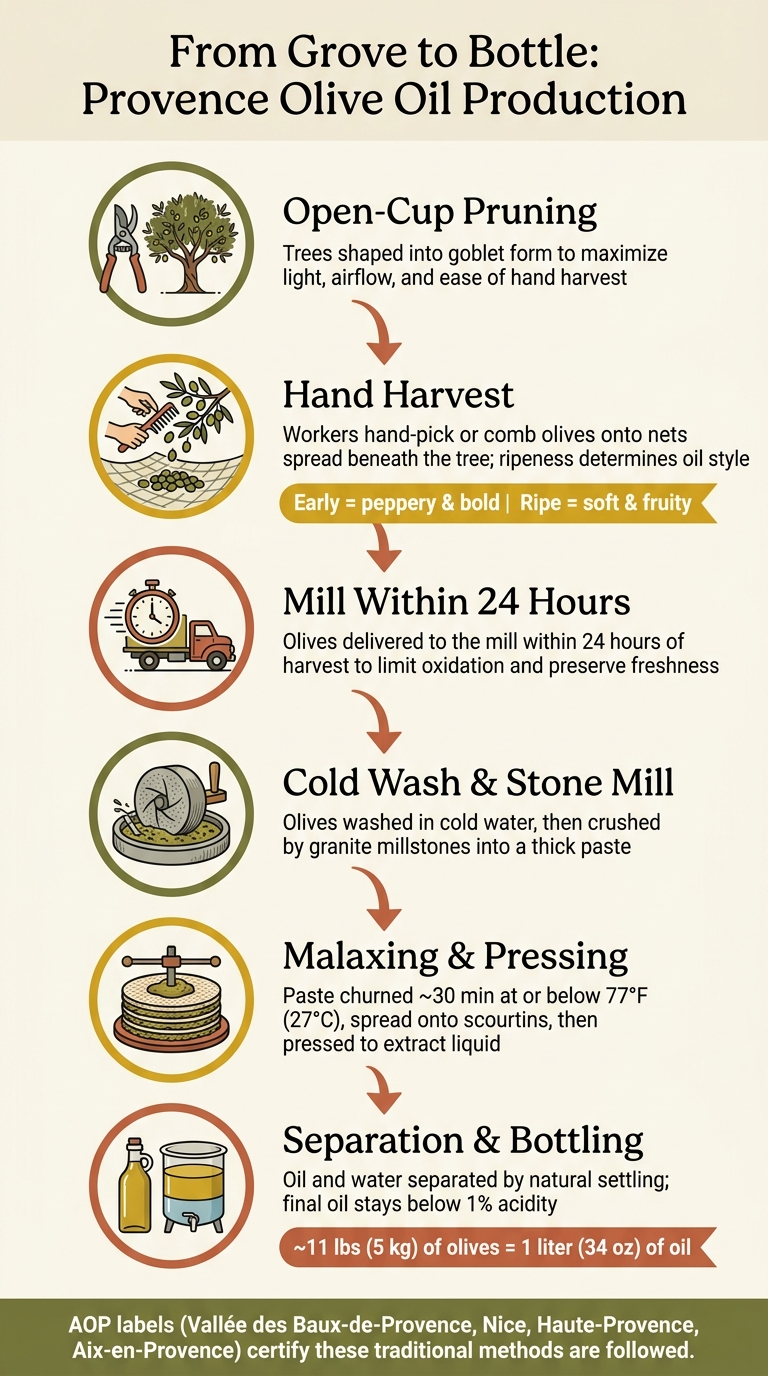
From Grove to Bottle: Provence Olive Oil Production Process
Goblet Pruning for Light, Airflow, and Hand Harvest
Those wide, dry-farmed groves shape everything that comes next: pruning, picking, and milling. Provençal trees are usually pruned into an open-cup, or goblet, form. That open center lets light into the canopy, helps air move through the tree, and makes hand harvest much easier.
Hand Harvest on Nets and Ripeness Timing
Harvest usually starts with nets spread under the tree. From there, workers hand-pick the olives or comb them down onto the nets.
Ripeness changes the oil in a big way. Early green olives tend to produce a sharper, more peppery oil, similar to our fresh harvest selections. Riper fruit gives a softer, fruitier oil and usually more yield. Premium producers try to get the olives to the mill within 24 hours to limit oxidation.
Once the olives are off the tree, the clock starts ticking at the mill too.
Stone Mills, Scourtins, and Low-Temperature Pressing
Traditional Provençal milling follows a simple sequence. First, the olives are washed in cold water. Then granite millstones crush the whole fruit into a thick paste. That paste is gently churned for about 30 minutes at or below 77°F (27°C).
Next, the paste is spread onto scourtins and stacked in layers for pressing. The pressure pushes out the liquid, and the oil and water are then separated by natural settling in resting tanks. This method takes about 11 pounds (5 kilograms) of olives to make 1 liter, or about 34 ounces, of oil.
Traditional pressing relies on stone mills, scourtins, and natural settling. Modern centrifuge systems use enclosed mechanical separation and work faster. Put simply, the older method is slower and exposes the paste to more air, while centrifuge extraction is faster and cleaner. Either way, the biggest thing is speed between harvest and milling.
These inherited methods are now protected by AOP rules.
How Old Techniques Survive in Modern Quality Standards
AOP Rules, Preservation, and Working Groves
Those older methods didn’t disappear. They now live on through AOP rules. In France, AOP standards protect Provençal production by requiring local olive varieties, grove care, and extraction rules.
That’s why labels like AOP Vallée des Baux-de-Provence, AOP Haute-Provence, AOP Nice, and AOP Aix-en-Provence mean more than place names. Each one is linked to a set region and a clear set of production rules.
You can also see these methods at work in active mills. Moulin à huile Jullien in Saint Saturnin lès Apt is a fourth-generation family operation that has focused on organic Aglandau production since 2009. That kind of continuity matters. It shows these practices aren’t museum pieces - they’re still part of how oil gets made.
Why These Methods Still Matter When Buying Olive Oil
For buyers, the label gives you a quick read on how those old practices shape the oil in the bottle. Cold extraction and gentle hand harvest help keep aroma, polyphenols, and freshness in place. Premium Provençal extra virgin olive oil often stays below 1% acidity.
When you shop, a few label details can tell you a lot:
- Look for "cold extraction"
- Check whether the bottle names a specific variety
- Note the style linked to that variety
An Aglandau-based oil often has a bold, peppery finish, while a Tanche usually leans more mellow and nutty. Those clues help you size up freshness and style fast.
Key Lessons from Provence Olive Farming
The core idea is simple: Provence’s climate and terrain still shape how olives are grown and processed today. You can see it all the way through the chain - from terraced hillsides and drought-adapted groves to goblet pruning, hand harvest, and cold extraction.
FAQs
How do Provence terraces affect olive oil flavor?
Terraced slopes in Provence do more than shape the landscape. They help the soil keep water and organic matter, which gives olive trees a better shot at getting through dry spells.
In these rain-fed, low-density groves, a little water stress can actually change the fruit in a good way. The trees tend to produce fewer olives, but those olives are more concentrated. That can increase phenolic compounds, which gives the oil more depth, complexity, bitterness, and pungency.
Why does hand harvesting matter for quality?
Hand harvesting helps produce ultra-premium extra virgin olive oil because growers can pick olives at the exact moment they reach ideal ripeness.
That timing matters. When olives are picked by hand, there’s less bruising and less damage than you often get with heavy machinery. And less damage means more freshness and more of those delicate flavors that can get lost along the way.
This approach also makes a lot of sense in terraced groves, where machines are often hard to use or just not practical. In those settings, careful hand picking can support more concentrated fruit, higher phenolic content, and better oxidative stability.
What does an AOP label guarantee?
An AOP (Appellation d'Origine Protégée) label means an olive oil comes from a specific recognized region and is made using established local methods. In plain English: it ties the oil to a place, not just a recipe.
It confirms the product’s origin and shows that every stage of production happens within that area.
The label also means the oil must meet strict quality standards, including set chemical and sensory requirements. On top of that, it helps protect local heritage.