

Health Benefits of Chili Oil with Olive Oil
If you want a spicy condiment that does more than add heat, chili oil made with extra virgin olive oil is one of the better picks. It can give you monounsaturated fat, olive oil polyphenols, and chili heat without the high sodium and added sugar found in many bottled sauces.
Here’s the short version:
- EVOO-based chili oil can support heart health more than spicy condiments made with refined oils.
- Capsaicin from chili peppers and polyphenols in EVOO both help with oxidative stress and inflammation.
- Many bottled spicy condiments have 110 to 200 mg of sodium per teaspoon. Some go even higher.
- Sweet chili sauces can also pack in a lot of sugar. One example in the article lists 20 g of added sugar per 2 tablespoons.
- For home use, dried chilies are the safer choice.
- Homemade chili oil should be refrigerated at 40°F or below and used within the time range noted in the article.
- If you use fresh garlic, herbs, or fresh peppers, the oil needs tighter storage and faster use.
A simple way I’d look at it: if I want spicy flavor on eggs, vegetables, bowls, or toast, I’d rather use a small drizzle of EVOO chili oil than lean on a salt-heavy sauce.
| Item | Typical bottled spicy condiment | EVOO chili oil |
|---|---|---|
| Main base | Vinegar, sugar, salt, or refined oil | Extra virgin olive oil |
| Sodium | Often high | Often lower if I make it myself |
| Added sugar | Common in sweet styles | Usually none in a basic version |
| Antioxidant compounds | Low | Higher |
| Best use | Sauce-heavy flavor | Light finishing drizzle |
Bottom line: I’d use EVOO chili oil as a finishing oil, not a cooking oil, and I’d make it with dried chilies, store it cold, and use a good bottle of EVOO with a harvest date if possible.
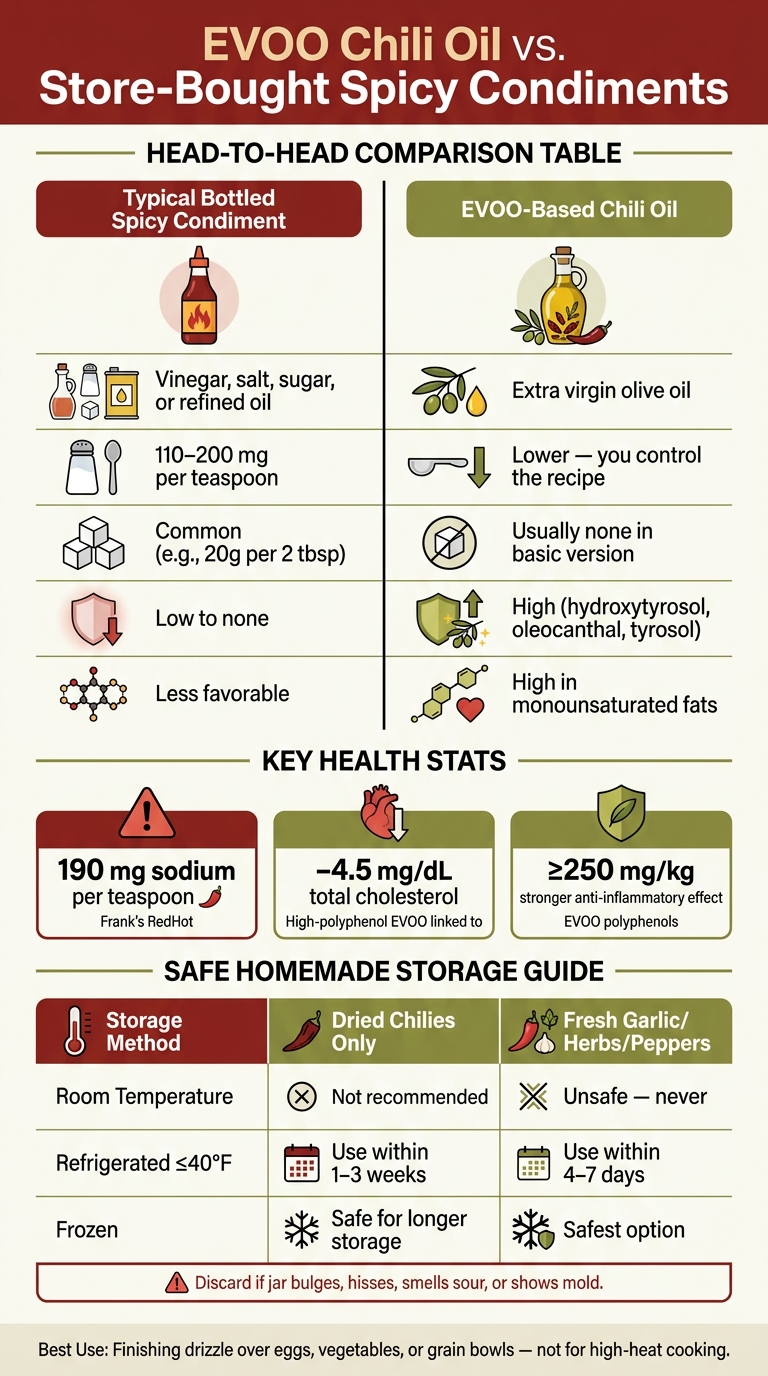
EVOO Chili Oil vs. Store-Bought Spicy Condiments: Nutrition & Safety Guide
What Makes Store-Bought Spicy Condiments Less Useful
Most bottled hot sauces and chili pastes bring the heat. But a lot of them also lean on sodium, sugar, and refined oils. That’s where the base starts to matter.
Too Much Sodium, Added Sugar, and Processed Oils
Sodium is the clearest issue. The FDA defines “low sodium” as 140 mg or less per serving. Many popular hot sauces go past that line. Frank's RedHot, for example, has 190 mg of sodium per teaspoon. And since condiments are easy to pour, drizzle, or splash on without much thought, that sodium can stack up fast over a full day of eating.
Added sugar is another problem. Sweet chili sauces and fusion-style options often use sugar to soften heat, acidity, or salt. Hannaford Sweet Chili Sauce, for instance, lists 160 mg of sodium and 20 g of added sugar per 2-tablespoon serving. That’s a lot packed into a small amount.
Then there’s the oil itself. Many store-bought chili oils and chili pastes use low-cost refined oils as the base. They can still carry spice and taste fine, but they don’t offer the same mix of monounsaturated fats and olive compounds - such as hydroxytyrosol, tyrosol, and oleocanthal - that make extra virgin olive oil stand apart from other oils.
What You Miss Without Extra Virgin Olive Oil
When the spicy kick comes mostly from vinegar, salt, sugar, or refined oil, there’s a clear nutrition gap. You still get heat. You just don’t get the same fat quality or the antioxidant compounds that olive oil brings to the table.
| Feature | Typical Bottled Spicy Condiment | EVOO-Based Chili Oil |
|---|---|---|
| Primary base | Vinegar, salt, sugar, or refined oils | Extra virgin olive oil |
| Fat profile | Less favorable fat profile | High in heart-healthy monounsaturated fats |
| Antioxidant content | Low to none | High (hydroxytyrosol, tyrosol, oleocanthal) |
| Sodium | Often 110–200 mg per teaspoon | Usually lower when you control the recipe |
| Added sugar | Common in sweet chili and fusion styles | Usually none in a basic homemade version |
That’s the key difference. EVOO doesn’t just shift the taste. It changes what the condiment brings with it nutritionally.
sbb-itb-4066b8e
How Chili Oil with Extra Virgin Olive Oil Supports Your Health
Swapping refined oil for extra virgin olive oil adds more than flavor. You also get heart-friendly fats and compounds that help your body deal with oxidative stress. Once you start with extra virgin olive oil, the health angle comes from the way its natural compounds work alongside chili.
Anti-Inflammatory and Antioxidant Effects from EVOO and Chili
EVOO contains several polyphenols that have been studied for their effects on inflammation and oxidative stress. Hydroxytyrosol is one of the best-known. It helps neutralize free radicals and may reduce key inflammation pathways. Oleocanthal works in a similar way by inhibiting COX-1 and COX-2.
Capsaicin, the compound that gives chili peppers their heat, adds another piece to the picture. Capsaicin and EVOO polyphenols both help counter oxidative stress and inflammation, which gives this type of chili oil a stronger health profile than plain oil. EVOO also helps distribute capsaicin through food and may help your body absorb it. In plain terms, it’s a condiment that does more than just bring the burn.
Heart-Healthy Fats and a Lower-Sodium Way to Add Flavor
A small amount of chili oil made with EVOO can add punch to a meal while helping you lean less on salty sauces. Research on high-polyphenol olive oils found lower oxidized LDL, with a standardized mean difference of about −0.44, lower total cholesterol by about −4.5 mg/dL, and higher HDL cholesterol by about +2.37 mg/dL.
That’s why it makes sense to use it as a light finishing drizzle instead of a salt-heavy sauce.
How to Use It in a U.S. Home Kitchen
This works best when you treat it like a finishing oil, not a high-heat cooking fat. High heat can break down heat-sensitive polyphenols such as hydroxytyrosol and tyrosol, so adding the oil after cooking is a better move than heating it in the pan.
Try drizzling it over eggs, roasted vegetables, or grain bowls right before serving. Those lower-heat uses help keep more of the polyphenols that make EVOO-based chili oil worth picking in the first place.
How to Make and Store Chili Oil Safely at Home
A health-focused condiment still needs careful handling. Homemade infused oils can carry a botulism risk if they’re stored the wrong way, so prep and storage matter just as much as the oil you pick. These bacteria grow in low-acid, oxygen-free settings, which is exactly what happens when ingredients sit submerged in oil. Good storage helps protect both the oil’s quality and the perks that make EVOO worth using.
Why Dried Chilies Are the Safer Choice
The safest place to start is with dry ingredients. Dried chili flakes or dried peppers are the safer option because they have much less moisture, which takes away the conditions bacteria need to grow. That’s why stored batches should use only dried ingredients and skip fresh garlic or fresh herbs.
If you want fresh aromatics, make a separate small batch, refrigerate it right away, and use it within 4 to 7 days.
How to Store Chili Oil: Temperature and Time
Once the oil is mixed, storage becomes the next big step. After the oil cools, transfer it to a clean glass jar, label it with the prep date, and refrigerate it promptly. Store it in the main compartment of your refrigerator at or below 40°F.
For infusions made with dried chilies only, use the oil within 1 to 3 weeks while refrigerated. Straining out the solids before storage lowers the risk even more. For longer storage, freeze it in small portions.
Safe vs. Unsafe Storage Practices at a Glance
Use the chart below to separate safe home practice from risky shortcuts.
| Practice | Dried Chilies Only | Fresh Garlic / Herbs / Fresh Peppers |
|---|---|---|
| Room-temperature storage | Not recommended | Unsafe - do not store at room temperature |
| Refrigerated at ≤40°F | Recommended; use within 1–3 weeks | Required; use within 4–7 days |
| Frozen | Safe for longer storage. | Safest option for any batch with fresh ingredients |
Use a clean, dry utensil every time. Toss the oil if the jar bulges, pops, or hisses when opened, smells sour or rancid, or shows mold.
How to Pick a Good EVOO and What to Take Away from This Article
Why Freshness and Polyphenol Content Matter
After storage, freshness is the next big thing to check. The upside of chili oil depends a lot on the olive oil you use at the start. EVOO polyphenols, including hydroxytyrosol and oleocanthal, break down when they're exposed to heat, light, and oxygen. That means a fresh bottle will often give you more antioxidant support than an older one, even if both say extra virgin on the label.
When you shop, look for a clearly printed harvest date. A bottle from the past 12 to 18 months is usually a better pick than one that only shows a "best by" date. Packaging matters too. Dark glass or tin can help protect the oil, and once you open it, a peppery, grassy smell and taste can hint at higher polyphenol content. Oils with 250 mg/kg polyphenols or more are often treated as high-polyphenol EVOOs, and those are the oils tied to stronger anti-inflammatory and antioxidant effects.
Refined Oil vs. Premium EVOO: A Side-by-Side Look
This gap is easiest to see when you compare refined olive oil with premium EVOO in chili oil.
| Attribute | Refined Olive Oil | Premium Extra Virgin Olive Oil |
|---|---|---|
| Antioxidant level | Low; many natural polyphenols are removed during refining | High; retains hydroxytyrosol, oleocanthal, vitamin E, and more |
| Fat profile | Mostly monounsaturated fat; fewer bioactive compounds | Monounsaturated fat plus diverse phenolic compounds |
| Freshness markers | Often no harvest date; mild or flat aroma | Harvest date listed; peppery, grassy, or fruity aroma |
| Best kitchen use | High-heat cooking | Finishing oil and chili oil |
Refined oil gives you fat and calories, but not much in the way of antioxidants. Premium EVOO gives you the same main fat type, plus more polyphenols that may help support heart health and antioxidant activity.
Key Points to Remember
The main point is pretty simple: pick fresh, high-quality EVOO, use dried chilies for safety, and store homemade chili oil the right way to help protect both flavor and its upsides.
FAQs
Is chili oil with olive oil actually healthy?
Yes. Chili oil made with extra virgin olive oil can be a smart choice for your diet.
It gives you monounsaturated fats and phenolic compounds, which can help support heart health and lower inflammation. That’s one of the big reasons extra virgin olive oil stands out from many other oils.
Chili peppers bring capsaicin into the mix. Capsaicin may help support metabolism, healthy blood flow, and added antioxidant effects. And when you use a high-quality olive oil, you’re more likely to keep those upsides in place.
Can I cook with EVOO chili oil?
Yes. EVOO chili oil works well as both a finishing oil and a cooking base for dishes like stir-fries and sautés.
Its smoke point is about 410°F, so it holds up well for most everyday cooking. But if you want the best flavor, use it near the end of cooking. That helps keep more of its aroma intact.
How long does homemade chili oil last?
Homemade chili oil made with Big Horn Olive Oil can stay fresh for up to six months when kept in an airtight container in the refrigerator.
When you serve it, use a clean, dry spoon. That helps keep out moisture and bacteria.
If the oil thickens in the fridge, just let it sit at room temperature for 20 to 30 minutes before using.