

Clay Pot Cooking By Region: Mediterranean Guide
I choose a clay pot by how much moisture the dish needs - not just where the recipe comes from. A covered pot keeps food moist; a shallow, open dish lets sauces reduce. Before cooking, I check that the pot is food-safe and approved for my oven or burner.
Here’s how I compare the six regions at a glance:
Quick Comparison
| Region | Pot choice | Main cooking use |
|---|---|---|
| North Africa | Conical-lidded tagine | Slow braising with little added liquid |
| Greece | Deep covered pot or shallow ovenware | Beans and braises, or dishes that need browning |
| Italy | Deep terracotta pot | Gentle simmering for beans, soups, and stews |
| Spain | Broad, shallow cazuela | Sauce reduction, simmering, and baking |
| Turkey | Deep covered güveç | Slow oven cooking with steam held inside |
| The Levant | Local covered pots or shallow bowls | Recipe-specific cooking, with different lids and heat sources |
Across these methods, I let the recipe guide the liquid, olive oil, herbs, and spices. I use mild EVOO for lighter dishes and peppery oil for stronger flavors, with a final drizzle when I want more aroma.
My safety rule: <u>oven-safe does not mean stovetop-safe</u>. I heat clay gradually, follow the maker’s soaking and cleaning directions, and serve it on a dry, heatproof trivet. I also check food temperature - 165°F for poultry - and refrigerate perishable leftovers within 2 hours.
The goal is simple: match the pot, heat, and seasoning to the dish.
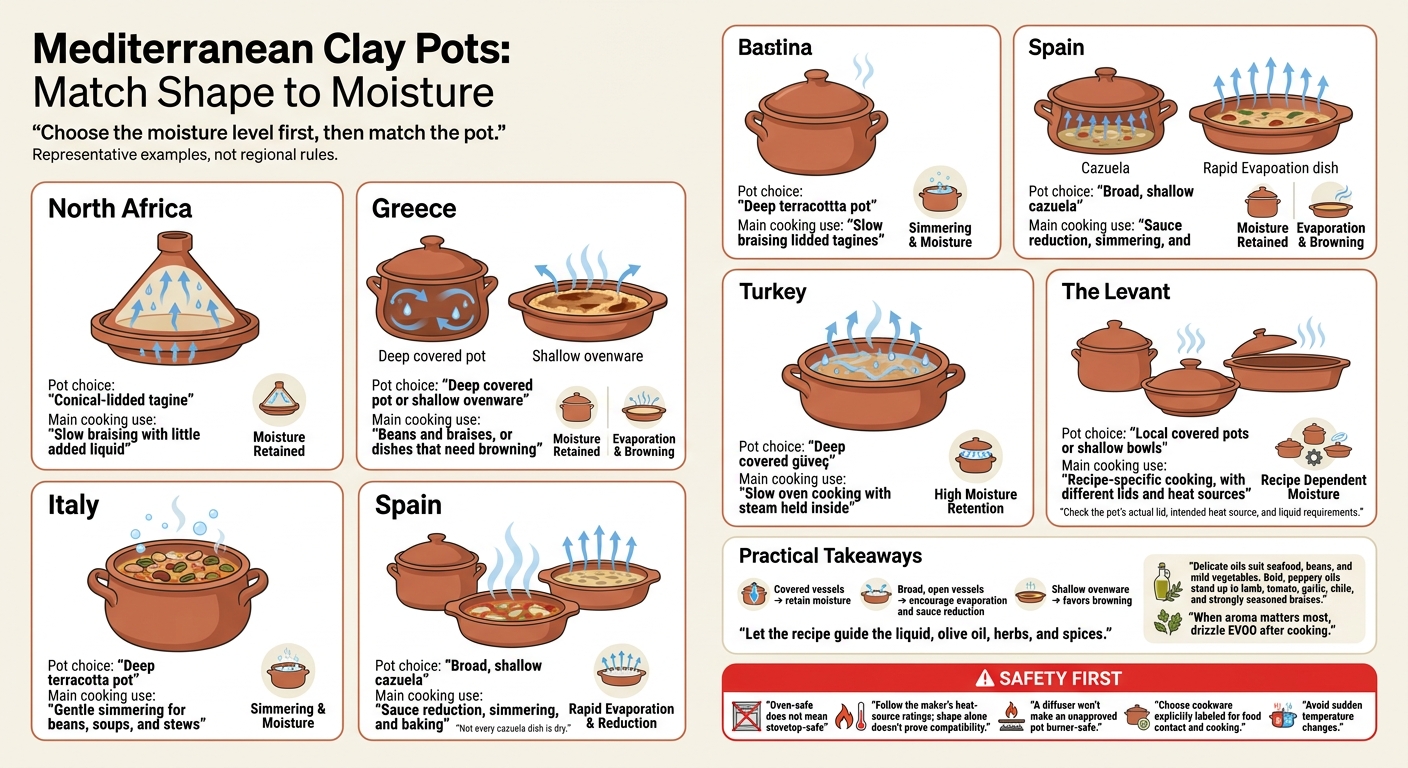
Mediterranean Clay Pots: Match Shape to Moisture
Clay Pot Cooking in North Africa, Greece, and Italy
North Africa: Tagines and Conical Lids
Moroccan tagines combine a shallow base with a conical lid for slow braising with little liquid. Layer onions and garlic beneath the food, add a small amount of liquid, and keep the lid closed. Olive oil carries the aromatics. Add cumin, ginger, saffron, herbs, chermoula, olives, or preserved lemon as the recipe calls for them - there’s no fixed spice blend.
Algerian braises are part of the same Maghrebi family, though pot names and shapes differ by region. Tunisian tajine, by contrast, is a baked egg dish, not a stew cooked under a conical lid. Moroccan tagines often come to the table in their cooking vessel, ready to share with bread. Individual plates work, too.
Greece: Oven-Cooked Beans and Braises
Greek clay cooking follows the same low-and-slow approach, but uses deep covered pots rather than conical lids to hold in moisture.
In Sifnos, revithada is baked slowly in a sealed clay pot with chickpeas, onions, olive oil, and bay leaves. The covered skepastaria traditionally goes into a wood-fired oven on Saturday for Sunday eating. For a modern version, use a deep covered clay pot, cover the soaked chickpeas with water, and cook until the beans are creamy and the broth is reduced.
Match the pot to the dish: shallow Greek ovenware works for browning, while deep covered pots suit beans and braises. Let the recipe guide your use of tomato, garlic, oregano, thyme, or lemon; they don’t all belong in every dish. Serve family-style with bread, oil, or lemon.
Italy: Terracotta Pots for Beans, Soups, and Stews
Italian terracotta cooking leans toward gently simmered bean broths and soffritto. Deep pots suit beans, soups, and stews. As the beans absorb liquid, top up with hot water or stock.
For soffritto, gently cook onion, carrot, celery, or garlic in EVOO to build the flavor base. Choose sage, rosemary, bay, parsley, or marjoram to suit the dish. Finish with a drizzle of EVOO, then bring rustic bread, shared bowls, and finishing oil to the table.
sbb-itb-4066b8e
Clay Pot Cooking in Spain, Turkey, and the Levant
Spain: Cazuelas for Simmering and Baking
These western Mediterranean pots offer plenty of surface area for reducing sauces and can go straight to the table.
A cazuela is usually broad, shallow, and round, often with a glaze, low sides, and small handles. Its open surface helps sauces reduce, making it suited to seafood, vegetables, beans, poultry, and rice. Garlic and olive oil work well in gambas al ajillo. Add tomato, onion, paprika, or parsley only when the recipe calls for them. Measure the liquid for rice and braises: not every cazuela dish is dry.
Start stovetop-safe cazuelas over low heat. Use a diffuser unless the manufacturer explicitly rates the pot for direct flame. Follow the maker’s oven-start instructions, let baked dishes rest when appropriate, and place the pot on a heat-safe trivet for serving.
Turkey: Güveç and Slow Oven Cooking
Turkey’s güveç cooking moves from open sauce reduction to deeper pots and steamier oven cooking. Both deep pots for shared meals and individual casseroles may be glazed or unglazed. A lid or dough seal holds in steam during slow oven cooking.
Let the recipe guide the liquid. Some lamb-and-vegetable dishes need no added water; others call for stock. Meat dishes may use butter or meat fat, while olive-oil vegetable dishes are a separate style. Black pepper, paprika, oregano, and mint depend on the dish - they aren’t a standard blend. Follow the pot’s heating limits, and serve with bread, rice, or yogurt as the recipe requires.
The Levant: Local Earthenware Cooking
Levantine clayware differs most in its soaking needs, sealing methods, and lid designs.
Reuters describes Palestinian fukhara cooking in a covered, unglazed clay pot soaked only when the maker allows it, where steam circulates and the food cooks in its own juices. Gaza’s larger qidra cooks rice and meat in a clay oven, while the smaller zibdiyyeh can serve as a mortar, cooking bowl, or serving bowl.
Before adapting a recipe to home cookware, check the pot’s actual lid, intended heat source, and liquid requirements.
Lebanese documentation records fukhar uses for eggs, vegetables, meat, and preserved foods; Palestinian and Jordanian records identify meat-and-poultry vessels and ma’janeh associated with mansaf preparation. Gaza lentils feature red pepper flakes, crushed dill seed, garlic, and cumin, not a universal Levantine blend.
Choose seasonings for the specific preparation. Serve with bread, yogurt, or pickles as the dish requires.
Let`s learn how to cook Clay Pot Lamb Kebab (Guvec)?
Choosing Clay Cookware and Olive Oil
Use the regional examples above to match the vessel shape, heat source, and oil finish to your dish. Shape controls moisture, heat source controls browning, and oil controls flavor.
Regional Cooking and Vessel Comparison Tables
These are representative examples, not regional rules. Compare capacity in U.S. quarts, then check usable space and oven clearance before buying.
| Region | Key cookware decision |
|---|---|
| North Africa | Choose a conical-lidded tagine for moist braising with little added liquid. Check lid clearance. |
| Greece | Use deep, covered earthenware for beans and braises. Shallow ovenware favors browning. |
| Italy | Choose a deep terracotta pot to gently simmer beans, soups, and stews. Serve in the pot only if its construction and temperature limits allow. |
| Spain | Choose a broad, shallow cazuela when you want the sauce to reduce. |
| Turkey | Use a deep, covered güveç-style pot for slow oven cooking with less evaporation. |
| The Levant | Match covered pots or shallow dishes to the recipe’s moisture needs and intended heat source. |
Clay Cookware Safety, Heating, and Cleaning
Choose cookware explicitly labeled for food contact and cooking, with clear instructions listing permitted heat sources. Avoid decorative pottery, unmarked imports, vessels labeled “Not for Food Use,” and cookware from unknown sources when you can’t establish food-contact safety.
The FDA warns that improperly manufactured or glazed pottery can leach lead into food. Washing or boiling won’t remove it. FDA guidance also identifies cadmium as a potential contaminant that can be extracted from ceramic ware, especially by acidic foods.
Follow the maker’s heat-source ratings; shape alone doesn’t prove compatibility. A diffuser won’t make an unapproved pot burner-safe. Before use, check for cracks, chips, and damaged glaze. Avoid sudden temperature changes. Let the pot cool naturally on a dry, heat-resistant surface, then wash it with warm water and a soft sponge or brush. Dry both the pot and lid completely before storing.
Measure food temperature - not just oven temperature. USDA minimums are 165°F for poultry and reheated leftovers, 160°F for ground meat, and 145°F for whole cuts of beef, pork, lamb, and veal, followed by the applicable rest period. These are food temperatures, not cookware settings.
Transfer perishable leftovers to shallow containers and refrigerate within 2 hours, or 1 hour above 90°F. Don’t wait for a heavy pot to cool. Refrigerated leftovers generally keep 3–4 days.
Once you’ve chosen the pot, pick an oil that matches the dish’s intensity.
EVOO for Cooking and Finishing
Use EVOO to soften aromatics, coat braising ingredients, carry marinade flavors, or finish a dish. Match the oil’s intensity to the food: delicate oils suit seafood, beans, and mild vegetables. Bold, peppery oils stand up to lamb, tomato, garlic, chile, and strongly seasoned braises.
When aroma matters most, drizzle EVOO after cooking. Check harvest information and buy only what you’ll use before the oil loses its flavor. Store it tightly closed, away from heat and light. Taste before finishing: stale, waxy, or rancid notes are warning signs.
Big Horn Olive Oil offers Ultra Premium EVOOs and Modena balsamic vinegars for modern finishing, not as standard clay-pot ingredients.
Conclusion: Match the Pot to the Cooking Method
Across these regions, the rule stays the same: Choose the moisture level first, then match the pot.
A tagine’s conical lid sends condensation back into the food, while a shallow cazuela gives sauce room to reduce; deeper, covered vessels suit Turkish slow cooking and Greek or Italian beans and stews, while Levantine regional earthenware should match the recipe rather than one standard shape.
Start with one documented regional recipe before making changes. Use its vessel, heat sequence, liquid level, and cooking time as your guide when adjusting for your cookware. Choose food-safe cookware approved for your heat source and follow the maker’s instructions. Watch uncovered dishes for evaporation, and add warm liquid sparingly. Don’t flood food that needs to brown or sauce that needs to reduce.
For cooking or finishing, choose EVOO that suits the dish’s flavor. Set the pot on a heatproof trivet and serve carefully, adding bread, grains, herbs, or a final drizzle as the dish calls for.
FAQs
Can I substitute a tagine for a güveç?
Yes. Both are earthenware pots that trap steam and baste the ingredients as they cook slowly. The tagine comes from North Africa, while the güveç comes from Turkey. Both use gentle, slow heat to deepen flavors.
If you don’t have either, a heavy-duty Dutch oven also works well for similar slow-braising results.
How do I adjust recipes for glazed versus unglazed clay?
Use slightly less liquid than you would with standard cookware, since clay pots retain more moisture. Soak porous, unglazed clay pots in water for 15 to 20 minutes before use to help retain moisture and improve flavor. Glazed pots are nonporous, so they don’t need soaking.
For both types, let the pot heat gradually along with the oven to prevent cracks caused by sudden temperature changes.
When should I add finishing EVOO to a hot clay pot?
Drizzle extra virgin olive oil (EVOO) over your hot clay pot dish just before serving. The dish’s remaining heat gently releases the oil’s aromas, adding flavor and fragrance. Adding high-quality EVOO at this point also helps protect its delicate notes and antioxidants, which prolonged cooking at high heat may damage.