

Cloud Traceability for Growing Olive Oil Supply Chains
If your olive oil supply chain grows, weak recordkeeping turns into a risk fast. More farms, mills, tanks, warehouses, and sales channels mean more chances for missing lot data, label mistakes, fraud, and slow recalls.
Here’s the short version: cloud traceability gives you one shared product record from harvest to bottle. That helps you track lot IDs, harvest dates, lab results, storage logs, bottling data, and shipments in one place instead of across notebooks, spreadsheets, emails, and PDFs.
What that means for you:
- Less record confusion across growers, mills, co-packers, and warehouses
- Faster trace-backs when a batch has a quality issue
- Clearer proof for claims like origin, harvest date, and extra virgin grade
- Better buyer confidence through QR-linked bottle history
- Lower fraud risk in a category under pressure
The pressure is real. In Q1 2024, the EU reported 50 olive oil fraud and mislabeling cases. And olive oil is often listed as one of the world’s most adulterated foods. So if you sell into the U.S., buyers want more than a label. They want facts they can check.
A cloud system works best when it includes:
- Lot-level tracking
- QR codes on bottles
- Time-stamped records
- Sensor data for storage and shipping
- Lab results like acidity and composition
- Audit-ready trace-back tools
La filiera olivicola digitalizzata con xFarm 🫒 CVO
sbb-itb-4066b8e
Quick comparison
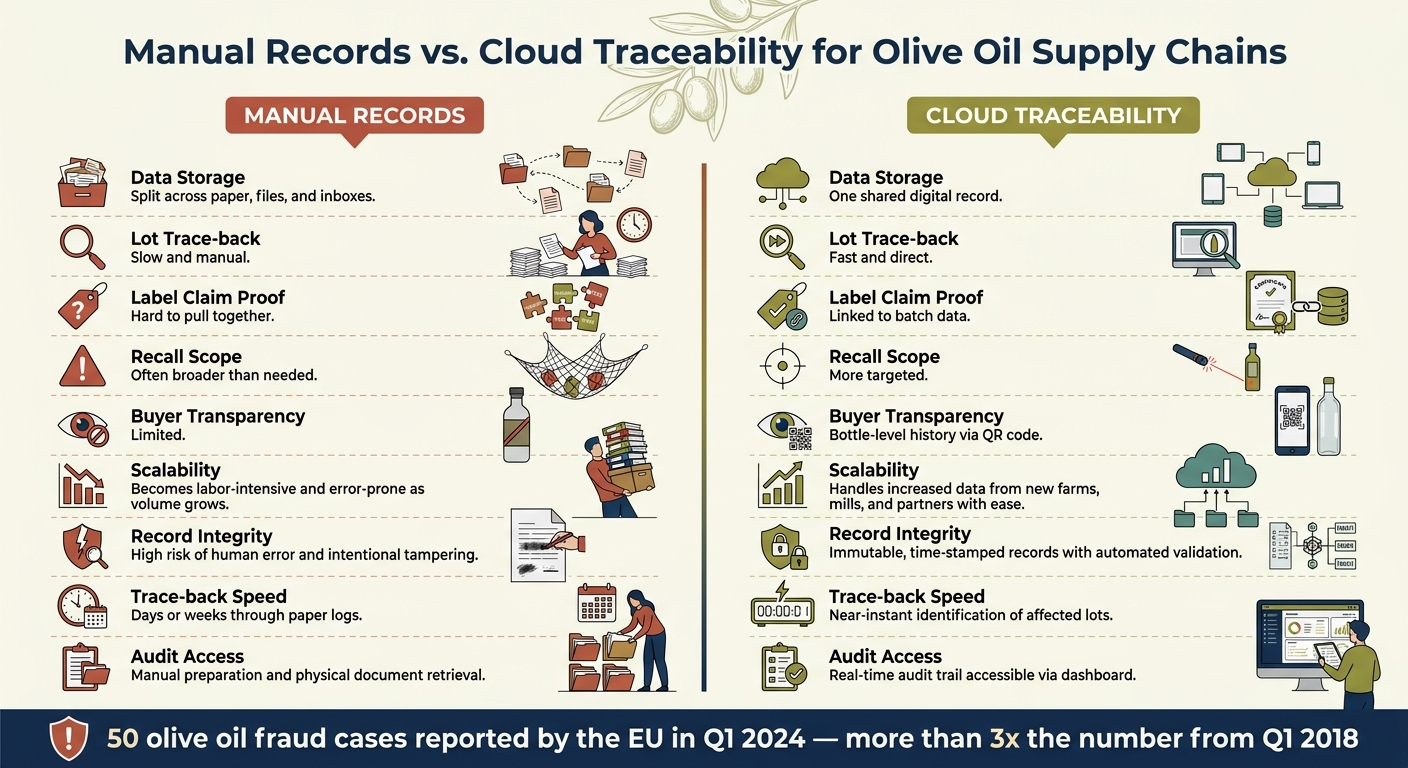
Manual Records vs. Cloud Traceability for Olive Oil Supply Chains
| Area | Manual records | Cloud traceability |
|---|---|---|
| Data storage | Split across paper, files, and inboxes | One shared record |
| Lot trace-back | Slow and manual | Fast and direct |
| Label claim proof | Hard to pull together | Linked to batch data |
| Recall scope | Often broader than needed | More targeted |
| Buyer transparency | Limited | Bottle-level history via QR |
If you want to grow without losing control of quality records, cloud traceability is not just a software upgrade. It’s how you keep proof tied to every bottle.
The main problems that come with scaling olive oil operations
Fragmented records across farms, mills, storage, and shipping
As an olive oil business grows, its records usually stop living in one place. A grower might write a harvest date in a notebook. The mill may store extraction data in a spreadsheet. Other details often sit in emails, PDFs, or separate software tools. By the time the oil is bottled, its full harvest-to-bottle history can be spread across notebooks, spreadsheets, emails, PDFs, and software systems.
That creates disconnected records with no single system in charge. And when teams don’t use the same definitions for lot codes and harvest dates, lining everything up gets slow and messy. The trouble shows up fast when a brand needs proof.
Higher risk of labeling errors, fraud, and slow recalls
Scattered records don’t just waste time. They increase risk.
If label claims such as "organic" or "single-estate" can’t be tied back to clear evidence, a brand is left open to overclaiming and misrepresentation. Fraud is part of the picture too. U.S. buyers are not immune, and counterfeit EVOO has been documented in exports.
Weak traceability also makes recalls harder to manage. When a quality issue appears, finding the affected batch may mean digging through old emails and PDFs by hand. That kind of delay can expand the recall, lead to more wasted product, and hurt retailer trust. At scale, traceability stops being a back-office task and starts looking like a business liability.
Why manual systems break down as order volume grows
Paper logs and spreadsheets can work for a while. Then volume climbs, SKU counts grow, and cracks start to show.
Repeated data entry leads to version drift and batch mix-ups. Manual systems are also fragile, with weak backups and limited remote access during peak seasons. Teams often need weekly reconciliation just to catch stock mismatches and batch mix-ups.
At that point, the problem isn’t just extra admin work. It’s that the system itself can’t keep up, which is why many operations end up needing one shared cloud record.
How cloud traceability addresses these problems
One shared record from harvest to bottle
A cloud traceability platform brings harvest, milling, storage, bottling, and shipping data into one digital record that authorized team members can view in real time. Instead of information getting dropped at each handoff, it stays tied to the product as olives move from grove to crate, mill, tank, bottle, and shipment.
That matters for a simple reason: fewer gaps mean fewer mistakes. RFID tags and tank sensors can also send data straight into the platform, which cuts down on manual entry.
Standardized data makes growth easier to manage
A cloud system also keeps records consistent. Every lot uses the same ID and the same required fields, such as cultivar, harvest date, yield, and acidity.
As a business adds more volume, more partners, and more distribution points, that consistency becomes a lot easier to manage than a patchwork of spreadsheets and paper logs. Records are easier to reconcile, and audit trails stay cleaner. It also makes audits, recalls, and customer verification faster.
Faster trace-backs, better proof, and stronger consumer trust
When a quality issue comes up, a cloud system can isolate the affected lot fast and show which orders received it without digging through manual records. That makes recalls faster and more precise.
The same record that speeds up a recall also helps build buyer confidence. Time-stamped records and QR codes can link each bottle to its origin, variety, certifications, and sourcing claims. In 2022, Deoleo partnered with IBM to implement IBM Food Trust for its "Maestros de Hojiblanca" brand, giving consumers in Spain, France, and the U.S. a way to scan a unique QR code and verify product information for 4 million bottles per year.
"IBM Food Trust has been the ideal solution, combining advanced technology in a flexible, business-oriented platform." - Niklas Sannebro, Strategic Operations Director, Deoleo
For U.S. buyers, verifiable provenance matters because olive oil is the second most adulterated food in the world, surpassed only by seafood. A time-stamped digital record carries more weight than a label claim on its own. But that only works if the system includes the right tools, like QR codes, lot tracking, and quality data capture.
Key features to look for in a scalable olive oil traceability system
Once the risks are clear, the next step is choosing features that can keep up as volume grows.
QR codes, lot tracking, and consumer-facing product history
Start with bottle- or lot-level QR codes that connect each product to its digital record. When someone scans the code, they should see the harvest date, variety, source cooperative, and bottling date - not some generic landing page. For a growing olive oil business, that kind of detail links each lot to a source you can check as more farms and sales channels come into the mix.
QR code security matters just as much as the data behind it. Use unique, non-cloneable codes to stop counterfeit bottles from copying a legitimate product history. Some producers also use protected "scratch-to-reveal" QR codes so only the end purchaser can access the product's full history.
That same record should include quality data too, not just product history.
Sensor and lab data for quality control
For olive oil, the platform should keep temperature logs, storage conditions, acidity results, and chemical composition data in the same record. IoT sensors can send temperature and humidity data straight into the cloud record without manual entry, which creates a continuous log during storage and shipping. Add acidity and composition results to the lot record so extra virgin claims can be checked against actual data.
Some systems can also flag a batch on their own if its acidity reading goes past the threshold for extra virgin classification before it moves to the next stage. That cuts out a layer of human judgment from a decision that should come from the data.
These differences stand out fast once more farms, mills, and channels enter the chain.
Manual tracking vs. cloud-based traceability: a side-by-side comparison
The table below shows how the two approaches compare across the areas that matter most to a growing specialty food brand.
| Feature | Manual/Siloed Systems | Cloud-Based Traceability |
|---|---|---|
| Scalability | Becomes labor-intensive and error-prone as volume grows | Handles increased data from new farms, mills, and partners with ease |
| Record Integrity | High risk of human error and intentional tampering | Immutable, time-stamped records with automated validation |
| Trace-back Speed | Days or weeks to trace back through paper logs | Near-instant identification of affected lots |
| Audit Access | Requires manual preparation and physical document retrieval | Real-time audit trail accessible via dashboard |
| Buyer Transparency | Limited to generic label claims, such as "Product of Italy" | Bottle-level details including harvest date and lab results |
Those gaps get harder to ignore as the supply chain adds more origins, storage sites, and orders.
Conclusion: How cloud traceability supports quality as olive oil brands grow
Each new farm, mill, warehouse, or shipping partner in an olive oil supply chain adds one more place where data can slip through the cracks, get mislabeled, or show up late. That matters because olive oil is the second most adulterated food product in the world. And the problem isn't fading. In the first quarter of 2024, the European Union reported 50 cases of olive oil fraud and mislabeling, which is more than three times the number from the same period in 2018.
For brands making Ultra Premium claims, proof isn't a nice extra. It's part of the product. For premium brands, proof matters just as much as taste.
For premium olive oil brands, traceability turns quality claims into something buyers can check. For Big Horn Olive Oil, cloud traceability turns freshness into proof. Harvest date, acidity, and bottling records give U.S. buyers clear facts they can verify.
That leads to three business gains:
- Better batch visibility helps cut mix-ups as order volume grows.
- Faster trace-backs help contain damage when a quality issue appears.
- Consumer-facing transparency, delivered through lot-level QR codes linked to lab data, gives U.S. shoppers more confidence that what's on the label matches what's in the bottle.
Brands that build this system early can grow without losing the quality that sets them apart.
FAQs
How does cloud traceability work across farms, mills, and bottling?
Cloud traceability links farms, mills, and bottlers through shared digital records and IoT data. At each stage, from harvesting and milling to shipping, the system logs activity in real time under a single batch ID.
The result is a secure, verifiable record of the olive oil’s path from orchard to bottle. That record helps teams track quality, confirm where the oil came from, and give buyers a clear view of the product’s journey.
What data should be tied to each olive oil lot?
Each olive oil lot should include the core details needed to track it from orchard to bottle: the farm or orchard name, region, harvest date, milling date, extraction method, cultivar, and storage conditions.
It should also include lot numbers, lab test results, packaging dates, shipment references, customs documents for imported oil, and temperature and humidity records during transport and storage.
How can QR codes help prove olive oil quality and origin?
QR codes link each bottle to a secure digital record that tracks its journey. Scan the code with a phone, and you can view data connected to blockchain databases.
That record can show fixed details such as the olive cultivar, orchard location, harvest time, and bottling date. For premium brands like Big Horn Olive Oil, this gives buyers clear proof of origin and quality standards.