

Composting Olive Pomace for Soil Use
Composting olive pomace transforms a challenging byproduct of olive oil production into a nutrient-rich soil amendment. Olive pomace contains valuable nutrients like nitrogen, phosphorus, and potassium, but its raw form is harmful to plants due to high levels of polyphenols and biological oxygen demand. Composting neutralizes these toxic compounds, stabilizes organic matter, and creates a fertilizer that improves soil fertility, water retention, and nutrient cycling.
Key Takeaways:
- Why Compost Olive Pomace? Raw pomace is toxic to plants but rich in nutrients. Composting makes it safe and useful for soil.
- How to Compost: Mix olive pomace with nitrogen-rich additives (e.g., manure) and bulking agents (e.g., straw). Maintain proper moisture (50–60%) and a carbon-to-nitrogen (C/N) ratio of 25:1 to 35:1.
- Process: Keep compost piles at 113–140°F for effective decomposition and turn them regularly to ensure aeration. The process takes 6–10 months.
- When Is It Ready? Compost is mature when it cools to ambient temperature, shrinks by half, and has an earthy smell.
- Application: Spread 55–66 lbs per tree or follow local guidelines. It's especially effective for improving low-organic-matter soils.
By following these steps, olive producers can turn waste into a cost-effective fertilizer while improving soil health and reducing reliance on synthetic inputs.
Finally making olive waste compost in Italy!! Yay!!
sbb-itb-4066b8e
How the Composting Process Works
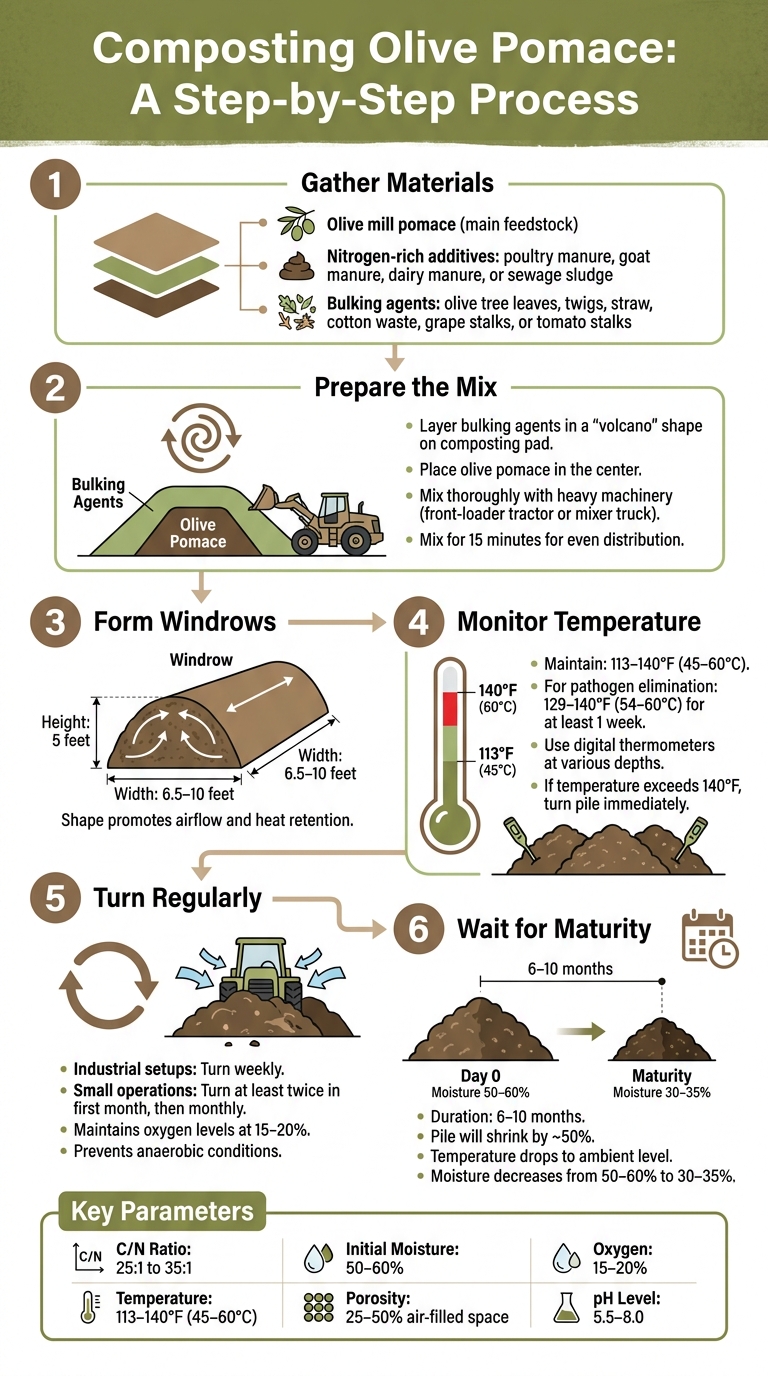
Step-by-Step Guide to Composting Olive Pomace for Soil Amendment
Transforming olive pomace into a nutrient-packed soil amendment involves carefully balancing materials and maintaining the right conditions for microbial activity. By combining the correct feedstocks and creating an environment conducive to decomposition, you can efficiently turn waste into a valuable resource. Here's how to get started.
Materials You'll Need
To successfully compost olive pomace, you'll need three key ingredients: olive mill pomace, nitrogen-rich additives, and bulking agents. Olive pomace, the main feedstock, has a high carbon-to-nitrogen (C/N) ratio and low nitrogen content, so you'll need to supplement it with nitrogen sources like poultry manure, goat manure, dairy manure, or even sewage sludge.
Bulking agents are equally important. These materials, such as olive tree leaves, twigs, straw, cotton waste, grape stalks, or tomato stalks, help maintain structure and provide air pockets. Without them, the pomace can compact, leading to anaerobic conditions and unpleasant odors.
For the best results, aim for an initial C/N ratio between 25:1 and 35:1. Ratios below 25 can lead to nitrogen loss, while ratios above 35 may slow the process. Also, ensure the moisture content is between 50–60%, which is manageable since olive pomace naturally contains 50–70% moisture. These conditions are essential for turning potentially harmful residues into a safe, nutrient-rich fertilizer.
Step-by-Step Composting Method
Start by layering your bulking agents on a composting pad, arranging them in a "volcano" shape. Place the olive pomace in the center and mix everything thoroughly with heavy machinery like a front-loader tractor or mixer truck. A 15-minute mix ensures even distribution of materials.
Next, shape the mixture into windrows that are approximately 5 feet high and 6.5–10 feet wide. These dimensions promote proper airflow while retaining the heat necessary for decomposition.
Temperature control is vital. Use digital thermometers to monitor internal temperatures at various depths. The pile should stay between 113–140°F (45–60°C). For effective pathogen and weed seed elimination, the core temperature must reach 129–140°F (54–60°C) for at least a week. If temperatures exceed 140°F, turn the pile to protect beneficial microbes.
Turning the piles is another critical step. In industrial setups, turn the piles weekly. For smaller operations, turn them at least twice during the first month, then continue monthly. Regular turning ensures oxygen levels remain between 15–20% and prevents anaerobic conditions. Over 6 to 10 months, the pile will shrink by about 50% as decomposition occurs. You’ll know the compost is ready when key parameters indicate maturity.
| Parameter | Optimal Range |
|---|---|
| C/N Ratio | 25:1 to 35:1 |
| Initial Moisture | 50% – 60% |
| Temperature | 113–140°F (45–60°C) |
| Oxygen Concentration | 15% – 20% |
| Porosity | 25% – 50% air-filled space |
| pH Level | 5.5 – 8.0 |
How to Tell When Compost Is Ready
Mature olive pomace compost stops generating excess heat, with its internal temperature aligning with the surrounding environment after turning or watering. This temperature shift signals reduced microbial activity, as noted by the LSU AgCenter:
A compost is considered mature once it moves from a phase of high microbial activity to a phase of low microbial activity.
You’ll also notice physical changes. The pile shrinks to about half its original size, the moisture content decreases from an initial 50–60% to around 30–35%, and the texture transforms into smaller, uniform particles with a dark color and a pleasant, earthy smell.
To confirm maturity, you can use a Solvita test or conduct basic chemical and germination tests . The Solvita test kit is a quick way to measure carbon dioxide and ammonia emissions - low levels of these gases indicate that the compost is ready.
Maturity Testing Methods
Chemical tests are another reliable option. These evaluate key parameters like pH (ideally between 5.5 and 8.0), the carbon-to-nitrogen ratio, and electrical conductivity.
For a simpler approach, try a germination test. Plant seeds directly into a compost sample; if the seeds grow normally without signs of stunted growth, the compost is free of harmful compounds. Studies show that olive pomace mixtures can achieve significant pathogen reduction and stability after approximately 120 days of composting, though the entire process may take 6 to 10 months depending on conditions.
Once these tests confirm stability, the compost is ready to enrich your soil. The next section will guide you on how to apply it effectively.
Applying Composted Olive Pomace to Soil
How to Apply the Compost
Once your compost has matured, it's time to put it to work in the soil. The most common method is surface spreading - distributing the compost evenly across the soil surface between olive tree rows. This approach delivers nutrients to the soil while also improving its structure and overall health.
For Mediterranean soils, which often contain just about 1% organic matter, incorporating the compost directly into the soil yields even better results. This method enhances the soil's ability to hold nutrients (cation exchange capacity or CEC), increases water retention, and stabilizes soil aggregates, which helps combat erosion. Additionally, the compost's carbon content provides energy for beneficial soil microorganisms, further enriching the ecosystem.
A practical example comes from the Casa Pareja organic farm in Murcia, Spain. Between 2002 and 2005, the farm conducted field experiments using composted two-phase olive mill waste combined with goat manure and grape stalks. Guided by Juan Molina, the trials showed that applying this compost improved soil organic matter, CEC, and nutrient uptake for over a year compared to untreated controls. To replicate these benefits, following the right application rates is key.
Application Rates
For organic olive orchards, the ideal application rate is between 25 and 30 kg (roughly 55–66 lb) of compost per tree. This amount helps boost phosphorus and potassium levels in the soil. However, in regions prone to nitrate leaching, such as parts of Andalusia, Spain, environmental regulations cap nitrogen application at less than 170 kg per hectare per year (approximately 70 kg per acre per year). These restrictions are designed to limit over-fertilization and protect groundwater from contamination.
Composted olive pomace is nutrient-dense, retaining about 70% of the nutrients harvested from the olive crop. This makes it an excellent alternative to chemical fertilizers, allowing farmers to cut back on synthetic inputs while maintaining healthy soil. Plus, compost prices are stable and unaffected by the volatility of petroleum markets, offering a cost-effective solution.
For long-term soil improvement, it's best to focus on degraded lands or soils with low organic matter. Research shows that using compost over 17 years can increase resistant organic matter pools by six to eight times in certain soils, like carbonated and silicic types. By adopting these practices, farmers can maximize nutrient recovery from olive pomace and promote sustainable soil management in olive orchards.
Pros and Cons of Composting Olive Pomace
Benefits
When composted correctly, olive pomace can significantly improve soil health. This material retains much of the nutrients from olive crops - such as potassium, nitrogen, phosphorus, and magnesium - and boosts soil organic matter, which is especially vital for Mediterranean soils that often hover around just 1% organic content.
The physical improvements are also noteworthy. Composted pomace enhances the soil's ability to hold water and stabilizes soil aggregates, which helps reduce erosion. It also promotes biological activity by nourishing beneficial microorganisms and increasing enzyme activities like β-glucosidase and phosphatase, both of which are important for carbon and phosphorus cycling. Over time, this process builds soil carbon stability, aiding in carbon sequestration and reducing greenhouse gas emissions.
From a financial perspective, composted olive pomace can save money compared to chemical fertilizers. Its cost remains steady and isn’t tied to fluctuations in the petroleum market. Scientific Advisor J.M. Álvarez de la Puente highlights this advantage:
The production cost of olive mill pomace compost is not only significantly lower than the cost of chemical fertilization, the cost is also more fixed and not directly linked to the petroleum industry.
Limitations
Despite its benefits, composting olive pomace comes with challenges. Raw pomace contains high levels of polyphenols, lipids, and organic acids, which can be toxic to plants and soil microorganisms. To make it safe for use, the composting process must last 6 to 10 months.
To address these issues, raw pomace needs to be combined with bulking agents like straw, olive leaves, or manure. This improves aeration and balances the carbon-to-nitrogen ratio, which is crucial for proper decomposition.
There are also regulatory and logistical hurdles. For instance, in nitrate-sensitive areas of Andalusia, Spain, nitrogen application is limited to less than 170 kg per hectare annually (about 70 kg per acre). Additionally, specialized equipment like windrow turners is necessary for efficient composting, and careful monitoring of temperature and moisture levels is required throughout the process.
Comparison Table: Advantages vs. Disadvantages
| Advantages | Disadvantages / Limitations |
|---|---|
| Boosts soil organic matter and carbon stability | Requires 6–10 months for composting and curing |
| Enhances water retention and soil structure | Needs bulking agents for proper aeration |
| Reduces erosion and nitrogen loss | Raw pomace is phytotoxic without treatment |
| Supplies sustainable N, P, K, and Mg | Application limits exist in sensitive zones |
| Enhances microbial and enzyme activity | Requires specialized equipment for processing |
| More cost-effective than chemical fertilizers | Risk of odors if not managed properly |
These points underscore the need for careful management of the composting process to fully harness the benefits while addressing the challenges.
Conclusion
Composting olive pomace turns what would otherwise be waste into a practical, eco-friendly fertilizer. By reusing the massive amounts of byproducts generated each year from olive oil production, this process not only enhances soil health but also reduces dependency on mineral-based fertilizers.
This method addresses pressing environmental challenges while recovering essential nutrients. Composting can decrease waste volume by nearly 50%, prevent harmful byproducts from polluting soil and water, and even help store carbon in agricultural soils. Research has demonstrated that composted olive pomace increases organic matter and microbial activity, which are crucial for building resilient soils.
The benefits extend beyond soil health. Composting improves soil structure, boosts water retention, and enhances nutrient availability. A study conducted in Jaén, Spain, revealed that olive groves treated with pomace compost produced fruit with 15% more olive oil content compared to those using only mineral fertilizers.
As highlighted by Antonia Fernández-Hernández and her team:
Composting TPOMW with agricultural wastes can be an environmentally friendly solution to the disposal problem of these wastes and an adequate low-cost strategy for the recycling of olive oil by-products.
This practice creates a full-circle system, returning valuable nutrients from olive oil production back to the orchards, effectively closing the ecological loop.
While composting requires careful management and time, the long-term benefits for soil health and environmental care make it a smart choice for olive producers and farmers dedicated to sustainable farming. At Big Horn Olive Oil, we embrace practices that not only elevate the quality of our ultra-premium extra virgin olive oil but also contribute to the well-being of our environment and communities.
FAQs
Can I compost olive pomace at home without heavy equipment?
Yes, it's possible to compost olive pomace at home without needing any heavy machinery. Olive pomace is packed with organic material, making it suitable for composting as long as you carefully manage factors like moisture, acidity, and odor. To make the process easier, you can:
- Aerate the compost regularly to ensure proper oxygen flow.
- Mix the pomace with other compostable materials, like dry leaves or kitchen scraps, to balance the composition.
- Keep an eye on moisture levels to avoid it becoming too wet or too dry.
By following these steps, you can successfully compost olive pomace at home and achieve great results without relying on specialized equipment.
How do I calculate the right C/N ratio with my materials?
To achieve the ideal carbon-to-nitrogen (C/N) ratio, aim for a range of 25-30:1. Start by determining the carbon and nitrogen content of your materials. This information is typically available in technical references or through specific testing methods. Once you have the data, adjust the proportions of your materials. For example, you can mix high-carbon materials like dried olive husks with nitrogen-rich options such as fresh green waste to strike the right balance. Regular monitoring throughout the composting process ensures the ratio stays within the target range.
Will olive pomace compost raise my soil salinity or pH?
Composting olive pomace can lead to an increase in soil salinity because of the mineral salts it naturally contains. Additionally, it may elevate the soil's pH, making it more alkaline. To avoid potential issues, it's crucial to regularly check both salinity and pH levels when incorporating olive pomace compost into your soil. This ensures it improves soil health without creating imbalances.