

Córdoba Olive Oil: History and Heritage
Córdoba's olive oil legacy spans over 2,000 years, blending ancient traditions with modern practices. As Spain's second-largest olive oil-producing province, Córdoba contributes significantly to the country's output, with 120,558.68 tons produced by December 2025, representing 16.83% of Spain's total production. The region’s oils, praised for quality rather than quantity, are shaped by diverse terrains - flatlands, mountains, and foothills - each contributing unique flavors and styles.
Key highlights:
- Production: Focus on premium Extra Virgin Olive Oil (EVOO), with Protected Designations of Origin (PDO) like Baena and Priego de Córdoba ensuring high standards.
- History: From Roman engineering to Islamic agricultural advancements, Córdoba's olive oil has deep roots in global trade and innovation.
- Varieties: notable olives include traditional favorites like Picuda, Hojiblanca, and Picual, each offering distinct characteristics.
- Tourism: Visitors can explore olive oil mills, ancient groves, and historical sites tied to this enduring craft.
Córdoba's olive oil is more than a product - it's a symbol of the region's enduring agricultural expertise and dedication to excellence.
The History of Olive Oil in Córdoba
Ancient Origins and Roman Influence
Before the Romans set foot in the region, the indigenous Iberian and Turdetani peoples were already gathering olives from wild trees - referred to locally as acebuche - to meet their everyday needs. However, it was under Roman rule that olive oil production became a large-scale operation. When Córdoba rose to prominence as part of the Roman province of Baetica, the Guadalquivir basin saw the development of expansive farming estates, known as latifundios. These estates were equipped with advanced machinery like the trapetum for crushing olives and the torcularium for pressing oil. Archaeological sites in Priego de Córdoba and other areas of the Subbética region reveal the extent of this infrastructure.
The oil produced in Baetica was stored in Dressel 20 amphorae and transported along the Guadalquivir River to Rome. Evidence of this massive trade can still be seen in Monte Testaccio, a man-made hill in Rome composed of about 25 million broken amphorae, many stamped with Baetican markings. Córdoba wasn’t just supplying olive oil; it was fueling the Roman Empire. This innovative period laid the groundwork for future advancements during the Islamic era.
Agricultural Advances Under Islamic Rule
After the fall of the Roman Empire, Córdoba entered a transformative period under Al-Andalus. Islamic engineers improved upon Roman irrigation systems, introducing technologies like norias (water wheels) and acequias (irrigation channels). These innovations allowed olives to be grown on previously unsuitable terrains, including mountain slopes and arid regions, through terrace farming. These methods not only boosted production but also helped define Córdoba’s agricultural identity.
The caliphs and emirs took a systematic approach to agriculture. Their estates became hubs for agricultural experimentation, where they tested new plant species and refined farming techniques. Researcher Kadir Erbil highlighted this legacy, stating:
"The agricultural lands established by emirs, caliphs, and high-ranking officials in al-Andalus... essentially served as research and experimentation centers, where new plant species were tested, and different seeds and plants were cultivated."
By 961 AD, the importance of olive cultivation was evident in the Cordoban Calendar, a guide prepared for Caliph al-Hakam II that outlined monthly agricultural tasks. The era even influenced the Spanish language, introducing Arabic-derived terms such as aceite (oil), aceituna (olive), and almazara (oil mill).
Modernization and Protected Designations of Origin
Centuries of agricultural progress set the stage for Córdoba’s olive oil industry to modernize. The Mendizábal land reform of 1836 redistributed church-owned estates, expanding olive farming and encouraging the use of hydraulic presses and steam-powered mills to improve efficiency. By the early 20th century, Andalusia had become the world’s largest olive oil producer. Businesses like Casa Carbonell de Córdoba (1866–1918) played a key role in this growth by combining refining and export operations.
The 1940s and 1950s marked another turning point as agricultural cooperatives emerged in towns like Baena, Priego de Córdoba, and Luque. These cooperatives gave small farmers access to modern milling equipment and better market opportunities. After Spain joined the European Union in 1986, the industry shifted its focus from bulk production to premium Extra Virgin Olive Oil (EVOO). The introduction of Denominación de Origen Protegida (DOP) systems established strict standards for olive varieties and harvesting practices, elevating Córdoba’s reputation as a producer of high-quality, region-specific oils.
sbb-itb-4066b8e
Inside Spain’s Olive Oil Capital | Harvest & Taste in Priego de Córdoba
Córdoba's Olive Oil Terroir and Varieties
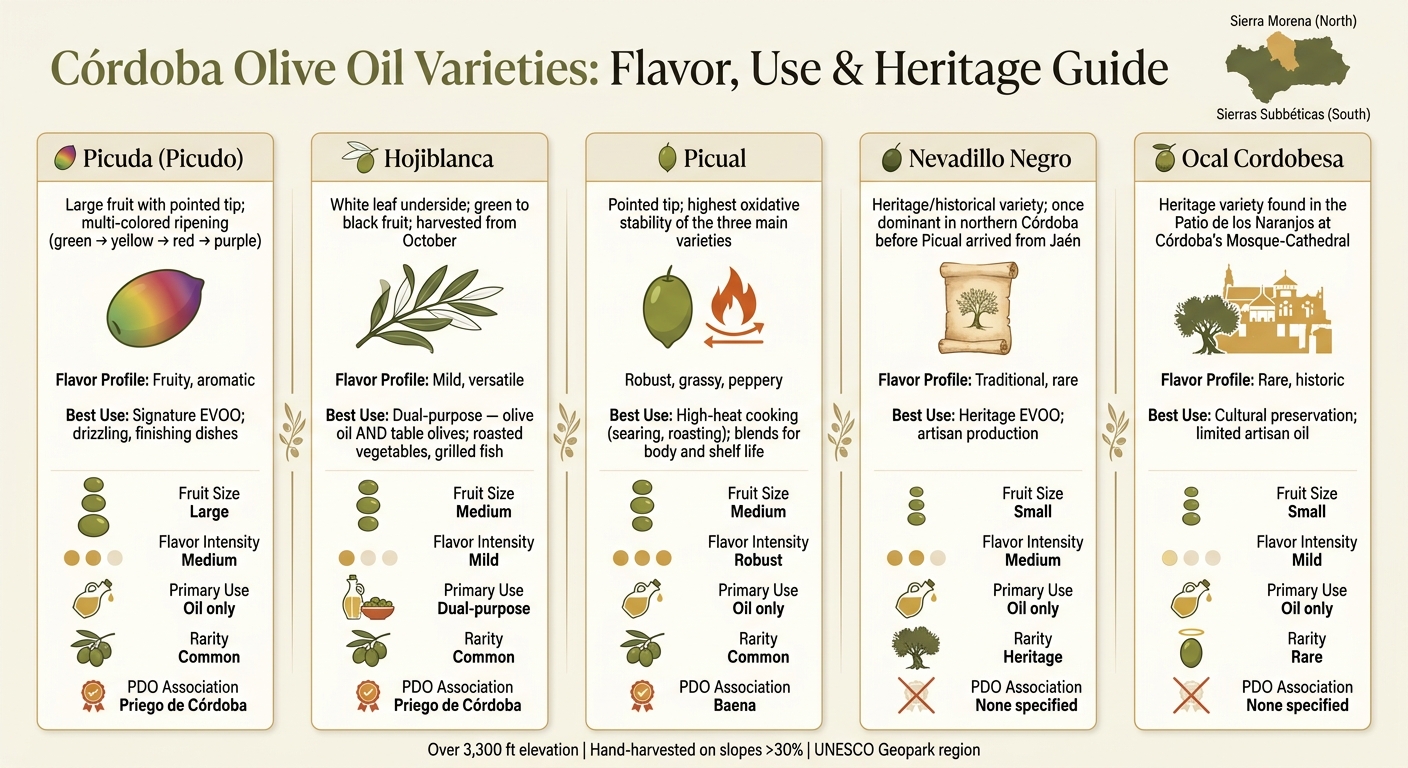
Córdoba Olive Oil Varieties: Flavor, Use & Heritage Guide
Geography and Climate of Córdoba's Olive Groves
Córdoba's olive groves thrive in two contrasting regions: the rugged Sierra Morena foothills to the north and the elevated Sierras Subbéticas to the south. The Subbéticas area, a UNESCO Geopark, is particularly remarkable. Over half of the olive groves in the DOP Priego de Córdoba are situated above 3,300 feet, with many on slopes steeper than 30%. This steep terrain means that harvesting must be done by hand, as machinery simply can't handle it. These geographical features play a big role in shaping the types of olives grown across the region.
The Sierra Morena foothills offer a different picture. Here, olive trees coexist with Mediterranean shrubs and forest species, creating a multifunctional landscape. For centuries, this area has supported grazing, firewood collection, and fruit harvesting. Some ancient olive trees in this region have trunk perimeters exceeding 9.8 feet, showcasing their impressive age. As noted by Francisco Jesús Gómez-Gálvez and his team at IFAPA:
"In these areas, the olive grove was integrated with forest species and presented an irregularity in the planting frame. It was a multifunctional crop, where the use of the cover for pasture and the extraction of firewood could be as important as the harvest of fruit."
Main Olive Varieties Grown in Córdoba
Córdoba boasts a wide range of olive varieties, each bringing its own personality to the region's oils. The Picuda (also called Picudo) stands out as a local specialty. This variety, concentrated in the DOP Priego de Córdoba, is known for its large fruit with a pointed tip and a colorful ripening process that transitions through green, yellow, reddish, and purple hues.
Another key variety is Hojiblanca, which gets its name from the whitish underside of its leaves. Harvested starting in October, it’s prized for its versatility, being used for both olive oil and table olives. Then there’s Picual, the most widely cultivated olive variety globally. In Córdoba, it’s often blended (coupages) to enhance stability and body.
In addition to these popular varieties, a 2021 study by IFAPA researchers identified seven heritage varieties among 68 ancient olive specimens in the Sierra de Córdoba foothills. These include Nevadillo Negro, once the dominant oil-producing variety in northern Córdoba before Picual arrived from Jaén, and Ocal Cordobesa, a variety linked to the ancient olive tree in the Patio de los Naranjos at Córdoba's Mosque-Cathedral.
| Variety | Key Characteristic | Role in Córdoba |
|---|---|---|
| Picuda | Large fruit, pointed tip, multi-colored ripening | Signature variety of DOP Priego de Córdoba |
| Hojiblanca | White leaf underside; green to black fruit | Versatile; oil and table olives |
| Picual | Pointed tip; high oxidative stability | Common in blends for body and shelf life |
| Nevadillo Negro | Historical northern Córdoba variety | Predated Picual as the main oil variety |
| Ocal Cordobesa | Heritage variety; high Sierra presence | Linked to the Mosque-Cathedral's olive tree |
These varieties not only define the region's olive-growing identity but also contribute to the unique flavors that make Córdoba's oils special.
Flavor Profiles and Cooking Uses
Córdoba's extra virgin olive oils (EVOOs) are evaluated based on three main qualities: fruitiness, bitterness, and pungency - that sharp, peppery sensation at the back of the throat. Harvest timing plays a big role in the final flavor. Oils made from early-harvested fruit in late October are intensely green and aromatic, while those from January harvests tend to be sweeter and milder.
These oils are essential to Córdoba's cuisine, particularly in dishes like salmorejo, where EVOO is both a key ingredient and a finishing touch. For home cooks in the U.S., a medium-intensity Hojiblanca or Picuda EVOO is a great choice for drizzling over roasted vegetables, grilled fish, or pasta. Meanwhile, a robust Picual-based oil is perfect for high-heat cooking, such as searing or roasting, making it a versatile option for everyday use.
Olive Oil in Córdoba's Culture and Tourism
Olive Oil as Part of Córdoba's Identity
In Córdoba, olive oil is much more than just a cooking staple - it’s woven into the fabric of everyday life, language, and the region's landscape. Words like almazara (olive mill) and aceite (oil) echo the area's deep Arabic heritage, a reminder of the cultural influences that have shaped the region over centuries.
Historically, olive oil played a central role in the lives of Córdoba’s people. It wasn’t just used for cooking - it illuminated homes, served medicinal purposes, and even supported religious obligations. After 1236, monasteries and military orders took the lead in olive cultivation, cementing its importance in the region’s economy and culture. This long history has transformed Córdoba’s olive groves into what some call a "constructed landscape" - a testament to human ingenuity and care over the ages.
One particularly powerful symbol of this legacy is the Ocal Cordobesa olive tree, located in the Patio de los Naranjos at the iconic Mosque-Cathedral (Mezquita-Catedral). This ancient tree stands as a living reminder of Córdoba’s agricultural roots and the enduring significance of olive oil in its story.
This deep connection to olive oil naturally extends to the region’s tourism, offering travelers a chance to immerse themselves in Córdoba’s heritage through unique olive oil experiences.
Visiting Córdoba's Olive Oil Sites
Córdoba’s rich olive oil history has paved the way for a growing tourism industry that invites visitors to explore this heritage up close. The region’s traditions, which have shaped its identity for centuries, now form the backbone of its vibrant olive oil tourism. For U.S. travelers, this means an opportunity to dive into oleotourism, starting with the towns of Priego de Córdoba and Baena. Both towns operate under strict Protected Designation of Origin (PDO) standards, ensuring the highest quality of extra virgin olive oil (EVOO). Local almazaras welcome visitors with tastings and guided tours, offering a behind-the-scenes look at how premium EVOO is made.
Two standout destinations provide particularly memorable experiences. Hacienda Guzmán offers an impressive Olivoteca featuring over 150 olive tree varieties from 13 countries. Visitors can also explore a restored 17th-century "blood mill", once powered by animals, and marvel at a 50-foot mahogany pressing beam from the same era. English-language tours are available, making it accessible for travelers from the U.S.
Another must-visit spot is Monteoliva Cordobesa in Montilla, which has been producing EVOO since 1870. Their modern extraction process maintains temperatures between 77°F and 80°F (25–26.5°C) to preserve the oil’s rich aroma. Afterward, the oil undergoes a 24-hour natural decantation process to remove impurities without using chemicals.
"Our almazara represents the ideal union of our philosophy, which combines tradition and technology, always focused on quality as our main differentiating factor." - Monteoliva Cordobesa
For those seeking a more natural setting, the foothills of Sierra Morena offer a chance to connect with history through its ancient olive trees. In areas like Arroyo Pedroche, some of these trees boast trunk perimeters over 9.8 feet and were historically grafted onto wild olive rootstocks. These centennial trees stand as living monuments to the region’s enduring olive oil legacy.
How to Taste and Use Córdoba Olive Oil at Home
How to Taste Córdoba Olive Oil
Tasting high-quality Córdoba extra virgin olive oil (EVOO) the right way can transform your experience. Professionals rely on the "4 Ss" method - swirl, sniff, slurp, and swallow - something you can easily try at home with a simple glass.
Start by gently swirling the oil in the glass to warm it to about 82°F. This releases its aroma, making it easier to detect its nuances. Then, uncover the glass and take a deep sniff to soak in the intensity and complexity of the scent. Take a small sip, drawing in air as you do, allowing the oil to coat your palate and activate retro-nasal receptors. Finally, swallow to experience the signature peppery sensation in your throat, a hallmark of high-quality EVOO.
"Pungency is a biting tactile sensation noticed in one's throat. Sometimes oils are referred to as one or two 'coughers' as this is a common response to pungency." - California Olive Oil Council
While tasting, pay attention to three key traits: fruitiness (think fresh grass, green apple, or artichoke), bitterness on the tongue, and pungency in the throat. These aren't flaws - they reflect freshness and a rich polyphenol content. If you're trying multiple oils, cleanse your palate with a slice of Granny Smith apple and water between tastings.
One useful tip: don’t judge the oil by its color. High-quality olive oils can range from pale yellow to deep green depending on the olive variety and harvest timing. Color has no bearing on flavor or quality.
Once you've explored its flavor profile, the next step is to put Córdoba EVOO to work in your kitchen.
Cooking with Córdoba-Style EVOO
The same characteristics that make Córdoba-style EVOO a standout for tasting also make it a versatile addition to your cooking. Its robust, grassy flavor - especially common in Picual varieties - holds up well under heat, making it perfect for sautéing vegetables, drizzling over grilled meats, or finishing a pasta dish. In the U.S., it’s also popular as a dipping oil, a base for vinaigrettes, or even spread on sourdough toast.
Keep in mind that EVOO starts losing its flavor and health benefits as soon as it’s pressed. Once opened, aim to use the bottle within four months. Store it in a dark, cool place - away from the stove - and use tinted glass bottles to protect it from light. Studies show that oils stored in darkness can maintain their quality for 49–56 days after opening, compared to just 28–35 days when exposed to light.
When buying olive oil, look for the harvest year on the label rather than just the bottling date. Oils cold-pressed soon after harvest tend to offer more complexity than those that have been sitting in storage for too long.
Big Horn Olive Oil: A Source for Ultra Premium EVOO
If you’re looking to bring the essence of Córdoba into your kitchen, check out Big Horn Olive Oil. Founded by Devan Stormont, this company offers Ultra Premium Extra Virgin Olive Oils that are cold-pressed within two hours of harvest and delivered fresh within three months of the crush date.
Big Horn Olive Oil features single-source options like Picual and Coratina EVOO, both priced at $8.99. These oils meet Ultra Premium (UP) standards, which are far stricter than international EVOO guidelines. UP-certified oils must have Free Fatty Acids (FFA) of ≤ 0.3% and a peroxide value of ≤ 9 mEQ O₂/kg, compared to the international standard of ≤ 0.8% FFA and ≤ 20 mEQ O₂/kg. This commitment to higher standards ensures a cleaner, more vibrant oil for your kitchen.
Conclusion: Córdoba's Olive Oil Heritage
Córdoba's olive oil history spans over 2,000 years, beginning with Iberian farmers long before Roman influence and evolving through Arab innovations, which introduced terms like aceite and almazara. This unbroken legacy is extraordinary. The Guadalquivir basin, once exporting oil to Rome's Monte Testaccio, now produces olive oils under Protected Designations of Origin like Baena and Priego de Córdoba. Notably, Priego de Córdoba holds the distinction of being the most awarded Denomination of Origin globally.
This heritage isn't just a story - it's visible in the region's landscape. Ancient olive trees in the Sierra Morena, some with massive trunks over 10 feet in circumference, stand as living witnesses to centuries of cultivation. The 'Ocal Cordobesa' variety, found in Córdoba's iconic Patio de los Naranjos at the Mosque-Cathedral, ties the city's urban landmarks back to its agricultural roots.
Córdoba’s dedication to preserving this legacy has earned it international recognition. DOP Priego de Córdoba credits its acclaim to the natural beauty of its groves, the enduring presence of century-old trees, and the expertise of its farmers and millers.
While Córdoba ranks among Spain's leading olive oil producers, its reputation is built on quality rather than sheer output. Supporting oils from traditional mountain groves (olivar de sierra) or PDO-certified producers helps protect rare local varieties. For example, some varieties have dwindled from 30,000 trees in the late 19th century to fewer than 600 in certain areas today. These efforts sustain not only unique olive types but also a cultural heritage deeply rooted in local cuisine.
This commitment to excellence defines Córdoba's culinary identity. As Turismo de Córdoba aptly states, "Olive oil is the distinguishing mark of Cordovan cuisine and the foundational ingredient in the majority of its dishes". Whether enhancing salmorejo, finishing a grilled dish, or simply enjoyed on its own, every drop of Córdoba's extra virgin olive oil reflects a tradition that has shaped the region for thousands of years.
FAQs
What makes Córdoba olive oil taste different from other Spanish EVOOs?
Córdoba olive oil is known for its well-rounded and smooth flavor profile. It offers a mix of fruity and mildly sweet notes, complemented by subtle hints of fresh herbs, green apple, and almond. This distinctive taste comes from local olive varieties like Hojiblanca and Picudo, which are an integral part of the region’s rich tradition.
How can I tell if a bottle is really PDO/DOP Baena or Priego de Córdoba?
To ensure a bottle is genuine PDO/DOP Baena or Priego de Córdoba olive oil, check for the EU PDO logo (a red and yellow sunburst), a label that clearly states Extra Virgin Olive Oil, and a numbered back label issued by the PDO Regulatory Council. Additionally, the bottle should mention specific regional names such as Priego de Córdoba or Baena. Be cautious of labels using terms like "style" or "produced as in", as these can be misleading.
What’s the best way to store EVOO at home to keep it fresh longer?
To keep extra virgin olive oil (EVOO) fresh, store it in a cool, dark place like a pantry, away from heat sources like stoves or sunlight. Opt for dark glass bottles or stainless steel containers to shield it from light, and always reseal the container tightly after use to minimize air exposure. Ideally, maintain a storage temperature between 55°F and 65°F. Avoid refrigeration, as it can alter the oil's texture.