

Economic Impact of Sustainable Olive Oil Packaging
Packaging can cut margin just as fast as it can support price. If I’m selling olive oil in the U.S., the best pack is not always the cheapest one to buy. It’s the one that balances shipping weight, breakage, oil protection, waste, and what buyers will pay.
Here’s the short answer:
- Glass supports premium pricing and strong oil protection, but it is heavy and more likely to break.
- PET is light and low-cost, but it protects EVOO less well, which can hurt shelf life and product value.
- Metal tins offer strong protection with lower damage risk, making them a solid middle-ground option.
- Bag-in-box cuts freight cost and slows oxidation after opening, but it has lower appeal for gift and premium shelf sales.
- In some tests, better glass setups cut breakage from 4.8% to 0.9% and lifted average order value by 12%.
- Small packs can carry a heavy footprint: for 0.1-liter bottles, packaging can account for up to 60% of total warming impact.
If I boil the article down to one point, it’s this: the right package depends on channel fit. A gift-focused brand may win with upgraded glass. A bulk or value-led brand may keep more profit with PET or bag-in-box. And if the pack fails to protect the oil, any savings at checkout can disappear later through returns, lower shelf value, or weaker pricing.
Quick Comparison
| Format | Upfront Pack Cost | Shipping Burden | Damage Risk | EVOO Protection | Best Fit |
|---|---|---|---|---|---|
| Glass | High | High | High | High | Premium retail, gifting |
| PET | Low | Low | Low | Low | Value and high-volume sales |
| Metal tin | Moderate | Moderate | Low | High | DTC shipping, pantry use |
| Bag-in-box | Moderate | Low | Low | High | Bulk, refill, volume sales |
So before I judge a package by unit cost alone, I’d look at the full math: freight, breakage, shelf life, disposal, and price upside.
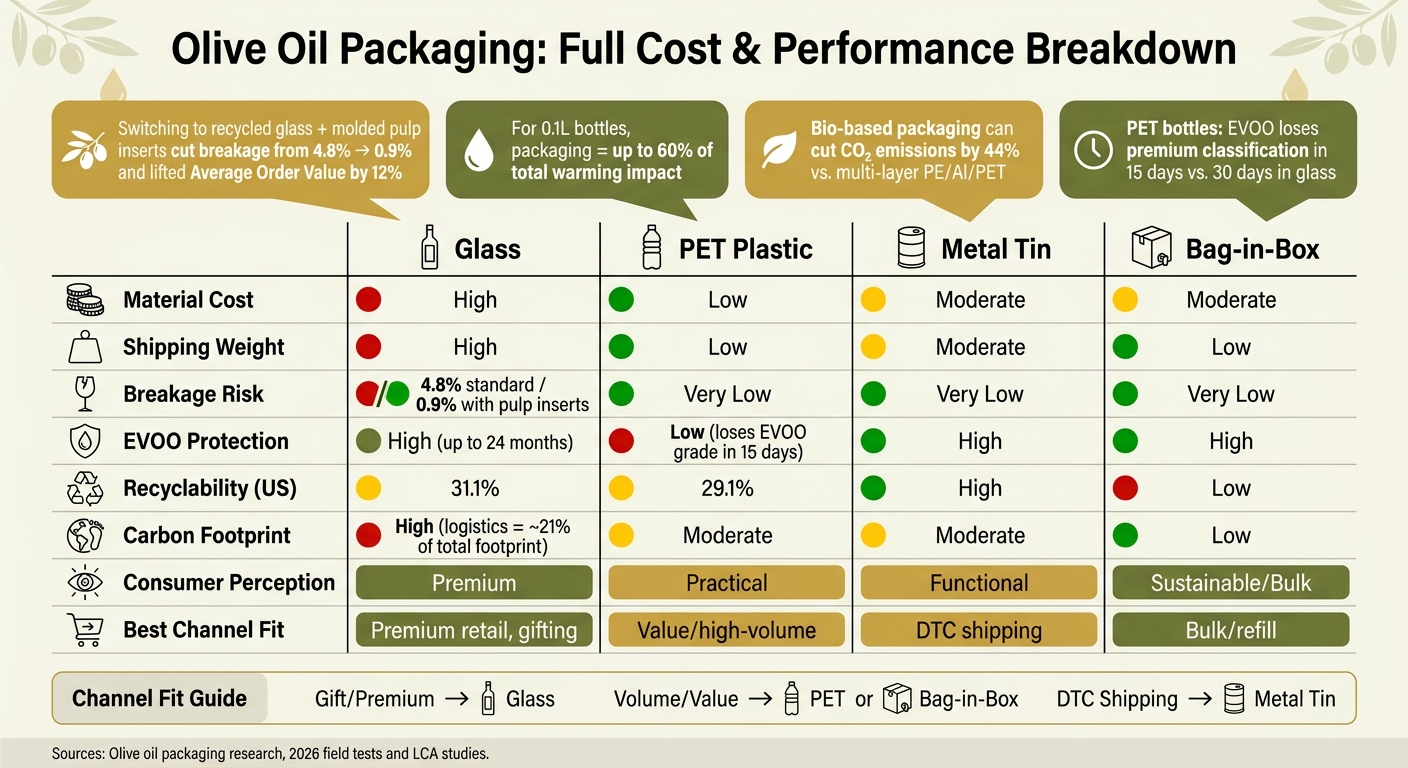
Olive Oil Packaging Formats: Cost, Protection & Sustainability Compared
Bag in Box for Extra Virgin Olive Oil – Benefits, Sustainability, and Comparison
sbb-itb-4066b8e
Packaging Formats Studied in Olive Oil Research
Cost pressure changes a lot based on the container. In olive oil research, four formats show up again and again: glass bottles, PET plastic bottles, metal tins, and bag-in-box systems. Each one changes freight cost, shelf-life protection, and disposal burden in its own way.
Glass, PET, Metal, and Bag-in-Box: Key Differences
The cost story starts with shipping, product protection, and what happens after use.
Glass is still the go-to format for premium EVOO because it is inert and helps preserve flavor. Tinted glass also blocks UV light. The tradeoff is pretty simple: glass is heavy and fragile, so shipping costs and breakage risk go up.
PET plastic is light and shatter-resistant, which makes it a common fit for high-volume or budget-tier products. Its weak spot is oxygen protection. That weaker barrier can shorten shelf-life protection for EVOO.
Metal tins - usually tinplate steel - give strong protection from both light and oxygen. They also hold up well in transit. If a tin gets dented, the oil inside is often still protected.
Bag-in-box is mostly used for larger volumes, usually 3 to 10 liters. As the oil is poured out, the inner bag collapses, which slows oxidation. It is also very light, and that can cut total landed cost for larger-volume sales. The catch? It uses more than one material, so recycling gets harder.
| Feature | Glass | PET | Metal (Tin) | Bag-in-Box |
|---|---|---|---|---|
| Material Cost | High | Low | Moderate | Moderate |
| Shipping Weight | High | Low | Moderate | Low |
| Carbon Impact | High | Moderate | Moderate | Low |
| Recyclability | High | Moderate | High | Low |
| Product Protection | High | Low | High | High |
| Breakage Risk | High | Low | Low | Low |
| Consumer Perception | Premium | Practical | Functional | Sustainable / Bulk |
Which Packaging Variables Drive Economics
Format choice shapes a lot more than the package bill.
The biggest gap usually comes from weight. Heavier formats cost more to move, and that adds up fast. For a premium Italian EVOO sold in glass, logistics and end-of-life disposal make up about 21% of the product's total carbon footprint. Change the package, and that share shifts too.
Damage rates matter as well. Glass breakage can mean lost product and extra handling. Tins tend to be steadier in long-distance retail distribution because they usually dent instead of leaking.
Recycling rates also affect the value of sustainability claims. In the U.S., glass recovery is about 31.1%, while the average across Europe is 78%. That gap matters. Lower U.S. glass recovery can weaken recyclable-packaging claims and cut some of their market value.
What Research Shows About Emissions, Logistics, and Waste
How Packaging Weight Affects Shipping Costs and Emissions
Format choice is only part of the cost picture. Shipping emissions, breakage, and what happens after use matter too.
Packaging weight has a direct effect on freight cost and emissions. For shipments over 250 miles, unrecycled plastic can produce a lower carbon footprint than glass.
Lighter packs usually help on freight. But there’s a catch: if more units arrive damaged, some of that gain disappears. In 2026 field tests, standard glass bottles posted a 4.8% breakage rate, while recycled-glass bottles with molded pulp inserts cut that figure to 0.9%. That drop helps protect margins and cuts waste from product that can’t be sold. Hybrid bottles with a thin polymer inner layer can also reduce shipping emissions by about 8% versus standard glass.
Recycling and Waste Reduction in Packaging Strategy
Recyclable packaging sounds good on paper. The problem is that recovery rates in the U.S. are still low.
Glass container recycling stands at 31.1%, and PET bottles come in at 29.1%. So if a brand is leaning on recyclability as a way to stand out, the market upside may be weaker than expected.
Small bottles make this even more stark. For 0.1-liter gift or tasting sizes, packaging can make up as much as 60% of the product’s total global warming potential.
Mono-material packaging can help here. It makes recycling rules easier to meet, supports faster sorting, and can reduce retailer pushback around disposal, which turns packaging choice into a direct cost and positioning issue. Bio-based options such as PLA and Bio-PE can deliver a 44% cut in CO₂ equivalent emissions compared with multi-layer PE/Al/PET packaging, though they still come with trade-offs in land and water use.
All of these logistics and waste effects flow straight into landed cost and margin.
Cost and Profit Trade-Offs by Packaging Format
Once shipping differences are clear, the next step is simple: which package leaves you with more margin?
Unit Cost vs. Total Landed Cost
Packaging economics come down to landed cost, not just the price of the container.
In the Spanish market, 750 mL glass bottles cost €0.731 to €3.299 per kilogram of oil, while 1 L PET containers cost €0.259 to €1.332 per kilogram of oil. On paper, PET looks much cheaper. But that’s only part of the story.
Once you add freight, breakage, and the extra outer packaging needed to protect the product, the gap can shrink fast. Glass weighs more, so it costs more to move and reduces pallet efficiency. Distribution costs for glass range from €0.177 to €0.419 per kilogram of oil, while PET logistics range from €0.142 to €0.419 per kilogram of oil.
And then there’s breakage. A lower freight bill doesn’t help much if damaged units eat into margin. Molded pulp inserts cut that risk sharply.
| Format | Material Cost | Freight Impact | Breakage Risk | Key Cost Driver |
|---|---|---|---|---|
| Glass (Standard) | High | Very High | 4.8% | Weight + returns |
| PET | Low | Low | Very low | Unit cost |
| Recycled Glass + Pulp | High upfront cost (+18%) | High | 0.9% | Upfront investment |
| Metal Tin | Moderate | Moderate | Very low | Protection efficiency |
| Bag-in-Box | Low | Lowest | Very low | Logistics savings |
Price Premiums, Buyer Perception, and Margin Potential
Low landed cost only helps if buyers are willing to buy that format at your target price. That’s where channel fit starts to matter.
Premium channels tend to pay for presentation. Volume channels care more about efficiency.
For premium EVOO sold through gift or direct-to-consumer channels, field tests found that switching to recycled glass with molded pulp inserts increased Average Order Value (AOV) by 12%. The switch adds about £0.95 to £1.90 per unit, but the higher AOV and lower breakage can bring the format to break-even within three months.
Bag-in-box and pouches are strong on logistics, but they have lower gift appeal. That makes them a weaker fit for premium retail or online gifting.
In practice, the best format depends on where and how you sell:
- Recycled glass with protective inserts fits gift-heavy channels.
- Tins suit direct-to-consumer shipping where durability and freight cost both matter.
- PET and bag-in-box fit volume-led or sustainability-focused channels where shipping efficiency matters more than shelf presence.
Sustainability pays off only when the package fits the channel, shipping profile, and shelf-life need. The key question is pretty down-to-earth: does the package protect EVOO quality without eating your margin?
Product Protection, Market Value, and Key Takeaways
How Packaging Protects EVOO Quality and Supports Premium Positioning
Those cost savings only matter if the package keeps the oil in good shape during shipping and on the shelf. If EVOO gets hit by light, oxygen, or heat, the math changes fast.
In simulated transport tests, olive oils lost EVOO classification after just 15 days in PET bottles, versus 30 days in glass bottles, which cut into sellable inventory and hurt premium positioning. Transport conditions can also push oxidation markers up by as much as 107% over 45 days.
Glass still stands out as a premium format. It blocks oxygen better than PET, and dark or opaque packs help limit light damage. For premium EVOO, that added protection can help keep freshness and polyphenol levels for up to 24 months.
That has a direct effect on resale value and margin. When packaging helps maintain quality, brands are in a better spot to support premium pricing, reduce returns, and build trust.
FAQs
Which packaging format is most profitable?
Profitability comes down to your business model, not one packaging format that works for everyone.
For gift-focused urban businesses, recycled glass paired with molded pulp inserts can pay off fast. This setup can lift gift-purchase conversion and average order value by 12%, which helps cover the $1.45 per-unit cost increase within three months.
If your margins are tight, a minimalist sleeve plus a digital tasting card is the lower-cost route.
Refillable programs can help profits too, especially by bringing loyal local customers back more often.
When is glass worth the extra cost?
Glass is worth the extra cost when protecting high-quality extra-virgin olive oil is the main goal. Because glass is inert and non-porous, it helps protect delicate flavors, aromas, and nutritional properties from light, heat, and oxygen for up to 24 months.
It can also help position a product as more premium, make it look better on the shelf, and support higher price points. In gift-heavy markets, that added value may help balance the higher cost per unit.
How does packaging affect olive oil shelf life?
Packaging has a big impact on olive oil shelf life because it shields the oil from light, heat, and oxygen. Those three things wear down both flavor and nutritional quality.
Dark glass and metal do a good job of blocking light. But there’s a catch: rigid containers can let air in each time oil is poured, which speeds up oxidation.
That’s why bag-in-box packaging and vacuum-collapsing liners can help oil last longer. They limit contact with oxygen, so the oil stays in better shape over time.
Big Horn Olive Oil recommends storing olive oil in the dark at 61–64°F.