

Energy-Efficient Harvesting: Benefits for Olive Oil Quality
Energy-efficient harvesting methods are transforming olive oil production. By reducing energy use and minimizing damage to olives during collection, these techniques improve both operational efficiency and the quality of extra virgin olive oil (EVOO). Here's a quick rundown:
- Lower Energy Use: Tools like trunk shakers and hand-held harvesters reduce energy consumption, measured in watt-hours per kilogram (W·h/kg). Adjustments, such as raising shaker attachment points, can cut power usage nearly in half.
- Higher Oil Quality: Efficient harvesting protects olives from bruising and oxidation, preserving phenolic compounds and enhancing flavor, aroma, and shelf life.
- Improved Metrics: Mechanical systems like trunk shakers achieve removal efficiencies as high as 98%, though some trade-offs in fruit damage may occur.
- Sustainability: These methods cut fuel consumption and CO₂ emissions, particularly in organic orchards, which use up to 22% less energy than conventional systems.
Energy-efficient harvesting isn't just about saving costs - it's about producing better olive oil while reducing environmental impact. The right tools and timing ensure olives remain intact, retaining their chemical properties and delivering premium-quality EVOO.
How TONS of Olives Become Liquid Gold Every Hour
sbb-itb-4066b8e
Energy Use in Olive Harvesting: Methods and Metrics
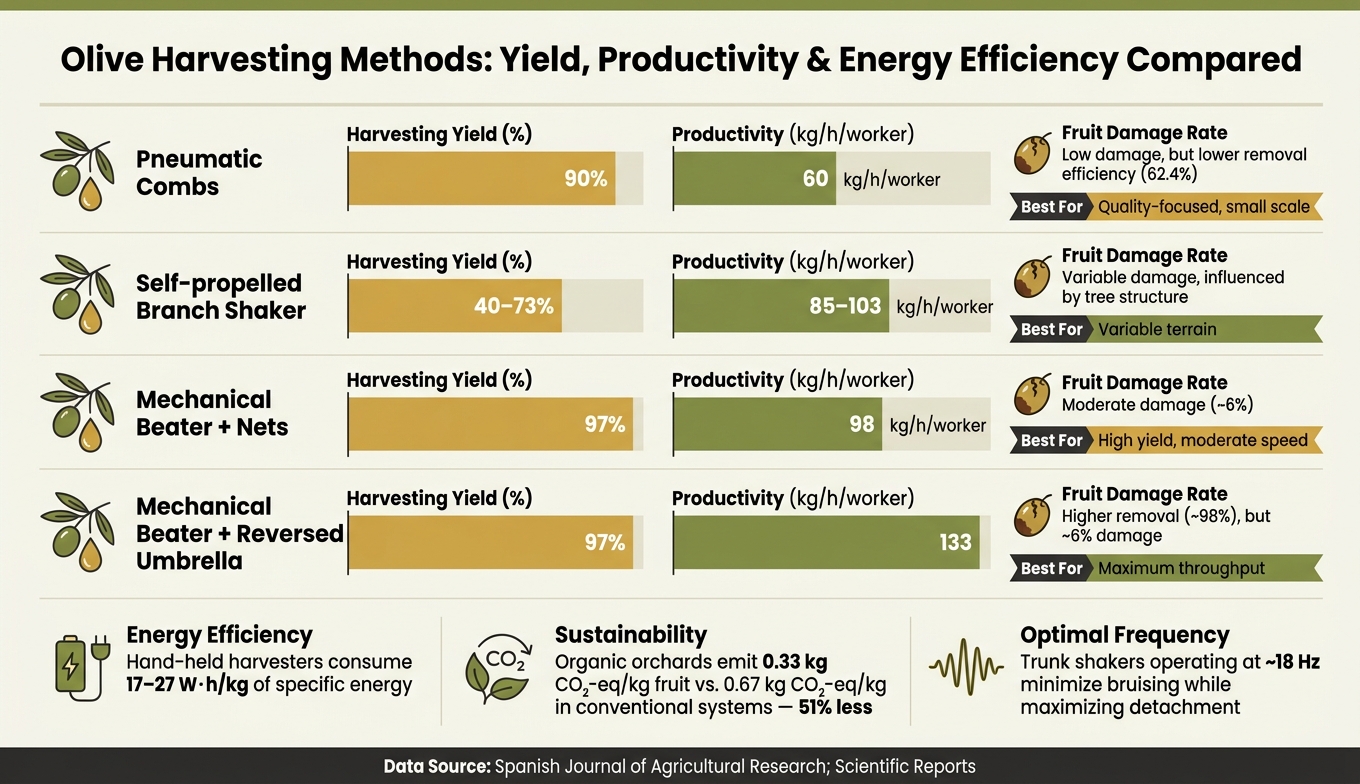
Olive Harvesting Methods: Yield, Productivity & Energy Efficiency Compared
How Energy Efficiency Is Measured in Harvesting
Energy efficiency in olive harvesting is all about precision. The main metric used is specific consumed energy, measured in W·h/kg. For hand-held mechanical harvesters, this typically ranges between 17.0 and 27.0 W·h/kg. A lower number means the equipment is doing more work with less energy - saving on costs and reducing environmental impact.
When it comes to larger equipment like trunk shakers, researchers focus on measuring the actual shaking power. This is done by analyzing the hydraulic oil flow and pressure alongside the fruit removal efficiency - the percentage of olives successfully detached from the tree. Efficient energy use only matters if it leads to effective harvesting. For instance, pulsed motion harvesters can achieve removal efficiencies of about 98%. However, this often comes at a cost - around 6% of the fruit may sustain damage, which can directly affect the quality of olive oil. This trade-off underscores the importance of balancing energy consumption with the overall harvesting outcome.
"The predicted required power of the olive trunk shaker is influenced by shaking displacement, fruit detachment force, fruit mass, stem length, damping ratio, unbalanced mass of the tree shaker, and exciting shaking frequency." - Scientific Reports
These metrics lay the groundwork for evaluating the performance and results of different harvesting methods.
Comparing Harvesting Techniques
Performance metrics reveal clear distinctions between harvesting methods. For example, a trial conducted in November 2009 in Southern Italy's Apulia region tested various methods on 'Cellina di Nardò' olive trees (60–100 years old). A mechanical beater mounted on a tractor, paired with a reversed umbrella catching frame, achieved a 97% harvesting yield and a productivity rate of 133 kg of olives per hour per worker. This was a significant improvement compared to a 2006 trial using the same beater but combined with hand-held pneumatic combs, which recorded only 60 kg/h per worker.
Here’s a side-by-side comparison of harvesting methods based on yield and productivity:
| Harvesting Method | Harvesting Yield | Productivity (kg/h/worker) |
|---|---|---|
| Pneumatic Combs | ~90% | 60 |
| Self-propelled Branch Shaker | 40%–73% | 85–103 |
| Mechanical Beater + Nets | ~97% | 98 |
| Mechanical Beater + Reversed Umbrella | ~97% | 133 |
Data Source: Spanish Journal of Agricultural Research
These differences in efficiency also influence the condition of the olives and, ultimately, the quality of extra virgin olive oil (EVOO). Fully mechanized systems tend to deliver better yields and faster results compared to semi-mechanical methods, without necessarily causing more fruit damage. On the other hand, hook-type hand-held harvesters are gentler on the fruit, keeping damage rates as low as 2.0–2.5%. However, their removal efficiency lags behind at 62.4%, making them a better fit for producers prioritizing oil quality over speed. The choice of harvesting method ultimately depends on the producer's goals - whether they value throughput, energy efficiency, or fruit integrity the most.
How Energy-Efficient Harvesting Affects Olive Oil Quality
Harvest Timing and Fruit Integrity
When energy-efficient trunk shakers operate at approximately 18 Hz, they distribute vibrations evenly across the olive canopy. This method not only improves olive detachment but also minimizes bruising, which is essential for maintaining the integrity of the fruit. Preserving fruit integrity is a key factor in ensuring the production of high-quality olive oil, as it safeguards vital bioactive compounds.
Phenolic Content and Antioxidant Preservation
Efficient harvest timing goes beyond preventing physical damage - it also helps retain critical chemical properties. In super-high-density (SHD) orchards, energy-efficient mechanical harvesting allows producers to optimize the timing of their harvest. For example, "Arbequina" and "Arbosana" cultivars are typically harvested in November, a period when phenolic and aromatic compounds are at their peak.
Between 2016 and 2018, researchers Juan J. Polari and Selina C. Wang from the University of California, Davis, collaborated with Mary Mori of California Olive Ranch to study SHD orchards growing "Arbequina", "Arbosana", and "Koroneiki" cultivars. Their findings highlighted how efficient SHD harvesting systems enable precise timing tailored to each cultivar, directly influencing the bioactive and sensory qualities of extra virgin olive oil.
"Phenolic and volatile compounds are profoundly affected by cultivars and crop seasons, suggesting the relevance of these factors on the sensory and nutritional properties of virgin olive oil from super-high-density cultivars." - Juan J. Polari, Department of Food Science and Technology, University of California Davis
Sensory Attributes and Shelf Life
Maintaining the integrity of the olives and processing them immediately after harvest significantly enhances the flavor, aroma, and stability of the oil. This approach reduces oxidation during the harvesting process, which, in turn, extends the shelf life of the oil. These sensory and preservation benefits underscore the importance of energy-efficient harvesting in producing premium-quality extra virgin olive oil that meets the expectations of discerning consumers.
Sustainability and Production Synergies
Reducing Carbon Footprint in Olive Oil Production
Adopting energy-saving methods in olive oil harvesting not only helps maintain oil quality but also significantly cuts greenhouse gas emissions. For instance, conventional orchards emit about 0.67 kg CO₂-eq per kilogram of fruit, while organic orchards using sustainable practices emit nearly half that amount - 0.33 kg CO₂-eq per kilogram. This impressive reduction is achieved by incorporating renewable energy sources and cutting back on synthetic fertilizers.
Energy usage also tells a similar story. Producing one kilogram of olive fruit in conventional systems requires 11.37 MJ, compared to just 8.81 MJ in organic systems. The most energy-intensive activities - harvesting, soil management, and pruning - are heavily reliant on fuel and electricity. By fine-tuning machinery settings, such as adjusting the height and frequency of trunk shakers, farmers can significantly lower fuel consumption per cycle. Over an entire growing season, these small adjustments translate into substantial emissions reductions.
These energy efficiencies don’t just benefit the environment - they also complement the steps taken during downstream processing.
Coordinating Harvesting and Milling for Quality
Energy-efficient harvesting techniques do more than reduce emissions - they also play a key role in preserving the quality of olive oil. By minimizing fruit damage and ensuring quick transport to the mill, these methods help protect the oil’s delicate aromatic and antioxidant properties. Delays in processing can lead to oxidation and enzymatic breakdown, which compromise both flavor and phenolic content.
Harvesting systems that operate at medium frequencies, around 18 Hz, are particularly effective. They distribute vibration energy evenly through the olive canopy, avoiding excessive stress near the shaking point. This ensures quicker and cleaner fruit detachment while reducing mechanical damage. The result? Olives arrive at the mill in optimal condition, preserving the volatile aromatic compounds and antioxidants that define the rich flavor and health benefits of high-quality extra virgin olive oil. In this way, the care taken in the orchard is reflected in the final product.
Conclusion: Key Takeaways for Premium EVOO
Benefits for Consumers and Producers
Energy-efficient harvesting isn’t just about reducing costs - it directly impacts the quality of extra virgin olive oil (EVOO). The right harvesting methods help preserve essential components like antioxidants, phenolics, and the volatile compounds responsible for premium EVOO's rich flavor. For consumers, this means oil that tastes fresher, boasts stronger health benefits, and lasts longer on the shelf. Producers also gain from these practices by achieving better yields and lowering emissions, all while maintaining top-tier product quality.
Cultivar selection adds another layer of importance. Certain olive varieties thrive under specific conditions, and timing the harvest correctly can make a big difference. For example, in super-high-density (SHD) systems, Koroneiki olives consistently produce oil with high oleic acid and stable phenolic content. Meanwhile, Arbequina and Arbosana varieties hit their peak oil maturity in November. Aligning harvest timing with the cultivar's natural rhythm is one of the simplest and most effective ways to enhance both yield and nutritional value.
Big Horn Olive Oil's Commitment to Quality
These findings reflect the care and precision that Big Horn Olive Oil brings to its production process. Their cold-pressing techniques are specifically designed to protect the natural bioactive compounds discussed here. By ensuring the olives remain intact from harvest to press, they deliver Ultra Premium EVOO that stands out for its freshness, antioxidant strength, and exceptional flavor.
FAQs
How do I measure harvesting energy use (W·h/kg) on my farm?
To calculate energy consumption during olive harvesting in watt-hours per kilogram (W·h/kg), you need two key pieces of data: the total energy used and the total weight of the olives harvested.
- Measure energy usage: Record the energy consumed by machinery or equipment in kilowatt-hours (kWh). Then, convert this to watt-hours by multiplying by 1,000 (since 1 kWh = 1,000 W·h).
- Weigh the harvested olives: Use a scale to determine the total weight in kilograms (kg).
- Perform the calculation: Divide the total energy in watt-hours (W·h) by the total weight of olives in kilograms (kg). The result gives you the energy usage in W·h/kg.
This method ensures an accurate measurement of energy efficiency during the harvesting process.
Does faster mechanical harvesting reduce EVOO quality?
Faster mechanical harvesting can influence some quality factors of extra virgin olive oil (EVOO), like lowering phenol levels and oxidative stability. However, with careful management, it usually doesn’t impact the oil’s ability to meet the highest quality standards.
How soon should olives be milled after harvesting?
Olives need to be milled within 12 to 24 hours after harvesting to preserve their taste, freshness, and antioxidant levels. Processing them quickly is key to producing top-quality olive oil.