

Environmental Impact of Composting in Olive Groves
If you want the short answer: composting olive waste usually causes less harm than dumping, raw spreading, or burning. In the studies covered here, treated olive waste cut pollution markers like COD by 93% and phenols by 85%, while field trials in Greece lifted soil organic matter from 1.65% to 4.33% in the top 4 inches.
Here’s the plain-English takeaway:
- Raw olive mill wastewater is risky because it is acidic, salty, and loaded with organic matter and phenols.
- Burning prunings adds CO₂ and throws away material that could stay in the grove.
- Compost and mulch can improve soil by adding organic matter, holding more water, and supplying nutrients.
- Results depend on rate, timing, and soil type. Too much material, poor timing, or unstable waste can still lead to salinity, water repellency, oxygen stress, and leaching.
- The best results came from mixing inputs, such as compost, chopped prunings, and cover crops, instead of using one material alone.
A quick way I’d frame it: composting helps most when the waste is stabilized first, applied at moderate rates, and paired with smart orchard management. If not, some of the same soil and water problems can still show up.
| Disposal or treatment | Main downside or result | What studies showed |
|---|---|---|
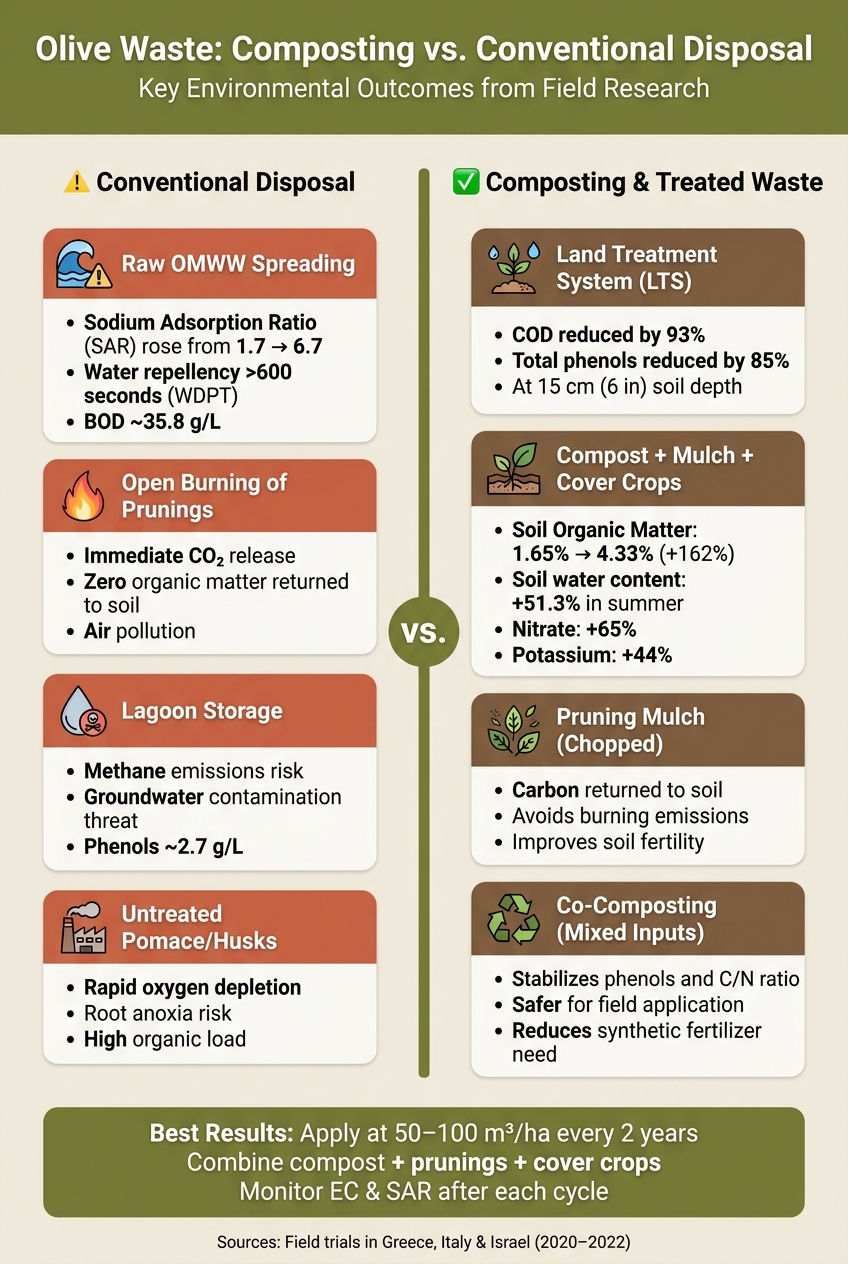
| Raw OMWW spreading | Salinity, phenols, water repellency | SAR rose from 1.7 to 6.7 in one study; WDPT passed 600 seconds in surface soil |
| Open burning of prunings | Air pollution and carbon loss | CO₂ released right away; no organic matter returned to soil |
| Land treatment for liquid waste | Pollution cut before deeper movement | Up to 93% COD and 85% phenol reduction at 6 inches depth |
| Compost + mulch + cover crops | Better soil condition | SOM rose from 1.65% to 4.33%; summer soil water also increased |
If you’re reading this as a grower, buyer, or researcher, the bottom line is simple: composting is not a free pass, but it tends to beat standard disposal when it is done with care.
Composting vs. Conventional Olive Waste Disposal: Environmental Impact Compared
How Regenerative Agriculture Helped Create the World’s Most Powerful Olive Oil
sbb-itb-4066b8e
Environmental Harm From Conventional Olive Waste Disposal
Standard disposal methods set the pollution baseline that composting has to beat. The way olive waste is handled can affect water, soil, and air in direct, measurable ways.
Waste Streams With the Highest Pollution Risk
Among olive waste streams, OMWW is often the biggest problem. Raw OMWW carries a high pollution risk because of its salts, phenols, organic matter, and acidity. Reported values include BOD of about 35.8 g/L, electrical conductivity as high as 12.1 dS/m, and phenolic concentrations near 2.7 g/L. That mix is bad news for the land: high BOD strips oxygen, high EC pushes salinization, and phenolic compounds are toxic to plants and soil microbes.
Solid by-products such as pomace and husks can also cause harm if they’re left untreated. Their high organic load can lead to fast oxygen depletion as they break down, which may trigger root anoxia in nearby crops. Pruning residues create a different kind of issue. When growers burn them in the field, they send CO₂ straight into the air and lose a chance to put organic matter back into the soil.
Measured Effects on Water, Soil, and Air Quality
Field research shows this damage in plain numbers. In a thirty-year-old olive grove in Perugia, central Italy, spreading OMWW at 80 m³/ha/year caused immediate jumps in soil salinity and changed the soil microbial community, with Firmicutes falling within 14 days. Longer-term use has also been tied to soil salinization. In one study, the sodium adsorption ratio (SAR) rose from 1.7 to 6.7.
There’s another problem here, and it’s easy to miss at first: soil water repellency. At the Gilat Research Center in Israel, Water Drop Penetration Time (WDPT) tests found severely water-repellent patches in the top 0–3 cm of soil, with WDPT values above 600 seconds after repeated OMWW applications. In plain English, water sat there instead of soaking in. That means more runoff and less rainfall absorption in rainfed orchards.
Put all of this together and the pattern is pretty clear:
- Lagoons threaten water and air
- Untreated spreading damages soil and water
- Burning harms air
- Landfilling can produce methane
The next section shows how composting changes these outcomes.
How Composting Changes Outcomes for Olive Waste
Composting can turn olive waste into stable soil amendments that improve soil fertility and water retention. The main study treatments are co-composting, mulching, and land treatment for liquid waste.
Composting Methods Used for Pomace, Husks, Sludge, and Prunings
Most studies focus on co-composting to deal with olive waste’s high C/N ratio and phenol load. Researchers mix olive-mill waste with materials like straw, manure, or chopped prunings so it breaks down better. On its own, raw olive waste is too carbon-rich and too high in phenols for direct field use.
Pruning residues are usually managed with direct mulching. That means growers chop the prunings and leave them on the soil surface. This avoids burning, sends carbon back into the soil, and increases soil fertility.
Liquid waste follows a different path. Here, land treatment systems (LTS) are often used instead of composting. In Skalani, Greece, a pilot LTS using Eucalyptus camaldulensis cut COD by 93% and total phenols by 85% at 15 cm (6 in) depth. Those results help show why researchers pay close attention to maturity and safety before anything goes back onto the land.
Researchers then check whether these treated materials are stable enough for field application.
How Studies Assess Compost Quality and Safety
Researchers assess treated olive waste using C/N ratio, total phenols, pH, and soil organic matter. COD is used mainly for liquid waste treatment.
The C/N ratio helps show whether nitrogen is available to plants or tied up for a while by microbes. A big drop in phenols points to safer material. In the N.AG.RE.F. study, an 85% drop in phenols showed that the waste had been detoxified. pH is used to track stabilization. In the same trial, retention pond pH increased from 5.04 to 7.47. Soil organic matter, or SOM, shows longer-term changes in soil condition. In a 2020–2022 Greek field trial, composted olive-mill waste, chopped prunings, and cover crops increased SOM from 1.65% to 4.33% in the top 0–10 cm (0–4 in).
Taken together, these measures help predict whether olive waste will improve soil or cause new losses after application.
Soil Carbon, Fertility, and Emissions in Compost-Amended Olive Groves
Once olive waste is stable, the next step is simple: does it help the soil, and can it cut emissions?
Soil Organic Carbon and Fertility Gains Reported in Field Trials
From 2020 to 2022, an ELGO-DIMITRA trial in Chania, Greece, found strong soil gains from a combined treatment that used composted olive-mill waste, pruning residues, and cover crops. Over two seasons, soil organic matter in the top 4 inches went from 1.65% to 4.33%.
That kind of change matters in day-to-day orchard management. More soil organic matter can mean less need for fertilizer, better moisture retention, and more carbon kept in the grove instead of released elsewhere.
| Soil Parameter | Combined Treatment | Control | Change |
|---|---|---|---|
| Soil Organic Matter (top 4 in) | 4.33% | 1.65% | +162% |
| Soil Nitrate (NO₃⁻) | 37.86 mg/kg | 22.90 mg/kg | +65% |
| Exchangeable Potassium (K) | 169.7 mg/kg | 117.93 mg/kg | +44% |
| Soil Water Content (Summer) | 4.36% | 2.88% | +51.3% |
The same research found that each 1% gain in SOM can increase water-holding capacity by up to 18.71 liters per square meter. In a dry olive-growing region, that’s not a small thing.
Greenhouse Gas Reductions Compared to Landfilling, Lagoons, and Burning
Composting and mulching pruning residues help avoid the direct CO₂ release that comes with open burning. They also keep more carbon in the soil. On top of that, controlled land application lowers disposal risk, and using olive by-products in place of synthetic fertilizer cuts emissions tied to fertilizer production and transport.
How Results Vary by Orchard System and Management
Results don’t look the same in every orchard. In the ELGO-DIMITRA trial, the combined treatment of compost, pruning residues, and cover crops did better than compost alone. It reached 4.33% SOM, compared with 3.20% in compost-only plots and 1.65% in the control. In plain terms, the stacked approach did the most.
There’s a catch, though. Heavy rain soon after application can move soluble nutrients deeper into the soil and increase leaching risk. So the upside depends a lot on timing, rainfall, and how the grove is managed.
Limits, Tradeoffs, and Gaps in Current Research
Those upsides hinge on stabilization, dose, and timing. Composting cuts harm only when the material is stable and used at the right rate. If not, olive waste amendments can bring back the same problems seen with raw disposal: salinity, runoff, and low-oxygen soil conditions.
When Composting Can Still Cause Emissions or Leaching
Bad timing or too much material can create clear risks. A high C/N ratio in olive pomace or olive mill wastewater can tie up nitrogen, which means less nitrogen is left for trees. If the material isn't stable, microbes can burn through oxygen as they break it down, leaving roots in low-oxygen conditions. And when waste dries on the surface without being worked into the soil, the top 0–3 cm can turn water-repellent.
Long-term overuse is another issue. One study found that applying 200 m³/ha of olive mill wastewater (OMWW) over nine years led to soil salinization and lasting increases in electrical conductivity.
| Risk Factor | Likely Effect | Management Condition Linked to It |
|---|---|---|
| High C/N ratio | Nitrogen tie-up and low-oxygen root conditions | Application of unstabilized olive pomace or wastewater |
| High application rates | Soil salinization, higher EC, and persistent water repellency | Repeated treatments at high doses |
| Poor aeration or high moisture | Low-oxygen root conditions and increased methane emissions | High-dose liquid application or over-irrigation of amended soils |
| Storm timing | Nutrient leaching to deeper soil layers, especially potassium | Application timed just before major storm events |
| Surface application without tillage | Water repellency and crusting | Waste left to dry on the soil surface without incorporation |
| High sodium content | Elevated Sodium Adsorption Ratio (SAR) | Repeated use of saline olive mill by-products |
Even the fixes come with a cost. Shallow tillage can help cut water repellency and crusting, but it can also disrupt soil aggregates and faunal communities.
That’s why high-resolution soil sampling matters both before and after application. The strongest effects are packed into the top 0–3 cm, so broad sampling can miss what’s happening right where the waste sits.
These problems can slip past researchers for a simple reason: many studies are short and don't follow the same design.
Common Limits in Olive Grove Compost Research
Most studies don't run long enough to catch slow salt buildup, phosphorus accumulation, or longer-term shifts in soil chemistry, microbes, and tree response. Feedstock mixes also vary a lot. Olive waste changes with climate, olive ripeness, and the extraction system used, which makes it hard to give growers one standard application rule.
There’s also not much data on soil-water quality, even though that’s the pathway most likely to reach groundwater. For U.S. growers, the biggest gap is location. About 98% of olive mill waste research and production is concentrated in the Mediterranean basin, mainly Italy, Greece, and Israel, so data for other olive-growing areas such as the U.S. are still limited.
What the Findings Mean for Olive Growers and Buyers
Management Practices Linked to Better Outcomes in the Studies
Within those limits, the studies point to a clear pattern: mixed organic inputs do better than single amendments.
Across the trials, the same three practices show up again and again. Apply olive mill wastewater at 50–100 m³/ha every two years, follow it with shallow tillage at about 5 cm depth, and combine carbon-rich prunings with nitrogen-rich cover crops.
That mix makes sense in plain terms. One input on its own can only do so much. But when growers combine materials that bring different things to the soil, the system tends to work better.
For sandy or lighter soils, there’s one extra step that matters. Monitoring electrical conductivity (EC) and sodium adsorption ratio (SAR) after each application cycle is a practical way to keep an eye on salinity.
How Sustainability Research Connects to Olive Oil Sourcing
For buyers, the clearest signal is documented grove management. In practice, that means looking for producers that track lower synthetic fertilizer use and comply with spreading limits.
Conclusion: Core Findings From Current Research on Composting in Olive Groves
Field trials show that composting olive waste causes less environmental harm than standard disposal methods. Study after study points in the same direction. Two findings stand out most: stabilizing residues cuts pollution, and well-managed compost use improves soil quality.
Key Points to Take Away
The clearest pattern is this: composting stabilizes residues that would otherwise create major pollution risks. In land-based treatment systems, the upper 6 inches (15 cm) of soil removed 93% of COD and 85% of total phenols.
Those pollution cuts also show up in the soil itself. A 2020–2022 field trial in Greece increased soil organic matter from 1.65% to 4.33% at 0–10 cm depth. That kind of shift can help soil hold more water and may lower fertilizer demand.
At the same time, results can vary. Outcomes depend on management and local conditions. The main limits come from differences in climate, application rate, and study length. Negative effects, such as temporary water repellency and salinity, are usually confined to surface soil and often fade with good management.
Put simply, the research shows a clear trend: composting can turn olive waste into a soil input, and the environmental payoff is strongest when it is used as part of a well-managed orchard system.
FAQs
How is olive waste composted safely?
Chop pomace and prunings into smaller pieces, then blend the olive waste with carbon-rich browns and nitrogen-rich greens. Keep olive waste at less than 5% of the total pile volume, and use a 1:2 ratio of olive leaves to pomace. Compost the mix in a covered windrow.
Keep the pile at 130–150°F and turn it once a week for 60 days. After that, let it cure until it stops heating up and turns dark brown. If salt is still a concern, leach the finished compost with water before use.
What risks can still happen after composting?
Even when compost is used to improve soil health, problems can still show up if it isn’t handled with care. Unfinished compost may contain ammonia, organic acids, or ethylene, and those compounds can slow or stop seed germination.
Use matters just as much as the compost itself. If compost is applied the wrong way, mineral salts can build up in the soil. And when drainage is poor, anaerobic conditions can develop and produce harmful compounds.
A few routine checks go a long way here. Regular testing of soil salinity and pH, along with enough moisture, helps lower these risks.
Which soils benefit most from compost use?
Compost helps most in soils that are low in organic matter and short on nutrients. It adds stable organic matter in the form of humus, which improves soil structure, helps the soil hold more water, and boosts nutrient levels.
It works especially well in sandy and loamy soils. That makes it a strong choice for supporting soil health and steady, long-term productivity in places where soil degradation is a concern.