

Environmental Impact of Olive Mill Waste Valorization
The olive oil industry generates massive amounts of waste every year - 30 million cubic meters of wastewater and 20 million tons of solid waste. This waste, if untreated, causes severe damage to soil, water, and air. However, modern valorization methods are turning this challenge into an opportunity by converting waste into biogas, fertilizers, and valuable compounds like hydroxytyrosol.
Key takeaways:
- Traditional methods (e.g., open ponds, land spreading) are cheap but harmful, causing pollution and long-term soil degradation.
- Anaerobic digestion reduces emissions, produces biogas, and recycles nutrients, but requires upfront investment and careful management.
- Polyphenolic extraction detoxifies waste and creates high-value bio-compounds but lowers biogas yields.
- Microalgae systems clean wastewater while producing biofuels and animal feed, though scaling remains a challenge.
- Combining these approaches in biorefineries can maximize resource recovery and profitability.
This article explores these methods, their challenges, and how integrating them can transform waste management in the olive oil industry.
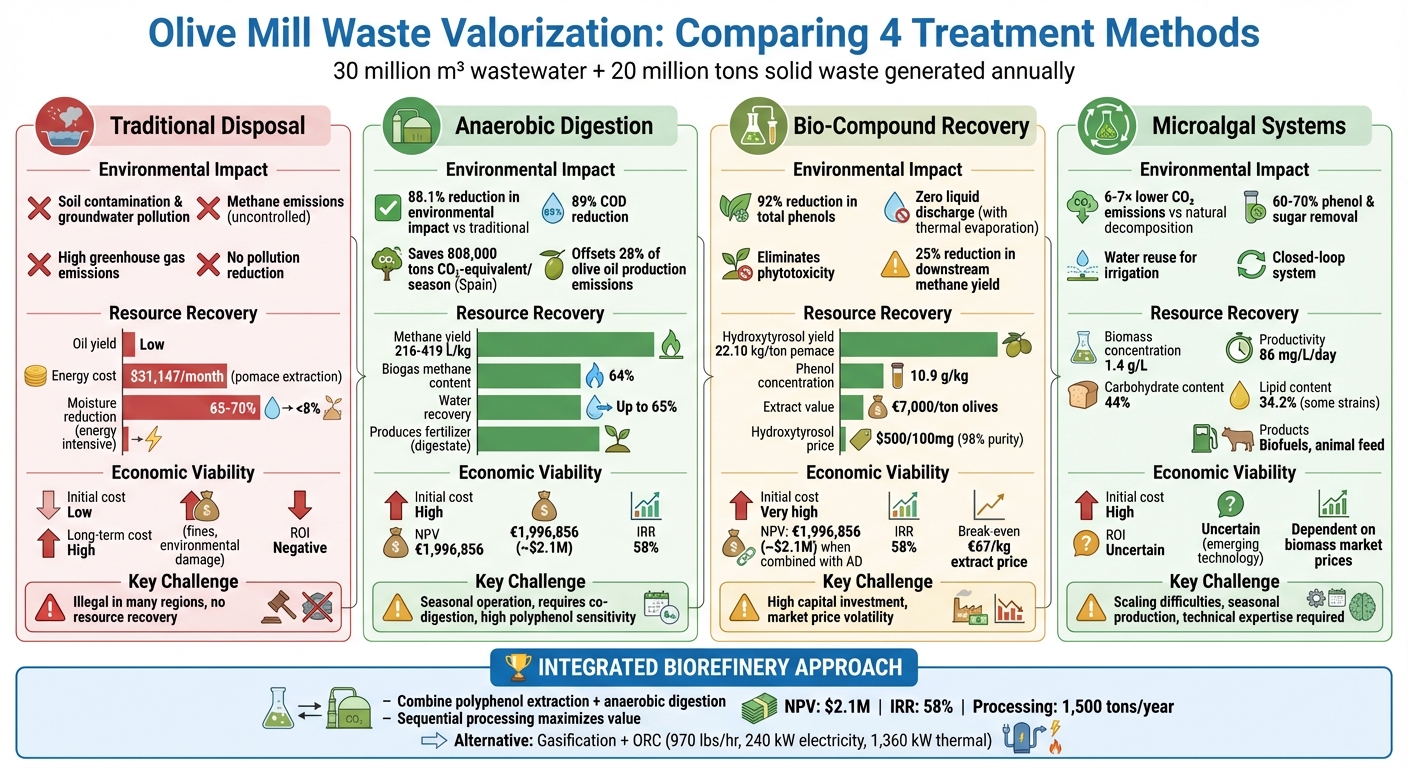
Comparison of Olive Mill Waste Valorization Methods: Environmental Impact and Economic Viability
P. Kougias | Valorization of olive mill wastewaters in the era of circular bioeconomy
1. Traditional Disposal Methods
For years, low-cost methods have been the go-to approach for managing olive mill waste. Among these, open evaporation ponds are the most common. These lagoons allow olive mill wastewater (OMWW) to evaporate naturally, requiring minimal infrastructure. However, the downsides are hard to ignore - soil contamination, groundwater pollution, unpleasant odors, insect infestations, and methane emissions are just a few of the environmental issues they cause. Antonio Messineo, writing in Science of The Total Environment, highlights this problem:
OMWW are usually treated by evaporation in controlled open ponds, therefore requiring vast areas of land and causing significant environmental issues such as soil poisoning due to leaching, bad odors, high proliferation of insects and methane emissions.
Pollution Challenges
Traditional disposal methods fall short when it comes to reducing pollution. For example, direct land spreading may provide soil nutrients, but the high phenolic content in OMWW acidifies the soil and hinders seed growth. In Greece, regulations limit OMWW land application to 20 cubic meters per hectare per year, yet even this controlled usage can lead to long-term soil degradation. Similarly, direct discharge into water bodies can cause eutrophication by promoting excessive algae growth. For solid waste, direct combustion in industrial boilers has its own problems - it produces high levels of carbon monoxide and causes "caking", where minerals and sugars fuse into hard masses that can damage equipment. These limitations make it clear that better solutions are needed.
Limited Resource Recovery
Traditional methods also fail to make the most of the resources locked in olive mill waste. Take pomace oil extraction, for instance. This process uses hexane solvents to recover residual oil, but it’s highly energy-intensive. The pomace, which starts with a moisture content of 65–70%, must be dried to below 8%, typically by burning natural gas or the pomace itself. Despite these efforts, the yields are low, and the energy costs are significant. A 2020 analysis estimated that the monthly operating cost for standard pomace oil extraction reached $31,147.32, with the bulk of the energy consumed in drying.
Scalability Issues
The simplicity of traditional disposal methods has made them popular, especially for small-scale olive mills. According to Environmental Science and Pollution Research:
The limited financial capabilities of olive mills make them usually unable to bear the high costs required for the disposal of their wastes.
Most olive mills are small, family-run businesses scattered across rural areas, and they only operate during the harvest season from October to March. This seasonal production surge, combined with their dispersed locations, makes setting up centralized treatment facilities a logistical nightmare. As a result, many mills stick to evaporation ponds, which are cheap and require minimal staffing.
Economic Drawbacks
While traditional methods may seem cost-effective at first, they come with hidden long-term costs. Stricter environmental regulations are making open lagoons and direct discharges either illegal or subject to hefty fines. Additionally, the shift from three-phase to two-phase olive oil extraction systems - common in Spain - has reduced wastewater volume by 75% but created a new challenge: managing a semi-solid residue called alperujo. With a moisture content of 65–75%, alperujo is expensive to transport, store, and dry. The low market value of crude pomace oil further limits profitability for secondary extraction plants.
Life cycle assessments reveal that modern solutions, such as anaerobic digestion, can cut the environmental impact of waste management by up to 88.1% compared to traditional methods like pomace oil extraction. These economic and environmental pressures make it clear that traditional disposal methods are becoming less viable, paving the way for more advanced approaches discussed in the next sections.
2. Anaerobic Digestion for Biogas Production
Anaerobic digestion (AD) is a process that works under oxygen-free conditions to convert waste into two valuable byproducts: biogas for energy and digestate for fertilizer. By capturing methane during this process, AD plays a key role in reducing greenhouse gas emissions. Unlike traditional waste disposal methods, AD offers a dual advantage - it minimizes environmental harm while generating usable resources. As noted by Serrano et al.:
Anaerobic digestion is an environmentally friendly management method whose total carbon dioxide emissions are more than 6 times lower than the natural degradation of OMSW.
Pollution Reduction
AD not only curbs greenhouse gas emissions but also significantly reduces pollution levels. For instance, it can lower chemical oxygen demand (COD) by up to 89%, preventing organic waste from contaminating soil and water. A clear example comes from Spain, where the AD of olive mill waste during a typical production season can save 808,000 tons of CO2-equivalent emissions. Additionally, AD decreases the Global Warming Potential of waste management by 345% when compared to traditional pomace oil extraction methods that rely on natural gas for drying. According to the Processes Journal, this technology can offset about 28% of the greenhouse gas emissions tied to olive oil production.
Resource Recovery Efficiency
AD excels in resource recovery, producing both energy and agricultural inputs. The amount of methane generated depends on the type of waste. For example, wastewater can yield up to 419 liters of methane per kilogram of volatile solids, while solid waste typically produces between 216 and 350 liters. Modern systems are also efficient at water recovery, reclaiming up to 65% of the initial water content for potential agricultural use.
A recent study in Sfax, Tunisia, demonstrated the practical application of AD. Between November 2022 and February 2023, researchers operated a 300-liter fixed-bed digester using waste from four local mills. Over 150 days, the system achieved stable performance, removing 71% of volatile solids and producing biogas with 64% methane content. Organic loading rates ranged from 1.8 to 5.8 kg COD/m³·d, showcasing the system's adaptability to varying conditions.
Scalability and Practicality
Scaling AD to an industrial level comes with its own set of challenges. One major issue is the seasonal nature of olive milling, which is concentrated between October and March. This leaves facilities idle for much of the year. Another hurdle is the high polyphenol content in olive mill waste - levels exceeding 2 grams per liter can inhibit microbial activity. To address this, co-digestion with nitrogen-rich materials like animal manure or cheese whey is often required. Some facilities also use thermal vapor injection at 320°F to improve organic matter solubility, though this adds operational complexity.
Economic Feasibility
Adopting a biorefinery model enhances the economic viability of AD. For example, a biorefinery processing 1,500 tons of pomace annually reported a net present value (NPV) of €1,996,856 (approximately $2,100,000) and an internal rate of return (IRR) of 58%. A 2021 study examined a plant in Jaén, Spain, which used waste from the 2015–2016 harvest provided by San Miguel Arcángel, S.A. This facility recovered 22.10 kg of polyphenols per ton of pomace before using AD to process the remaining material. Operating at an organic loading rate of 2.48 g VS/L·d, the system produced 278 liters of methane per kilogram of volatile solids.
3. Polyphenolic Extraction and Bio-Compound Recovery
Polyphenolic extraction focuses on reclaiming valuable antioxidants from olive mill waste before it undergoes energy processing. This step tackles a major issue: phenolic compounds are harmful to plants and can suppress beneficial microorganisms in soil and water. By removing these compounds, the waste becomes safer for the environment while also generating revenue from bio-compounds like hydroxytyrosol.
Pollution Reduction
Removing phenols from olive mill waste can cut total phenol concentrations by up to 92%, significantly reducing the risk of groundwater contamination and eliminating the harmful effects of phytotoxicity, which makes traditional land spreading unsafe. As Fernández-Prior and colleagues explain:
The extraction of the furans and phenolic compounds from the olive mill waste would then have a double benefit, i.e., the recovery of a fraction enriched in phenols and the detoxification of the remaining organic matter.
This detoxification process not only protects the environment but also improves the efficiency of subsequent treatments. The treated organic matter can be safely used as fertilizer or processed through anaerobic digestion without disrupting methane-producing bacteria. Some systems even achieve zero liquid discharge by pairing extraction with thermal evaporation, which allows water to be recovered for agricultural irrigation.
Resource Recovery Efficiency
The extraction process yields compounds with high market value. For example, using supercritical CO2 (SCO2) combined with ethanol can extract 77.6 grams of freeze-dried material per kilogram of raw waste, with a phenol concentration of 10.9 grams per kilogram. Alternatively, water-based extraction at room temperature provides a simpler method, yielding 22.10 kilograms of polyphenols per ton of pomace.
Although extracting phenols reduces the organic material available for biogas production - lowering methane yields by roughly 25% - the financial benefits often outweigh this drawback. Hydroxytyrosol with 98% purity can sell for more than $500 per 100 milligrams, while concentrated extracts containing 10% hydroxytyrosol are priced around $550 per liter (€520/L). Even after phenolic extraction, the remaining residue can still be used for anaerobic digestion, though with diminished methane output.
Scalability and Practicality
Scaling up this process presents challenges. Technologies like pulsed electric fields require significant upfront investment, and seasonal olive production limits year-round operations. Additionally, the geographical spread of olive mills complicates logistics, as waste must be transported to centralized facilities for processing.
For practical use, extraction methods must integrate seamlessly into existing production lines. Water-based extraction at ambient temperature appears to be the simplest option. It keeps solvent costs low and aligns well with regulatory requirements for food and pharmaceutical applications. After supercritical CO2 extraction, the leftover waste is nearly dry, making it ready for thermochemical recovery without further drying steps.
Economic Feasibility
A biorefinery capable of processing 1,500 tons of extracted olive pomace annually has shown promising financial results, with a net present value of €1,996,856 (around $2,100,000) and an internal rate of return of 58%. This model combines polyphenol extraction with anaerobic digestion of the remaining material.
The financial success of such operations hinges on the sales volume and pricing of hydroxytyrosol. The phenolic fraction alone can reach a potential value of up to €7,000 (approximately $7,400) per ton of olives. However, profitability requires phenol extract prices to remain above €67.0 per kilogram (about $71). Many olive mills, however, lack the financial resources to invest in the necessary infrastructure, making subsidies or public-private partnerships essential for broader adoption. These economic factors highlight the potential for advanced waste processing methods to play a key role in future valorization strategies.
sbb-itb-4066b8e
4. Microalgal Integration and Closed-Loop Systems
After anaerobic digestion and polyphenolic extraction, integrating microalgae offers a biological way to transform olive mill wastewater into something useful. This method not only cleans the wastewater but also produces valuable biomass. Instead of relying on open pond disposal - which can pollute soil and create unpleasant odors - species like Scenedesmus sp. convert the nutrients in wastewater into lipids and carbohydrates that have practical applications.
Pollution Reduction
One of the biggest challenges in managing olive mill wastewater is its organic load, which can be 20 to 400 times higher than municipal sewage. Microalgal systems address this issue effectively. By employing a two-stage cultivation process - starting with optimal growth conditions before gradually introducing wastewater - these systems can handle the high levels of organic and phenolic compounds. This approach removes 60–70% of phenols and sugars from the wastewater.
When combined with anaerobic digestion in closed-loop setups, these systems significantly reduce CO2 emissions - by as much as 6–7 times compared to natural decomposition. The treated water can often be reused for irrigation or within the olive mill itself, promoting a circular economy where resources are recycled instead of wasted.
Resource Recovery Efficiency
Traditional batch methods often struggle with high phenol concentrations, which can be toxic to microalgae. However, two-stage cultivation strategies overcome this limitation and achieve a biomass concentration of 1.4 grams per liter, nearly double the yield of fed-batch methods. As highlighted in the Chemical Engineering Journal:
The OMW supply strategy can be purposefully tailored to regulate biomass production and OMW biodegradation.
The biomass produced is highly valuable. Optimized systems can reach productivity rates of 86 milligrams per liter per day, with carbohydrate levels reaching 44% as microalgae process the sugars in the wastewater. Some strains, like Chlorella pyrenoidosa, can even accumulate 34.2% lipid content when grown in a solution containing 25% olive mill wastewater. These lipids and carbohydrates can serve as raw materials for biofuels or high-quality animal feed, turning waste management into a potential revenue source.
Scalability and Practicality
While these recovery rates are promising, scaling up remains a significant challenge. Seasonal production cycles and the scattered locations of olive mills make centralized treatment facilities difficult to manage. Additionally, the phenolic compounds in wastewater can inhibit biological processes, requiring dilution or pre-treatment steps that increase costs. Many small-scale mills also lack the technical expertise needed to implement such systems effectively.
Economic Feasibility
The long-term viability of microalgal integration hinges on generating revenue from high-value products rather than relying solely on waste treatment fees. Although the technology has shown potential in lab settings, scaling it up for industrial use demands significant investment - something that many individual olive mills cannot afford. Furthermore, fluctuations in the market prices for bio-compounds like lipids and carbohydrates add another layer of financial uncertainty.
One potential solution is cooperative models, where smaller mills join forces to share the costs of centralized treatment facilities. However, the success of these models depends on stable markets for the recovered biomass and supportive policies that acknowledge the environmental benefits of closed-loop systems.
Pros and Cons
Here’s a breakdown of the trade-offs for each valorization strategy mentioned earlier, highlighting the key advantages and challenges.
Each method comes with its own set of environmental and economic considerations.
Anaerobic digestion offers impressive environmental benefits, significantly lowering global impacts when compared to traditional pomace oil extraction powered by natural gas. This method transforms high-moisture waste into biogas and fertilizer without the need for energy-intensive drying. However, it comes with challenges like high upfront costs, long processing times, and sensitivity to elevated polyphenol levels, which can inhibit the process.
Polyphenolic extraction presents a lucrative opportunity by recovering valuable antioxidants like hydroxytyrosol, which can sell for around $520 per liter. This not only detoxifies the waste but also creates economic value. On the downside, this method reduces methane production in downstream processes by about 25% and is heavily influenced by fluctuations in market prices.
Microalgal integration turns wastewater into biomass that can be used for biofuels or animal feed. While promising, scaling this method is difficult due to factors like seasonal production cycles, the scattered locations of mills, and the technical expertise required to implement and maintain operations.
Traditional disposal methods, though inexpensive, come with severe environmental consequences. These include soil poisoning, groundwater contamination, and high greenhouse gas emissions. Unfortunately, some small mills still rely on these outdated practices, which provide no resource recovery and create long-term environmental liabilities.
An emerging solution lies in integrating multiple technologies. For instance, combining polyphenolic extraction with anaerobic digestion allows operators to achieve both high-value product recovery and effective waste stabilization. In one case study, a system processing 1,500 tons of olive pomace annually demonstrated a net present value of approximately $2.1 million and an internal rate of return of 58%.
These comparisons highlight the potential of integrated strategies to maximize resource recovery while addressing sustainability challenges effectively.
Conclusion
Integrated biorefinery systems offer a practical and effective way to manage large-scale olive mill waste. By combining high-value polyphenol extraction with anaerobic digestion, these systems provide both environmental and economic advantages. For instance, a 2021 study conducted in Jaén, Spain, demonstrated strong financial returns from this approach.
Anaerobic digestion alone significantly reduces environmental impacts - cutting them by up to 88.1%. It also prevents 808 kilotons of CO₂-equivalent emissions and offsets 28% of the emissions tied to olive oil production. These findings highlight the importance of using multiple waste valorization strategies together.
The best outcomes come from sequential processing. Extracting valuable polyphenols, such as hydroxytyrosol, before digesting the remaining waste maximizes overall benefits. While this step lowers methane yields by about 25%, the income from selling antioxidants more than compensates for the reduced energy production.
For areas dealing with water scarcity, gasification paired with Organic Rankine Cycle (ORC) systems offers a zero-discharge solution. This method processes around 970 pounds of biomass per hour, generating 240 kW of electricity and 1,360 kW of thermal energy. It also recovers purified water from wastewater, with the added benefit of biochar production, which accounts for 70–90% of the system's revenue.
Traditional disposal methods, which often lead to soil contamination and high greenhouse gas emissions, need to be replaced. The olive oil industry is urged to adopt integrated biorefinery systems that prioritize resource recovery and reduce environmental impact. Achieving this will require strong energy policies and collaborative efforts.
FAQs
What are the environmental advantages of using multiple methods to repurpose olive mill waste?
Integrating various techniques like anaerobic digestion, phenol extraction, pyrolysis, and biofuel production can transform olive mill waste into opportunities for recovery and reuse. By using a combination of these methods, it’s possible to cut down on waste, lower greenhouse gas emissions, and reclaim valuable energy and compounds.
This approach doesn’t just address pollution - it also fits seamlessly into a circular economy model, where resources are reused effectively, contributing to ongoing efforts to manage resources responsibly.
How does extracting polyphenols from olive mill waste benefit the environment and economy?
Transforming olive mill waste into a resource starts with extracting polyphenols, powerful antioxidants with a range of applications. These compounds can be repurposed into products such as nutraceuticals, cosmetics, and functional foods. This not only opens up new revenue opportunities but also cuts down on waste disposal costs. On top of that, the leftover organic material from the process can be converted into biogas, adding a renewable energy source to the mix.
By integrating polyphenol recovery into a circular economy model, managing olive mill waste becomes both environmentally friendly and financially smart. For companies like Big Horn Olive Oil, this strategy supports their dedication to high-quality products and environmental stewardship. It’s a win-win: waste is turned into valuable resources, and their operations become more sustainable.
What obstacles do small olive mills face in adopting advanced waste management technologies?
Small olive mills often face significant hurdles when it comes to adopting advanced waste management technologies. The biggest barrier? High upfront costs paired with limited financial resources. Technologies like gasification, pyrolysis, or anaerobic digestion can demand investments that run into hundreds of thousands of dollars. On top of that, there are ongoing expenses - energy consumption, feedstock preparation, and the need for skilled labor. For smaller producers, these costs can feel insurmountable.
Another issue stems from the seasonal and inconsistent nature of olive mill waste. The composition of waste can vary greatly from one batch to another, making it tricky to implement efficient, large-scale processes. Small mills often lack the economies of scale that would make these systems financially viable. Plus, the need for adaptable treatment systems to handle this variability only adds to the cost.
Regulatory challenges add yet another layer of complexity. Many small mills struggle with compliance due to a lack of financial incentives like subsidies or grants that could help offset these burdens. Without such support, moving from basic disposal methods to more sustainable waste solutions becomes an uphill battle for these smaller operations.