

EU vs. US: Olive Oil Trade Disputes Explained
The olive oil trade dispute between the EU and the US is a long-standing conflict rooted in subsidy claims, tariffs, and international trade policies. Here’s what you need to know:
- Origins: The US imposed tariffs on Spanish olives in 2018, citing unfair subsidies under the EU's Common Agricultural Policy (CAP). These tariffs reached 46% by 2025, slashing Spanish olive exports to the US by 60%.
- Economic Impact: Spain’s olive industry lost €260 million by late 2025, with total losses projected at €800 million. US consumers faced higher prices and fewer premium olive oil options.
- WTO Ruling: In 2025, the WTO ruled the US tariffs violated trade rules, allowing the EU to impose $13.64 million in annual retaliatory tariffs on US goods.
- Recent Developments: In February 2026, the US Supreme Court invalidated a 15% tariff on EU olive oil imports, but anti-dumping duties remain in place.
This dispute highlights broader tensions over agricultural subsidies and trade practices, affecting producers, importers, and consumers on both sides of the Atlantic.
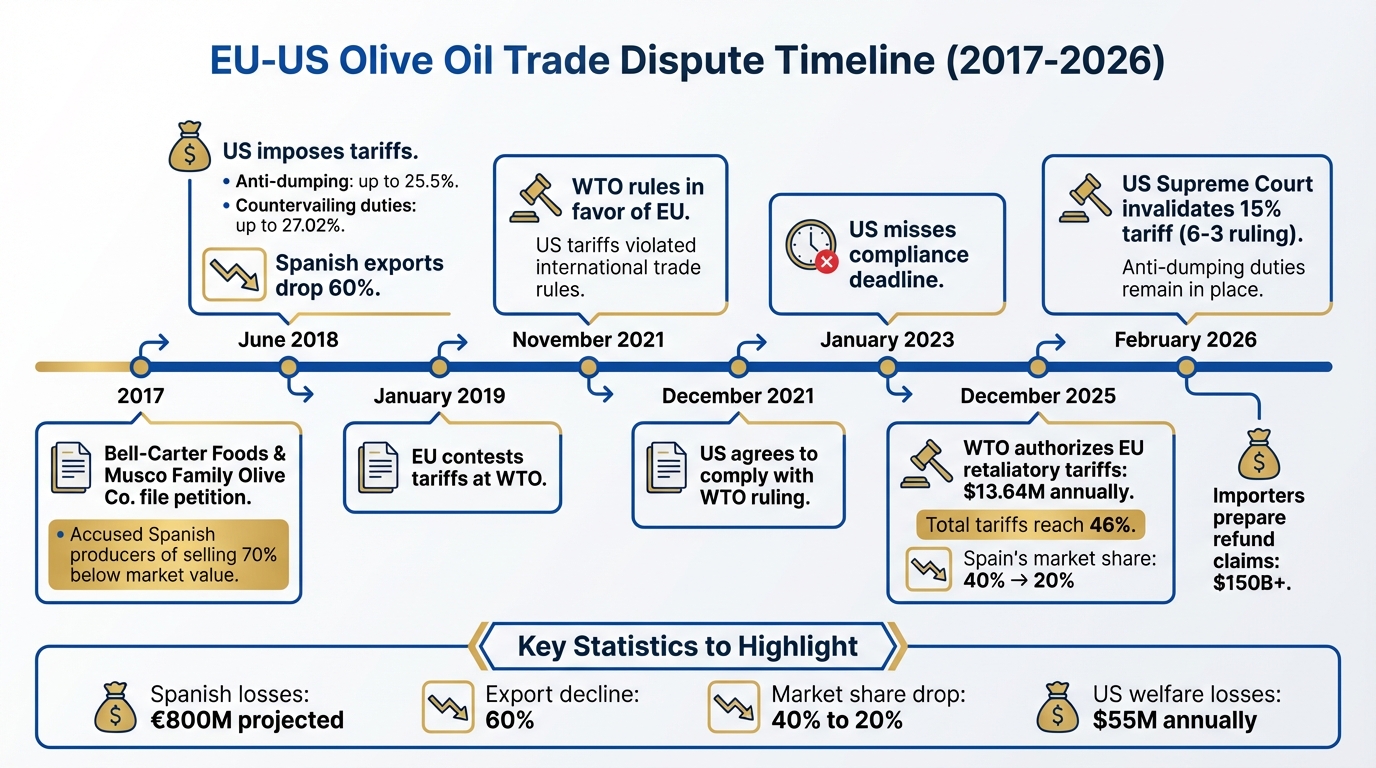
EU-US Olive Oil Trade Dispute Timeline 2017-2026
US Tariffs on EU Olive Oil Imports
How US Tariffs on EU Olive Oil Started
The dispute over tariffs began in 2017 when two California-based olive producers - Bell-Carter Foods Inc. and Musco Family Olive Co. - filed a petition. They accused Spanish producers of selling olives in the U.S. at prices around 70% lower than market value.
Following this, the Commerce Department launched an investigation to determine if EU producers benefited unfairly from subsidies through the Common Agricultural Policy (CAP) and specific Spanish government programs. By June 2018, the U.S. imposed anti-dumping tariffs of up to 25.5% and countervailing duties reaching 27.02%. The International Trade Commission supported these measures, citing the need to protect U.S. olive producers. U.S. Representative Doug LaMalfa defended the move, saying:
Spain should stop subsidizing and dumping olives in the U.S. which violates good trade practices and is destroying the U.S. olive industry.
The U.S. justified these tariffs under Section 771B of the Tariff Act of 1930. This section assumes that subsidies given to raw agricultural producers are automatically passed on to processors who export the final products.
These actions marked the beginning of major changes in the market, setting the stage for significant disruptions, as detailed in the analysis of current tariff rates and their effects.
Current Tariff Rates and Effects on EU Producers
The tariffs introduced in 2018 have had a profound effect on Spanish olive exports, dramatically altering market dynamics. Before the tariffs, Spain exported approximately $67.6 million worth of olives to the U.S. each year. After the duties were implemented, Spanish black olive exports to the U.S. plummeted by 60%. For the three largest Spanish exporters, combined duties ranged from 7.52% to 27.02%.
The financial toll on Spanish producers has been severe. Antonio De Mora, representing ASEMESA, warned that ongoing tariffs could strip Spain of its dominant position in the U.S. black olive market. His prediction became reality: Spain’s market share dropped from over 40% to less than 20%. Between 2017 and 2025, this decline is expected to cost Spanish producers €800 million ($870 million), alongside €17 million ($18.5 million) in legal expenses.
In January 2019, the EU contested these tariffs at the World Trade Organization (WTO). By November 2021, a WTO panel ruled in favor of the EU, stating that the U.S. measures violated international trade rules. Although the U.S. agreed to comply with the ruling in December 2021, it failed to meet the January 2023 deadline. As a result, the WTO authorized the EU in December 2025 to impose retaliatory tariffs of $13.64 million annually on U.S. goods.
EU Tariffs on US Olive Oil Imports
How EU Tariffs Work for US Olive Oil
The EU's tariffs on U.S. olive oil serve as a strategic response to U.S. trade measures. While the U.S. imposed tariffs on EU olive oil over subsidy disputes, the EU countered with its own retaliatory tariffs, authorized by the World Trade Organization (WTO). These tariffs allow the EU to impose duties worth $13.64 million annually on U.S. goods.
The EU specifically targets U.S. agricultural exports, including olive oil and related products, to match this authorized value. But there’s more to it than just balancing the numbers. The EU's strategy focuses on political impact. Instead of taxing goods that are vital to European consumers, the EU deliberately selects products from politically sensitive U.S. regions, such as swing states, to increase pressure on American policymakers.
Beyond political maneuvering, these tariffs also disrupt market dynamics, creating additional hurdles for U.S. producers trying to compete globally.
How EU Tariffs Affect US Olive Oil Producers
For U.S. olive oil producers, these tariffs add another layer of difficulty in an already challenging market. They’re not only up against the EU’s Common Agricultural Policy (CAP), which subsidizes European growers, but now also face higher costs due to retaliatory tariffs.
U.S. olive oil, which typically retails for $20–$25 per bottle internationally, becomes even less competitive as these tariffs push prices higher. This makes it harder for American producers to rival the high-volume, lower-cost olive oil from Europe.
A European Commission spokesperson noted that these tariffs are intended to compensate for the economic harm caused by the U.S.'s non-compliance with WTO rulings.
The impact is particularly tough on California farmers. Many of them shifted from growing table olives to producing olive oil in the late 1990s, attracted by its higher profit margins. However, the EU's trade barriers now confine premium U.S. olive oils to a niche luxury market, significantly restricting their access to broader international markets.
Economic Effects on Both Regions
Effects on EU Producers and Markets
The financial strain on Spanish producers is undeniable, with losses in the black olive sector estimated between $287 million and $883 million since 2018. On top of that, cumulative duties have climbed to 46%, which includes a 15% tariff on European exports. To counteract these challenges, the EU has introduced retaliatory measures valued at $13.64 million annually, aiming to apply pressure on the U.S..
"It is impossible to replace such an important market as the US in the short and medium term." – Antonio De Mora, General-Secretary for ASEMESA
In an effort to adapt, Spanish producers have employed strategies like "frontloading" shipments to the U.S. before new tariffs take effect. Additionally, some are exploring direct investments in U.S.-based production facilities as a way to sidestep import restrictions entirely. These moves highlight the broader strategic adjustments EU producers are making to navigate the ongoing tariff challenges.
Effects on US Consumers and Importers
While EU producers are reeling from financial losses and adjusting their strategies, U.S. consumers and importers are dealing with their own set of issues. A 25% tariff on non-bulk Spanish olive oil has led to $55 million in annual welfare losses for the U.S.. To manage costs and maintain supply, U.S. importers are now turning to bulk shipments and sourcing from non-EU countries. Although these tariffs were designed to protect domestic producers, they’ve made it harder for American consumers to access premium European olive oils. The next section will explore how recent policy changes and legal decisions are influencing the future for both regions.
sbb-itb-4066b8e
Recent Changes and What's Next
2026 Policy Updates and Court Decisions
February 2026 brought major developments in the olive oil trade dispute. On February 20, the U.S. Supreme Court issued a 6–3 ruling that limits the president’s authority to impose tariffs without clear congressional approval under the International Emergency Economic Powers Act (IEEPA). Chief Justice John Roberts explained:
The president asserts the extraordinary power to unilaterally impose tariffs of unlimited amount, duration, and scope. In light of the breadth, history, and constitutional context of that asserted authority, he must identify clear congressional authorization to exercise it.
This decision invalidated the 15% tariff on European olive oil imports. Now, U.S. importers who paid these tariffs are preparing legal claims to recover what could amount to over $150 billion in duties collected.
Earlier, on February 13, the U.S. Department of Commerce released preliminary findings from its 2023–2024 administrative review, setting a 3.54% dumping margin for major Spanish exporters, including Agro Sevilla Aceitunas. While the broader 15% tariff has been eliminated, anti-dumping duties remain in effect. At the same time, the European Union is moving forward with $13.64 million in annual WTO-approved countermeasures, focusing on exports from politically sensitive U.S. regions.
Victor Schwartz, owner of New York-based importer V.O.S. Selections, who played a key role in challenging the tariffs, described the Supreme Court ruling as a pivotal win for the industry:
This decision feels like a gold medal win, marking an important victory for the industry.
Despite this victory, the Office of the U.S. Trade Representative emphasized that:
The WTO decision does not disturb the U.S. antidumping and countervailing duty orders on ripe olives from Spain, which will continue to provide relief for U.S. producers.
These legal changes not only reverse significant tariff policies but also intensify scrutiny of trade practices between the U.S. and Europe. Industry players must now act swiftly to adapt to this evolving landscape.
How Producers and Importers Can Adapt
With these new legal shifts, olive oil producers and importers face critical decisions. U.S. importers should prioritize documenting refund claims through the Court of International Trade while exploring alternative sourcing options, as administrative reviews are still ongoing. Retailers like Costco, which filed lawsuits in December 2025 over these tariffs, are already positioning themselves for potential refunds.
For businesses subject to anti-dumping duties, active participation in Department of Commerce reviews is essential to influence duty rates. On the European side, producers are employing a "frontloading" strategy, shipping larger volumes to the U.S. in anticipation of further policy changes. Spain, which once held over 40% of the U.S. market before 2018, now controls less than 20%. Whether Spanish exporters can regain their foothold depends on whether U.S. importers stick with diversified sourcing or return to European suppliers.
Both U.S. and EU stakeholders must rethink their strategies to thrive in this new trade environment.
How Spanish olive exporters survived Trump tariffs since 2017 | REUTERS
Conclusion: What the EU-US Olive Oil Trade Dispute Means
The EU-US olive oil dispute has left a lasting mark on the industry, far beyond the surface-level tariff discussions. Since the tariffs were introduced in 2018, Spanish olive oil producers have seen their U.S. market share plummet - from over 40% to less than 20%. This decline has caused losses of up to €800 million and has jeopardized thousands of jobs, particularly in regions like Andalusia, where olive farming is a cornerstone of the local economy.
The effects extend beyond Europe. U.S. consumers now face higher prices and fewer options when it comes to traditional European olive oil products. Meanwhile, WTO-approved countermeasures and anti-dumping duties continue to influence market conditions, creating ripple effects for both producers and buyers.
But this dispute isn’t just about olive oil - it’s also a test of the EU’s Common Agricultural Policy. Critics argue that the conflict highlights vulnerabilities in the policy, raising questions about its sustainability and opening the door for similar scrutiny of other subsidized agricultural sectors in Europe.
In response, the industry must adapt. Producers will need to explore new markets and strategies, importers must remain flexible, and policymakers have to find a way to balance domestic priorities with international trade obligations. This conflict serves as a powerful example of how interconnected trade and policy decisions are, emphasizing the fine line between protecting local industries and staying competitive on the global stage.
FAQs
What’s the difference between anti-dumping duties and regular tariffs on olive oil?
Anti-dumping duties are designed to address cases where imported olive oil is sold at prices below its fair market value. The goal is to shield domestic producers from unfair competition. These duties are calculated based on the dumping margin determined during investigations.
In contrast, regular tariffs are general taxes on imports, applied regardless of pricing strategies. Their purpose is often to regulate trade or provide protection to specific industries.
In disputes between the EU and the US, anti-dumping duties have been used to counteract unfair subsidies, while tariffs are implemented as part of broader trade policy objectives.
Will the 2026 Supreme Court ruling lower olive oil prices in the U.S.?
The 2026 Supreme Court ruling is anticipated to lower the costs of imported goods, such as olive oil, by removing tariffs and duties that previously drove up prices for importers. As a result, U.S. consumers could see olive oil become more budget-friendly.
Which products could the EU target with its WTO-approved retaliatory tariffs?
The European Union is considering retaliatory tariffs on U.S. agricultural products, with olive oil and olives likely to be targeted. This move stems from the ongoing dispute over U.S. tariffs on Spanish ripe olives, a matter where the World Trade Organization has already granted the EU the authority to take countermeasures. Although the exact list of targeted goods hasn’t been finalized, the EU is expected to concentrate on olive-related items, reflecting the sector affected by the U.S. tariffs.