

Study Summary: Daily EVOO and Oxidative Stress
Here’s the short answer: daily extra virgin olive oil, usually 15–30 mL a day (about 1–2 tablespoons), appears to make small improvements in some lab markers tied to oxidative stress - mainly oxidized LDL (ox-LDL). But these studies track biomarkers, not heart attacks, strokes, or other long-term health results.
If you just want the main points, here they are:
- Best-supported marker: ox-LDL
- Common study dose: about 25–30 mL/day
- Main factor: oils with more phenolic compounds tend to do better
- What looks mixed: FRAP, F2-isoprostanes, and some inflammation markers
- Big limit: most trials were short, often around 3 weeks
- What this does not prove: that EVOO prevents disease
One pooled review from 2026 looked at 23 randomized controlled trials with 1,138 people. It found that higher-phenolic EVOO lowered ox-LDL by 7.73 U/L versus low-phenolic oil, and CRP by 0.99 mg/L in some comparisons. That’s a lab change, not proof of long-term health gain.
What I’d keep in mind is simple: the data lean in a good direction, but the effect is modest, the methods vary, and the outcome is still a surrogate marker story rather than a disease-outcome story.
The article below explains what the markers mean, what the trials found, and where the weak spots are.
The Health Benefits of Olive Oil Most People Don’t Know
sbb-itb-4066b8e
Which biomarkers researchers track in EVOO studies
There isn’t one lab test that can sum up oxidative stress on its own. So researchers usually look at a mix of lipid, DNA, and inflammation markers. Most of these are measured in fasting blood or 24-hour urine samples. In daily EVOO trials, the goal is often to spot small, short-term changes. That’s why these markers matter: they frame the trial results that come next.
Lipid oxidation markers: ox-LDL, MDA, and F2-isoprostanes
Oxidized LDL (ox-LDL) shows oxidative damage to LDL cholesterol. It’s also linked to cardiovascular risk.
Malondialdehyde (MDA) tracks the breakdown of polyunsaturated fatty acids during oxidative stress. F2-isoprostanes, especially 15-F2t-isoprostane, are also used to track lipid peroxidation. Researchers measure them in urine or plasma, and urine results need creatinine adjustment so the numbers aren’t thrown off by how diluted the urine is.
DNA damage and antioxidant-capacity markers
Urinary 8-OHdG is a standard marker for oxidative DNA damage. That said, it doesn’t tell a perfectly clean story, because levels can also reflect DNA repair activity.
FRAP and TEAC (Trolox Equivalent Antioxidant Capacity) look at total antioxidant capacity. In plain terms, they give a broad readout rather than pointing to one specific type of damage.
Inflammatory markers that appear alongside oxidative stress
Oxidative stress and inflammation often move together and can feed off each other. Because of that, researchers often track both in the same trial.
CRP is a common marker of systemic inflammation and often appears alongside oxidative stress measures. Researchers also look at cytokines such as IL-6, IL-8, IL-10, IL-18, and TNF-alpha when they want a closer look at inflammatory signaling. One catch: these markers have a short half-life in blood, so their levels can shift a lot over the course of a day.
These markers don’t all show the same thing, and they aren’t measured the same way:
| Biomarker | What It Reflects | Sample Type | Main Limitation |
|---|---|---|---|
| ox-LDL | Oxidative damage to LDL cholesterol | Plasma | Lipid-only marker |
| F2-isoprostanes | Lipid peroxidation | Urine or plasma | Urine concentration effects |
| 8-OHdG | Oxidative DNA damage | Urine | Reflects repair activity too |
| TEAC / FRAP | Total antioxidant capacity | Plasma | Non-specific measure |
| CRP | Systemic inflammation | Plasma | Non-specific; infection-sensitive |
| Cytokines (IL-6, TNF-α) | Inflammatory cell signaling | Plasma | Rapid daily fluctuation |
These are the markers researchers use most often when they’re trying to see whether daily EVOO shifts oxidative stress in trials.
What daily EVOO studies have found so far
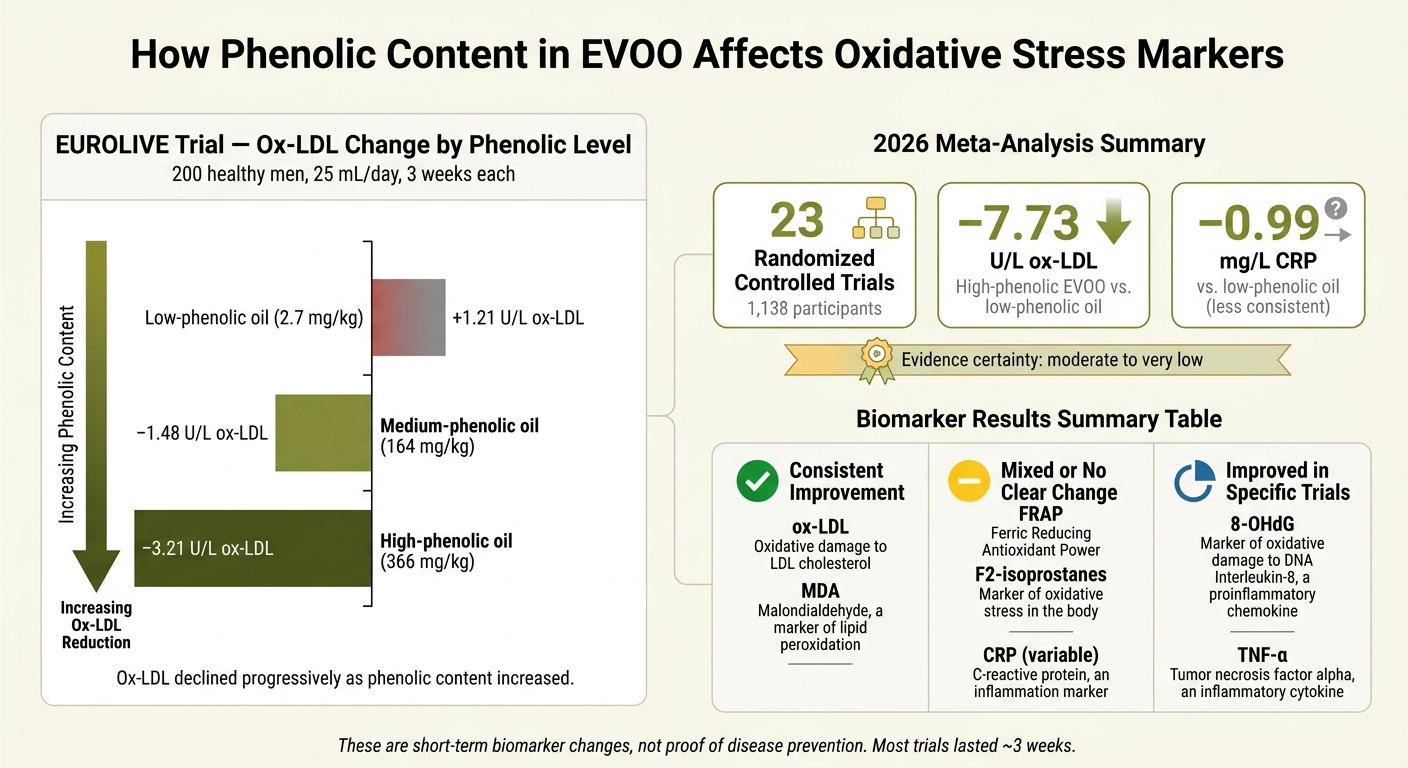
EVOO Phenolic Content vs. Oxidative Stress Markers: What the Studies Show
Daily phenolic-rich EVOO shows modest, mostly favorable effects on markers tied to lipid oxidation. And when you look across the data, one signal stands out more than the rest: lipid oxidation markers, especially ox-LDL.
Meta-analyses: the strongest summary of short-term trial data
Of the markers discussed above, ox-LDL shows the steadiest improvement. A 2026 systematic review and meta-analysis pooled 23 randomized controlled trials with 1,138 participants. The researchers found lower ox-LDL with EVOO than with lower-phenolic oils: about −4.59 U/L versus medium- and low-phenolic oils combined, and about −7.73 U/L versus low-phenolic oil alone. CRP was also about 0.99 mg/L lower versus low-phenolic oil, although CRP results were less steady from study to study. Certainty ranged from moderate to very low, and several trials had risk-of-bias issues.
An earlier review of eight trials found much the same pattern. Phenolic-rich olive oils lowered both ox-LDL and MDA, while FRAP did not change in a meaningful way. In plain terms, the steadiest gains show up when the oil contains more phenolic compounds.
Key individual trials: EUROLIVE and crossover studies
The EUROLIVE crossover trial is one of the best-known studies in this area. It included 200 healthy men, and each person took 25 mL per day - about 1.7 tablespoons - of three oils with low, medium, and high phenolic content for three-week periods. Ox-LDL moved in a dose-related way as phenolic content went up: +1.21 U/L with the low-phenolic oil, −1.48 U/L with the medium-phenolic oil, and −3.21 U/L with the high-phenolic oil. That kind of step-by-step drop is hard to ignore.
Another randomized, double-blind crossover trial looked at 51 healthy adults who used 30 mL per day - about 2 tablespoons - of a phenolic- and triterpene-rich virgin olive oil for three weeks. Compared with a lower-bioactive oil, the phenolic- and triterpene-rich oil led to lower urinary 8-OHdG, IL-8, and TNF-α. So the changes were not limited to lipid oxidation alone; researchers also saw shifts in oxidative DNA damage markers and inflammatory signaling.
| Study | Participants | Daily Amount | Duration | Phenolic Comparison | Biomarkers Measured | Main Findings |
|---|---|---|---|---|---|---|
| 2026 meta-analysis of RCTs | 1,138 across 23 trials | Varied | Short-term | EVOO vs. low- or medium-phenolic oils | ox-LDL, CRP, and others | Lower ox-LDL (−7.73 U/L vs. low-phenolic); lower CRP (−0.99 mg/L); certainty ranged from moderate to very low |
| Earlier meta-analysis | Varied across 8 trials | Varied | Short-term | Phenolic-rich vs. lower-phenolic oils | ox-LDL, MDA, FRAP | Lower ox-LDL and MDA; FRAP unchanged |
| EUROLIVE crossover trial | 200 healthy men | 25 mL/day (~1.7 tbsp) | 3 weeks per oil | 2.7, 164, and 366 mg/kg | ox-LDL and related lipid-oxidation markers | Ox-LDL declined progressively as phenolic content increased |
| Randomized, double-blind crossover trial | 51 healthy adults | 30 mL/day (~2 tbsp) | 3 weeks per oil | Triterpene- and phenolic-rich oil vs. comparison oil | Urinary 8-OHdG, IL-8, TNF-α | Lower urinary 8-OHdG, IL-8, and TNF-α with the phenolic- and triterpene-rich oil |
Overall pattern in the results
Taken together, the studies point to phenolic content as a main driver of the effect, especially for ox-LDL and MDA. By contrast, results for FRAP and F2-isoprostanes are less steady. In EUROLIVE, for example, F2-isoprostanes did not change. So while the case for ox-LDL looks fairly strong, other markers tell a more mixed story - which sets up the next issue: how much of the effect comes from phenolic content itself?
Why phenolic content matters and where the evidence still falls short
Phenolic compounds, freshness, and differences between oils
The findings point toward phenolics. But olive oil isn't a fixed product. Its phenolic content can change based on the olive variety, harvest timing, processing, and storage. That makes it tough to pin an effect on any one compound alone.
Phenolic levels also move quite a bit with ripeness, processing, and storage. In one review, Greek virgin olive oils ranged from undetectable phenolics all the way up to 355 mg/kg, with higher levels showing up in earlier harvest oils. That's a big spread, and it's a major reason study results don't always line up neatly.
Short trials, small samples, and mixed methods
Even when a trial is put together well, the evidence still has clear weak spots. The table below shows where current studies do a good job - and where limits still remain.
| Study strength | Why it helps | Remaining limitation |
|---|---|---|
| Randomization | Helps distribute known and unknown confounders between groups | Small samples still imprecise. |
| Crossover design | Each participant receives more than one oil, allowing within-person comparisons | Carryover can blur effects. |
| Matched oils with different phenolic levels | Better isolates phenolic content as the intended variable | Minor oil differences still confound results. |
| Controlled dietary conditions | Reduces the influence of other foods and supplements | May not reflect typical diets. |
| Biomarker measurement | Detects changes in oxidative or inflammatory pathways | Surrogate signal, not outcome proof. |
| Laboratory phenolic analysis | Quantifies total or individual phenolic compounds | Methods are not uniform. |
A lot of these interventions lasted only about three weeks. That's enough time to spot short-term biomarker shifts, but nowhere near enough to tell us much about long-term cardiovascular outcomes.
The broader review of 23 randomized controlled trials covering 1,138 participants found that every included study had some risk of bias. It also rated the certainty of the evidence from moderate to very low. On top of that, lab methods for measuring oxidation, antioxidant capacity, and inflammation were not the same across studies, which makes head-to-head comparison messy.
That context matters, because it shapes how much weight we can put on the results that come next.
Conclusion: What readers can reasonably take from the findings
The short version is pretty simple: based on short-term biomarker data, daily EVOO appears to produce small, mostly favorable changes in markers of oxidative stress, most often ox-LDL and, in some studies, MDA.
One of the clearest data points comes from a review of 23 randomized controlled trials with 1,138 participants. In that review, high-phenolic EVOO lowered ox-LDL by 7.73 U/L compared with low-phenolic oil alone. That matters as a biomarker change. It does not mean disease prevention has been proven.
In day-to-day use, the studies tend to land in a pretty similar range. There is no proven ideal daily dose, but many trials use about 25 to 30 mL per day, or about 1.7 to 2 U.S. tablespoons. Since EVOO adds calories, it makes more sense as a swap for butter, shortening, or other less favorable fats than as an extra add-on to the same diet.
Phenolic content seems to play a role, but it is not a magic lever. A higher-phenolic oil does not guarantee the same outcome for every person or every study. Fresh EVOO, stored the right way and used on a steady basis, is the more sensible approach.
That kind of use makes the most sense as part of an overall eating pattern, not as a stand-alone fix. The current trials look at short-term biomarker shifts, not long-term disease outcomes, and the evidence has limits: short intervention periods, modest sample sizes, differences in olive-oil composition, and inconsistent biomarker methods. Results from healthy volunteers also may not carry over in the same way to people with obesity, diabetes, cardiovascular disease, or other conditions. If someone is dealing with a health issue, it’s smart to work with a qualified clinician.
FAQs
How much EVOO should I use each day?
Experts generally suggest 1 to 4 tablespoons a day. Even a small amount, like 1/2 tablespoon, may help support heart health.
For blood sugar control, insulin sensitivity, and protection against oxidative stress, research points to 1.5 to 3 tablespoons per day as a common range.
Do these biomarker changes mean EVOO prevents heart disease?
No. Changes in oxidative stress biomarkers suggest EVOO polyphenols may help reduce oxidative damage, which is one path tied to cardiovascular risk.
But these shifts do not show that daily EVOO prevents heart disease. The research looks at markers and mechanisms, not direct heart-disease outcomes. Results also depend on getting enough phenolic compounds and on product quality and storage that keep those compounds intact.
How can I tell if an EVOO is high in phenolics?
Check the label for polyphenol content. A good target is about 366 mg/kg or more. As a rule of thumb, oils above 250 mg/kg are often seen as especially rich.
Your senses can help too. High-phenolic EVOO often tastes more bitter and has a peppery bite. It may even cause a slight throat cough, which is linked to oleocanthal. Early-harvest oils also tend to have higher antioxidant levels.