

EVOO Traceability: Blockchain Case Studies
- Why It Matters: EVOO is one of the most commonly adulterated foods. Blockchain helps verify its origin, quality, and sustainability claims.
- How It Works: Blockchain creates a tamper-proof digital record of every step in the supply chain, accessible to producers, distributors, and consumers.
-
Key Players:
- Deoleo: Uses IBM Food Trust to trace over 35% of its EVOO production with QR codes linking to verified data.
- BOOSCh: A public Ethereum-based system offering decentralized traceability for smaller producers.
- Big Horn Olive Oil: Focuses on direct sourcing and quality standards, with future potential for blockchain integration.
- Consumer Insights: Studies show buyers are willing to pay more for blockchain-certified EVOO, especially when paired with trusted origin labels.
Blockchain is reshaping trust in the EVOO industry by offering transparency and addressing fraud. Keep reading to explore how leading brands and technologies are driving these changes.
DNA fingerprinting to validate authenticity of PDO and PGI extra-virgin #OliveOil
Deoleo's Blockchain Traceability with IBM Food Trust
Deoleo, the world’s largest olive oil producer, has embraced blockchain technology to enhance traceability for its flagship brands, Bertolli and Carapelli.
Traceability Workflow and Data Points
Deoleo’s traceability system integrates IBM Food Trust with Telefónica Tech’s TrustOS blockchain platform to log critical data throughout the production process. The blockchain records key details such as the cooperatives where olives are harvested, bottling dates, geographical sourcing, and results from quality tests conducted both internally and externally. This data is securely and permanently stored on the blockchain.
The initiative is being piloted with the Carapelli 100% Italian product, which features a QR code on its label linked to blockchain-verified data. Currently, over 35% of Deoleo’s extra virgin olive oil (EVOO) production is traceable through this technology.
| Data Point Captured | Purpose |
|---|---|
| Olive harvesting cooperatives | Verifies geographic origin |
| Bottling dates | Confirms freshness and production timeline |
| Internal & external quality tests | Ensures "extra virgin" designation |
| Sustainability certifications | Highlights transparency and eco-friendly practices |
This meticulous data collection supports Deoleo’s efforts to strengthen consumer trust.
How Deoleo's Blockchain Builds Consumer Confidence
By leveraging blockchain technology, Deoleo provides consumers with a clear view of their product’s journey. Scanning the QR code on a bottle offers a detailed, tamper-proof record of its path from field to shelf.
Thierry Moyroud, CEO of Deoleo North America, emphasized the company’s commitment:
"As the world's largest olive oil company, we have a responsibility to our heritage, our industry and most importantly, our consumers to deliver sustainability."
The QR system not only ensures traceability for the Carapelli 100% Italian product but also highlights sustainability efforts across the brand. For example, Deoleo uses 100% recycled plastic (rPET) packaging and has reduced packaging weight by 10% for other products.
BOOSCh: Decentralized EVOO Traceability on Ethereum
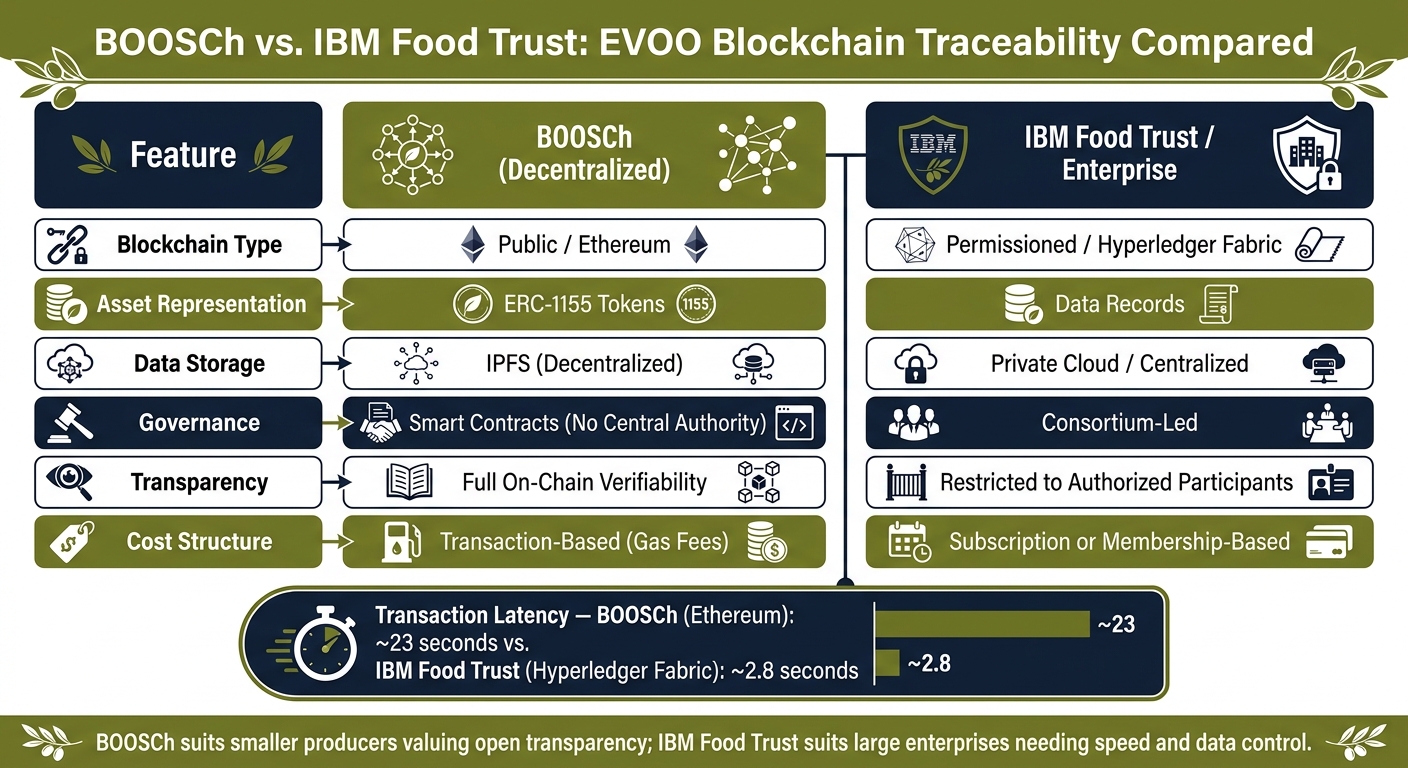
BOOSCh vs. IBM Food Trust: EVOO Blockchain Traceability Compared
Unlike many blockchain solutions for EVOO (extra virgin olive oil) traceability that rely on private, company-managed systems, BOOSCh takes a decentralized, public approach. Operated under the name Olive Oil Trust, BOOSCh is built on the Ethereum blockchain, ensuring no single entity has control over the network.
How BOOSCh Works
BOOSCh uses Ethereum's ERC-1155 tokens to represent batches of olive oil, allowing all participants in the supply chain - from olive growers to retailers - to interact through Solidity-based smart contracts. These contracts enforce consistent trading and certification standards across the network.
Here’s a simplified look at the process:
- An olive grower mints a token representing a specific batch of olives.
- This token moves through the supply chain - from the mill, to the bottling plant, and finally to the distributor or retailer.
- Transfers are secured by an escrow system, ensuring that ownership is only transferred after payment is confirmed and approved by the seller. This eliminates the need for manual checks or third-party financial services.
For data handling, BOOSCh uses IPFS for storing large documents like production certificates in a decentralized manner, while TheGraph and GraphQL make it easy to query on-chain data. Every step - from harvesting to retail - is recorded on the blockchain, ensuring the data is both permanent and publicly accessible. This setup stands in stark contrast to centralized systems.
"The idea behind this project is to use the Ethereum blockchain as a means to give trust to its members and customers that the actions performed in the supply chain are, and will always remain, stored and unaltered." - Alberto Bas, Developer of Olive Oil Trust
Now that the mechanics are clear, let’s look at how BOOSCh stacks up against centralized blockchain solutions.
BOOSCh vs. Centralized Blockchain Solutions
The key distinction between BOOSCh and systems like IBM Food Trust lies in control and accessibility. While centralized systems prioritize speed and efficiency, BOOSCh focuses on transparency and decentralization. For example, Ethereum transactions average a latency of 23 seconds, whereas private blockchains like Hyperledger Fabric process transactions in about 2.8 seconds.
| Feature | BOOSCh (Decentralized) | Enterprise Solutions (e.g., IBM Food Trust) |
|---|---|---|
| Blockchain Type | Public / Ethereum | Permissioned / Hyperledger Fabric |
| Asset Representation | ERC-1155 Tokens | Data records |
| Data Storage | IPFS (Decentralized) | Private cloud / Centralized |
| Governance | Smart contracts (no central authority) | Consortium-led |
| Transparency | On-chain verifiability | Restricted to authorized participants |
| Cost Structure | Transaction-based (gas fees) | Subscription or membership-based |
For smaller producers or cooperatives that value open, verifiable traceability without hefty licensing costs, BOOSCh offers a strong alternative. However, factors like transaction delays and fluctuating gas fees should be considered when evaluating its suitability.
sbb-itb-4066b8e
Big Horn Olive Oil: Freshness, Quality, and Sourcing Transparency
Big Horn Olive Oil takes a unique approach to transparency, focusing on quality and direct sourcing long before any QR code or blockchain technology is involved. Their process prioritizes strict standards and detailed consumer information, setting them apart in the olive oil industry.
Commitment to Freshness and Quality
Big Horn Olive Oil’s dedication to quality begins at the harvest. They adhere to the Ultra Premium (UP) standard, which far exceeds the requirements of international extra virgin olive oil (EVOO) regulations. This is reflected in their measurable metrics:
| Metric | International EVOO Standard | Big Horn UP Standard |
|---|---|---|
| Free Fatty Acids (FFA) | < 0.80% | ≤ 0.30% (avg. ~0.19%) |
| Peroxide Value | < 20 mEq O₂/kg | Avg. ~6.1 mEq O₂/kg |
| Polyphenols | No minimum set | 150–535 ppm |
| Harvest-to-Press Timeframe | Varies | Within 2 hours of harvest |
Olives are cold-pressed within just 2 hours of harvest, which minimizes oxidation and preserves both flavor and beneficial polyphenols. Each batch undergoes testing at a leading AOCS-certified olive oil lab to ensure these high standards are consistently met.
"Fresh trumps everything, including where the oil was produced." - Big Horn Olive Oil
To maintain freshness throughout the year, Big Horn sources olives from both hemispheres, including countries like Spain, Greece, Italy, Tunisia, Chile, Argentina, Australia, and the U.S. This rotation ensures that their oils are always from a recent crush cycle, keeping them as fresh as possible for consumers.
Transparency in Sourcing and Production
Big Horn Olive Oil’s commitment to transparency goes beyond industry norms. Instead of relying on anonymous bulk suppliers, they work directly with small regional mills and growers. Every batch is fully traceable, with records detailing the exact farm, mill, and grower involved.
"Because we believe consumers deserve to know more than a label, our supplier enforces full traceability: they know the exact farm, the mill, and the grower for each batch of olives." - Big Horn Olive Oil
Each bottle comes with detailed information such as harvest and crush dates, country of origin, cultivar, and lab test results. While they currently share this data through labels and online product pages at bhooc.com, their internal record-keeping already aligns with the principles of blockchain traceability. Their system tracks every step of the supply chain - from harvest to milling, bulk shipment, bottling, and distribution - creating a foundation for seamless blockchain integration in the future. This level of detail ensures that consumers can trust the quality and origin of every bottle they purchase.
What 2025 Research Says About Blockchain and EVOO Consumer Preferences
Study Setup and Key Findings
Research published in 2025 offers fresh insights into how consumers perceive blockchain-traced extra virgin olive oil (EVOO).
The first study, conducted by Staffolani et al. and featured in AIMS Agriculture and Food, surveyed 245 Italian consumers aged 18 to 40. Using a discrete choice experiment, the researchers found that consumers were willing to pay more for EVOO that featured both blockchain certification and Italian origin labeling. Their conclusion was straightforward:
"Blockchain technology could become a viable instrument to improve transparency and ensure the uniqueness and excellence of Italian EVOO." - Staffolani G. et al.
Meanwhile, a study published in PLOS One by Collart et al. examined U.S. consumer behavior. It revealed that shoppers were willing to pay an additional $0.33–$0.38 for blockchain verification, on top of a $1.45 premium for QR code traceability. A survey of 322 supermarket consumers further highlighted that the perceived usefulness of blockchain was the strongest predictor of consumer engagement.
These findings underscore blockchain's ability to improve transparency and elevate EVOO's appeal, ultimately driving higher price premiums.
How Blockchain Traceability Shapes EVOO Marketing
When paired with authentic origin labels, blockchain verification becomes a powerful marketing tool for EVOO. The studies show that consumers respond most positively when blockchain is combined with trusted origin claims, such as "Italian origin" or a PDO (Protected Designation of Origin) label. On its own, blockchain can seem abstract, but when tied to these labels, it serves as a trust signal that resonates with shoppers.
Blockchain's impact is amplified when it tells a clear, engaging story. For example, QR codes that link to detailed, easy-to-follow "field-to-fork" narratives - showcasing the farm, harvest date, and lab results - outperform QR codes that simply present raw data. This approach can increase consumers' willingness to pay by up to 9%.
| Marketing Strategy | Consumer Impact | Key Benefit |
|---|---|---|
| Blockchain + Origin Label | Highest trust and WTP | Protects brand authenticity |
| Blockchain-specific QR Code | +$0.33–$0.38 premium over standard QR | Perceived as tamper-proof |
| "Blockchain-verified" labeling | Up to 9% increase in WTP | Premium product positioning |
| Standard QR traceability only | Moderate transparency | Basic information access |
It's worth noting that traditional certifications like PDO and Organic still hold stronger immediate recognition among many EVOO shoppers. Blockchain works best as an additional layer of assurance rather than a standalone feature. Producers who combine blockchain verification with established quality labels are better positioned to command higher premiums and strengthen consumer trust.
Lessons from Blockchain-Based EVOO Traceability
Key Takeaways for EVOO Producers
The success of blockchain in EVOO traceability hinges on the accuracy of input data. Even small errors - like an incorrect harvest date or misidentified olive variety - can undermine the entire chain of custody. To minimize risks, pairing blockchain with IoT sensors can automate data collection and improve reliability. For example, the LOCALVINO project (DO Campo de Borja), completed in August 2025, combined blockchain with IoT to certify harvest, pressing, and bottling processes. This approach resulted in a 25% boost in consumer trust and a 30% cut in audit times.
Testing the system on a single product line for 3–4 months is a smart way to iron out any workflow issues and confirm the technology’s effectiveness. Additionally, choosing the right blockchain network is crucial. Public networks like Ethereum offer flexibility, whereas Permissioned networks such as Fabric/IBM provide stricter control over data access.
| Step | Action | Expected Outcome |
|---|---|---|
| Identify Critical Data Points | Track harvest date, olive variety, plot location, and lab results | Establish a clear chain of custody |
| Network Selection | Decide between Public (Ethereum) or Permissioned (Fabric/IBM) | Balance transparency with data control |
| Label Integration | Add QR or NFC tags to bottles | Engage consumers directly at the point of sale |
| Pilot Phase | Conduct a 3–4 month trial on one product line | Validate technology before scaling |
These steps provide a clear roadmap for EVOO producers looking to implement blockchain effectively.
Where Blockchain in EVOO Traceability Is Headed
The next wave of advancements involves integrating blockchain with AI and IoT to automate tasks like certification and blending. A great example of this is Deoleo's collaboration with Telefónica Tech’s TrustOS platform, announced in May 2026. Using AI, this system helps master blenders ensure consistency across 4 million bottles annually for the "Maestros de Hojiblanca" brand.
Regulatory developments are also driving adoption. The EU Digital Product Passport, rolling out from 2024 to 2026, requires producers to embed digital documentation into their supply chains, making blockchain a natural fit. Looking ahead, NFT-based labels for limited-edition oils and digital tourism experiences are starting to gain traction as niche applications. These innovations highlight the need for producers to decide when and how to invest in blockchain infrastructure.
With these advancements, the EVOO industry is steadily moving toward full traceability and stronger consumer trust.
FAQs
What can’t blockchain prove about EVOO?
Blockchain is excellent at preserving the integrity of records, but it can't guarantee the accuracy of the data entered into it. Essentially, it depends entirely on the reliability of the information provided at the time of entry. For example, when recording details about extra virgin olive oil, blockchain cannot independently verify if the initial claims are truthful or accurate.
How can shoppers verify QR-code traceability is real?
Shoppers can use the QR code to access detailed information stored on the blockchain. This includes the product's origin, harvest date, quality certifications, and storage conditions. It offers a clear view of the product's journey and helps verify its authenticity.
Which supply-chain data points matter most for EVOO?
When it comes to ensuring the traceability of extra virgin olive oil (EVOO), several key data points play a crucial role. These include the olive harvest location, the harvest date, and detailed information about the farm or cooperative involved. Together, these factors help confirm the oil's origin and its legitimacy.
Additional important details include any organic certifications the product holds, as well as the harvest conditions - such as temperature and humidity during collection. Processing information, like bottling dates and unique identifiers, also contributes to the traceability process.
By recording this data securely through blockchain technology, the system not only boosts transparency but also helps combat fraud and strengthens consumer confidence in the product.