

Extra Virgin Alliance: Educating Consumers on Olive Oil Quality
Most olive oils labeled "Extra Virgin" aren't what they claim to be. Fraud, mislabeling, and low-quality products dominate the market, leaving consumers unaware of what they're really buying. The Extra Virgin Alliance (EVA) is stepping in to fix this.
EVA is a nonprofit organization focused on ensuring olive oil quality through strict certification standards and consumer education. They help shoppers identify genuine extra virgin olive oil (EVOO) by promoting transparency, traceability, and rigorous testing. Here's what you need to know:
- Fraud in Olive Oil: Common issues include dilution with cheaper oils and selling low-grade products as premium EVOO.
- EVA Standards: Stricter than industry norms, requiring lower acidity levels, fresher oils, and detailed labeling (e.g., harvest dates, dark packaging).
- Consumer Tips: Look for harvest dates, dark bottles, and certifications like EVA's seal. Price and packaging can also signal quality.
- Traceability Tools: EVA uses blockchain and QR codes to verify oil origins and authenticity.
EVA's efforts empower consumers to make informed choices and restore trust in the olive oil market.
How to spot FAKE Olive Oil | 7 science-backed tips
sbb-itb-4066b8e
The Extra Virgin Alliance: What It Does and Why It Matters
The olive oil industry has long battled issues of fraud and mislabeling, leaving consumers uncertain about what they're really buying. Enter the Extra Virgin Alliance (EVA) - a non-profit organization on a mission to "inform, connect, and celebrate" genuine extra virgin olive oil. EVA aims to rebuild trust in an industry that has faced repeated scandals over adulterated and mislabeled products.
EVA's Mission: Promoting Genuine Olive Oil
EVA focuses on three key areas: education, producer support, and consumer confidence. It shines a spotlight on small-scale producers from regions such as Italy, Spain, Morocco, Tunisia, Portugal, and North America. These producers often craft outstanding oils but struggle to connect with buyers who value quality. EVA bridges this gap by offering tasting classes and media resources to help people understand the sensory characteristics of authentic olive oil.
"Part of what makes olive oil important in the world is knowing the producer and the culture." - Alexandra Kicenik Devarenne, Co-founder, Extra Virgin Alliance
Beyond education, EVA evaluates producers based on both the quality of their oil and their business practices. The "+Factors" framework examines three core areas:
- The Oil: Factors like traceability, proper storage, and high polyphenol content.
- The Land: Emphasis on biodiversity, organic farming, and preservation of heritage trees.
- The People: Consideration of family-owned operations and community involvement.
As Devarenne explains, EVA values not just the oil itself but the integrity of the businesses producing it, prioritizing honesty and ethical practices. To further its mission, EVA enforces strict certification standards to ensure that only authentic, high-quality oils earn its approval.
Rigorous Standards and Certification Processes
EVA's certification program is a direct response to widespread fraud in the olive oil market. The EVA Mark of Quality and Authenticity is a badge of trust, only awarded to producers who meet stringent criteria. To qualify, producers must submit a Certificate of Analysis (COA) for each oil, verified by independent third-party labs. EVA's chemical and sensory benchmarks go well beyond standard regulations.
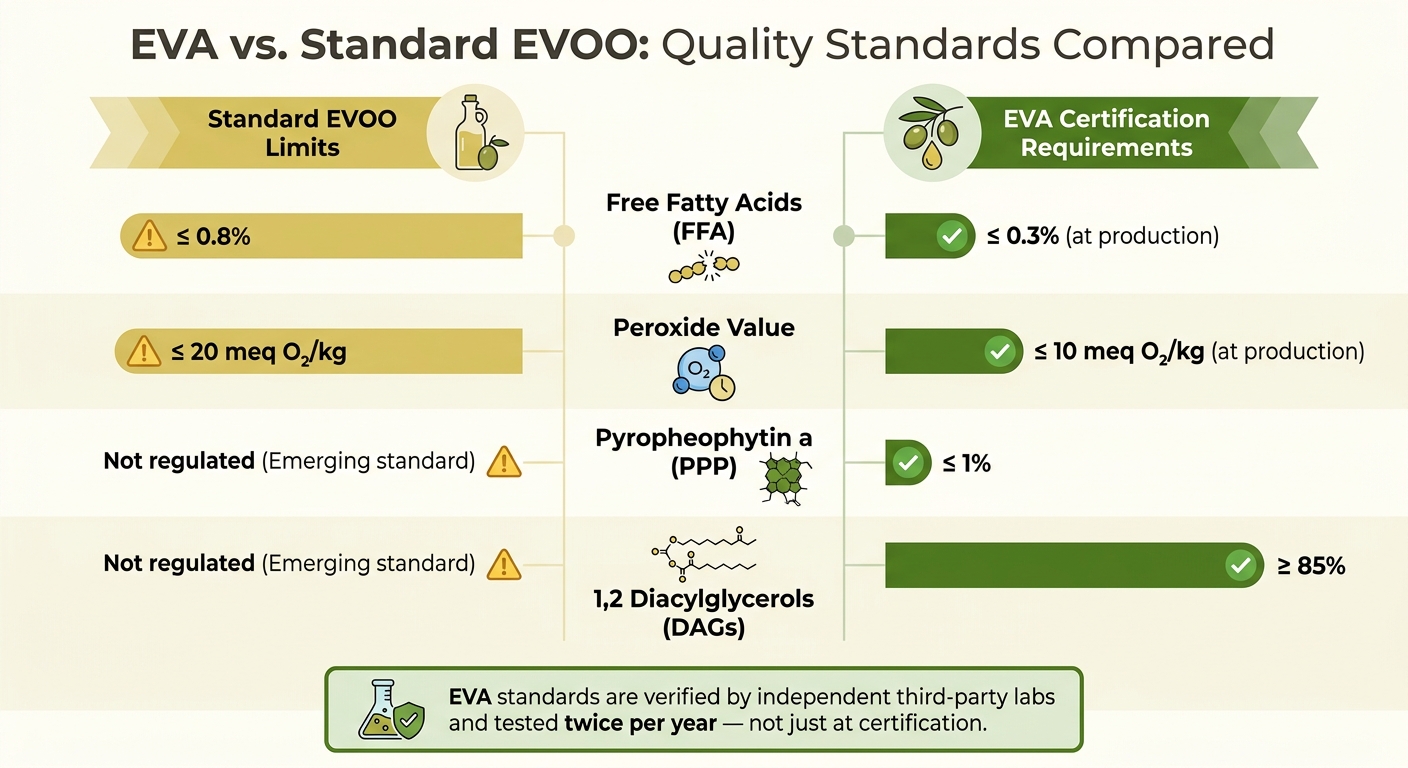
For instance, EVA requires a free fatty acid (FFA) level of ≤ 0.3% at production, far stricter than the 0.8% limit for basic extra virgin grades. Similarly, peroxide values - an indicator of oxidation - must be ≤ 10 meq O₂/kg at production, compared to the industry standard of 20.
Sensory testing is equally rigorous. Oils must have zero defects and a fruitiness median of at least 3.5 at production. EVA also monitors freshness using advanced markers like Pyropheophytin a (PPP) and 1,2-Diacylglycerols (DAGs), aligning with anticipated FDA standards for olive oil in the U.S.. Below is a breakdown of how EVA's standards evolve as the oil ages:
| Parameter | At Production | At Bottling | At Best By Date |
|---|---|---|---|
| Free Fatty Acids (%) | ≤ 0.3 | ≤ 0.4 | ≤ 0.5 |
| Peroxide (meq O₂/kg) | ≤ 10 | ≤ 12 | ≤ 15 |
| Defects (median) | 0.0 | 0.0 | 0.0 |
| Fruitiness (median) | ≥ 3.5 | ≥ 3.5 | ≥ 1.0 |
Packaging is another critical aspect of certification. EVA-certified oils must be sold in dark or opaque containers to protect against light damage, and labels must clearly display the harvest year and a Best By Date no more than 32 months from harvest. Producers also undergo randomized quality testing twice a year to ensure ongoing compliance, not just a one-time certification. This rigorous process ensures that EVA-certified oils consistently meet elevated quality standards.
How the Extra Virgin Alliance Educates Consumers
Certification standards only work when consumers know how to interpret them. That’s where the Extra Virgin Alliance (EVA) steps in, offering practical guidance on understanding labels and evaluating olive oil quality through taste.
How to Read an Olive Oil Label
Labels often go unnoticed by shoppers, but EVA emphasizes their importance. They encourage consumers to look for four key details: the country of origin, confirmation of a single harvest season, a clear "Best By" date, and dark or opaque packaging. These elements indicate a producer’s commitment to quality and transparency.
EVA also provides an online Product Directory, which lists certified oils along with in-depth information on farming methods, production history, and quality indicators. The directory features +Factor Icons, which highlight qualities like traceability, land stewardship, and ethical practices. For instance, oils made from at least 80% local olive varieties earn a "Heritage Variety" badge, while oils from groves with 50% or more centenarian trees receive a "Centennial Trees" designation. Producers who include details like the specific olive cultivar or a QR code linking to traceability data demonstrate an extra level of transparency, which EVA views as essential.
But understanding labels is just one part of the equation. EVA also teaches consumers how to evaluate olive oil through taste.
Using Taste and Aroma to Judge Olive Oil Quality
Labels set expectations, but taste and aroma confirm the quality. EVA guides consumers in developing their palate to recognize a spectrum of flavors, from mild to bold, depending on whether the olives were harvested green or ripe - similar to how wine flavors vary.
"Extra virgin olive oils vary in style and intensity, just like wine! Oils can range from mild to robust with a variety of olive fruit flavors from green to ripe." - Extra Virgin Alliance
To help consumers identify quality, EVA promotes a four-step tasting process: Swirl, Sniff, Slurp, and Swallow. This method helps detect key characteristics like fruitiness, bitterness, and pungency, while also spotting flaws such as rancidity or vinegary notes. Between samples, they suggest cleansing the palate with a Granny Smith apple slice or water.
EVA’s sensory standards are stringent, requiring a median defect score of 0.0 from production through the oil’s best-by date. These benchmarks give consumers a reliable framework for evaluating olive oil at home, ensuring they can make informed choices. Through these tools, EVA continues to build trust and confidence in extra virgin olive oil.
Fraud Prevention and Building Consumer Trust Through Collaboration
EVA vs. Standard EVOO: Quality Standards Compared
Ensuring every bottle matches its label goes beyond educating consumers. The Extra Virgin Alliance (EVA) not only sets high standards but also collaborates with producers, independent labs, and tech providers to ensure certified oils maintain their integrity from production to purchase.
Tools That Support Traceability and Transparency
EVA mandates the use of blockchain technology and QR codes to create full traceability from the olive grove to the grocery store. This system allows consumers to access verified information about their oil's origins and production process. By scanning a QR code, buyers can uncover details like the olive cultivar, harvest date, and pressing specifics. These data points are tough to falsify and easy to verify, making them a powerful defense against fraud.
One example of this approach is the partnership between Spanish olive oil giant Deoleo and IBM. In 2022, Deoleo utilized the IBM Food Trust blockchain to enhance traceability for its Maestros de Hojiblanca brand. This initiative introduced unique QR codes on approximately 4 million bottles annually across Spain, France, and the U.S. Rafael Pérez del Toro, General Manager of Quality at Deoleo, explained:
"This initiative seeks to go a step further in the relationship with our consumers to improve their experience with the brand and interaction with the product."
EVA also highlights Estate Produced oils - where olives are grown and milled on the same property - as a gold standard for traceability. This model offers unparalleled production control, minimizing the risk of adulteration.
These technological advancements not only improve transparency but also strengthen fraud prevention efforts.
Research-Based Fraud Prevention Programs
In addition to technology, EVA employs cutting-edge analytical markers to safeguard the quality of every bottle. Two key markers are Pyropheophytin a (PPP) and 1,2 Diacylglycerols (DAGs), which can identify oils that have been aged or heat-treated - common tactics in fraudulent practices. While these tests aren't yet required by standard regulatory bodies, EVA's use of them sets a higher benchmark for quality assurance.
Every product certified by EVA includes a Certificate of Analysis (COA) validated by independent labs, ensuring compliance with stricter fraud-prevention criteria. These labs also conduct ongoing market monitoring to uphold standards. The table below compares EVA's chemical thresholds to those of standard extra virgin olive oil (EVOO):
| Parameter | EVA Requirement (at Production) | Standard EVOO Limit |
|---|---|---|
| Free Fatty Acids (FFA) | ≤0.3% | ≤0.8% |
| Peroxide Value | ≤10 meq O₂/kg | ≤20 meq O₂/kg |
| Pyropheophytin a (PPP) | ≤1% | N/A (Emerging) |
| 1,2 Diacylglycerols (DAGs) | ≥85% | N/A (Emerging) |
This gap between EVA's stringent standards and the legal baseline highlights where lower-quality oils can slip through. EVA's combination of collaboration, rigorous research, and advanced testing ensures a higher level of integrity in the olive oil market.
What EVA's Work Means for U.S. Consumers and Retailers
EVA's standards play a key role in helping American shoppers and specialty retailers make smarter olive oil choices. With olive oil now present in 50.9% of U.S. households as of February 2026, ensuring quality has become more important than ever.
How U.S. Consumers Can Spot High-Quality Olive Oil
When shopping for olive oil, the harvest date is your best guide. EVA-certified oils must come from a single harvest season and include a "Best By Date" no more than 32 months from that harvest. If a bottle only lists an expiration date without mentioning the harvest, that’s a red flag.
Packaging also matters. Choose oils in dark glass or opaque tins, as these protect the oil from light, which can degrade its quality. Steer clear of clear bottles, and remember: color isn’t an indicator of quality. A darker green hue doesn’t necessarily mean better oil.
Price can also be a clue. A 2024 study revealed that adulterated olive oils were often priced over 50% lower than authentic ones. Joseph R. Profaci from the North American Olive Oil Association explains:
"The top concern we hear from consumers is whether the olive oil they're buying might be cut with seed oils - a fear largely driven by sensational claims on social media about so-called 'fake' olive oil."
The reassuring news is that 98% of olive oil sold in U.S. stores is authentic, according to cumulative NAOOA testing. Additionally, a 2024 study of 190 samples covering 85% of the U.S. market found zero adulteration among the top brands. To further ensure quality, look for the EVA seal or the NAOOA Quality Seal, both of which are backed by independent lab testing.
These tips empower consumers to make confident choices and highlight examples of transparency in the olive oil industry.
Big Horn Olive Oil: Quality and Transparency in Practice
Brands like Big Horn Olive Oil set the gold standard for quality and transparency. Their Ultra Premium Extra Virgin Olive Oils are cold-pressed within 2 hours of harvest and reach customers within 3 months - a freshness benchmark that surpasses most labeling practices. Their single-source oils, such as the Picual and Coratina varieties, showcase the kind of cultivar-specific clarity that EVA promotes as a marker of excellence. For shoppers who value clear and honest labeling, Big Horn Olive Oil exemplifies the transparency that EVA aims to help consumers identify and demand.
Conclusion: Better Consumer Education Leads to Better Olive Oil Choices
Even though many olive oils meet strict quality standards, making informed choices is still crucial. Knowledge empowers shoppers to navigate labels, identify quality markers, and trust credible certifications. This kind of awareness helps consumers truly value efforts aimed at ensuring olive oil authenticity.
The challenge? Misunderstanding persists. For example, research reveals that 70% of consumers are unaware of the legal maximum acidity level required for extra virgin olive oil (EVOO) classification. Even more surprising, only 31.3% know the recommended 12-month shelf life for EVOO. These details might seem small, but they’re vital in distinguishing fresh, authentic olive oil from products that just scrape by on basic standards.
Organizations like the Extra Virgin Alliance (EVA) are stepping up by setting higher thresholds for quality and requiring clear harvest date labeling. As EVA Director Alexandra Kicenik Devarenne explains:
"You can talk about olive oil all day long, but it is not until you put somebody in a kitchen with different wonderful olive oils... that is when the magic happens."
To bridge the gap between standards and consumer understanding, hands-on education - like culinary workshops - paired with clearer labeling and traceable QR codes can make a world of difference. When shoppers know what to look for, they naturally gravitate toward producers and retailers committed to quality and transparency. This ripple effect benefits everyone in the supply chain, reinforcing EVA’s goal of elevating olive oil standards across the board.
FAQs
What does the EVA seal actually guarantee?
The Extra Virgin Alliance (EVA) seal is a mark of quality and trust for olive oil lovers. It signifies that the oil has passed rigorous third-party testing to meet strict standards of quality and purity. To earn this certification, producers must adhere to several key criteria:
- Single Harvest Season: The oil must come from olives harvested during one specific season, ensuring freshness and consistency.
- Protective Packaging: Oils must be stored in packaging that shields them from light, preserving their flavor and quality.
- Transparent Labeling: Labels must clearly display the harvest date, the country of origin, and a best-by date, which can’t exceed 32 months from the harvest.
Beyond these requirements, producers carrying the EVA seal also pledge to uphold responsible farming and production practices, focusing on environmental care and supporting local communities.
How can I verify an olive oil’s origin with a QR code?
To check where an olive oil comes from, simply scan the QR code on the bottle label with your phone. This will usually take you to a website or app providing detailed information about the product, including its origin, batch number, olive varieties, and any quality certifications. Some brands even add security features like scratch-off layers to ensure authenticity. At Big Horn Olive Oil, we prioritize transparency, making it easy for you to access all the details about our Ultra Premium Extra Virgin Olive Oils.
What are the easiest taste cues to spot rancid or defective EVOO?
Rancid extra virgin olive oil gives off distinct smells - think fresh paint, wax, stale nuts, or even spoiled fat. When tasted, it might feel greasy, taste dull, or have a crayon-like flavor. To test it at home, pour a small amount into a glass, swirl it to warm it up, and take a deep sniff. If you catch sour, musty, or unpleasant odors, the oil has gone bad and shouldn't be used.