

Gender Equity in Olive Oil Supply Chains
Women do much of the work in olive oil, but many still lack equal pay, land rights, credit, and a seat in key decisions. If you buy, source, or sell olive oil, the fix is pretty clear: track women’s work, pay people properly, use written contracts, open training and leadership paths, and check labor data as part of sourcing.
Here’s the short version:
- Women work from grove care and harvest to milling, quality testing, packaging, and retail
- A lot of that work is seasonal, informal, or unpaid family labor
- 76.2% of women in one olive farming study said they had no access to credit or savings schemes
- 42.9% reported direct gender-based discrimination
- 23.8% had no social protection or insurance
- In one study, 47.6% of women belonged to farm groups, but only 19% held leadership roles
- Women globally own less than 15% of agricultural land
What this means for you is simple: if women’s labor is missing from records, then pay, safety, and accountability are harder to check. And when women are shut out of land, loans, training, and boards, the whole supply chain loses out.
I’d boil the article down to three points:
- Women are present at nearly every stage, but their work is often hidden
- The biggest gaps are in ownership, pay, credit, safety, and decision-making
- Buyers and suppliers can act now with contracts, payroll checks, training access, and sex-disaggregated workforce data
| Area | Main problem | What to check |
|---|---|---|
| Farm work | Unpaid or off-the-books labor | Labor logs, contracts |
| Credit and land | Women lack title and finance access | Land records, loan access |
| Mill and quality roles | Skill without equal authority | Job titles, training records |
| Leadership | Low share of women in board seats | Governance records |
| Safety and pay | Uneven pay, weak protections | Payroll data, grievance systems |
Bottom line: this is not just a labor issue. It affects sourcing, traceability, output, and business results too.
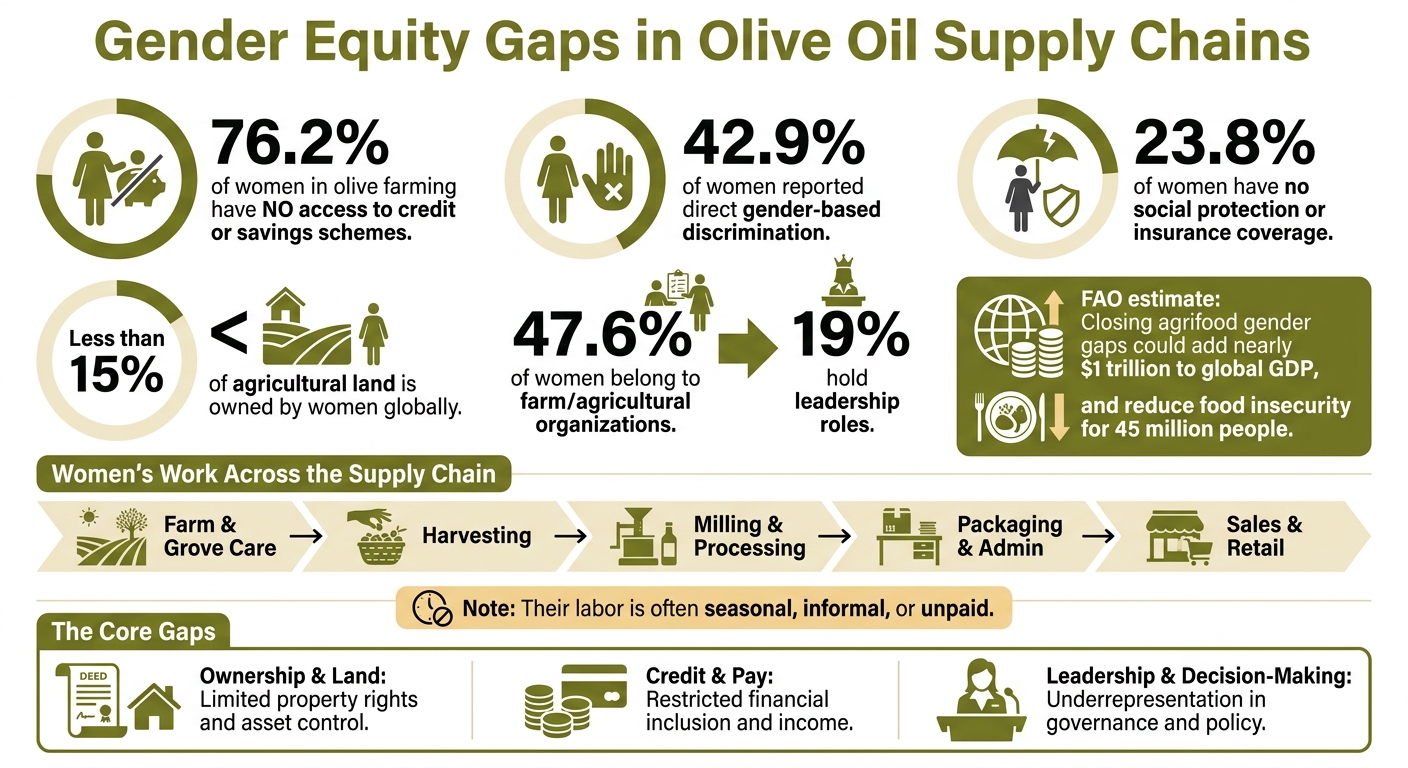
Gender Equity Gaps in Olive Oil Supply Chains: Key Statistics
Zaytoun: Growing olives in Palestine - a woman-led business
sbb-itb-4066b8e
How Women's Work Shows Up Across the Supply Chain
Women work across the value chain, but their jobs tend to cluster in informal, seasonal, and hard-to-see work. The specifics change from one stage to the next. What stays the same is low visibility and spotty recordkeeping.
The table below shows where the biggest equity gaps appear at each stage:
| Supply Chain Stage | Key Equity Issues |
|---|---|
| Farm & Grove Care | Labor is often undercounted or unpaid in family operations; lack of land ownership |
| Harvesting | Concentration in seasonal, informal, and lower-paid roles |
| Milling & Processing | Women contribute to quality work without matching decision-making power; limited access to technical training for mill operation |
| Packaging & Admin | Roles are often less visible and offer lower pay compared to technical or management roles |
| Sales & Retail | Female-owned brands face bias, and their expertise is often overlooked |
Farm Work, Harvesting, and Unpaid Family Labor
The biggest gaps start at the farm level, where family labor is the least likely to be tracked. On family-run farms, women often take on pruning, sorting, and harvest support without any formal employment record. In many producing regions, that work gets folded into household labor instead of paid work. And when work isn't recorded, it barely shows up in official data.
"Most of those [harvest] crews are managed by men from cultures that typically assume men are in charge. It presents challenges, and I usually need to ask my husband not to be present because his presence undermines my authority." - Beth McCown, Owner, Central Coast Olive Company
That quote gets at the issue in plain terms: the work is there, the skill is there, but authority and credit don't always follow.
Milling, Testing, Packaging, and Retail Roles
Further up the chain, women's jobs often become more technical, but recognition still trails behind the work itself. Women are showing up more often in sensory evaluation and quality roles. At the 2024 NYIOOC World Olive Oil Competition, 9 out of 19 judges - nearly 50% - were women.
Still, being seen in competitions doesn't always mean being seen at work. In packaging, administration, and e-commerce, women often keep daily operations moving, yet those roles tend to bring less pay and less visibility than technical or management jobs.
Women's work spans the supply chain. The credit for that work still doesn't.
Main Barriers to Gender Equity in Olive Oil Production and Trade
The biggest barriers fall into three connected areas: ownership, workplace conditions, and decision-making. In plain terms, women face hurdles when trying to control assets, work under fair conditions, and shape the choices that drive the business.
| Barrier | Level | Who Is Affected | Business Impact |
|---|---|---|---|
| Credit | Structural | Entrepreneurs & Farmers | Prevents investment in quality-improving technology and inputs |
| Land Title | Structural | Farmers | Limits ability to use land as collateral for loans or long-term planning |
| Equipment Design | Workplace | Workers & Farmers | Increases physical strain and reduces labor productivity for women |
| Unpaid Care Burden | Workplace | All Women | Reduces time available for training, networking, and leadership |
| Leadership Gaps | Decision-Making | Cooperative Members | Women's perspectives on pricing and standards are excluded from decisions |
| Bias | Decision-Making | Entrepreneurs | Undermines authority with labor and limits negotiation power |
Land, Credit, Contracts, and Access to Inputs
Access on paper is not the same as control in practice. Women may receive land through inheritance, but many still run into social barriers when they try to secure formal ownership or buy land on their own. Globally, women own less than 15% of agricultural land. Without formal title, it becomes much harder to use land as collateral, get credit, or make long-term investment plans.
The financing gap is also stark. In one study, 76.2% of women in olive farming reported having no access to credit or saving schemes. That shuts the door on tools, inputs, and upgrades that could improve quality and output. And even when women are part of contract or pricing talks, bias can weaken their bargaining position.
Equipment adds another layer to the problem. Many tools and machines are built around male body norms, which can increase strain and lower efficiency for women.
Pay Gaps, Seasonal Work, Safety, and Unpaid Care Burdens
Women in olive supply chains are often concentrated in labor-heavy jobs like harvesting, sorting, and cleaning, while men are more likely to handle machinery and irrigation. That split shapes pay, job security, and room to move up.
Then there's the second shift. Paid work is only part of the day for many women. Unpaid care work at home cuts into the time they could spend on training, networking, or stepping into management roles. It's hard to build influence when your schedule is already packed.
A 2026 study found that 42.9% of women in olive farming reported direct gender-based discrimination, including being ignored in professional conversations or dealing with sexist comments. On top of that, 23.8% have no social protection or insurance coverage at all.
Lower pay and unstable work don't just hurt income. They also make it harder for women to join cooperatives, stay involved, and move into leadership.
Low Representation in Cooperatives and Decision-Making Bodies
If women aren't in leadership, they have less say over pricing, standards, and contracts. That's a big deal, because cooperatives are often where those calls get made. So underrepresentation doesn't stay in the meeting room; it shapes what happens across the supply chain.
In a study of Greek olive farmers, 47.6% of women were members of agricultural organizations, but only 19% held leadership positions. That gap shows the difference between being present and having power.
"Women in Crete are most often the invisible force behind everything... but often due to patriarchal structures or cultural stereotypes they do not want to take on leading roles." - Chloe Dimitriadis, Biolea
Research also links lower output on women-managed farms to unequal access to inputs, technology, and support. That means the productivity gap is not just a social issue. It's also a business cost.
Steps Companies and Suppliers Can Take Toward Gender Equity
Finding the barriers is only part of the job. The next part is building systems that deal with them in plain, enforceable ways: written policies, training people can actually attend, and sourcing choices that back fair labor practices. These steps focus on the same gaps already discussed: pay, safety, access, and voice.
Supplier Policies, Fair Pay, and Safe Working Conditions
Suppliers should use written contracts for seasonal, family, and permanent workers so pay, protections, and job duties are enforceable. This helps fix the invisible labor problem. If work isn't documented, it can't be checked, protected, or improved.
Payroll records should show equal pay for equal work, broken down by gender. Anti-harassment procedures should be part of supplier standards and matched with anonymous grievance channels workers can use without fear. Suppliers can also add maternity protections to their own labor standards and audits. Where insurance coverage is missing, they can provide or help pay for basic insurance.
Training, Leadership Pathways, and Women's Roles in Quality Work
Women should have access to sensory, milling, and agronomy training. That speaks directly to the access gap noted earlier. Women already work in technical roles, but formal training paths haven't kept up.
Training also needs to fit rural life. Schedules, distance, and caregiving duties all shape who can show up. Webinars and local workshops cut travel barriers. When suppliers and cooperatives plan training around caregiving needs, more women can take part in high-value technical education and move into quality and technical roles over time.
Leadership paths need the same level of intent. Mentorship programs, formal quotas, or board composition targets are practical ways to close the cooperative representation gap discussed earlier. If a cooperative tracks the share of women in management and board roles and sets clear targets, it creates a measurable path toward parity.
How Buyers Can Add Gender-Equity Checks to Sourcing and Traceability
Buyers can turn these practices into sourcing requirements. This doesn't call for a separate system. It means asking for information that responsible suppliers should already be tracking.
Buyers can request:
- sex-disaggregated workforce data
- information on women's representation in leadership
- proof of written labor contracts and grievance procedures
They can use the same records already collected for origin and harvest date to review labor practices. That data can then be checked through audits or QR code data, which keeps gender data inside the sourcing system instead of treating it like a side issue.
The table below shows where the baseline often falls short and what a gender-responsive practice looks like in day-to-day use:
| Area | Baseline Practice | Gender-Responsive Practice | What to Verify |
|---|---|---|---|
| Labor Standards | Informal or verbal agreements | Written contracts for all seasonal and family workers | Signed copies of contracts and labor logs |
| Pay Equity | Flat rates per grove or household | Equal pay for equal work; sex-disaggregated payroll | Payroll records showing identical rates for same tasks |
| Training | In-person sessions at central hubs | Webinars and local practical demos with childcare support | Attendance records and training delivery methods |
| Leadership | Male-dominated boards/management | Quotas or pathways for women in cooperative leadership | Board composition and management titles |
| Traceability | Origin and harvest date only | Traceability including labor conditions and wage verification | QR code data or audit reports on worker treatment |
| Safety | General safety rules only | Written anti-harassment policy; anonymous reporting | Employee handbook; number of grievances filed/resolved |
Farming yields are negatively correlated with gender-based discrimination. That's why premium buyers have a business reason, not just an ethical one, to make these checks part of standard sourcing practice.
Measuring Progress and Key Takeaways
Useful Indicators for Farms, Mills, Cooperatives, and Buyers
Once gender checks are part of sourcing, the next move is simple: track whether they lead to change. A policy on paper doesn't do much by itself. You need clear indicators that show what's happening with ownership, pay, leadership, training, and safety, not just production output.
The table below pulls together practical indicators across the supply chain. Each one lines up with a gap covered in this guide: ownership, pay, training, leadership, and safety.
| Supply-Chain Level | Indicator | Outcome Type | Data Source |
|---|---|---|---|
| Farm | Women farm owners or heads (%) | Ownership | Land registry / Farm surveys |
| Farm | Paid vs. unpaid family labor share | Pay equity | Labor logs / Time-use interviews |
| Mill / Processing | % of women in technical roles (milling, testing) | Skill access | Employment records |
| Mill / Processing | Women's participation in technical training | Skill access | Training attendance logs |
| Cooperative | % of women in board or leadership seats | Decision-making | Governance records |
| Buyer / Sourcing | % of suppliers with anti-discrimination policies | Safe working conditions | Supplier audits / Codes of conduct |
| Supply Chain | Access to credit or loans without male mediation | Financial resilience | Bank / Credit union applications |
| Supply Chain | Reported safety and harassment incidents | Workplace safety | Anonymous reporting channels |
These indicators matter because the gap in decision-making roles is still large, even in places where women take part in farm groups. In a Crete-based study, 28.6% of women were farm heads, while 47.6% belonged to agricultural organizations but only 19% held leadership roles.
Key Takeaways for a Fairer Olive Oil Supply Chain
The main point of this guide is plain: women's labor in olive oil is real, common, and often overlooked. From harvesting and sorting to milling and quality testing, women are present at every stage. But equal pay, land ownership, credit access, and decision-making power are still out of reach for many of them.
The business case is just as strong as the moral one. The FAO estimates that closing agrifood gender gaps could add nearly $1 trillion to global GDP and reduce food insecurity by 45 million people. That alone makes gender equity part of supply-chain planning, not some side project.
For buyers, the practical move is to build gender checks into sourcing and traceability systems. For suppliers and cooperatives, it means tracking pay, leadership, and credit access alongside production data. The barriers are not mysterious: land access, credit limits, caregiving burdens, and informal labor keep showing up. And because they can be measured, they can be managed.
FAQs
Why is women’s work in olive oil often invisible?
Women do a great deal of work across the olive oil supply chain, but that work often goes unseen. In many places, social norms and patriarchal systems still give men more control over leadership and decision-making.
Women also face limits that make their work less visible and their progress harder. These include unpaid caregiving duties, along with barriers to land ownership, business education, access to credit, and roles in management or trade.
How can buyers verify gender equity in sourcing?
Buyers can check gender equity in sourcing through gender-sensitive due diligence across the supply chain. That starts with mapping the people and businesses involved in production, processing, and trade so hidden or pushed-aside groups don't get missed. It also helps surface the obstacles those groups face.
Using established frameworks, such as FAO or OECD-FAO guidance, businesses can look at whether women have fair access to training, financial services, and leadership roles. They can also review whether benefits, costs, and decision-making power are shared fairly across the supply chain.
What metrics best show progress on gender equity?
Progress on gender equity shows up most clearly in outcomes tied to economic power and participation in public life. That means looking at measures like income, asset ownership, productivity, and savings.
It also means paying attention to how often women serve in leadership roles, how much say they have in family and community decisions, and whether they can move freely in their daily lives. Big Horn Olive Oil supports this progress by putting fair trade standards first, including pay equity and chances for women to help shape community development decisions.