

5 Ways Olive Oil Producers Support Gender Equality
Women are vital in agriculture, making up 40% of the workforce globally. Yet, they own less than 15% of farmland. In the olive oil sector, this gap is even wider. Addressing gender inequality in this industry isn’t just fair - it boosts productivity and economic growth. Here’s how producers are making a difference:
- Equal Pay: Companies are introducing transparent contracts and pay audits to close wage gaps.
- Training Access: Programs like Re:Olive teach women modern farming techniques and sustainable practices.
- Leadership Roles: Women are stepping into decision-making positions, reshaping the industry.
- Safe Workplaces: Policies ensure harassment prevention, wage equity, and work-life balance.
- Economic Support: Cooperatives and financial initiatives help women access land, loans, and higher profits.
These efforts empower women, improve production, and create higher-quality products for consumers. Gender equality in olive oil production benefits everyone.
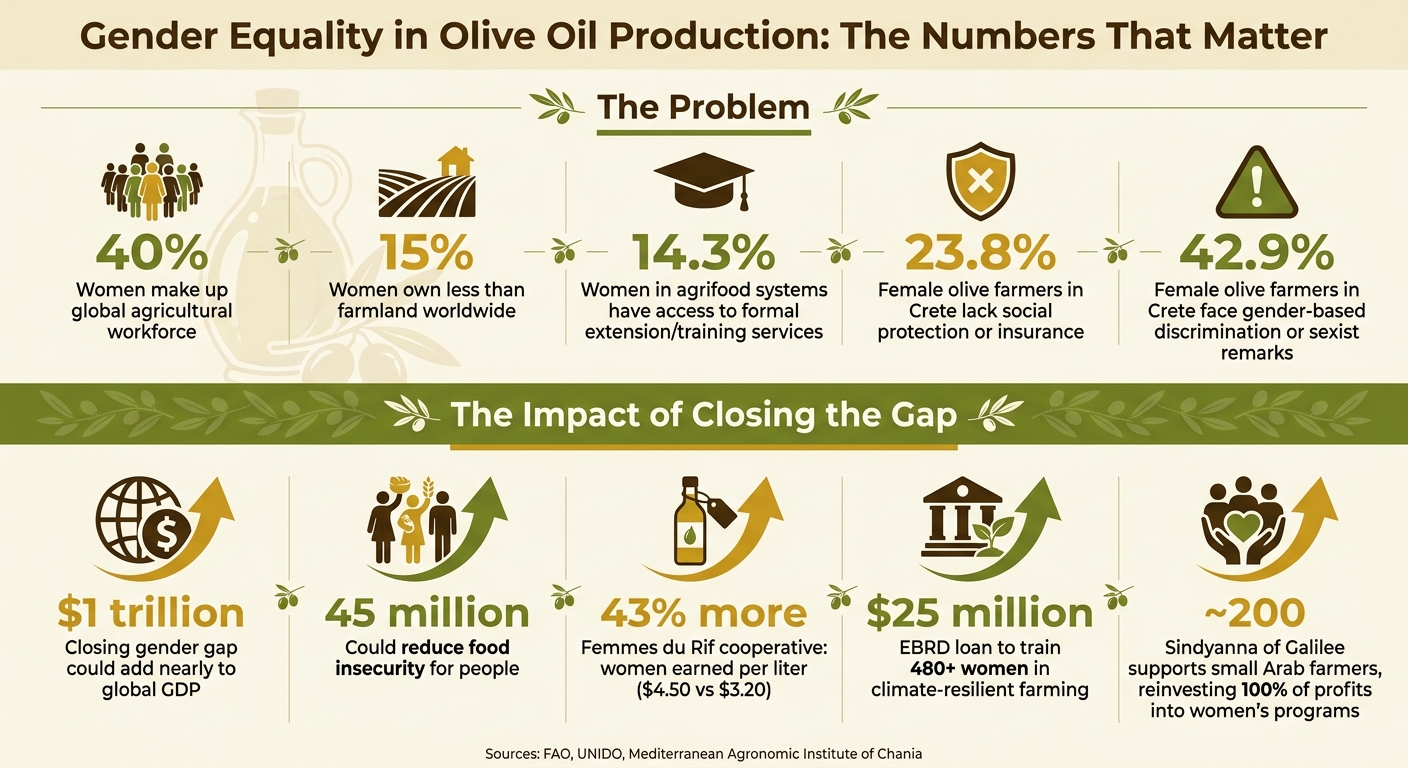
Gender Inequality in Olive Oil: Key Stats & Solutions
Meet Lucia, Spain's Leading Regenerative Olive Oil Producer
1. Equal Pay and Fair Employment Contracts
Producers are tackling wage disparities head-on by incorporating equal pay clauses directly into employment contracts. This is a critical step in addressing the well-documented issue of women in agrifood systems being paid less than their male counterparts - a gap that is both persistent and difficult to defend. These standardized contracts go beyond just setting wages; they also clearly define roles and include anti-discrimination protections. When workers have a transparent understanding of their pay structure, it becomes much harder for inequities to take root.
"Closing the gender gap in farm productivity and the wage gap in agrifood systems would increase global gross domestic product by nearly USD 1 trillion." - FAO
A great example of this in action is Pompeian, a collective of family olive growers. They’ve adopted fair labor standards to ensure equitable pay throughout their workforce. On top of that, they conduct regular pay audits to identify and address any discrepancies. These measures not only uphold fairness but also boost morale and productivity across the board. The measurable benefits of these practices highlight why they’re so important.
In January 2026, the United Nations designated the year as the International Year of the Woman Farmer. This global recognition has motivated many producers to double down on their efforts to formalize wage equity and strengthen their commitments to fair employment practices.
These steps are laying a strong foundation for more initiatives aimed at empowering women in olive oil production.
2. Training Programs and Access to Resources
Equal pay is only one piece of the puzzle. Without access to proper training and tools, women in olive oil production face significant hurdles. Shockingly, only 14.3% of women in agrifood systems report having access to formal extension services - programs designed to teach modern farming techniques and technologies. This lack of access makes it challenging for women to stay competitive.
However, some initiatives are stepping up to address this issue. In January 2026, Cristina Stribacu, co-owner of LIÁ in Greece, introduced the Re:Olive educational program. This initiative focuses on teaching sustainable olive-growing practices to small producers, with a particular emphasis on equipping women farmers to tackle climate challenges and modernize their operations. The program goes beyond traditional lectures, offering hands-on and practical learning opportunities.
Similarly, the cooperative Oleoestepa has implemented targeted training programs for women, covering agricultural techniques and farm management. These efforts have led to a noticeable increase in women taking on decision-making roles within the cooperative. This kind of training doesn’t just build skills - it creates opportunities and fosters leadership.
Access to technology is another game-changer. Tools like satellite imagery for crop monitoring are now being incorporated into training programs, providing women farmers with the same advanced resources that larger operations rely on. As Vera Alexandropoulou of Elysian Earth noted:
"Education and training have improved significantly among Greek women. More women are now entering agrifood-related studies and bringing strong technical and academic knowledge into the sector."
Mentorship programs also play a vital role. By connecting experienced farmers with newcomers, these networks can increase productivity and contribute to reducing global food insecurity, potentially benefiting 45 million people worldwide.
3. Leadership Roles and Women-Led Cooperatives
Training programs give women the tools they need to succeed, but stepping into leadership roles allows them to reshape the industry itself. In the olive oil sector, more women are being elevated from entry-level roles to positions in management, technical operations, and governance. And the impact? It's changing the game. These shifts are strengthening governance and creating a more inclusive industry.
Take Olivarera de Casariche, a cooperative in Seville, Spain. Here, Virginia López Rodas started as an administrative assistant in 2006. Fast forward to 2021, and she became Director of the credit section, overseeing accounting and credit operations. Over her 15 years with the cooperative, she played a key role in increasing female participation in general assemblies from nearly zero to 15–20%. That number might seem small, but in an industry where women’s voices have often been excluded, it’s a meaningful step forward.
Women-led organizations are also making waves at the community level. Sindyanna of Galilee, a fair-trade certified group in Israel co-managed by Hanan Manadreh Zoabi and Nadio Giol, supports around 200 small Arab farmers. Every penny of their profits goes back into empowering Arab women, offering programs like hydroponics training and culinary workshops.
But the ripple effects of women-led cooperatives go far beyond individual farms. Research shows that closing the gender gap in agrifood systems could improve food access for around 45 million people. As Inmaculada García, a farmer member of Olivarera San Isidro de Gilena, puts it:
"The more women there are on the Governing Council of a cooperative, the better it will be." - Inmaculada García
Another standout example is the Lametia Dop Consortium in Italy. Created by entrepreneur Mary Cefaly, it was the first agricultural cooperative formed entirely by women. The consortium’s dedication to social inclusion and sustainability earned it the title of "Consortium of the Year" in 2024. Stories like these aren’t just isolated wins - they’re proof that when women take the lead, entire communities thrive. Their leadership not only empowers individuals but also strengthens resilience and drives economic growth.
sbb-itb-4066b8e
4. Safe Working Conditions and Family-Friendly Policies
Creating a supportive workplace is critical for women aiming for leadership roles. While opportunities for advancement are important, they mean little without a safe and encouraging environment. For women involved in olive oil production, ensuring physical safety, fair treatment, and a balance between work and family life is not optional - it’s essential. Producers are increasingly recognizing that fostering a healthy work environment is the foundation for growth and progress.
A standout example is Oleocampo SCA, a cooperative in Jaén, Spain. In July 2025, it became the first and only olive oil cooperative in Andalusia to earn the "Marca Andaluza de Excelencia en Igualdad" (Andalusian Excellence in Equality mark) from the Andalusian Institute for Women. Under the leadership of President Juan Gadeo, the cooperative put an equality plan into action. This plan addresses key issues like harassment prevention, wage equity, and work–life balance. The certification is valid for four years, with regular monitoring to ensure compliance.
"This distinctive is a reflection of the joint effort of all our partners... to create a more egalitarian environment, in which the talent of all people is valued equally, regardless of their gender." - Juan Gadeo, President, Oleocampo
Beyond policies, improving the physical aspects of the workplace is gaining attention. Cooperatives are upgrading tools and machinery to reduce the physical strain of tasks like harvesting and processing, which have traditionally been labor-intensive. For instance, lighter, ergonomic tools are becoming more common, helping to ease daily work demands.
"These lighter tools ease daily tasks in the olive grove." - Sophie Girona, Farmer Member, San José de Lora de Estepa Cooperative
Flexibility in work arrangements is another critical factor. Many women in rural areas juggle farm work with caregiving responsibilities. To address these challenges, some producers are offering online training and webinars, enabling women to build skills without needing to travel or secure childcare. A great example is Miriam Pradas Luque, an Oil Master Miller at Agrícola de El Rubio. In May 2026, the Oleoestepa cooperative shared how her workplace supported her family responsibilities, allowing her to balance her career with her personal life. These measures not only support women but also highlight their importance in advancing the industry.
Despite these efforts, challenges remain. A study of female olive farmers in Crete revealed that 23.8% lacked social protection or insurance, and 42.9% faced gender-based discrimination or sexist remarks.
"Women require appropriate infrastructure and services to help them balance family and work demands, thereby reducing the burden of caregiving responsibilities." - Hadil Rbib, Researcher, Mediterranean Agronomic Institute of Chania
5. Community Programs That Support Women's Economic Growth
Safe workplaces and leadership opportunities are essential, but breaking down financial barriers is just as important for empowering women. One of the most significant hurdles is land ownership - women control less than 15% of the world's agricultural land. Without land as collateral, many female farmers struggle to access traditional bank loans needed for equipment, certifications, or expanding their markets. However, innovative cooperative models are helping women overcome these challenges by building collective financial power.
One effective approach involves organizing women into Groups of Economic Interest (GEO) or cooperatives. A standout example is the Femmes du Rif cooperative in Morocco's Ouezzane province, supported by UNIDO. By February 2019, this GEO united 10 all-women cooperatives with 329 members. They achieved Protected Geographical Indication (IGP) certification for their olive oil, enabling them to sell it for 43 dirhams ($4.50) per liter - a 43% increase compared to the standard market price of 30 dirhams ($3.20). The additional income not only improved individual earnings but also funded community projects, such as building a 37-mile road to the remote village of Nefzi, helping to combat depopulation.
"For each woman, we estimate an annual benefit of $6,850, approximately. Those revenues give an economic stability to their families and communities." - Hanane Lachehab, President, Femmes du Rif
Beyond workplace initiatives, community-based financial programs address deeper economic inequalities. Some organizations reinvest profits directly into empowering women. For example, Sindyanna of Galilee in Israel dedicates 100% of its profits to creating new income opportunities. These include hydroponics training, biodynamic beekeeping, and culinary workshops, expanding economic benefits far beyond the olive harvest.
Institutional partnerships are also amplifying these efforts. In April 2024, the European Bank for Reconstruction and Development (EBRD) granted a $25 million loan to Bunge Gıda in Turkey to grow its "Olive Academy" in Ayvalık. This academy, which had already trained 110 women, aims to train at least 480 more female farmers in climate-resilient farming techniques and financial literacy. By collaborating with established financial institutions, these programs significantly extend their impact, benefiting women well beyond individual farms or villages.
Conclusion
These five practices tackle the obstacles that have traditionally held women back in the olive oil industry, laying the groundwork for meaningful change.
According to FAO data, closing the gender gap in agrifood systems could add nearly $1 trillion to global GDP and reduce food insecurity for 45 million people. Beth McCown, Owner of Central Coast Olive Company, highlights the issue:
"I think farming is one of the last areas in our economy to overcome bias against women in the workforce, especially in management roles."
These initiatives do more than just level the playing field. They strengthen the entire supply chain. Producers benefit from a broader talent pool and fresh farming perspectives. Women gain financial independence, safer work environments, and more influence over farm management. And consumers? They enjoy higher-quality olive oil made with care, transparency, and a focus on ethical practices.
When you choose products like Ultra Premium Extra Virgin Olive Oil from Big Horn Olive Oil, you’re supporting this commitment. Their oil is cold-pressed within 2 hours of harvest and delivered fresh within 3 months, ensuring exceptional quality and responsible sourcing.
As the olive oil industry embraces gender equity, these efforts uplift women while improving the quality and integrity of olive oil for everyone.
FAQs
How can olive oil producers prove they pay women and men equally?
Olive oil producers uphold fair pay practices by adhering to fair trade standards, which mandate equal wages for equal work, regardless of gender. They maintain transparency using tools such as third-party audits, blockchain tracking, and detailed wage documentation. To further validate compliance, they rely on independent worker interviews and thorough financial reviews. Certifications from trusted organizations also serve as concrete evidence of ethical labor practices, ensuring their payment systems remain fair and traceable throughout their operations.
What training or tools help women olive farmers increase yields and quality?
Women olive farmers are stepping into opportunities that equip them with essential skills for success. Specialized training programs are opening doors to modern cultivation techniques, climate-resilient farming methods, and sustainable practices tailored to their needs. These programs are designed to help them adapt to changing conditions while improving their yields.
Beyond farming techniques, leadership workshops and coaching sessions are empowering women to take charge during critical periods like harvest. These sessions focus on building management skills, enabling them to lead teams effectively and handle operations with confidence.
Joining cooperatives and growers' associations is another game-changer. These groups allow women to pool resources, such as specialized equipment, and streamline processes like quality control. More importantly, they provide a platform to exchange knowledge and experiences, which boosts productivity and enhances the quality of their olive products. Together, these efforts are helping women thrive in an industry that demands both expertise and collaboration.
How can I support gender equality when buying olive oil?
You can help advance gender equality by selecting olive oil brands that emphasize ethical labor practices and openness about their sourcing. Pay attention to labels that share information such as farm origins and harvest dates - these often reflect responsible sourcing practices. Choose brands that advocate for fair pay for women and collaborate with cooperatives that provide resources, training, and leadership opportunities to women working in agriculture.