

Guide to Phenolic Compound Analysis in Olive Oil
Phenolic compounds in olive oil are key to its flavor, shelf life, and health benefits. They contribute to the oil's bitterness, peppery kick, and antioxidant properties, which help protect against oxidative damage. Here's what you need to know:
- Key Phenolic Compounds: Oleocanthal (anti-inflammatory), Oleuropein (cardiovascular health), Hydroxytyrosol (antioxidant).
- Health Impact: Oils with higher phenolic levels offer stronger antioxidant and neuroprotective effects.
- Testing Methods: High-Performance Liquid Chromatography (HPLC) is the most accurate for profiling individual compounds, while the Folin-Ciocalteu assay provides a quick estimate of total phenolic content.
- Factors Affecting Phenolic Levels: Olive variety, harvest timing, processing methods, and storage conditions all influence the final phenolic content.
For consumers, choosing high-phenolic olive oil means better taste, longer shelf life, and added health benefits. Look for oils with verified lab testing and recent harvest dates for the best quality.
Analytical Considerations for Quantification of Polyphenols in Virgin Olive Oil
sbb-itb-4066b8e
Methods for Analyzing Phenolic Compounds
Olive Oil Phenolic Analysis Methods Compared
Measuring phenolic compounds in olive oil requires choosing the right method. Some techniques focus on identifying specific compounds, while others provide an overall phenolic profile. Understanding these methods helps interpret lab results and assess olive oil quality effectively.
Chromatographic Techniques
High-Performance Liquid Chromatography (HPLC) is the go-to method for analyzing phenolic compounds. This technique separates complex oil samples into individual components, allowing precise identification and quantification of compounds like hydroxytyrosol, tyrosol, and secoiridoid derivatives. To enhance accuracy, labs often pair HPLC with Diode Array Detection (DAD) or Mass Spectrometry (MS).
Before running HPLC, phenols are extracted using liquid-liquid extraction (LLE), which is both cost-efficient and reliable for aglycone-type phenolics. Optimized LLE systems can recover up to 93% of the nine major phenolic compounds found in olive oil.
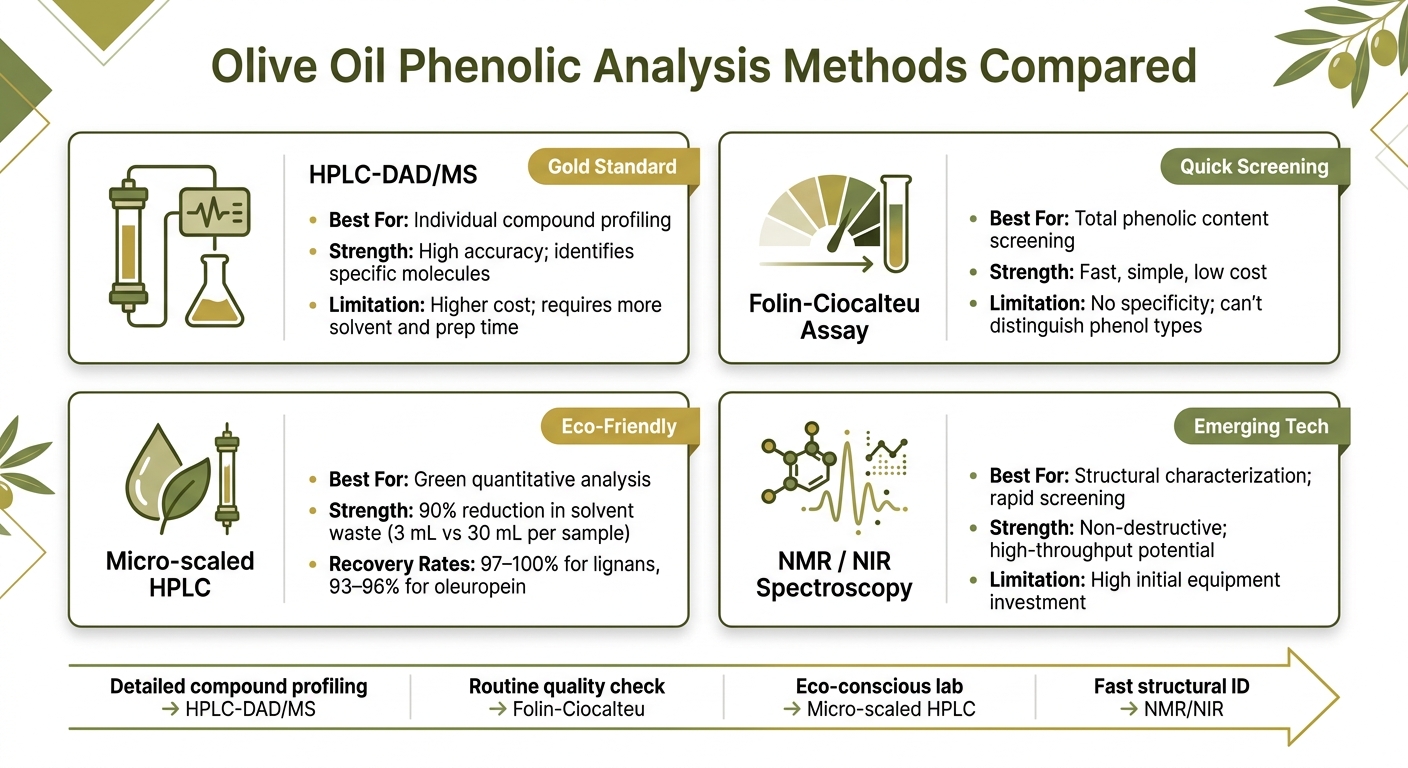
A micro-scaled version of HPLC significantly reduces solvent use, cutting waste by 90%. Instead of 30 mL, only 3 mL of organic solvent is needed per sample. As Giovanni Caprioli and colleagues at the University of Camerino observed:
"The total quantity of organic solvents used in the sample preparation is decreased from 30 to 3 mL with an important abatement of waste, costs, and working time requested." - Giovanni Caprioli et al.
Despite the reduced solvent usage, recovery rates remain high, achieving 97–100% for lignans and 93–96% for oleuropein.
Spectrophotometric Methods
The Folin-Ciocalteu assay is one of the most commonly used spectrophotometric methods. It measures phenolic antioxidants by observing how much a specific reagent is reduced during the reaction. A greater reduction causes a noticeable color change, which correlates to the phenolic content. This method is quick, simple, and cost-effective, making it ideal for routine quality checks.
However, it lacks specificity. The Folin-Ciocalteu assay combines all phenols into a single total value, without distinguishing between different types. As researchers Karel Hrncirik and Sonja Fritsche noted:
"The colorimetric assay is reasonably valid for a rough prediction of the total phenolic content."
Another challenge is that results from colorimetric methods and HPLC are often expressed in different units, making direct comparisons difficult. Converting the data to a common reference base is essential when comparing studies.
Emerging Analytical Techniques
Newer methods like Nuclear Magnetic Resonance (NMR) and near-infrared (NIR) spectroscopy are gaining traction. These non-destructive techniques offer faster analysis. NMR excels at revealing detailed molecular structures without altering the sample, while NIR spectroscopy is being explored for high-throughput applications where speed is critical.
Here’s a quick comparison of the main methods:
| Method | Best For | Strength | Limitation |
|---|---|---|---|
| HPLC-DAD/MS | Individual compound profiling | High accuracy; identifies specific molecules | Higher cost; requires more solvent and prep time |
| Folin-Ciocalteu | Total phenolic content screening | Fast, simple, low cost | No specificity; can't distinguish phenol types |
| Micro-scaled HPLC | Green quantitative analysis | 90% reduction in solvent waste | Requires specialized micro-analytical validation |
| NMR / NIR | Structural characterization; rapid screening | Non-destructive; high-throughput potential | High initial equipment investment |
The choice of method depends on the specific goals, whether it's ensuring compliance with regulations, supporting health claims, or verifying authenticity. For detailed analysis, HPLC or UHPLC-MS/MS is ideal. For quick checks during production, the Folin-Ciocalteu assay is a practical option. The importance of selecting the right method ties into broader themes of quality assurance and authenticity, which are discussed further in the next sections.
Factors That Affect Phenolic Content in Olive Oil
While analytical methods help measure phenolic content, external factors like olive variety, harvest timing, processing methods, and storage conditions play a major role in determining the final levels found in olive oil.
Cultivar and Harvest Timing
The type of olive used is a major factor in phenolic content. Genetics dictate both the amount and the specific types of polyphenols in the oil. For instance, Koroneiki olives are naturally abundant in oleocanthal and hydroxytyrosol, while Arbequina olives typically produce oils with lower phenolic levels. Similarly, Coratina olives yield bitter, pungent oils with high phenolic concentrations, whereas Ogliarola salentina olives create sweeter oils with fewer phenolics. These genetic traits directly influence the phenolic profile observed during analysis.
Harvest timing is equally important. Phenolic levels reach their peak during specific growth stages, as these compounds are part of the olive tree's defense mechanisms. Oils made from early-harvest, green olives consistently have the highest phenolic content, delivering a distinct bitterness (from oleuropein) and a peppery sensation in the throat (from oleocanthal). As olives ripen, their phenolic content decreases, and their shelf life shortens.
A 2024 study led by Yasin Ozdemir at the Ataturk Horticultural Central Research Institute examined 'Gemlik' olives at three different maturation stages. Early-harvest samples demonstrated the highest bioaccessibility of hydroxytyrosol and tyrosol, with CUPRAC antioxidant capacity bioaccessibility reaching 308.27% during the intestinal phase - far surpassing later-harvest samples.
One key tip: when selecting olive oil for its phenolic content, check the harvest year, not just the bottling date. Polyphenols naturally degrade over time, so fresher oils are better.
Processing Techniques
Even olives with high phenolic potential can lose much of their value if processed improperly. Each step in the extraction process - washing, crushing, malaxation, and centrifugation - affects how much of the phenolic content makes it into the final oil.
Cold-pressing is the best method for preserving phenolic compounds. Heat extraction and refining methods, on the other hand, can significantly degrade these beneficial molecules. Timing is also critical: milling olives immediately after harvest prevents enzymatic activity from breaking down phenolic compounds. For example, Big Horn Olive Oil ensures their olives are cold-pressed within hours of harvest, maximizing phenolic retention and maintaining the quality of their Ultra Premium Extra Virgin Olive Oils.
Malaxation, the process of mixing olive paste, can enhance phenolic extraction to a point. However, prolonged malaxation or higher temperatures can reduce phenolic retention. Additionally, two-phase centrifugation systems are generally more effective at preserving bioactive compounds compared to three-phase systems, which produce significantly more wastewater. Processing decisions like these directly impact the phenolic profile measured in lab tests.
Storage Conditions
Once bottled, olive oil begins to lose phenolic content due to oxidation. When oxygen interacts with fatty acids, it sets off a chain reaction that diminishes the protective phenolic compounds. Exposure to light, heat, and air accelerates this process.
An unopened bottle can lose up to 50% of its polyphenols within six months, while an opened bottle can lose up to 40% within just a few weeks. In a study involving eight Italian olive cultivars stored at 68°F (20°C) in complete darkness for seven months, all samples showed a decline in total phenolic content, with some dropping by more than 25%.
"During storage, depending on packaging and environment, olive oils experience compositional changes primarily driven by oxidation processes, particularly the interaction between oxygen and fatty acids." - Mario Vendrell Calatayud et al.
| Chemical Parameter | Trend After 7 Months | Impact on Oil Quality |
|---|---|---|
| Free Fatty Acids (FFA) | Significant increase | Leads to rancidity and promotes oxidation |
| Peroxide Value (PV) | Significant increase | Indicates early-stage oxidation |
| Total Phenols | General decrease | Reduces antioxidant protection and health benefits |
| Hydroxytyrosol | Often increases | Result of secoiridoid hydrolysis |
To slow phenolic degradation, store olive oil in dark glass bottles, away from heat, and keep it tightly sealed. For the best results, consume high-phenolic oils within 12 to 18 months of the harvest date. Understanding these variables is key to maintaining oil quality and meeting regulatory standards for authenticity and health benefits.
Regulatory Standards and Quality Assurance
Regulatory standards play a key role in ensuring consistent quality in phenolic data for olive oil. These frameworks create a standardized approach to measuring phenolic content, enabling producers, laboratories, and consumers to communicate effectively about olive oil quality.
International Olive Council (IOC) Standards
The International Olive Council (IOC) serves as the global authority on olive oil quality and authenticity. Their guidelines define how biophenols should be measured, reported, and interpreted across various olive oil grades. For extra virgin olive oil (EVOO), the IOC sets specific thresholds for quality markers, including total phenolic content, which producers must meet to maintain their classification.
For Ultra Premium EVOO, adhering to IOC standards is more than a requirement - it’s a commitment to excellence. Producers such as Big Horn Olive Oil rely on these internationally recognized benchmarks to ensure their oils consistently meet the phenolic levels expected of high-end products.
Validation and Calibration of Analytical Methods
Accurate phenolic analysis depends on validated methods and properly calibrated equipment. Without rigorous validation, lab results can vary significantly.
The choice of extraction method is crucial. Liquid-Liquid Extraction (LLE) is often preferred over Solid-Phase Extraction (SPE) for analyzing phenolics in olive oil. LLE systems typically achieve recovery rates of around 93% for key phenolics. SPE, on the other hand, can struggle with selectivity, particularly for aglycone-type phenolics - some of the most important bioactive compounds.
When comparing methods, it’s essential to convert measurement units. Phenolic levels expressed in parts per million (ppm) using HPLC often differ significantly from results obtained through colorimetric methods. This difference has direct implications for regulatory labeling. As Karel Hrncirik and Sonja Fritsche explain:
"As these units can differ in orders of magnitude, it is necessary to convert the data to a common base before comparing or combining them."
For premium olive oil profiling, HPLC remains the standard of choice. While the Folin-Ciocalteu colorimetric assay provides quick, rough estimates of total phenolic content, it should always be validated against HPLC for precise quality assurance. Research on 23 virgin olive oil samples demonstrated a strong correlation between LLE/HPLC methods and colorimetric assays, confirming the latter’s utility as a preliminary screening tool.
This level of validation ensures the accuracy needed for precise labeling claims.
Phenolics and Labeling Claims
Phenolic content is a critical factor in determining label claims. In some regions, regulatory guidelines specify criteria for health claims related to olive oil polyphenols. While the FDA in the United States does not currently recognize a specific qualified health claim for olive oil polyphenols, producers marketing to health-conscious consumers often reference internationally accepted standards to support their claims.
Regardless of the region, any label claim tied to phenolic content must be backed by validated analytical data - not estimates or marketing-driven assumptions. Producers rely on HPLC-verified data to ensure their claims align with regulatory requirements and maintain consumer trust.
Practical Uses of Phenolic Analysis in Premium Olive Oil Production
Phenolic testing plays a key role in ensuring consistent quality for producers and verifying product value for consumers.
Maintaining Product Consistency
Phenolic content can vary significantly from one harvest to the next. Factors like weather changes, harvest timing, and slight adjustments in processing can lead to noticeable differences in polyphenol levels between batches. Without testing each batch, producers can't guarantee that the quality of this year's oil matches that of the previous year.
Lab reports provide precise measurements in mg/kg, offering a clear picture of quality. This is especially important for Ultra Premium EVOO, where buyers expect a consistent sensory and nutritional profile. As O-Liv highlights, "Standardization is critical; unverified EVOO can vary drastically between batches, affecting both research outcomes and consumer benefits."
Testing after bottling adds another layer of security. Since phenolic compounds degrade when exposed to heat, light, or oxygen, analyzing the oil at multiple stages - beyond just pressing - ensures it retains its potency throughout storage and shipping. A high phenolic count at harvest means little if the oil oxidizes before reaching the consumer. Consistency in phenolic levels also underpins reliable health and quality claims.
Supporting Health and Quality Claims
Accurate phenolic analysis is essential for substantiating health and quality claims. Claims like "polyphenol-rich" must be backed by measurable data, not just marketing buzzwords.
For example, to meet the European Food Safety Authority (EFSA) health claim regarding blood lipid protection from oxidative stress, an olive oil must contain at least 5 mg of hydroxytyrosol and its derivatives per 20 g of oil. This requirement can only be confirmed through validated analytical methods like HPLC, which precisely measures compounds such as hydroxytyrosol, oleocanthal, and oleuropein.
Producers often use rapid, cold-press techniques to preserve high phenolic levels. Early-harvest olives, in particular, yield oils with higher polyphenol concentrations compared to fruit harvested later in the season, when natural ripening diminishes these bioactive compounds.
"Lab reports - typically measuring compounds like oleocanthal, oleuropein, and hydroxytyrosol - are the only way to objectively verify whether an oil is truly 'high phenolic.'" - O-Liv
One practical approach for building consumer trust is publishing Certificates of Analysis (CoAs). These can be made easily accessible via a QR code on the bottle, offering transparency and reinforcing confidence in the product.
Verifying Authenticity and Traceability
In line with IOC standards, phenolic profiles serve as natural fingerprints for authenticity. Each olive oil's unique phenolic and terpenic composition reflects its specific cultivar, region, and production process. This chemical fingerprint is a powerful tool for ensuring traceability and preventing fraud.
A February 2023 study at the Sociedad Cooperativa Andaluza Olivarera Pontanense in Puente Genil, Spain, demonstrated this concept using HPLC-ESI-TOF/MS. Researchers mapped phenolic and terpenic compounds throughout the production of the Hojiblanca variety, tracking bioactive compounds like maslinic acid (measured at 120 ± 20 µg/g in decantation residues) from raw olives to the final oil. This study provides a clear model for tracking bioactive components from fruit to bottle.
High-precision techniques like LC-MS/MS (liquid chromatography with tandem mass spectrometry) are particularly effective for identifying adulteration. Blending premium EVOO with lower-quality oils disrupts its characteristic phenolic ratios, which these advanced methods can detect - something simpler tests might miss. For producers making bold quality claims, third-party lab certification isn't just helpful; it's essential to differentiate genuinely elite oils from standard supermarket varieties.
Conclusion
This guide has highlighted the role of phenolic analysis in ensuring both the quality and authenticity of olive oil. By identifying the antioxidant strength and spotting adulteration, these methods set premium olive oils apart from the rest. High-phenolic extra virgin olive oils (EVOOs) not only boast superior quality but also offer measurable health benefits, such as anti-inflammatory and heart-protective effects, that lower-phenolic oils can’t provide.
For consumers, the advice is simple: choose oils with verified harvest dates, third-party lab certifications, and dark glass bottles. Pay attention to sensory details like bitterness and a peppery kick in the throat - these are natural indicators of high levels of oleuropein and oleocanthal, two key markers of quality. Stick to oils from reputable brands that follow strict production standards, and for the best results, use them raw within 12–18 months after harvest.
Big Horn Olive Oil sets the bar high in this regard. Their Ultra Premium EVOOs are cold-pressed within just two hours of harvest and delivered fresh within three months, maintaining the phenolic content that defines exceptional olive oil. For them, phenolic analysis isn’t just about quality control - it’s a promise to their customers.
FAQs
What phenolic level is considered “high-phenolic” olive oil?
High-phenolic olive oil is known for its richness in polyphenols, with a concentration of at least 250 mg per kilogram of oil. This higher polyphenol content is often linked to better quality and potential health advantages.
How can I tell if an olive oil’s phenolic lab report is trustworthy?
To ensure the reliability of a phenolic lab report, confirm that it originates from a certified and reputable lab adhering to international standards, such as those set by the International Olive Council. The report should provide detailed measurements of key phenolic compounds like oleocanthal, oleuropein, and hydroxytyrosol, analyzed using dependable methods like HPLC (High-Performance Liquid Chromatography). Reports that meet these standards are far more likely to be accurate and dependable.
Why do two tests show different phenolic numbers for the same olive oil?
Phenolic numbers can vary due to differences in measurement techniques. Each method comes with its own sensitivity and analytical process, which can influence the outcomes. These differences are expected and largely depend on the specific testing method applied.