

How Ancient Techniques Shaped Modern Balsamic Vinegar
Modern balsamic still follows a very old playbook. If you want the short answer: the closer a bottle stays to cooked grape must, natural fermentation, and long barrel aging, the more it lines up with old Modena cellar practice - and the more it usually costs.
Here’s the article in plain English:
- I found that ancient Roman cooked must was the starting point
- Modena families later turned that into a cellar process with wood barrel batteries
- That process still shapes today’s two main categories:
- The price gap reflects the process gap:
- about $4 to $20 for many PGI bottles
- about $50 to $200+ per 3.4 oz. / 100 mL for PDO
- Research links long aging to:
- thicker texture
- more concentrated sugars and acids
- deeper wood-driven flavor
- a more balanced sweet-sour taste
If you’re shopping, the fastest label check is simple: “Tradizionale” means PDO, while bottles without it are usually PGI.
| Type | Main ingredients | Aging | Typical U.S. price |
|---|---|---|---|
| PDO | 100% cooked grape must | 12–25+ years | $50–$200+ / 100 mL |
| PGI | Must + wine vinegar, up to 2% caramel | 60 days to 3 years | $4–$20 |
I’ll walk through how Roman syrup, Modena attic barrels, and modern rules all connect - and why that still matters when you pick up a bottle today.
Balsamic Vinegar of Modena and Traditional Balsamic Vinegar of Modena
sbb-itb-4066b8e
The historical roots of balsamic vinegar in Emilia-Romagna
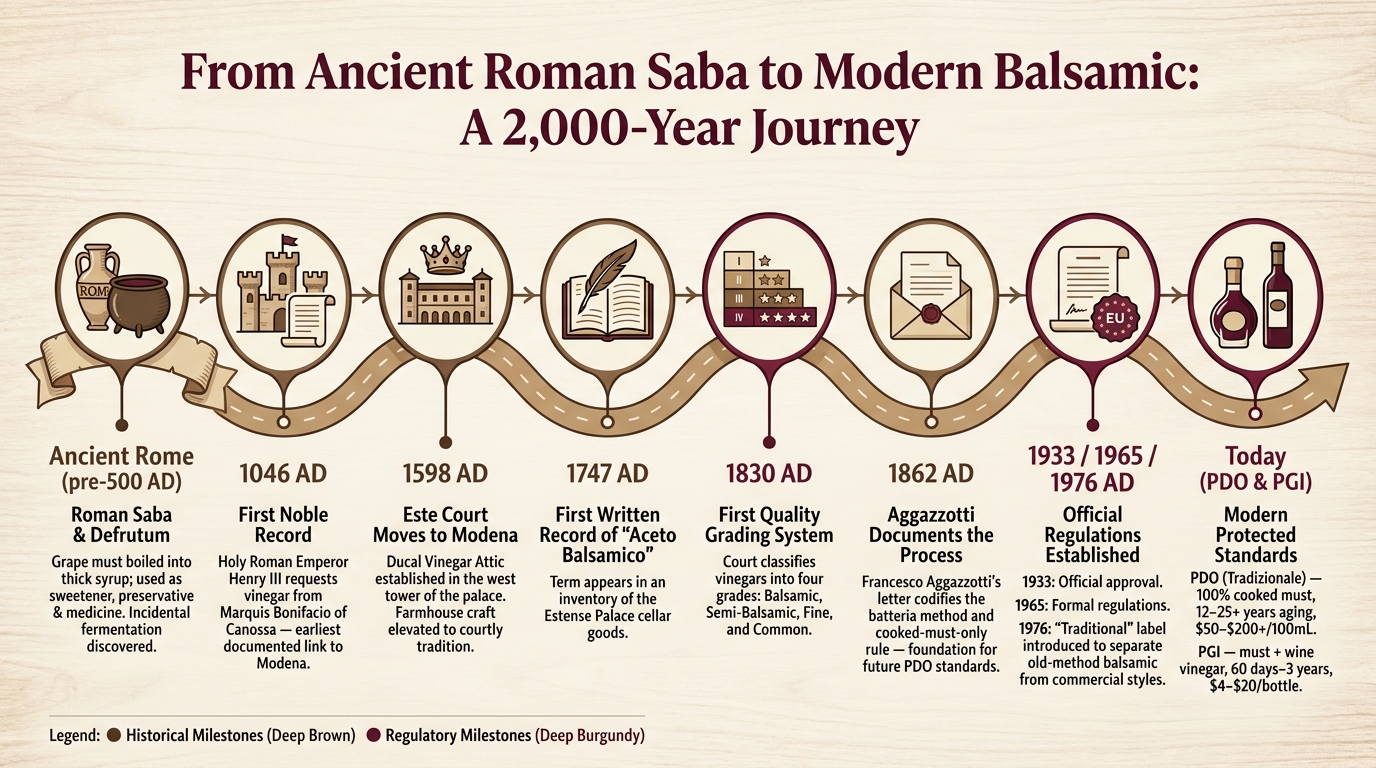
From Ancient Roman Saba to Modern Balsamic: A 2,000-Year Journey
From Roman saba to early vinegar practices
The story starts in ancient Rome. People boiled grape must into a thick, sweet syrup. The final product had different names based on how much it was reduced: saba (or sapa), defrutum, or caroenum. Romans used it as a sweetener, a preservative, and a medicinal remedy. In the Modena area, the Latin verb defrutare was coined to describe this process.
At some point, part of this cooked must likely fermented while it was being stored. That would have produced an early form of vinegar almost by accident.
Modena later took that accident and turned it into a deliberate cellar craft.
Medieval and ducal cellar practices in Modena
By the 11th century, this kind of production was already tied to noble castles. In 1046, the future Holy Roman Emperor Henry III asked Marquis Bonifacio of Canossa for vinegar, one of the earliest recorded links between the Modena area and this prized product. At that time, it was prized both as a medicinal tonic and as a high-status diplomatic gift.
When the Este court moved to Modena in 1598, it pushed a local farmhouse habit into court life. The court also set up a Ducal Vinegar Attic in the west tower of the palace.
The first recorded use of aceto balsamico appears in a 1747 inventory of the Estense Palace's "cellar goods". By 1830, the court sorted its vinegars into four grades: balsamic, semi-balsamic, fine, and common. Outside the palace, families kept their own aging casks too. Many even started a new battery when a daughter was born, so it could later become part of her dowry.
Historical comparison table
| Era | Main Grape Product | Typical Use | Key practice |
|---|---|---|---|
| Roman Era | Saba / Defrutum / Caroenum | Sweetener, preservative, medicinal remedy | Cooked must; incidental fermentation |
| Middle Ages | "Perfect" vinegar (Aceto del Duca) | Medicinal remedy and noble diplomatic gift | Natural cellar fermentation |
| Early Modern Modena | Aceto Balsamico | Courtly condiment, dowry, health remedy | Wood-cask battery aging |
Those early habits set the stage for the controlled methods used today.
The core techniques that define balsamic production
Cooked must, natural fermentation, and acetification
The old Modena cellar method still comes down to three linked steps: cooking, fermentation, and barrel aging.
Modern balsamic starts with cooked grape must. In Modena, producers use Trebbiano and Lambrusco grapes, then cook the must in open cauldrons at 175–195°F (80–90°C) for 13 to 20 hours. That slow cook cuts the liquid by half or more, concentrates the sugars, and sets off browning reactions that give balsamic its dark color and caramel-like depth.
After the must cools, it ferments on its own. Native yeasts turn the sugars into ethanol. Then acetic acid bacteria create a surface film, the "mother of vinegar," and convert that ethanol into acetic acid. Those two stages are what give balsamic its mix of sweetness and bite. It’s the same cellar process that old producers kept alive over time.
From there, the liquid moves into the barrel battery for slow aging.
Aging in a barrel battery
The fermented liquid goes into the batteria - a set of 5 to 7 wooden barrels, each one smaller than the last, arranged from largest to smallest. Each year, producers draw a small amount of finished vinegar from the smallest cask. That barrel is then topped off from the next largest one, and the process continues down the line, with fresh cooked must added to the biggest barrel to start the cycle again. This yearly top-up process (rincalzo) mixes vinegars of different ages and adds more depth over time. What began as a family habit became a steady production method.
The wood matters just as much as the time in barrel. Oak and chestnut add tannins and deepen the color. Cherry brings a fruitier sweetness. Juniper adds resinous, spicy notes. Mulberry is more porous, so it speeds up evaporation and concentration. During aging, about 10% of the liquid evaporates each year.
These three steps shape balsamic long before the aging process finishes the profile.
Technique impact table
| Technique | Key Process Parameters | Sensory Impact |
|---|---|---|
| Must Cooking | 175–195°F (80–90°C) for 13–20 hours; open cauldrons | Sweetness, dark color, caramel notes |
| Natural Fermentation | Native yeasts; open vessels | Sugar-to-ethanol conversion |
| Acetification | AAB surface film; "mother of vinegar" | Acidity and sharpness |
| Batteria Aging | 12–25+ years; 5–7 barrels of oak, chestnut, cherry, juniper, mulberry | Thickness, wood aroma, balance |
How old methods became modern standards
From family practice to written technical standards
What started as household routine took a long time to turn into formal rules. Gallesio and Francesco Aggazzotti put long-used cellar methods into writing. In 1862, Aggazzotti described his family's process in a letter: cooked must only, the batteria setup, and the yearly transfers. That letter later became the basis for modern PDO rules.
The process then moved step by step into law. Official approval came in 1933, formal regulations followed in 1965, and the term "Traditional" was added in 1976 to separate the old method from faster commercial styles. Those rules later shaped modern labels and aging claims.
PDO and PGI standards
Modern balsamic now follows two protected routes: PDO for the old method and PGI for a broader commercial product.
Traditional Balsamic Vinegar of Modena PDO sticks to the original process. It must age for at least 12 years, or 25 years for Extravecchio. Output is small, at only about 14,000 to 20,000 bottles per year. In the U.S., prices usually run from $50 to $200+ per 100 mL bottle.
Balsamic Vinegar of Modena PGI works differently. It must contain at least 20% grape must and 10% wine vinegar, and it can include up to 2% caramel for color. The minimum aging time is just 60 days, though bottles labeled "aged" (invecchiato) must mature for at least 3 years. Production is far larger, reaching roughly 30 million bottles each year. Prices usually land between $4 and $20 per bottle.
Labels make the split easier to spot. If the word "Tradizionale" appears, it's the PDO version. If it doesn't, it's the PGI version. That clear split also made balsamic quality easier to measure in later research.
Standards comparison table
| Feature | Traditional Balsamic PDO | Balsamic Vinegar of Modena PGI |
|---|---|---|
| Base Ingredients | 100% cooked grape must | Cooked or concentrated must, wine vinegar, max 2% caramel |
| Minimum Aging | 12 years; 25 years for Extravecchio | 60 days; 3 years for "aged" |
| Vessel Type | Battery of 5 to 7 barrels, multiple woods | Large oak barrels or wooden containers |
| Regulatory Protection | PDO (DOP) - strict EU rules | PGI (IGP) - geographic protection |
| Typical U.S. Price | $50–$200+ per 100 mL | $4–$20 per bottle |
What science and industry research show about aging and quality
What studies show about aging and composition
Those production rules lead to clear, measurable changes in the bottle. Research shows that aging shifts balsamic’s chemistry, texture, and flavor over time. The main driver is slow water loss through the barrel walls, which concentrates sugars, acids, and other dissolved compounds.
As that concentration builds, it helps form melanoidins - large compounds linked to thickness and flavor depth. In lab measurements, traditional PDO balsamic shows viscosity 2 to 3 times higher than a simple mix of glucose, fructose, and acetic acid at the same concentrations. Its density can reach 1.24 g/mL in Modena PDO product.
That chemistry shows up in the way it tastes and feels. Long-aged balsamic develops a velvety, full-bodied, harmonious profile. Sugar concentration in older balsamic often reaches about 40% (w/v), with glucose and fructose in roughly equal amounts. Total acidity usually lands between 2% and 5% acetic acid, while pH ranges from 2.3 to 3.2.
Wood choice also shapes the final result. Each type leaves its own mark:
- Oak adds structure
- Chestnut deepens color
- Cherry adds sweetness
- Mulberry speeds concentration
- Juniper adds resinous aroma
Put simply, the chemical profile of traditional balsamic helps explain why it tastes so different from products made on a shorter timeline.
Why old methods still matter for premium balsamic today
The numbers also make one thing plain: shortcuts change the end product. Research shows that industrial blending of cooked must with wine vinegar does not match the complexity of naturally fermented balsamic.
Studies connect that shortcut with bitterness, a flatter aroma, and weaker flavor.
That’s why the rincalzo fractional blending system still sits at the heart of traditional balsamic production. Each year, producers draw a small amount from the smallest barrel, then refill it from the next largest barrel, and continue that pattern through the full battery. Over time, every refill adds more depth to the blend.
Research comparison table
| Feature | Traditional Balsamic (PDO) | Balsamic Vinegar of Modena (PGI) |
|---|---|---|
| Typical Aging Time | 12 to 25+ years | 60 days to 3 years |
| Key Chemical Markers | High melanoidins, 5-HMF, high-molecular biopolymers | Lower concentration of complex polymers; may include added caramel (E150d) |
| Flavor Attributes | Syrupy, velvety, complex, balanced sweet-sour profile | Mild acidity and woody notes |
| Production Drivers | Natural evaporation and gradual refilling | Faster concentration and simpler maturation |
Conclusion: The ancient methods that still define modern balsamic
Put the history and chemistry side by side, and the reason becomes clear: balsamic still follows the old Modena model because that process still shapes the final product. Premium balsamic is still made in the same basic way as it was generations ago: cooked grape must, slow natural fermentation, acetification, and long aging in a barrel battery.
Later, those practices were written into law. Modern regulations didn’t replace the old approach. They turned long-used methods into formal production standards.
You can see that same pull in the market. Demand for traditional balsamic reflects a growing interest in handmade goods and time-tested production. And yes, that shows up in the price. Premium balsamic costs more because time, wood, and process build layers of flavor that fast production can’t match.
For buyers, the label is the fastest clue. Look for the PDO or PGI seal to check the production standard.
FAQs
How can I tell PDO from PGI at a glance?
Check the bottle and the label.
PDO Traditional Balsamic Vinegar is sold ONLY in a distinctive 100 ml bottle. In many cases, the cap color also points to the aging period, such as white for 12+ years and gold for 25+ years.
PGI balsamic vinegar is sold in many bottle shapes and sizes. You can also look for the official yellow-red PDO seal.
Why does traditional balsamic cost so much more?
Traditional balsamic vinegar costs more because it’s a small-batch product that takes a lot of time, work, and patience.
It’s made from only cooked grape must, which is simmered for 12 to 24 hours and then aged for 12 to 25 years in a series of wooden barrels. Each year, makers carefully decant and refill the barrels to handle evaporation and build its deep, syrupy character.
What do different barrel woods add to the flavor?
In the batteria system, each type of wood shapes the vinegar in its own way. Oak brings structure, balance, and notes of vanilla and spice. Chestnut adds deeper color, a bolder character, and tannins. Cherry lends a light, fruity sweetness, while mulberry helps build concentration and density.
Juniper adds resinous, spicy aromas. Ash or acacia bring floral notes and a softer, rounder feel. Together, these woods give high-quality balsamic vinegar its depth and layered character.