

How Modena Masters Age Balsamic Vinegar
Modena's balsamic vinegar is a product of patience, precision, and centuries-old techniques. Here's what makes it special:
- Aging Process: The vinegar matures in a series of wooden barrels for 12 to 25 years, with each barrel contributing unique flavors.
- Key Ingredients: Made from cooked grape must, primarily from Trebbiano and Lambrusco grapes, without shortcuts like added sweeteners.
- Seasonal Climate: Modena’s hot summers and cold winters naturally shape the vinegar’s flavor and texture.
- Quality Standards: Protected by strict regulations (PDO and PGI labels) to ensure authenticity and high standards.
The result? A dense, flavorful vinegar with a sweet-tart balance, perfect for enhancing dishes like cheese, fruits, or even as a digestive. Keep reading to learn how Modena’s artisans craft this culinary treasure.
How One of the World's Best Balsamic Vinegars Is Made - Vendors
This process is best exemplified by traditional dark balsamic vinegar produced using the Solera system.
sbb-itb-4066b8e
Grapes and Grape Must in Balsamic Production
Every bottle of authentic Modena balsamic begins its journey in the vineyard. The choice of grape varieties and how their juice is handled before aging are key steps that shape the final product, which matures over 12 to 25 years - or even longer.
Grape Varieties Used in Modena
The backbone of traditional balsamic production lies in two primary grape varieties: Trebbiano (a white grape) and Lambrusco (a red grape). Trebbiano contributes high natural sugar levels and crisp acidity, ensuring the vinegar maintains a balanced profile. Lambrusco, on the other hand, adds body and the earthy depth that defines the traditional flavor. Other approved varieties, such as Sangiovese, Ancellotta, Albana, Fortana, Montuni, and Spergola, are also used by some producers to create unique blends.
| Grape Variety | Type | Primary Contribution |
|---|---|---|
| Trebbiano | White | High sugar content and balancing acidity |
| Lambrusco | Red | Full-bodied character and earthy flavor |
| Ancellotta | Red | Deep color and elevated sugar levels |
| Sangiovese | Red | Complex aromatic qualities |
Producers take extra care to delay the grape harvest and sun-dry the fruit to enhance its natural sugar concentration. This ripeness is essential because the high sugar levels allow the must to caramelize and concentrate properly during cooking - without needing any added sweeteners.
Once the grapes are harvested and reach their peak ripeness, the transformation begins with the cooking of the grape must.
How Grape Must Is Cooked
After pressing, the juice - called must - is immediately filtered. This step is crucial because, unlike premium wine vinegars, traditional balsamic is never derived from wine. Instead, the must is transferred straight from the press to the cooking stage, preserving its raw, unfermented essence.
The cooking process may sound simple, but it requires precision and patience. The must is simmered in large, open copper cauldrons over a direct wood fire at low heat for 13 to 16 hours, though some batches may take as long as 24 hours. The goal is to reduce the liquid by about 50%, concentrating its sugars, natural acids, and flavor compounds. During this time, heat-induced Maillard reactions occur, giving the vinegar its signature dark color and syrupy texture.
The result is mosto cotto - a caramelized, thick liquid with a minimum density of 1.240 g/mL at 68°F (20°C). This concentrated base is the cornerstone for the long aging process that transforms it into the Modena balsamic vinegar we know and love. Explore our full selection of artisan vinegars to experience these flavors at home.
Aging Methods: Barrel Batteries and Annual Processes
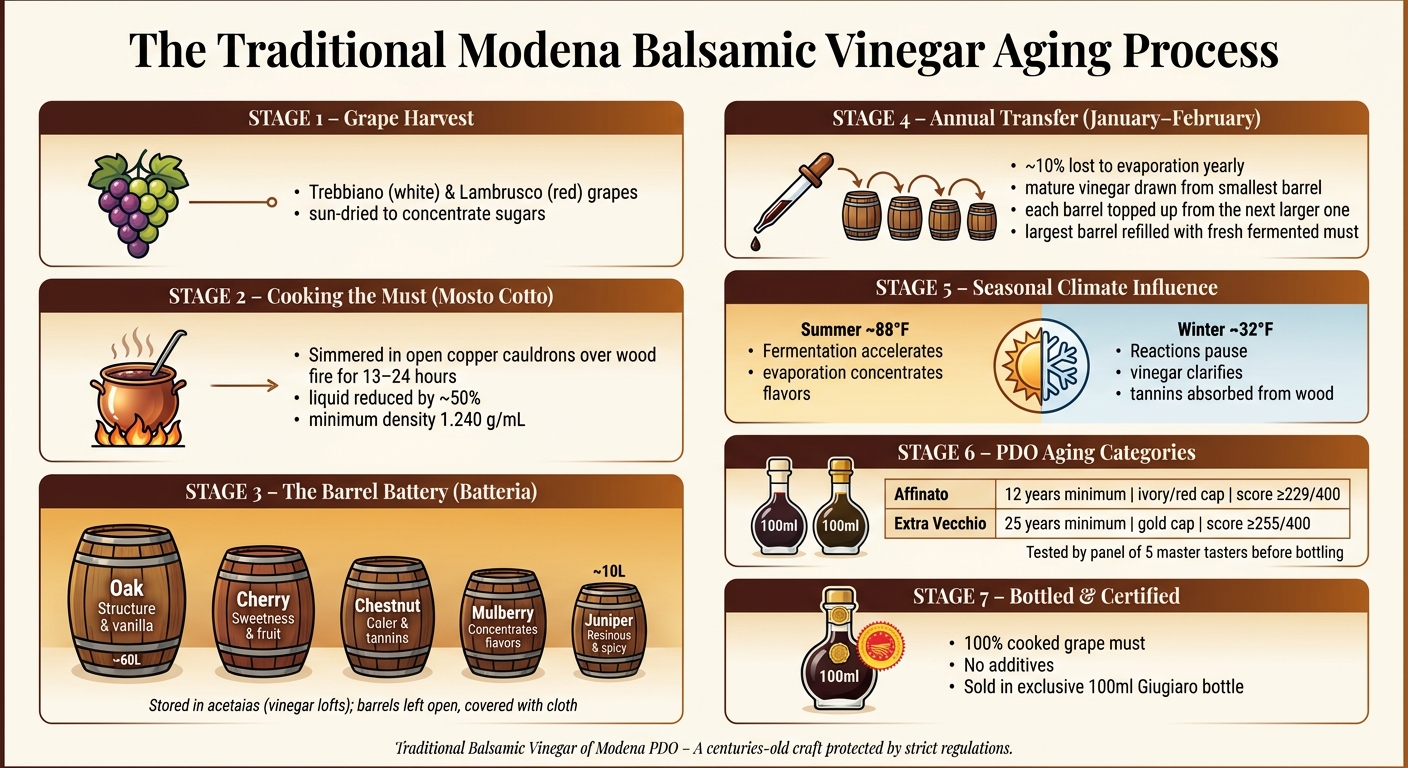
How Traditional Modena Balsamic Vinegar Is Made: From Grape to Bottle
Once the mosto cotto has cooled, it begins its journey through a series of wooden barrels, where it will slowly transform into vinegar over decades.
How the Barrel Battery System Works
At the heart of traditional balsamic vinegar production lies the batteria - a series of 5, 7, or 9 wooden barrels, each smaller than the last. The largest barrel typically holds about 60 liters (16 gallons), while the smallest may hold as little as 10 liters (2.6 gallons). Each barrel is crafted from a specific type of wood, contributing unique flavors to the vinegar as it ages.
| Wood Type | Flavor Contribution |
|---|---|
| Oak | Adds structure and subtle vanillin notes |
| Cherry | Contributes a sweet, fruity profile |
| Chestnut | Enhances color and provides rich tannins |
| Mulberry | Speeds up evaporation, concentrating flavors |
| Juniper | Infuses resinous and spicy undertones |
| Ash & Acacia | Imparts delicate, floral hints |
These barrels are stored in acetaias (vinegar lofts), where they experience the region's natural temperature swings. Hot summers encourage evaporation and fermentation, while cold winters slow down reactions, stabilizing the vinegar. To allow for steady evaporation, each barrel remains open at the top, covered only by a light cloth.
"The ageing of a Traditional Balsamic Vinegar of Modena PDO takes place in a series of five or seven small casks of different woods, arranged in increasing order of capacity and, importantly, left open." - Giusti 1605
This system of barrels sets the stage for the annual transfer process, a key step in refining the vinegar’s complexity and depth.
Annual Transfers and Evaporation
Every January and February, when the cold winter air stabilizes the vinegar, the master vinegar maker undertakes the critical travaso (decanting) and rincalzo (refilling) process. Using a long glass pipette known as a "thief", they extract a portion of the most mature vinegar from the smallest barrel for bottling. Then, each barrel is topped up with vinegar from the next larger one, cascading upward through the series. The largest barrel is replenished with fresh cooked must that has fermented for one to two years in a separate vessel called the badessa.
This meticulous process compensates for the roughly 10% of liquid lost to evaporation each year and ensures that every barrel in the system continues to develop consistent quality and complexity.
"In winter, the cold conditions of the loft halt any chemical reactions, allowing the intervention of the master vinegar maker, a custodian of local know-how and protagonist of a timeless traditional method." - Giusti 1605
Aging Categories and Quality Standards
The time spent in these barrels determines the vinegar’s quality and classification. Not all balsamic vinegars from Modena are aged the same way, and the label provides clear information about the aging process.
| Category | Minimum Aging | Ingredients | Bottle |
|---|---|---|---|
| PDO Affinato | 12 years | 100% cooked grape must | 100ml Giugiaro bottle |
| PDO Extra Vecchio | 25 years | 100% cooked grape must | 100ml Giugiaro bottle |
| PGI Standard | 60 days | Must + wine vinegar | Various |
| PGI Invecchiato | 3 years | Must + wine vinegar | Various |
Traditional Balsamic Vinegar of Modena PDO is the most strictly regulated. Made exclusively from cooked grape must, it must age for at least 12 years (Affinato) or 25 years (Extra Vecchio) and is sold only in a distinctive 100ml bottle designed by Giorgetto Giugiaro. Before bottling, each batch undergoes rigorous testing by a panel of five master tasters, with a minimum score of 229 points required for the 12-year designation.
On the other hand, Balsamic Vinegar of Modena PGI follows a less intensive process. It combines cooked grape must with wine vinegar and requires a minimum aging period of 60 days in wooden containers. For PGI balsamic labeled invecchiato (aged), the vinegar must spend at least three years in wood. While it doesn’t carry the same prestige as PDO balsamic, a high-quality PGI product can still offer a taste of tradition for those who enjoy its flavors.
How Aging Changes Flavor and Quality
The Effect of Time and Wood on Flavor
Time works its magic on balsamic vinegar, transforming it into something truly special. As it moves through the batteria - a series of wooden barrels - each type of wood contributes its own character. Oak lends structure, cherry adds a touch of sweetness, and juniper brings a resinous, almost spicy quality. Over time, about 10% of the liquid evaporates each year, leaving behind a thicker, more concentrated vinegar bursting with flavor.
"These wooden barrels, having been used for decades, is where the intense, expressive notes characteristic of true balsamic vinegar are acquired." - Bona Furtuna
Take Acetaia Pedroni, a Modena producer that’s been perfecting its craft since 1862. They still use barrels started by Giuseppe Pedroni over 160 years ago. This long-standing relationship between wood and vinegar is a big reason their certified 12-year and 25-year PDO balsamics are so layered and rich.
The interplay between time, wood, and climate creates the foundation for the vinegar's unique character.
Seasonal Cycles and Microbial Activity
In Modena, the climate isn’t just a backdrop - it’s a key player in the aging process. Summers are hot, speeding up evaporation and fermentation, while winters are cold, halting chemical reactions and allowing the vinegar to rest. This natural rhythm is what builds the complexity of traditional balsamic vinegar.
Each season brings something different to the table:
| Season | Condition | What Happens |
|---|---|---|
| Summer | High heat (~88°F) | Fermentation speeds up; liquid evaporates, concentrating the flavors |
| Winter | Cold (~32°F) | Reactions pause; vinegar absorbs tannins from the wood and clarifies |
| Spring/Fall | Mild temperatures | Aerobic bacteria interact with air as the barrels remain partially open |
Producers in Modena often use lofts to expose the vinegar to these seasonal changes. Francesco Luigi, a local producer, describes the process:
"The windows are open all year round in order to bring the constantly changing outside temperatures closer to the temperature of the aging room."
Unlike wine or cheese, which are aged in controlled environments, balsamic vinegar thrives on the full range of seasonal shifts. This traditional approach is essential for creating vinegar with unmatched depth and complexity.
These seasonal dynamics aren’t just about aging - they actively shape the flavor and aroma, making each batch a true reflection of its environment.
What Well-Aged Balsamic Looks, Smells, and Tastes Like
When you see well-aged balsamic vinegar, it’s hard to miss its deep, dark, almost syrup-like appearance. This "black gold" flows slowly, a result of years - sometimes decades - of evaporation and concentration.
Its aroma is equally captivating, with intense fruity notes balanced by warm, woody undertones. On the palate, it’s all about harmony. The sweetness and acidity don’t compete; instead, they complement each other beautifully. A properly aged PDO balsamic delivers a flavor that is round, complex, and lingering, leaving a lasting impression.
"This 'natural chemistry' allows Balsamic Vinegar to develop and improve for decades, even centuries." - Sapore Balsamico
This balance is what makes aged balsamic so versatile. It pairs effortlessly with aged Parmigiano-Reggiano, enhances the sweetness of fresh strawberries, or even works as a post-meal digestive, where its acidity and beneficial bacteria aid digestion.
Getting Aged Modena Balsamic Today
How Producers Keep Old Methods Alive
Producers in Modena continue to honor centuries-old traditions when crafting balsamic vinegar. Each batch of Traditional Balsamic Vinegar of Modena (DOP) undergoes an intense sensory evaluation, with up to 90 tests conducted by five master tasters. For instance, a 12-year-aged vinegar must achieve a minimum score of 229 out of 400, while the 25-year-aged Extravecchio requires at least 255 points to pass.
The process involves tools and techniques passed down through generations. One example is the use of a long glass pipette, called a "thief", which allows vinegar makers to carefully transfer the liquid between barrels. Even the barrels themselves are a piece of history. As Sapore Balsamico explains:
"The casks are highly prized and many are hundreds of years old... artisans repurpose salvageable wood to craft new casks, preserving the aged character."
Every step in this meticulous process ensures the vinegar’s exceptional quality, from the aging methods to the distinct packaging and labeling.
How to Spot a Real Modena Balsamic
When searching for authentic balsamic vinegar, there are a few telltale signs to look for. Genuine DOP balsamic vinegar is sold exclusively in a 100 ml bulb-shaped bottle designed by Giugiaro. The cap color also provides clues: an ivory or red cap signifies Affinato (12+ years), while a gold cap indicates Extravecchio (25+ years). Another key detail is the ingredient list - authentic DOP balsamic contains only cooked grape must. If wine vinegar is listed, the product falls under the IGP classification, which has less strict aging requirements and serves as a more versatile option.
| Feature | Traditional Balsamic (DOP) | Balsamic Vinegar of Modena (IGP) |
|---|---|---|
| Ingredients | 100% cooked grape must | Cooked must + wine vinegar |
| Minimum Aging | 12 years (Affinato) or 25 years (Extravecchio) | Varies; typically shorter |
| Certification | Regulated by the Consortium | Protected Geographical Indication |
Aged Balsamics at Big Horn Olive Oil
For those eager to experience the artistry of traditional balsamic vinegar, Big Horn Olive Oil offers exceptional options that reflect Modena's time-honored techniques. Their Traditional 18-Year Aged Dark Balsamic, priced at $8.99, boasts rich, concentrated flavors developed over nearly two decades in the batteria. The result is a thick, velvety vinegar with a complex flavor profile.
For a true taste of excellence, the Molto Denissimo 25-Year Aged Dark Balsamic, available for $12.99, represents the pinnacle of the Extravecchio standard. Aged for 25 years and transferred through multiple wooden casks, this vinegar undergoes about 10% evaporation annually, creating an intensely concentrated product. Perfect for drizzling over aged cheeses, fresh fruits, or even enjoyed as a digestif, it’s a testament to the dedication and skill of Modena’s vinegar makers.
Conclusion: Why Modena's Aging Methods Matter
What sets Modena's balsamic vinegar apart isn't just one secret ingredient or a single step - it's the entire process, perfected over decades. The use of 5–7 wooden barrels, each crafted from a different type of wood, creates a depth of flavor that modern shortcuts just can't match. Chestnut contributes color and tannins, cherry softens the profile, and oak adds a hint of vanilla. Take away any one of these, and the final product would lose its balance.
Time is just as vital as the barrels. As Giusti 1605 explains:
"Local grape varieties, barrels made from fine woods and the patience of a silent wait are the ingredients of a good Balsamic Vinegar of Modena."
This quote highlights how every detail in the aging process matters. The time spent aging allows the vinegar to develop the complexity that defines it, with Modena's unique climate playing a key role. Hot summer days encourage evaporation and fermentation, while the cold winters naturally settle and clarify the vinegar.
Retailers like Big Horn Olive Oil offer balsamics that showcase these traditional techniques, such as the Traditional 18-Year Aged Dark Balsamic and Molto Denissimo 25-Year Aged Dark Balsamic. Each bottle embodies years of careful barrel transitions, seasonal cycles, and the expertise of skilled vinegar makers.
FAQs
Why are the barrels left partially open?
Barrels are kept partially open to let natural seasonal temperature shifts work their magic. These changes drive evaporation, fermentation, and the concentration of flavors, all of which are crucial for creating the deep and layered taste that defines aged balsamic vinegar.
Does older balsamic always taste better?
Balsamic vinegar aged 12 years or more from Modena is highly regarded for its deep, layered flavor. But aging isn’t the only factor that makes it special - its quality also comes down to the choice of ingredients and the time-honored production techniques that go into crafting it.
How should I store aged balsamic at home?
To keep aged balsamic vinegar at its best, store it in a cool, dark spot, away from direct sunlight and temperature fluctuations. Use a tightly sealed container, like a glass bottle or another non-reactive vessel, to avoid evaporation or contamination. This ensures the vinegar retains its deep flavors and high quality over time.