

How French Terroir Shapes Verdale Olive
The short answer: French Verdale oils can taste different because place, pick date, and milling change the fruit before it becomes oil. I’d look at four Verdale types, then check region, soil, slope, weather, and harvest timing before I make any call about style.
Here’s the core idea in plain English:
- “Verdale” is not one single olive across France
- The main types here are:
- Verdale des Bouches-du-Rhône
- Verdale de Carpentras
- Verdale de l'Hérault
- Verdale des Pyrénées-Orientales
- Warmer, sunnier, drier sites often move fruit along faster
- Deeper, wetter soils can slow ripening and change fruit balance
- Earlier picks often give greener, firmer, more bitter oils
- Later picks often give softer, rounder, milder oils
- Same-day milling helps keep orchard character in the bottle
If I wanted to read a Verdale oil fast, I’d check these five things first:
- The exact Verdale name on the label
- The commune, department, or appellation
- The orchard setting: slope, sun, wind, drainage
- The harvest window: often from October to December, depending on zone
- The taste markers: fruitiness, bitterness, and throat sting
A few facts matter right away. In steep olive ground, slopes above about 20% to 25% are harder to work with machinery. And for Verdale de l’Hérault, oil harvest often runs in November to early December. Those details help explain why oils from one French area may not line up with oils from another.
Bien choisir ses variétés d’oliviers : entre terroir, débouchés et contraintes techniques
sbb-itb-4066b8e
Quick Comparison
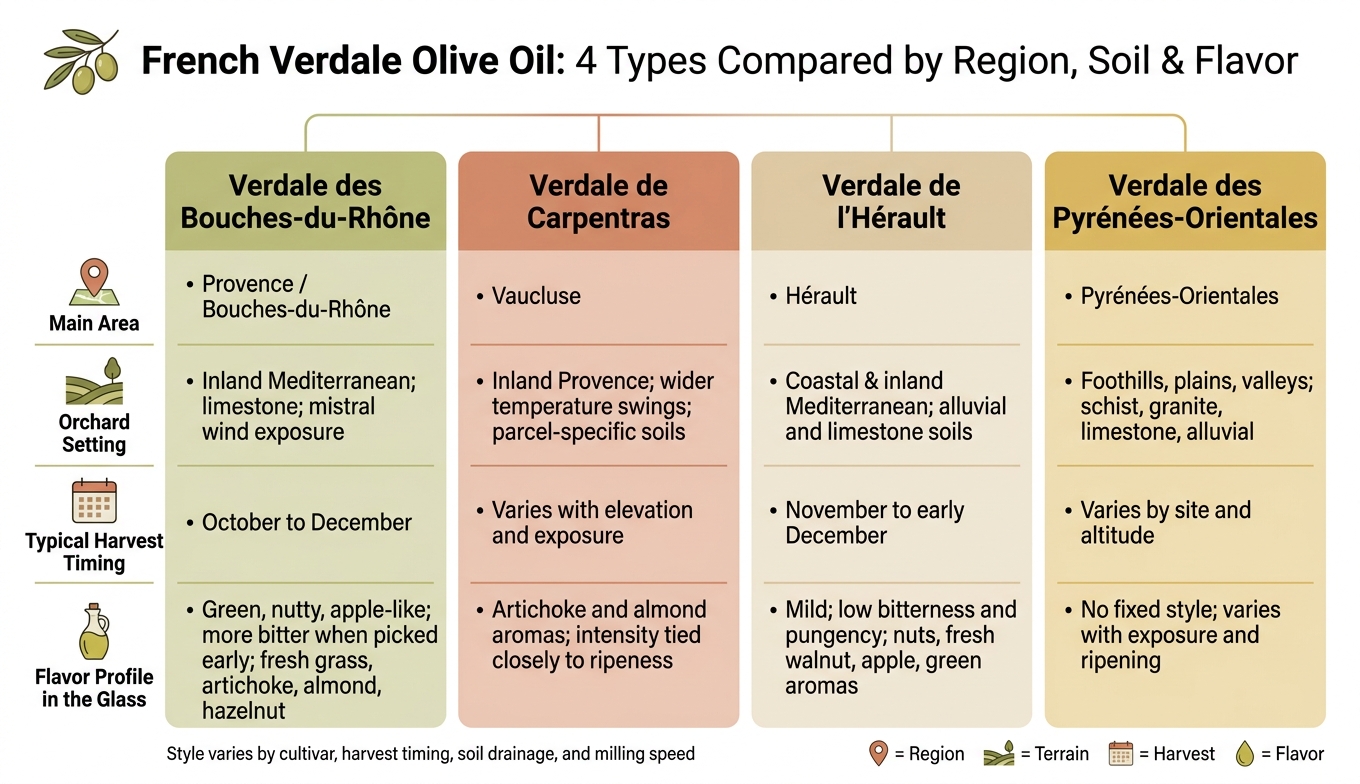
French Verdale Olive Oil: 4 Types Compared by Region, Soil & Flavor
| Verdale type | Main area | General orchard setting | Usual style in the glass |
|---|---|---|---|
| Verdale des Bouches-du-Rhône | Provence / Bouches-du-Rhône | Inland Mediterranean ground, often limestone and wind exposure | Often green, nutty, apple-like, with more bitterness when picked early |
| Verdale de Carpentras | Vaucluse | Inland Provence with more temperature swings | Often artichoke and almond notes, with style tied closely to ripeness |
| Verdale de l'Hérault | Hérault | Coastal and inland Mediterranean sites | Often milder, with nut and apple notes and lower bitterness |
| Verdale des Pyrénées-Orientales | Pyrénées-Orientales | Foothills, plains, and valley sites with big site-to-site shifts | No single fixed style; exposure and ripeness matter a lot |
So when I taste Verdale, I don’t stop at the variety name. I treat it as a starting point, then match the oil to its place, weather, harvest moment, and mill handling.
Step 1: Identify the Verdale Growing Zone
Once you know the Verdale name, start with the growing zone. Read the label and find the cultivar.
How southern French regions shape Verdale
The four zones - Bouches-du-Rhône, Vaucluse, Hérault, and Pyrénées-Orientales - do not produce the same kind of Verdale. That matters more than it may seem at first glance.
For example, in Vaucluse, "Verdale" can refer to Aglandau rather than the Bouches-du-Rhône type. So don’t lump them together. The exact cultivar wording on the label - not just the word "Verdale" - is the best place to start.
Climate also shifts the picture. Mediterranean heat, inland temperature swings, slope, and mistral exposure all shape how fast olives ripen.
Use the region as your first filter. Step 2 will tighten the match by looking at soil and exposure.
Region-by-region comparison: geography, soils, harvest period, and oil profile
Use the table below to compare the label details that matter most.
| Growing Zone | Geography & Exposure | Soil Notes | Typical Harvest Timing | Reported Oil Profile |
|---|---|---|---|---|
| Bouches-du-Rhône (Vallée des Baux-de-Provence, Aix-en-Provence) | Inland Mediterranean Provence; Alpilles influence; mistral exposure | Limestone, stony parcels; orchard-specific | First half of October through end of December, depending on maturity and product style | Delicate, light; green, fresh-walnut, apple; also fresh grass, artichoke, almond, hazelnut, bitterness, pungency when harvested green |
| Vaucluse (Carpentras area) | Inland Provence; wider temperature swings | Parcel-specific; no department-wide soil type | Varies with elevation, exposure, cultivar, and maturity | Artichoke and almond aromas; intensity changes with maturity |
| Hérault | Mediterranean southern France; coastal and inland settings | Parcel-specific; coastal alluvial and limestone differ from inland | November to early December for oil olives | Mild; low bitterness and pungency; nuts, fresh walnut, apple, green aromas |
| Pyrénées-Orientales | Mediterranean zone near the Pyrenees; slope, elevation, and wind effects | Mountain foothills, coastal plains, and valley sites differ substantially | Varies by site and altitude | Varies with exposure and ripening; no fixed profile without producer or appellation evidence |
Before you taste, write down the cultivar, commune or department, appellation, harvest date, and any orchard notes. Those details will help with the soil and climate check in the next step.
Step 2: Assess Soil, Climate, and Orchard Exposure
Once you know the growing zone, look closely at the orchard itself. Soil, seasonal weather, and slope work together to shape how Verdale fruit matures. Start with drainage. Then look at climate and exposure in the same block.
Soil and drainage: limestone, gravel, schist, granite, and alluvial ground
Check drainage first. The rock name matters less than how water moves through the site.
Verdale trees tend to do best in soils that let excess winter water drain away, while still holding enough moisture to carry fruit through a hot, dry summer. In the Pyrénées-Orientales, schist, granite, limestone, and alluvial soils can lead to different drainage patterns and rooting depths. Deep alluvial soils usually hold more moisture. That can push stronger canopy growth, which may slow ripening or weaken concentration if water levels get too high.
Soil type tells you how a site tends to behave, but it doesn't decide flavor on its own. Look at how fast water drains after rain, how deep the topsoil is, and how vigorous each block appears.
Climate signals that affect ripening and oil accumulation
French Verdale follows a classic Mediterranean rhythm: cooler, wetter winters, then hot, dry summers. Warm, dry summers move ripening along. Well-timed winter and spring rain helps fruit set and oil build. And timing matters more than yearly totals. Rain during fruit set helps development, while rain right before harvest can soften fruit, dilute oil concentration, and increase disease pressure.
Track weekly highs and lows, rainfall, and the first color change in the fruit. Once the weather sets the pace, slope and wind shape how evenly that pace plays out across the orchard.
Exposure and slope: sunlight, wind, and water movement
South- and southeast-facing slopes warm up earlier, so they often ripen faster than shaded blocks or orchard floors in valley bottoms. That means two Verdale orchards in the same French zone can still produce noticeably different oils just because each block faces the sun a bit differently.
Slope also helps water move off the site after heavy rain, which cuts winter waterlogging risk. But steeper ground dries out faster and can make orchard work harder. The International Olive Council notes that slopes above about 20%–25% are tougher to manage with machinery.
A little wind can help by lowering humidity. Strong wind does the opposite of what growers want: it increases water loss and adds fruit stress. Compare sheltered blocks and wind-exposed blocks side by side. Check soil moisture, fruit size, and harvest readiness before making any terroir call.
| Site condition | Likely orchard effect | What to check |
|---|---|---|
| Limestone or rocky, well-drained slope | Faster drainage, warmer soil, possible summer water stress | Earlier ripening, smaller fruit; check against irrigation and harvest date |
| Sandy or gravelly soil | Fast drainage, lower water retention | Irrigation demand, fruit size, drought response |
| Schist or granite terrain | Variable rooting depth and water storage | Compare shallow vs. deep pockets; don't assume rock type alone drives flavor |
| Deep alluvial ground | Higher moisture and nutrient availability | Stronger canopy growth, later ripening |
| South- or southeast-facing slope | More direct sunlight and warmth | Faster maturity and different harvest timing than shaded blocks |
| Wind-exposed site | Higher evapotranspiration | Water status, fruit retention, canopy damage |
Use these site clues to judge when fruit is likely to hit the right harvest window, which Step 3 covers.
Step 3: Match Harvest Timing to Oil Style
Once you’ve read the site conditions, the next call is when to pick. Harvest timing isn’t a fixed date on the calendar. It’s a window shaped by fruit maturity, the oil style you want, and the weather right in front of you.
How ripeness changes flavor, texture, and intensity
Once the site tells you how Verdale ripens, harvest timing decides which of those traits make it into the bottle. Pick earlier, and Verdale leans greener and more forceful. Pick later, and the oil turns rounder and softer.
Earlier harvests tend to give you oil that’s greener, more bitter, and more pungent. Later harvests pull bitterness and pungency back, leaving a rounder, milder profile. Soil, slope, and exposure set the pace. Harvest timing decides how much of that pace stays in the finished oil.
What to check before choosing a harvest window
Start checking fruit about a month before harvest, then repeat every 7–10 days. Don’t rely on a single signal. Look at four things: color, firmness, taste, and weather.
Color gives you a quick visual read. As Verdale fruit moves from green toward purple or black, ripening is moving along. But color never tells the whole story. Fruit on the same tree can ripen unevenly, so one glance can fool you.
Firmness matters too. Earlier fruit holds up better during handling. Softer fruit bruises more easily, which usually points to later maturity. Taste helps tie it all together. Sample olives from different parts of the tree. Green fruit tastes vegetal and bitter. Riper fruit tastes softer and less sharp.
Then look at the forecast. Rain before harvest can dilute aromas and soften fruit. Frost or long wet spells can hurt quality fast. If wet weather is on the way, harvesting a few days early may make more sense than waiting for a better maturity reading on paper.
For Verdale de l'Hérault, oil harvest often falls in November to early December. Treat that as a guide, then adjust for site warmth, wind, and fruit health.
Why fast milling helps preserve terroir in the finished oil
Getting fruit to the mill fast is one of the simplest ways to protect what the orchard gave you. Once olives are picked, oxidation starts. Warm storage, bruised fruit, or tightly packed sacks all make that happen faster.
Handle fruit gently. Use shallow, ventilated containers. Mill the same day. Fast milling protects freshness and helps keep terroir in the finished oil.
Those harvest calls show up clearly in the glass, which the next step breaks down.
Step 4: Taste the Terroir in Verdale Oil
A simple tasting sequence for Verdale oil
Use the glass to check what Steps 1–3 hinted at about site, climate, and harvest timing.
Pour about 1 teaspoon (3–5 ml) of oil into a small glass. Cover it with your palm and warm it to about 80°F (26.5°C).
Smell it first. You may notice fresh-cut grass, herbs, green apple, almond, or raw artichoke. Greener oils usually show those notes more clearly. Riper oils tend to soften them.
Then taste. Take a small sip, gently pull in a little air, and let the oil move across your tongue. Pay attention to fruitiness, bitterness, and pungency as separate traits. Rate each one as light, moderate, or pronounced. These are the three standard positive traits in olive oil tasting.
Treat these as patterns, not promises. Cultivar, crop load, milling speed, and storage can all shape the final oil alongside soil and climate.
Sensory traits and likely terroir influences: a comparison table
The same oil can taste different because of both orchard conditions and handling.
| Observable trait | More green-fruity style | More ripe-fruity style | Main drivers |
|---|---|---|---|
| Aroma | Fresh grass, herbs, green apple, almond, hazelnut, raw artichoke, tomato leaf | Black olive, cocoa, mushroom, cooked artichoke | Maturity, milling delay, and storage |
| Bitterness | Noticeable to pronounced | Low or absent | Greener fruit; bitterness generally decreases as maturity advances |
| Pungency | Peppery, evident in the throat | Low or absent | Greener fruit; pungency generally decreases with maturity |
| Texture & finish | Assertive, lively, persistent | Softer, rounder, less peppery | Harvest maturity and oil composition |
| Overall style | Vivid and herbaceous | Mild and rounded | Growing zone, exposure, harvest timing, and milling speed |
Use language like "consistent with" rather than "proves." A tasting impression on its own can't confirm a specific soil type or orchard location.
Conclusion: the main factors that shape French Verdale
Verdale oil reflects cultivar, site, harvest timing, and milling speed. Taste for fruitiness, bitterness, and pungency to see how those factors show up in the glass.
FAQs
How can I identify the exact Verdale on a label?
Look for labels that clearly name the olive variety. Producers often include this to show how a certain type reflects its terroir.
It also helps to give priority to bottles with PDO or AOP certification, along with the harvest date and region of origin. Those details help confirm where the oil comes from, and they make it easier to track its source and verify it.
Does earlier harvesting always make Verdale oil more bitter?
No. Picking olives earlier can increase phenolic content and make some oils more bitter or pungent, but that does not happen every time.
The final flavor depends on the olive cultivar, terroir, and the producer’s harvest timing. Some olives naturally stay more fruity or slightly sweet, with only a little bitterness.
Why does same-day milling matter for Verdale oil quality?
Same-day milling helps Verdale olive oil keep what makes it special. When olives go from harvest to extraction with very little delay, there’s less time for oxidation and breakdown. That helps the oil hold onto its bright flavor, nutritional value, high phenolic content, and the sensory traits that set it apart.
At Big Horn Olive Oil, olives are cold-pressed within two hours of harvest. That short window helps preserve freshness, health perks, and the layered flavor profile of ultra-premium extra virgin olive oil.