

Italian Focaccia Recipe with Olive Oil
If I want focaccia that turns out airy, crisp, and rich with olive oil, I focus on four things: wet dough, full proofing, a well-oiled metal pan, and a hot oven at 425°F to 475°F.
This recipe keeps the process simple for a home kitchen. It uses all-purpose flour, a 9x13-inch metal pan, 105°F to 110°F water for the yeast, and plenty of extra virgin olive oil in the dough, under it, and on top. The goal is simple: a deep golden top, a crisp bottom, and a soft crumb with big air pockets.
Here’s the whole game plan in one glance:
- Use sticky dough. If I add extra flour, the crumb gets tight.
- Let it proof until puffy and jiggly. Time helps, but the dough’s look matters more.
- Oil the pan well. The article calls for 2 to 4 tablespoons in the pan alone.
- Dimple deep. This helps the oil pool and sink into the bread.
- Bake hot. Focaccia usually bakes in 20 to 30 minutes.
- Move it to a wire rack right away. That helps stop a soggy bottom.
- For more flavor, chill the dough for 8 to 24 hours if I have extra time.
A few topping ideas stay simple and classic:
- Rosemary
- Flaky sea salt
- Sliced garlic
If something goes wrong, the fix is usually simple too: dense crumb = stiff dough or short proof, pale top = not enough heat or oil, and soggy bottom = left in the pan too long.
That’s the full idea of the article: make the dough wet, use plenty of olive oil, give it time, and bake until dark golden brown.
You’ve Never Seen Focaccia Bread Made Like This
sbb-itb-4066b8e
Ingredients and Equipment for Olive Oil Focaccia
Get your ingredients and pan ready before you start mixing. Focaccia is pretty simple. You don't need special tools or hard-to-find items. Still, a few choices, especially the olive oil, have a big effect on flavor and crust.
Dough Ingredients and Olive Oil Topping
The dough uses unbleached all-purpose flour for a softer crumb, or bread flour if you want a chewier loaf. You'll also need active dry or instant yeast, lukewarm water, salt, and extra virgin olive oil. Warm the water to 105°F to 110°F. Use EVOO in the dough, in the pan, and over the top.
Fresh, high-quality EVOO makes a difference here. Big Horn Olive Oil's Estate Reserve Ultra Premium EVOO (bhooc.com) is bottled within three months of harvest.
Optional Toppings for Classic Style
If you want a classic Ligurian-style focaccia, keep it simple: fresh rosemary and flaky sea salt. Press them into the dimples before baking.
Home Kitchen Equipment and Pan Options
For a home batch, a 9x13-inch metal baking pan is the standard pick. If you want a thinner, crispier loaf, use an 18x13-inch half-sheet pan. Metal is the way to go here. Aluminum or dark metal pans brown the bottom crust better than glass or ceramic.
You'll also want:
- A large mixing bowl
- A sturdy spatula or wooden spoon
- Measuring cups and spoons
- A bench scraper for sticky dough
- A kitchen thermometer to check that the water is lukewarm before adding the yeast
- A wire cooling rack so the bottom doesn't steam and soften after baking
With the ingredients measured and the pan set, you're ready to mix the dough.
Mix the Dough and Let It Rise
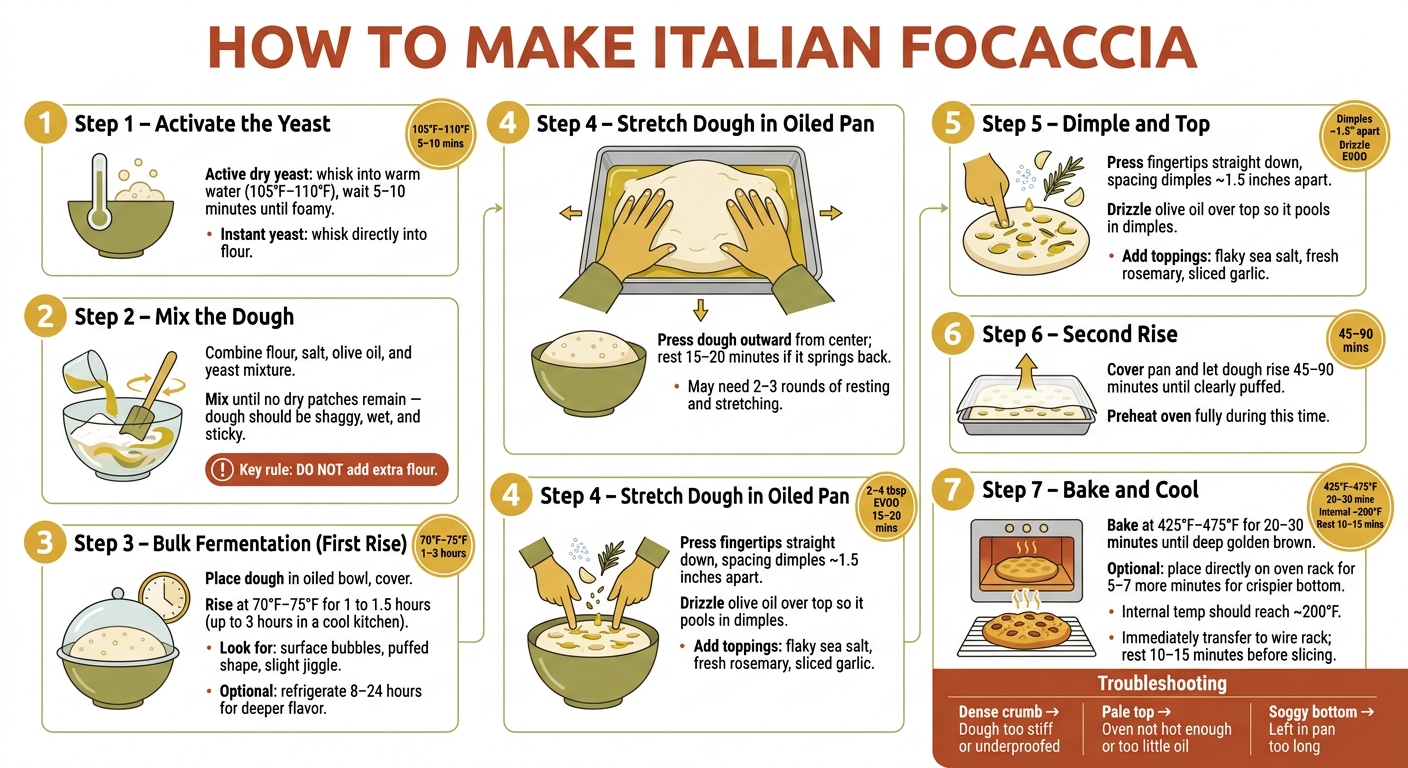
How to Make Italian Focaccia: Step-by-Step Visual Guide
Combine Water, Yeast, Flour, Salt, and Olive Oil
Start by pairing the yeast with the right method. For active dry yeast, whisk it into warm water and let it sit for 5 to 10 minutes, until foamy. For instant yeast, whisk it straight into the flour.
Then add the flour, salt, and olive oil. Mix with a sturdy spatula or dough whisk until there aren't any dry patches left. The dough should look shaggy, wet, and sticky. That's exactly what you want. Don't add more flour.
Once the dough comes together and feels tacky, transfer it to the bowl for the first rise. If you're using a stand mixer, mix on low until everything is combined, then switch to medium for about 5 minutes, until the dough feels elastic and tacky.
Bulk Fermentation Until Puffy and Airy
Lightly oil a large bowl, add the dough, cover it, and let it rise at 70°F to 75°F until doubled. This usually takes about 1 to 1.5 hours, though a cooler kitchen can stretch that to 3 hours.
The clock helps, but your eyes and hands matter more here. Look for bubbles on the surface, a puffed-up shape, and a slight jiggle when you gently shake the bowl. Those signs tell you more than the timer does. If your kitchen runs cold, put the covered bowl in an oven with the light on. Once the dough looks puffy and jiggly, it's ready to shape. This process is a staple in many of our traditional recipes.
Shape, Dimple, Top, and Bake the Focaccia
Stretch the Dough in an Oiled Pan and Add Toppings
Once the dough looks puffy, move it straight into the prepared pan. Pour 2 to 4 tablespoons of extra-virgin olive oil into a 9-by-13-inch metal pan, then tilt the pan so the oil coats the bottom.
Use a bowl scraper or spatula to gently move the risen dough into the center. Flip it once so both sides get coated in oil. Then, with oiled hands, press the dough outward from the center toward the edges.
If it springs back, don’t fight it. Let it rest for 15 to 20 minutes, then try again. You may need two or three rounds of resting and stretching before the dough reaches the corners.
When the dough is fully spread, press your fingertips straight down to make deep dimples all the way to the bottom of the pan, spacing them about 1.5 inches apart. Those dimples do more than make focaccia look like focaccia. They create little pockets that hold olive oil and help it sink into the bread as it bakes.
Drizzle more olive oil over the top so it settles into those pockets. Then add your toppings, such as:
- Flaky sea salt
- Fresh rosemary
- Sliced garlic
If you're using fresh toppings, coat them lightly with oil before baking so they don’t scorch.
Second Rise and Oven Baking Temperature
After topping, cover the pan and let the dough rise again for 45 to 90 minutes, until it looks clearly puffed up. While that happens, preheat the oven all the way. This step matters. A fully heated oven helps the focaccia bake up with a puffier crumb and deeper browning.
Bake at 425°F to 475°F for 20 to 30 minutes. You’re looking for a deep golden brown top and edges that start pulling away from the pan.
If you want a crisper bottom, take the focaccia out of the pan and place it right on the oven rack for another 5 to 7 minutes. It’s done when the top is deep golden brown and the inside reaches about 200°F.
Cool, Slice, and Serve with Olive Oil and Balsamic
Move the focaccia to a wire rack right away. If it sits in the pan, trapped steam can soften the bottom.
"Be generous with the oil (both in the pan and drizzled on top)... transfer it immediately to a cooling rack to prevent the steam from turning the crust soggy." - Chef Billy Parisi
Let it rest for 10 to 15 minutes before slicing. That short wait gives the crumb time to set. Cut too soon, and you can squash the inside.
Slice into squares or rectangles and serve warm with extra-virgin olive oil and aged balsamic vinegar for dipping.
Troubleshooting and Key Recipe Takeaways
Fix Dense Crumb, Pale Top, or Soggy Bottom
When focaccia falls short, the problem usually comes down to hydration, proofing, heat, or oil. In most cases, the trouble starts with one of three things: too little hydration, underproofing, or weak heat transfer.
A dense crumb usually starts at the mixing stage. If the dough was too stiff or didn’t rise long enough before baking, you won’t get those nice open air pockets. The fix is simple: keep the dough soft and sticky, and let it complete a full first rise until it looks clearly puffy. If you have more time, a cold ferment in the refrigerator for 8 to 24 hours can build deeper flavor and larger air pockets.
A pale top usually points to the baking stage. The oven may not have been fully preheated, or the surface may not have had enough oil before baking. A soggy bottom usually happens after baking, when the loaf sits in the pan too long. Move it to a wire rack right away.
Why Olive Oil Quality Changes the Finished Bread
Once the basics are in place, olive oil does a lot more than coat the dough. It goes into the dough, under the dough in the pan, and over the top before baking, so its flavor shows up in every bite.
Fresh, high-quality EVOO gives focaccia a cleaner taste, a better aroma, and a stronger finish. Big Horn Olive Oil (bhooc.com) offers Ultra Premium EVOO that delivers that kind of result.
Key Points to Remember Before Making It Again
Good focaccia comes down to a few must-do steps:
- Keep the dough soft and sticky.
- Let it rise fully before baking.
- Dimple deeply so the olive oil can pool and soak in.
- Use plenty of oil at every stage.
- Bake at 425°F or higher until the top is a deep golden brown.
Good focaccia depends on soft dough, full proofing, plenty of oil, and a hot oven. Get those parts right, and the next loaf should be lighter, darker, and more aromatic.
FAQs
Can I make the dough ahead of time?
Yes. You have two main options: make the dough through the first rise, then cover it and refrigerate it overnight to bake the next day, or bake the focaccia up to 1 day before serving.
For the best results, use high-quality ingredients like Big Horn Olive Oil to help keep the flavor and overall quality in good shape.
Why didn’t my focaccia get airy?
Your focaccia may not have turned out airy because the dough didn’t have enough water or didn’t get enough time to rise. Focaccia works best with a wet, sticky dough. That’s what helps create that open, bubbly crumb. If you add too much flour, the bread can come out dense and heavy.
Let the dough rise until it looks jiggly, puffed, and full of air before it goes into the oven. High-quality Ultra Premium Extra Virgin Olive Oil from Big Horn Olive Oil also adds rich moisture and deeper flavor.
Can I use bread flour instead?
Yes. Bread flour works, but it gives focaccia a different texture.
Because it has more protein, it makes the crumb chewier than all-purpose flour or tipo 00 flour, which give the bread a more tender interior. A high-quality extra virgin olive oil, such as one from Big Horn Olive Oil, can improve the dough’s flavor either way.