

Mediterranean Art: Olive Trees as Cultural Icons
The olive tree became a Mediterranean icon because it stands for land, faith, peace, memory, and daily life all at once. I’d sum it up this way: a tree first grown between 6,000 and 4,000 BC moved from farms into myth, religion, painting, mosaics, public emblems, and modern life.
If you want the short answer, here it is:
- It began as a staple crop used for food, lamp oil, and medicine.
- It became a symbol in Greek myth, especially through Athena and Athens.
- It took on sacred meaning in Judaism, Christianity, and Islam.
- Artists kept using it because its twisted trunk and gray-green leaves point at Mediterranean place at a glance.
- It still matters now because some olive trees live for hundreds or even thousands of years, linking art to living heritage.
You can also see why the image lasted so long:
- In Greek vase painting, it appears in harvest scenes as early as c. 520–510 BC
- In religious art, it points to covenant, peace, prayer, light, and blessing
- In public symbols, the olive branch came to mean peace in emblems like the UN and national seals
- In daily life, olive oil still carries ideas of home, place, and care into American kitchens
At its core, this is a story about how one tree moved from the grove into the human imagination - and stayed there.
The Historical Roots of Olive Tree Imagery
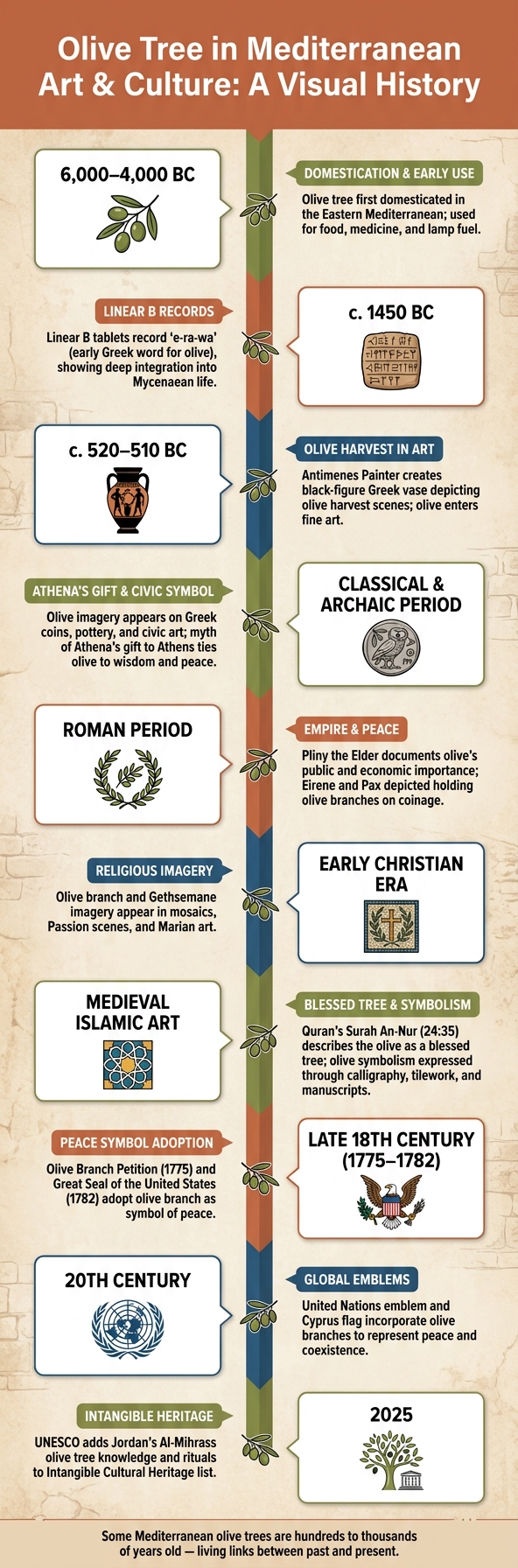
Olive Tree in Mediterranean Art & Culture: A Visual History
From Crop to Visual Symbol
The olive tree first took root in Mediterranean art for a simple reason: people depended on it. It fed families, lit homes, and came to stand for shared life across the region. Farmers in the Eastern Mediterranean first domesticated the olive between 6,000 and 4,000 BC, which made it one of the earliest fruit trees cultivated by humans. Along with wheat and grapes, it formed the core Mediterranean triad. Olive oil was used for food, medicine, and lamp fuel.
Because olive groves were such a common part of the landscape, artists began to treat the tree as a natural marker of place. It wasn’t just a plant in the background. It signaled Mediterranean life itself. Once the olive became tied to daily survival, artists started using it as a visual shorthand for the world around them.
Greek Myth, Roman Power, and Early Artifacts
Greek artists soon pushed the olive beyond daily use and into image-making. Around 520–510 BC, the Antimenes Painter made a black-figure vase that shows men gathering olives by beating the branches of the tree. It takes a scene of farm work and turns it into art. Even earlier, Linear B tablets from around 1450 BC record e-ra-wa, an early form of the Greek word for olive. That detail shows how deeply the tree was woven into Mycenaean life. Step by step, the olive moved from the field into public meaning.
The myth of Athena’s gift of the olive tree to Athens fixed that meaning in civic identity. The tree came to stand for wisdom and peace. By the Archaic and Classical periods, olive imagery appeared on coins, pottery, and civic art. Roman writers such as Pliny the Elder also confirmed its public and economic importance. From there, that civic role spread into religious art across Judaism, Christianity, and Islam.
sbb-itb-4066b8e
Sacred Meanings in Jewish, Christian, and Islamic Art
Each of these faiths gave the olive tree its own sacred place. Artists then turned those meanings into images, ritual objects, and ornament.
Judaism: The Olive as Covenant, Light, and Endurance
In Jewish tradition, olive imagery is tied to covenant, light, and continuity. Olive oil fed lamps and supported Temple ritual, so the tree came to stand for divine presence and endurance. You can see those ideas in synagogue imagery, Judaica, and Temple artifacts.
Christianity: The Olive Branch of Peace
Christian art inherited the olive branch as a sign of peace and then gave it added meaning through Gethsemane, where sorrow and hope meet. Because Jesus prayed among olive trees before his arrest, olive imagery appears in early Christian mosaics, Passion scenes, and Marian art.
Islam: The Blessed Olive Tree
The Quran describes the olive as a blessed tree in Surah An-Nur (24:35), the "Light Verse", where it is presented as a tree "neither of the East nor of the West", whose oil nearly glows on its own. In Islamic art, that meaning appears in calligraphy, manuscripts, tilework, and architectural ornament. Rather than showing the tree in one fixed way, artists often expressed its sacred role through pattern, text, and ornament.
Across these faiths, the olive tree carried related but different meanings. In Judaism, it pointed to lamps and Temple life. In Christianity, it became tied to Gethsemane and Passion imagery. In Islam, it appeared through calligraphy, manuscripts, tilework, and architectural ornament.
These sacred meanings shaped how artists used the olive tree across painting, mosaics, sculpture, and modern media.
How Artists Depict Olive Trees Across Media and Periods
Artists turned those meanings into repeated visual forms across many media and time periods. So the olive tree shows up not only as a plant, but as a kind of visual language people recognize at a glance.
Painting, Mosaics, and Sculpture from Antiquity to Modernism
One of the earliest surviving examples of the olive tree as an art subject is a Greek vase attributed to the Antimenes Painter (c. 520–510 BC). It shows men gathering olives from a tree by shaking branches and hand-picking fruit, turning harvest work into art. In later art, the olive tree’s twisted trunk, gray bark, and silvery-gray leaves became a quick signal for Mediterranean place and light.
By the time you get to modern art, that same form starts to carry more symbolic weight.
Modern and Contemporary Works Using the Olive Tree as a Symbol
Modern and contemporary artists use the olive tree as a shorthand for peace, endurance, cultural identity, and survival. That reading comes in part from the tree itself. Olive trees can survive drought and resprout after damage. Some ancient trees are even treated as living witnesses to history.
The table below shows how the olive tree motif works in different settings:
| Use | Focus | Key Visual or Thematic Elements |
|---|---|---|
| Landscape | Aesthetic and heritage | Gnarled trunks, silvery-gray foliage, and Mediterranean light |
| Symbolic | Peace and cultural tradition | The olive branch and the tree as a marker of Mediterranean identity |
| Historical | Labor and daily life | Harvesting scenes such as shaking branches and hand-picking olives |
| Ecological | Survival and resilience | Longevity and the tree as a living witness to history |
From these visual patterns, the olive tree also became a public symbol across the Mediterranean.
Why the Olive Tree Became a Mediterranean Icon
That visual shorthand turned the olive tree into more than a recurring image. It became a public symbol. Few images stand for the Mediterranean as clearly as the olive tree, which has appeared for thousands of years in art, sacred tradition, and state emblems.
From Art Motif to Public Symbol
Over time, the olive branch moved from classical art into public life as rulers and institutions used it to signal peace and legitimacy. In Greek and Roman coinage, Eirene and Pax often appear holding olive branches, tying political power to peace. By the late 18th century, the Great Seal of the United States showed an eagle carrying an olive branch to express a preference for peace. Cyprus and the United Nations also use olive branches in their emblems to stand for peace and coexistence.
The image shifts a bit depending on where it appears:
| Context | Primary Meaning | Key Examples |
|---|---|---|
| Institutional symbols | Peace, sovereignty, legitimacy | UN emblem, Great Seal of the U.S., Cyprus flag, Israel's emblem |
| Fine art | Sacred geography, endurance, human–land connection | Mythic and biblical olive grove scenes, modern paintings of ancient trees |
| Literature | Reconciliation, mercy, hope after conflict | Virgil's references to Pax; the 1775 Olive Branch Petition |
Heritage, Memory, and the Living Landscape
Part of the olive tree's force comes from one simple fact: the symbol is still alive in the landscape. Unlike painted emblems or carved seals, ancient olive trees are living markers. Some are hundreds or even thousands of years old, which means a single tree can connect many generations within the same community. Scholars describe these groves as living cultural heritage and as heritage landscapes because they join ecological longevity with human memory and daily practice.
UNESCO notes that the olive tree is:
"the tree that is most representative of the Mediterranean"
That line points to something bigger than farming. The olive tree helps shape how the region sees itself.
In 2025, UNESCO added Jordan's Al-Mihrass olive tree knowledge, skills, and rituals to its Intangible Cultural Heritage list. Across the Mediterranean, museums and public programs pair ancient oil presses, amphorae, and documentary photography of monumental trunks to show a clear line between past and present.
A Bridge to Olive Oil Culture in the United States
That heritage now shows up far from the groves themselves, including in American kitchens. In the United States, olive oil often carries ideas of provenance, tradition, and connection to place into everyday cooking.
So olive oil is more than something you keep in the pantry. It brings everyday meals into contact with the same ideas of nourishment, care, and continuity that the olive tree has long carried in Mediterranean art and culture.
Conclusion: Olive Trees as Art, Symbol, and Living Heritage
Few subjects in Mediterranean art carry as much weight as the olive tree. It lasts in the imagination for a simple reason: the olive tree is both part of the land and part of what that land means. That thread, running from grove to painting to memory, is what makes it such a lasting Mediterranean icon.
Olive trees can live for centuries, and even after severe damage, they can grow again from their roots. That kind of endurance in nature mirrors the endurance of the symbol itself. The same groves can link one generation to the next, and the same image keeps showing up in art, faith, and shared memory.
For readers in the United States, olive oil still brings that Mediterranean legacy into daily cooking. It shows up in kitchens in a very ordinary way, which is part of why the symbol still feels alive instead of distant.
Seen through art, faith, and heritage, the olive tree remains part of daily life - and that is why artists across centuries have kept returning to it. The olive tree endures because it remains art, symbol, and living heritage at once.
FAQs
Why do olive trees symbolize peace?
Olive trees came to stand for peace through a mix of history, myth, and religion.
In Greek mythology, Athena’s gift of the olive tree tied it to wisdom, prosperity, and peace. That link stuck.
The Bible deepened that meaning. When an olive leaf returned to Noah’s Ark, it marked restored harmony after the flood. Later, Roman envoys carried olive branches as a sign of peaceful intent. That helped cement the idea we still use today: “extending an olive branch.”
How did olive trees become sacred in different religions?
Olive trees became sacred in many faiths for a simple reason: they lasted. They could survive harsh conditions, live for centuries, and give people something useful in daily life. That mix of endurance, long life, and practical worth made the olive tree a natural sign of divine light and favor.
In Greek mythology, the olive tree was Athena’s gift. In Judaism, olive oil lit the menorah and anointed kings and prophets. In Christianity, it stands for the Holy Spirit and reconciliation. In Islam, the olive tree points to divine guidance and light.
Why do artists still use olive trees today?
Artists still turn to olive trees because they’re visually striking and loaded with meaning. The silvery leaves, twisted trunks, and the way Mediterranean light hits them give painters and photographers a lot to work with.
They also let artists dig into ideas like resilience, heritage, and the passage of time. That connection between ancient roots and modern ways of seeing keeps olive trees in the frame.