

Mediterranean Olive Oil and EU Agricultural Policy
If you buy or sell olive oil, EU farm policy helps shape the bottle in front of you. The EU produces about 67% of the world’s olive oil, uses about 53% of it, and puts about €386.6 billion into the CAP for 2021–2027. That means EU rules affect farm income, storage, labels, traceability, and grove rules across Spain, Italy, Greece, and Portugal.
Here’s the short version:
- Old policy paid for output. After the 2004 reform, support moved away from volume and toward income payments based on past records.
- Current policy ties aid to land and rules. Farmers now get paid mainly by hectare, with more checks tied to soil, water, and farm practices.
- Three CAP tools shape olive oil most: direct payments, private storage aid, and rural development grants.
- Producer groups matter more now. They can get sector support for quality, marketing, and planning.
- PDO and PGI labels matter for buyers. They help show where the oil came from and how tightly that origin is controlled.
- Country results differ. Spain leans on scale and storage tools, Italy on regional branding, Greece on smallholder support, and Portugal on modernization.
- For U.S. buyers, the practical check is simple: look for PDO/PGI seals, a harvest date, and clear origin details.
Special Report 01/2026: Control systems for olive oil in the EU
sbb-itb-4066b8e
Quick comparison
| Area | What changed | What it means |
|---|---|---|
| Farm support | Payments are no longer mainly tied to output | Growers can focus less on volume alone |
| Market tools | The EU can fund storage for 90 to 180 days when prices fall | Helps ease supply pressure |
| Rural funding | Grants support irrigation, mills, and younger farmers | Helps farms plan beyond one harvest |
| Label rules | PDO/PGI and conformity checks back origin claims | Buyers get more proof behind the label |
| Country pressure points | Water, farm size, costs, pests, and depopulation differ by country | CAP lands differently across the region |
I see the main point like this: CAP does more than send money to farmers. It shapes how olive oil is produced, how it is labeled, and what a premium brand can back up with records and controls.
How EU olive oil policy has changed over time
From early market support to the 2004 olive oil reform
This shift took time.
Before 2004, EU olive oil aid was built around volume. Put simply, the more oil growers produced, the more support they got. Payments were tied to output, so the message was clear: produce more, even if market demand didn’t fully justify it.
The 2004 "Mediterranean Package" reform changed that setup. Starting January 1, 2006, olive oil moved into the Single Farm Payment (SFP) scheme, which cut the direct tie between production volume and subsidy levels. Under this new decoupled model, payments were based on historical reference amounts from 2000–2002, not on how much oil a farmer produced in a given year.
That mattered a lot on the ground. Growers could scale back output or put more effort into quality without taking a hit on support.
There was a tradeoff, though. To keep receiving payments, growers had to meet cross-compliance requirements tied to environmental standards, food safety rules, and animal welfare. The EU also let Member States keep part of the aid as coupled area payments for groves with environmental or social value. That helped limit land abandonment in fragile rural areas.
Post-2013 CAP rules and the current policy period
After 2013, the CAP moved further in the same direction. The rules put more weight on environmental requirements and gave producer organizations a stronger role. For olive growers, that meant policy rules had more influence on daily farm decisions than they had in the past.
The next CAP cycle tightened that link even more. Under the 2023–2027 CAP framework, Member States must build their own National Strategic Plans, and direct payments now depend on stricter environmental and climate conditions. Eco-schemes - voluntary programs that reward practices like organic farming, agro-ecology, and carbon farming - must receive at least 25% of the direct payments budget.
The policy also places caps on payments to the largest farms, with the aim of backing smaller and younger farmers.
These policy changes set the terms for the CAP tools that shape olive oil production today.
The main CAP tools that affect olive oil production
After the move away from support tied to output, a different set of CAP tools now shapes olive oil production. For this sector, three matter most: decoupled income payments, private storage aid, and rural development grants.
Direct payments, subsidies, and farm income support
The main Pillar I payment is the Basic Income Support for Sustainability (BISS). It is an annual payment per hectare for active farmers, no matter how much they produce. Because this support is no longer tied to output, growers have more room to focus on quality instead of chasing volume.
In Andalusia, the world's top olive oil region, olive growers receive an average of €571 per hectare in CAP support. In high-output areas such as Jaén, that number climbs to about €690 per hectare. Across the 2023–2027 CAP period, Andalusia's olive sector is expected to receive about €8.1 billion.
CAP convergence shifts payments toward regions that used to get less support, while also placing limits on aid for the biggest farms. Under Spain's new CAP setup, 99% of olive growers are expected to gain, while only the largest 1% will see funding cut.
Private storage aid and other market stabilization tools
Income support helps steady farms. Market tools help steady prices.
When prices drop, the EU can pay for surplus olive oil to be stored for 90 to 180 days. That takes some oil off the market, eases supply pressure, and helps support prices. The EU also keeps an agricultural reserve of at least €450 million ($487 million) each year for emergency steps like this.
Private storage aid, or PSA, matters most in Spain, Italy, and Greece. That's where large producer groups and processors control enough volume for storage to make financial sense.
The CAP also backs longer-term improvements through sectoral interventions. These are grants for producer organizations in Spain, Greece, Italy, and France to improve quality, marketing, and value-chain position.
Rural development funding for modernization and long-term viability
Pillar II covers the kinds of investments that direct payments don't. Through co-financed grants, it supports irrigation efficiency upgrades, newer mill equipment, farming methods with a lighter footprint, and young farmers entering the sector.
Italy has set aside 3% of its direct payment funds for young farmers to help deal with the sector's aging workforce. That gives growers more room to think beyond the next harvest and plan for longer-term spending.
For premium EVOO producers, Pillar II can make a big difference. It can help offset the cost of precision irrigation and advanced extraction technology, which makes quality-led modernization easier to fund. These payments also shape how growers meet quality and environmental standards.
Quality standards, environmental rules, and country-level effects
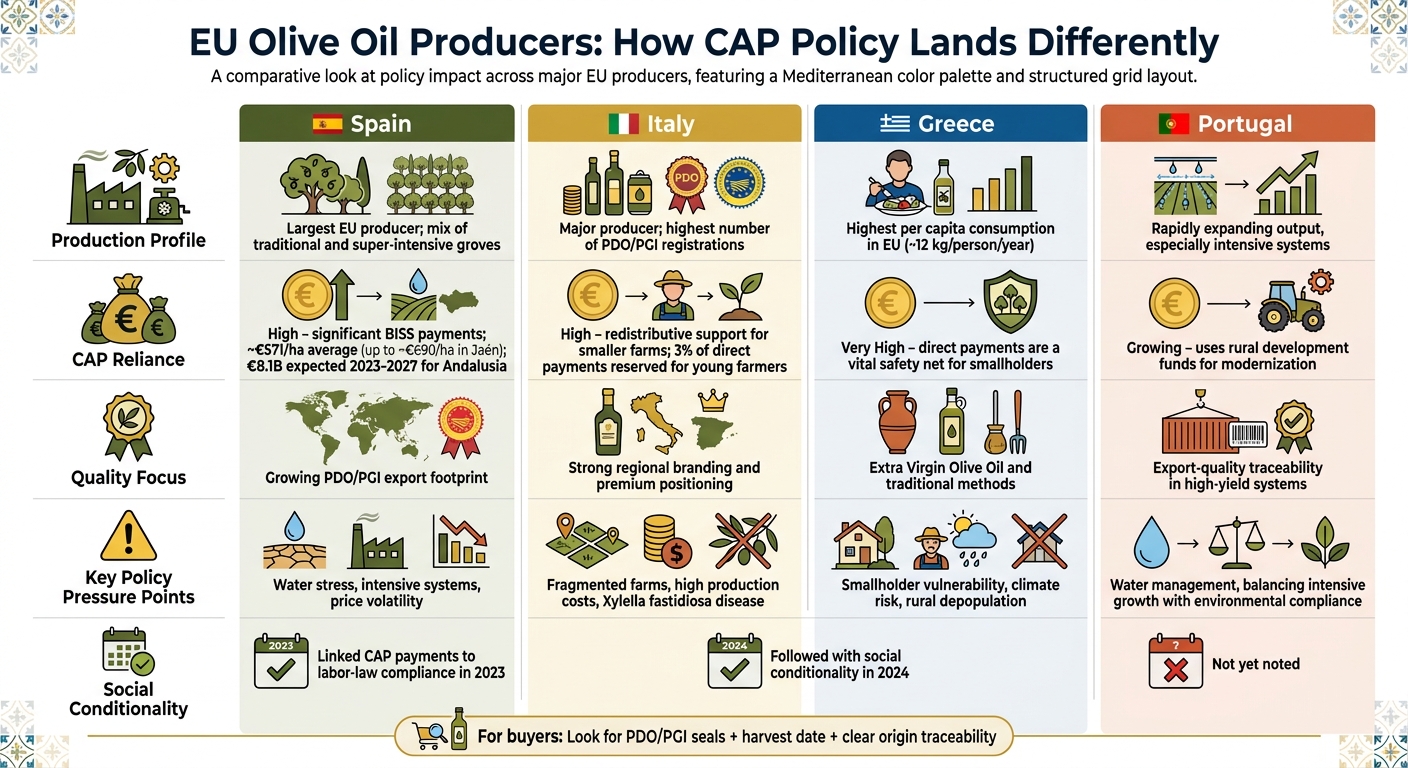
EU Olive Oil Producing Countries: CAP Policy Impact Compared
Beyond income support, CAP also sets the rules that shape how olive oil can claim origin and quality. It also affects labels, traceability, and day-to-day farm practices.
PDO, PGI, and traceability standards for olive oil
The EU uses two main origin labels for olive oil: Protected Designation of Origin (PDO) and Protected Geographical Indication (PGI), both registered under Regulation (EU) No 1151/2012.
Here’s the simple version:
- PDO means every stage of production must happen in the named region.
- PGI means only one stage must take place there.
That makes PDO the stricter label, while PGI gives producers more room when sourcing.
EU marketing standards also require annual conformity checks on olive oil operators, with checks scaled to sales volume, to make sure labels match the oil in the bottle. Optional terms such as "first cold pressing" and "cold extraction" give premium producers another way to signal quality.
Environmental conditions for olive groves
To receive full CAP payments, olive growers must comply with Good Agricultural and Environmental Conditions (GAEC). These are baseline rules that cover soil cover, water protection, and preservation of landscape features. Eco-schemes pay growers for going beyond the legal minimum.
Why does that matter? Because olive quality doesn’t just come from milling and storage. It starts in the grove. Healthy soil, stable water use, and biodiversity all support the long life of olive trees and the quality of the fruit they produce.
In Spain, where varieties like Picual dominate, the "Olivares Vivos" model brings biodiversity corridors directly into olive grove management. Growers also face a rule that they must dedicate at least 3% of their farmland to non-productive biodiversity areas to qualify for full support. Traditional groves also help prevent erosion and support biodiversity.
Spain, Italy, Greece, and Portugal compared
These rules don’t land the same way in every producing country. The basics may be shared across the EU, but each olive sector has its own pressure points.
| Country | Production Profile | CAP Reliance | Quality Focus | Policy Pressure Points |
|---|---|---|---|---|
| Spain | Largest producer; mix of traditional and super-intensive groves. | High; significant recipient of BISS payments. | Growing PDO/PGI export footprint. | Water stress; intensive systems; price volatility. |
| Italy | Major producer; high number of PDO/PGI registrations. | High; redistributive support for smaller farms. | Strong regional branding and premium positioning. | Fragmented farms; high production costs; Xylella fastidiosa. |
| Greece | Highest per capita consumption in the EU, about 12 kg per person per year. | Very high; direct payments are a vital safety net for smallholders. | Extra Virgin Olive Oil and traditional methods. | Smallholders; climate vulnerability; rural depopulation. |
| Portugal | Rapidly expanding output, especially in intensive systems. | Growing; uses rural development funds for modernization. | Export-quality traceability in high-yield systems. | Water management; balancing intensive growth with environmental compliance. |
Italy linked CAP payments to labor-law compliance in 2023, and Spain and Portugal followed with social conditionality in 2024. For premium buyers, that adds labor compliance to the quality story.
What EU policy means for premium olive oil buyers and brands
Why CAP rules matter to U.S. consumers buying premium EVOO
Those producer rules don’t stay on paper. They show up on the bottle.
CAP rules shape the labeling, traceability, and quality claims behind premium EVOO sold in the U.S. That matters when you’re standing in front of a shelf full of bottles that all look good at first glance. A polished label can say a lot. What matters more is what the brand can prove.
For U.S. buyers, the practical takeaway is simple: look for PDO or PGI seals, a harvest date, and clear origin traceability.
How Big Horn Olive Oil fits into the quality standards
Big Horn Olive Oil reflects that same focus on quality and control. The company offers Ultra Premium Extra Virgin Olive Oils that are cold-pressed within 2 hours of harvesting.
That emphasis on freshness, origin, and careful handling lines up with the quality standards CAP is meant to protect. For premium brands, that’s where compliance starts to matter in a very direct way: it becomes a quality signal, not just a box to check.
Conclusion: The link between CAP, growers, and olive oil quality
For premium EVOO buyers, CAP-backed traceability and quality rules make the label mean more. They give buyers a better way to judge what’s in the bottle.
Put simply, CAP matters because it shapes what premium olive oil can prove, not just what it can claim.
FAQs
How does the CAP affect olive oil prices?
Historically, the EU's Common Agricultural Policy (CAP) influenced olive oil prices through direct price supports and market interventions. Over time, that changed. The policy moved mostly toward decoupled direct payments, which help support farmers’ income without tying aid to how much they produce.
Today, swings in olive oil prices are driven less by CAP price controls and more by local factors on the ground. In many cases, the biggest driver is weather - especially extreme heat, drought, or other harsh conditions that hurt harvest yields.
What’s the difference between PDO and PGI?
PDO means a product is made, processed, and prepared in a specific geographic area using recognized know-how.
PGI means at least one stage of production, processing, or preparation happens in that region, and the product’s quality, reputation, or another trait is tied to its geographic origin.
Why do CAP rules affect countries differently?
CAP rules don’t play out the same way in every country. That’s because each EU member state can set its own national strategic plan. In plain English, countries get more room to deal with local needs, economic pressure, and farming conditions while still working toward the EU’s main goals.
Production costs and income gaps also vary from one country to another. Farm size matters. Terrain matters. And so does the type of cultivation, whether it’s more old-school or highly intensive. Because of that, countries don’t all back the same kinds of support in the same way.