

Mediterranean Snacks with Olive Oil: 5 Recipes
Yes - you can use olive oil in a weight-loss plan if you measure it. Since 1 tablespoon of EVOO has about 120 calories, the article’s main point is simple: pair a set amount of olive oil with foods that have fiber, protein, and volume so your snack feels satisfying without getting too big.
Here’s the short version:
- Measure the oil: usually 1 teaspoon to 1 tablespoon
- Build snacks around fiber and protein: chickpeas, hummus, vegetables, cheese, yogurt
- Keep snack calories in check: about 150–250 calories
- Use prep to avoid overeating: portion hummus, chickpeas, cheese, and dressing ahead of time
- Pick based on hunger: lighter veggie snacks for a small gap, protein-heavy options when you need more staying power
The five snack ideas covered are:
- Hummus snack bowl - vegetables + hummus + EVOO
- Roasted chickpeas - crunchy, high-fiber, easy to portion
- Cucumber tomato olive salad - low-calorie, high-volume
- Caprese skewers - more protein per bite
- Mezze snack plate - the most balanced mix
Quick Comparison
| Snack | Calories | Protein | Fiber | Olive oil |
|---|---|---|---|---|
| Hummus snack bowl | ~210 | 8 g | 6 g | 1 tsp to 1 tbsp |
| Roasted chickpeas | ~150 | 7 g | 6 g | 1 tbsp |
| Cucumber tomato olive salad | ~130 | 3 g | 3 g | 1–2 tsp |
| Caprese skewers | ~160 | 9 g | 1 g | ~1 tsp drizzle |
| Mezze snack plate | ~245 | 9 g | 6 g | 1 tbsp |
What I take from the article is simple: don’t cut olive oil - control the pour. That gives you the flavor and staying power of EVOO, while keeping portions snack-sized.
Why Olive Oil-Based Mediterranean Snacks Support Weight Management
Mediterranean snacks work for a simple reason: they usually combine produce, legumes, and a measured amount of EVOO. Many packaged snacks don't offer much fiber or protein, so you're hungry again not long after eating them. Mediterranean-style snacks tend to do the opposite. They bring together ingredients that add fiber, volume, and healthy fat, a pattern linked with better appetite control and easier weight maintenance.
How EVOO, Fiber, and Protein Help You Stay Full
EVOO adds flavor, and it can also help a snack feel more satisfying. Its oleic acid may play a role in fullness, and meals rich in EVOO have been linked to a lower urge to keep eating. Fiber from chickpeas and vegetables adds bulk, which helps a snack feel more filling. Protein from feta, Greek yogurt, or legumes helps it stick with you a bit longer.
That mix matters. High-protein, high-fiber snacks have been shown to reduce calorie intake at the next meal compared with high-fat, high-sugar options. So instead of a snack that gives you a short burst and then disappears, you get one that holds you over.
Portion Size Matters More Than Avoiding Olive Oil
For weight management, portion size matters more than cutting out olive oil. Studies link olive-oil-rich diets with modest improvements in weight and waist size when olive oil replaces less satisfying fats. That's the key idea here.
Each recipe uses a set amount, usually 1 teaspoon to 1 tablespoon per serving. You still get the satiety perks, but without letting calories creep up too far.
The recipes below take that formula and turn it into quick, snack-sized portions.
What to Expect From the 5 Recipes
Each recipe includes the main ingredients, the olive oil amount, an approximate serving size, and a short note on why it can help with weight management. Prep stays simple. Most of these snacks come together by mixing, roasting, assembling, or skewering. They're also portioned like snacks, not mini meals, so the goal is to curb hunger without overdoing it.
| Recipe | Olive Oil Amount | Why It Works |
|---|---|---|
| Mediterranean Hummus Snack Bowl | 1 tbsp EVOO | Fiber + plant protein (chickpeas) |
| Crispy Mediterranean Roasted Chickpeas | 1 tbsp EVOO | Fiber + protein + crunch |
| Cucumber Tomato Olive Salad | 1 tsp EVOO | Volume + fiber + healthy fat |
| Caprese Skewers with Olive Oil and Balsamic | 1 tsp EVOO | Protein (mozzarella) + fat |
| Mediterranean Mezze Snack Plate | 1 tbsp EVOO | Balanced fat, fiber, and protein |
First up: a simple hummus bowl built for steady fullness.
sbb-itb-4066b8e
1. Mediterranean Hummus Snack Bowl
This snack bowl comes together in minutes and does a lot with a little. You get hummus, raw vegetables, and a measured drizzle of EVOO for a snack that feels filling without drifting into full-meal territory.
A ¼-cup serving of hummus has about 4 grams of protein and 3 grams of fiber. Pair that with 1 to 2 cups of raw vegetables like cucumber, cherry tomatoes, and bell pepper, and the calories stay modest. The result is simple: more volume, some protein, and extra fiber in one bowl. That's a smart place to start if you're trying to keep portions in check while still eating well.
Use 1 teaspoon to 1 tablespoon of EVOO, based on your calorie goal and whether your hummus already has oil in it. Measuring the oil matters here. It adds flavor and richness without letting the snack creep past your target.
For the bowl itself, layer ¼ to ⅓ cup hummus with cucumber, cherry tomatoes, red onion, and a few Kalamata olives. Then finish it with a small sprinkle of feta, lemon juice, EVOO, and za'atar or paprika.
If you're prepping ahead, keep the parts separate and put the bowl together right before eating. That helps the vegetables stay crisp. Most of the ingredients hold well in the refrigerator for 3 to 4 days. Next, the same setup gets crunchier with roasted chickpeas.
2. Crispy Mediterranean Roasted Chickpeas
After the hummus bowl, this higher-crunch option makes portioning easy. Roasted chickpeas stick with the same Mediterranean setup - measured EVOO, fiber, and protein - but bring a crisp bite. A ½-cup serving has about 7 to 9 grams of protein and 6 to 7 grams of fiber. It’s simple to portion, simple to pack, and helps you stay full without much fuss.
Start with one 15-ounce can of chickpeas. Drain, rinse, and dry them very well. If they’re damp, they’ll turn out chewy instead of crisp. Toss the dried chickpeas with 1 tablespoon of EVOO and your spice mix, then spread them in one layer on a parchment-lined baking sheet. Roast at 400°F for 30 to 40 minutes, shaking the pan every 10 to 15 minutes, until they’re golden and crisp. That works out to about 1 teaspoon of oil and 40 calories per ½-cup serving.
Garlic powder, smoked paprika, and sea salt are a solid starting point. You can also switch things up with za’atar, cumin, oregano, or lemon zest. If you’re using a flavored EVOO from Big Horn Olive Oil, use less of the dry seasoning and keep the oil measured.
Don’t refrigerate them. Let the chickpeas cool all the way, then move them to a jar or a loosely covered container and store them at room temperature. A tight lid traps moisture fast, and that’s what makes them go soft. Kept at room temperature in a loose-lid container, they stay crisp for 3 to 5 days. If they lose a bit of their crunch, spread them on a baking sheet and warm them at 350°F for 5 to 10 minutes, then let them cool fully before eating.
For meal prep, roast a double batch on Sunday and divide it into ½-cup snack containers for easy grab-and-go snacks during the week.
Next: a five-minute no-cook salad.
3. Cucumber Tomato Olive Salad
After the roasted chickpeas, this cool, no-cook salad keeps things simple and crisp. One serving gives you about 4 grams of fiber, and the mix of vegetables, olives, and a measured amount of EVOO helps keep it filling and supports hunger control.
For one serving, combine ½ cup chopped English cucumber, ½ cup halved cherry or grape tomatoes, 4 to 6 Kalamata olives, 2 tablespoons thinly sliced red onion, and a handful of fresh parsley or dried oregano. Dress it with 1 to 2 teaspoons of EVOO and lemon juice or red wine vinegar, then season with salt and pepper.
If you want it to hold you a bit longer, add 1 tablespoon of crumbled feta or ¼ cup of chickpeas. A bold EVOO brings plenty of flavor, even at just 1 to 2 teaspoons.
For meal prep, store the dressing on the side and keep the chopped vegetables dry in an airtight container. Add the salt and dressing right before eating. Salt draws water out of the cucumbers, and that’s how you end up with a soggy bowl instead of a crisp salad. Stored this way, the vegetable base stays fresh for 3 to 4 days.
Taking it with you is easy. Pack the salad base in a small container, put the dressing in a mini jar, and keep everything cold in an insulated bag with an ice pack. It’s a simple setup that helps with portion control and makes weekday grab-and-go lunches a lot easier.
For a more portable option, the next recipe turns these same flavors into skewers.
4. Caprese Skewers with Olive Oil and Balsamic
These skewers pack about 11 to 14 grams of protein per serving thanks to 2 oz of small mozzarella balls. Paired with olive oil, they make a small snack that can help take the edge off hunger between meals.
Each skewer includes a cherry or grape tomato, a fresh basil leaf, and a small mozzarella ball. The tomatoes bring fiber, vitamin C, and lycopene. The basil keeps the flavor bright without adding many calories.
For the drizzle, combine 1 tablespoon of EVOO with 1 tablespoon of balsamic vinegar, plus a pinch of sea salt and freshly ground black pepper. Use about 1 teaspoon of this mixture per serving of 4 to 6 skewers, either lightly drizzled over the top or brushed on. You don’t need much. A bold EVOO and balsamic can do a lot with just a small touch.
If you want to make them ahead, assemble the skewers and chill them separately from the drizzle. Store the skewers in an airtight container in the refrigerator at or below 40°F for up to 24 hours ahead, then add the drizzle right before eating.
Taking them with you? Use a shallow, rigid container so the skewers stay flat. Pack an ice pack if they’ll be out of the fridge for more than 2 hours. The drizzle is easy to carry in a small leak-proof dressing cup. For the final snack, keep that same Mediterranean mix in a simple mezze plate.
5. Mediterranean Mezze Snack Plate
This is the most flexible snack on the list. It brings together the same core parts from the recipes above in one bigger snack plate. One serving can give you roughly 15 to 20 grams of protein and about 7 grams of fiber, based on what you add. That combo helps the snack feel balanced and satisfying. Next, use the nutrition snapshot below to compare all five snacks at a glance.
A single serving includes ¼ cup hummus (about 4 grams of protein and 3 grams of fiber), 1 oz feta cheese (about 4 grams of protein), 1 cup of mixed raw vegetables like cucumber slices, cherry tomatoes, bell pepper strips, and carrot sticks, 4 to 6 olives, and ½ small whole-grain pita cut into triangles. For olive oil, measure 1 tablespoon and drizzle half over the hummus and the rest lightly over the vegetables or feta. Measuring the oil helps keep the portion snack-sized. A bold EVOO like Big Horn Olive Oil works well here.
Wash, dry, and cut the vegetables, then store them in airtight containers with a paper towel to soak up extra moisture. Portion the hummus into individual ¼-cup containers, and cube the feta into 1-oz servings. Keep the olives in a small container with their brine so they stay flavorful. Store everything in the refrigerator at or below 40°F. The prepped parts stay fresh for 3 to 4 days. For the best texture, keep each item separate until you're ready to eat.
Add the olive oil right before eating so the flavors stay fresh. If you're packing this snack for later, bring the oil in a small leakproof container so you can measure it on the go. The next section breaks down the nutrition across the full list.
Snack Nutrition at a Glance
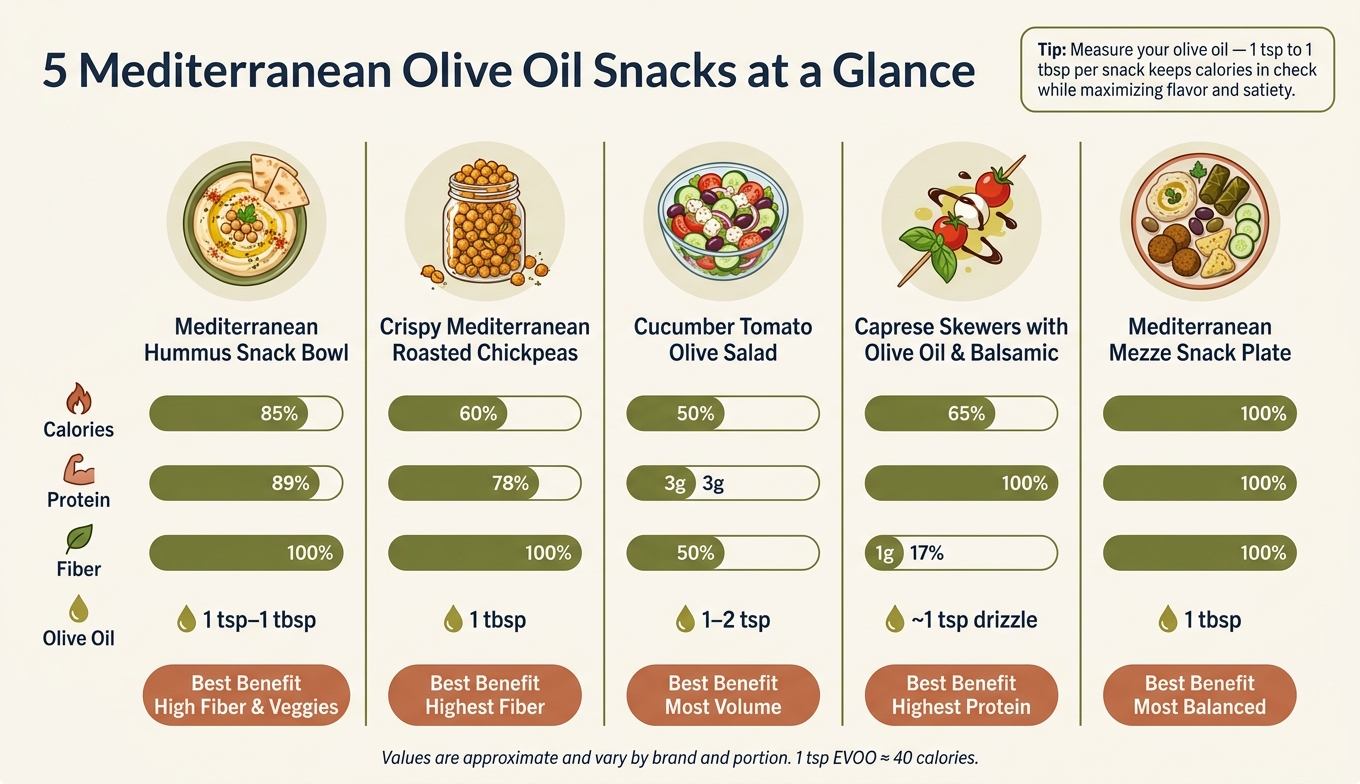
5 Mediterranean Olive Oil Snacks: Calories, Protein & Fiber Compared
Here’s a quick side-by-side look at the five recipes above. These numbers are approximate, based on standard U.S. ingredients and common home-style portions. Your totals can change a bit depending on the hummus brand, the pita you use, or how much olive oil goes into the bowl. The table makes it easy to compare each snack fast.
| Snack | Calories (approx.) | Protein (g) | Fiber (g) | Olive oil per serving | Best benefit |
|---|---|---|---|---|---|
| Mediterranean Hummus Snack Bowl | ~210 | 8 | 6 | 1 tsp to 1 tbsp | High fiber & veggies |
| Crispy Mediterranean Roasted Chickpeas | ~150 | 7 | 6 | 1 tbsp | Highest fiber per serving |
| Cucumber Tomato Olive Salad | ~130 | 3 | 3 | 1 to 2 tsp | Highest volume for calories |
| Caprese Skewers with Olive Oil and Balsamic | ~160 | 9 | 1 | 1 tsp drizzle mixture | Highest protein per bite |
| Mediterranean Mezze Snack Plate | ~245 | 9 | 6 | 1 tbsp | Most balanced snack |
Values are approximate and vary by brand and portion.
Use the table to match the snack to your hunger level. If you need something more filling, the mezze plate or caprese skewers give you more protein and may help curb cravings. If you want something lighter, or dinner is right around the corner, the cucumber tomato olive salad gives you the most volume for the fewest calories.
A teaspoon of EVOO adds about 40 calories, so it helps to measure instead of free-pouring. That small step keeps flavor high while keeping the portion snack-sized.
Next, use these numbers to fit one or two snacks into your day.
How to Work These Snacks Into Your Day
Use the nutrition snapshot above to match your snack to your hunger level and your schedule. Most people do well with 1 to 2 snacks a day. A smart range is about 150–200 calories per snack. The big idea here is simple: treat each snack as a planned portion, not something you nibble on without thinking.
Simple Portion Guides for Olive Oil, Legumes, and Cheese
For EVOO, keep it measured. Use 1 teaspoon for a lighter snack and 1 tablespoon when you want something that sticks with you longer. It sounds small, but this is one of those spots where a free pour can get away from you fast, so measuring spoons help.
For legumes like chickpeas or hummus, 1/4 cup is a solid snack portion. With cheese, aim for about 1 oz for a lighter snack, or 1–2 oz if you want a bit more staying power.
Once your portion is set, timing makes a big difference in how satisfying that snack feels.
When to Eat These Snacks
Mid-afternoon tends to work best for most people. That’s often the point in the day when energy dips and hunger starts creeping in.
If you like a snack after dinner, go small. A little mezze plate with raw veggies, a few olives, and 1 tablespoon of hummus can hit the spot without feeling too heavy.
Meal Prep and Portable Options
Pre-portioning helps prevent using too much olive oil or cheese. Keep the parts separate, store oil and dressing in small containers, and put everything together right before you eat.
A bento box makes this easy because it keeps portions in check without much fuss. And if you’re packing oil, use a leakproof container. Nobody wants olive oil all over their bag.
Conclusion
Mediterranean snacks built around extra virgin olive oil, vegetables, and legumes can curb hunger without throwing off your weight goals. The big idea is simple: pair measured olive oil with fiber-rich whole foods.
Each recipe works for a different kind of craving - crunchy, fresh, savory, or more protein-heavy. But the same rule shows up every time: measure the oil. A small, measured drizzle of high-quality EVOO over chickpeas or sliced vegetables adds flavor and can help with satiety. In day-to-day eating, small swaps you can stick with matter more than perfection.
Trading one or two processed snacks each day for a 150–250 calorie Mediterranean option can help move your overall eating pattern in a better direction. Measured olive oil - not cutting it out - is what makes these snacks work.
FAQs
How much olive oil should I use per snack?
Use about 1 tablespoon of olive oil per snack, which comes to roughly 120 calories.
If you're putting together a mezze-style snack with dips or cheeses, start with about 4 teaspoons and add more if needed.
Which snack is best for staying full longer?
Choose snacks with plenty of fiber, like chickpeas, lentils, beans, quinoa, farro, and brown rice. These foods give you steady energy and can help keep blood sugar on a more even track.
It also helps to pair them with high-quality extra virgin olive oil. The monounsaturated fats can slow digestion, which may help you stay full for longer. Big Horn’s Lemon Apricot Oatmeal Bars are another solid pick when you want something satisfying.
Can I meal prep these snacks ahead?
Yes. A lot of Mediterranean-inspired snacks can be made ahead and kept in the refrigerator for up to 4 days. Homemade vinaigrettes and dressings usually last 3 to 5 days when stored in airtight glass containers.
That said, some snacks are better when you put them together right before serving. With salads, store the dressing and delicate greens separately, or serve them within 30 minutes after assembly.