

Modena's Role in Balsamic Vinegar Certification
If a bottle only says "balsamic", that does not prove it came from Modena. I’d look for the full protected name, the EU seal, the right aging term, and, for PDO, the required 100 mL bottle.
Here’s the short version:
-
Modena has two protected categories:
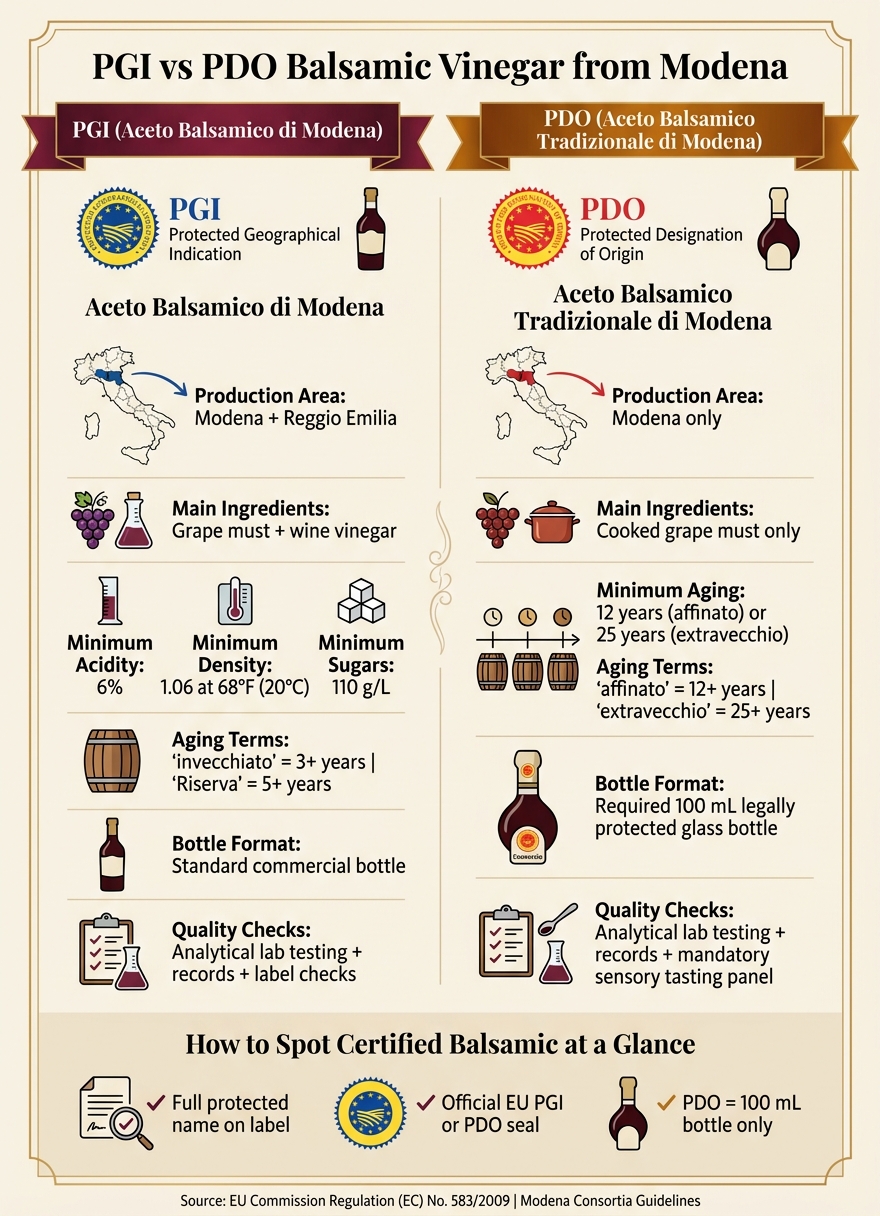
PGI = Aceto Balsamico di Modena
PDO = Aceto Balsamico Tradizionale di Modena - PGI must be made in Modena and Reggio Emilia and meet set lab standards, including at least 6% acidity and minimum density of 1.06 at 68°F (20°C).
- PDO follows tighter rules: only cooked grape must, production and bottling inside Modena, plus 12 years minimum aging for affinato and 25 years for extravecchio.
- Checks come from more than one level: consortia, accredited control bodies, and Italy’s ICQRF enforcement system.
- Verification includes records, label checks, lab testing, sensory review, and in some cases digital traceability tools.
- For shoppers in the U.S., the safest read is simple: the full name matters more than the word "balsamic."
This means Modena’s role is not just about place. It’s about rules, testing, label control, and fraud checks tied to that place.
PGI vs PDO Balsamic Vinegar: Modena Certification Guide
How Certified Balsamic Vinegar Of Modena Is Made
sbb-itb-4066b8e
Quick Comparison
| Item | PGI | PDO |
|---|---|---|
| Protected name | Aceto Balsamico di Modena | Aceto Balsamico Tradizionale di Modena |
| Production area | Modena + Reggio Emilia | Modena only |
| Main ingredients | Grape must + wine vinegar | Cooked grape must only |
| Minimum aging | Not fixed in the base category | 12 years / 25 years |
| Label clue | EU PGI seal | EU PDO seal |
| Bottle format | Standard bottles | Required 100 mL bottle |
| Main checks | Records + lab controls | Records + lab controls + tasting panel |
If I wanted to judge a bottle fast, I’d start with those label signals before I looked at anything else.
The legal framework that ties balsamic vinegar to Modena
EU geographical indication protection for Aceto Balsamico di Modena PGI
Commission Regulation (EC) No. 583/2009 registered "Aceto Balsamico di Modena" as a PGI in the EU register. That registration does more than add a name to a list. It sets the legal rules for what can carry that label.
Under the product specification, production is limited to Modena and Reggio Emilia, and all main production stages must take place there. The rules also restrict which ingredients may be used and set measurable composition standards. Those registered requirements are what later compliance checks are built on.
How the protected name limits misuse of the Modena identity
The law does not just protect the product. It also controls how the name appears on labels. In this case, protection applies to the full compound name "Aceto Balsamico di Modena," not to the generic words inside it.
That matters because terms such as "balsamic vinegar" or other wine vinegars can still be used in the market, but they do not signal the Modena PGI. At the same time, EU law can still step in when a label creates an obvious link, in the mind of the average consumer, to the protected name.
For U.S. shoppers, the practical takeaway is pretty simple: "balsamic" by itself does not prove origin. The full protected name does.
Who verifies compliance in Modena
The role of PGI and PDO consortia
After the Modena name gets legal protection, the next step is simple: someone has to check that producers follow the rules.
In Modena, two consortia oversee certified balsamic vinegar. One covers PGI. The other covers PDO.
The Consorzio Tutela Aceto Balsamico di Modena manages the PGI designation and holds a Ministry mandate to monitor and protect it. Part of that job is very hands-on. The consortium checks whether the amount of product certified matches the amount that actually reaches the market, which helps support traceability.
The Consorzio Tutela Aceto Balsamico Tradizionale di Modena handles the PDO side together with Kiwa Cermet, the Ministry-appointed control body. Their work includes supply-chain checks and sensory approval for the 100 mL PDO bottle.
Accredited certification bodies and ministry oversight
The actual verification work is handled by accredited control bodies.
For PGI, CSQA audits facilities, reviews records, samples product, checks labels, and runs sensory tests when needed. A product has to pass these checks before it can be sold under the protected name.
Above the consortia and the control bodies is ICQRF, the Ministry's enforcement arm. ICQRF approves control plans, supervises private certification bodies, and carries out its own inspections. It also goes after fraud online and through field inspections, which gives the system a government backstop.
For U.S. importers and retailers, that means the process does not rely on a single party. Consortia, accredited control bodies, and government enforcement each serve as a separate checkpoint. Those checks are what create the traceability records covered next.
How certification confirms origin, traceability, and product integrity
Production rules and analytical testing
Certification doesn't stop at checking paperwork or site controls. It also checks the product in the bottle.
For PGI balsamic, the specification ties origin to approved grape varieties: Lambrusco, Sangiovese, Trebbiano, Albana, Ancellotta, Fortana, and Montuni. That link to grapes from the defined area is the first guardrail against imitation.
Then the rules move from general to precise. Finished PGI balsamic must hit set lab thresholds, including:
- total acidity of at least 6%
- density at 68°F (20°C) of at least 1.06
- reducing sugars of at least 110 g/L
- sulfur dioxide of no more than 100 mg/L
Those figures form a test profile that ties chemical results back to origin checks. If a sample lands outside the expected range, it can be flagged during a routine audit or a market inspection.
Standard chemistry isn't the only tool in play. Researchers linked to Modena's universities and consortia also use isotopic and chemical profiling to spot more advanced fraud, such as balsamic cut with cheaper vinegars or sweetened with non-grape sugars. They look at stable isotope ratios, acid patterns, and trace elements linked to Modena grapes and aging conditions. Put simply, routine testing catches the plain stuff, and advanced profiling helps catch the sneaky stuff.
Sensory panels and the 100 mL PDO bottle
For Traditional Balsamic Vinegar of Modena PDO, passing lab tests still isn't enough. Every batch must also pass an official sensory panel. Tasters score appearance, aroma, flavor, and overall balance against an official scale. They're checking for the traits named in the specification, including the intense brown color, limpid clarity, and sweet-and-sour harmony.
The score bar is strict. Minimum sensory scores apply to both aged and extra-aged PDO batches. So even if a batch clears every chemical test, it still can't be sold as PDO if it falls short in tasting. That two-part check - lab plus panel - helps stop off-style batches from weakening the category's name.
The mandatory 100 mL bottle is the clearest visual sign of PDO status. Its standard glass design is legally protected and required for Traditional Balsamic Vinegar of Modena PDO. Bottling must happen inside the province of Modena under consortium or authorized-body supervision. The bottle also needs tamper-evident closures and label details that tie it to a certifying lot number and producer code.
For U.S. retailers, that small bottle is a useful visual check: if it shows the EU PDO logo and reads Aceto Balsamico Tradizionale di Modena DOP, it has passed both analytical and sensory review.
Digital traceability tools in the Modena balsamic sector
Traceability in Modena is also moving into digital systems. Paper records have long been the legal base for traceability, but they come with limits. They can be lost, forged, or slow to move through a global supply chain.
That helps explain the push toward digital tools. In October 2019, CSQA announced that Balsamic Vinegar of Modena PGI became the first major Italian geographical indication to begin testing a Digital Passport, developed with the State Printing and Mint and the Qualivita Foundation. A 2023 University of Parma study also named Aceto Balsamico di Modena PGI among Italian protected products using blockchain to verify compliance with specification requirements.
These systems create tamper-resistant records, help spot anomalies faster, and let downstream buyers or sellers scan a code to check certification data. Paper records still remain the legal base, while digital tools add a faster layer of verification.
What Modena certification means for U.S. consumers and retailers
Those checks matter most when you're standing in the aisle and looking at the bottle. At that point, the label does most of the talking.
How to read certified labels: PGI vs. PDO
At retail, the label tells you whether a balsamic vinegar is PGI or PDO.
For PGI balsamic, the label should show "Aceto Balsamico di Modena" with "Protected Geographical Indication" or "PGI" and the blue-and-yellow EU PGI seal. "Modena" needs to appear as part of the protected name, not just as decorative packaging text. On PGI bottles, "invecchiato" means at least 3 years of wood aging, and "Riserva" means more than 5 years.
For PDO balsamic, look for "Aceto Balsamico Tradizionale di Modena" with the red-and-yellow EU PDO seal and the required 100 mL bottle. PDO aging rules are tighter: "affinato" means at least 12 years, and "extravecchio" means at least 25 years.
Use this quick comparison to spot the difference fast.
| Feature | PGI (Aceto Balsamico di Modena) | PDO (Aceto Balsamico Tradizionale di Modena) |
|---|---|---|
| Label signals | Full protected name + PGI wording + blue-and-yellow EU PGI seal | Full protected name + PDO wording + red-and-yellow EU PDO seal |
| Aging terms | "invecchiato" = 3+ years; "Riserva" = 5+ years | "affinato" = 12+ years; "extravecchio" = 25+ years |
| Bottle format | Standard commercial bottle | Required 100 mL bottle |
| Quality checks | Analytical testing and certification controls | Analytical testing and required sensory panel |
Why sourcing from Modena supports transparency
For U.S. retailers, documented sourcing from Modena makes origin easier to check. Big Horn Olive Oil sources Modena balsamics, including 18-year and 25-year options, which makes origin easier to verify.
Conclusion: Key findings from the research
For U.S. buyers, the protected name, official seal, aging term, and traceability record are the clearest proof of origin. When the name, seal, aging term, and source records line up, the label is credible.
FAQs
How can I tell if a balsamic is really from Modena?
Look for the official PGI or PDO seal on the bottle.
The PGI label is a yellow-and-blue sticker. It shows the balsamic meets strict standards and comes from Modena or Reggio Emilia.
If you want the top tier, check for the PDO label on Traditional Balsamic Vinegar of Modena. That mark means every step of production happened within Modena.
What is the difference between PGI and PDO balsamic?
PDO balsamic follows much tighter rules. Often called Traditional Balsamic Vinegar of Modena, it’s made from 100% cooked grape must with no additives, produced only in Modena, and aged for at least 12 years in wooden barrels.
PGI balsamic gives producers more room to work and usually costs less. It combines grape must and wine vinegar, ages for at least 60 days, and can include up to 2% caramel for color.
Why does PDO balsamic come in a 100 mL bottle?
PDO Traditional Balsamic Vinegar of Modena comes in a distinctive spherical 100 mL glass bottle.
That bottle isn’t just for looks. It’s required to protect the product’s identity and to meet strict quality rules.
The packaging is mandatory and includes a numbered, tamper-proof seal. Paired with the rule that every step of production - from grape growing to aging - must happen in the Province of Modena, it helps protect the vinegar’s integrity and the craft behind it.