

Multi-Stakeholder Networks vs. Fraud in Olive Oil
Olive oil fraud is a growing issue, driven by high market value and limited consumer ability to detect adulteration. Fraud includes mixing extra virgin olive oil (EVOO) with cheaper oils, mislabeling lower-grade oils, and falsely claiming origins. While individual producers use tools like chemical tests and QR codes to ensure quality, multi-stakeholder networks - such as the EU Food Fraud Network - offer broader solutions by pooling resources, sharing data, and coordinating enforcement across borders. Networks leverage advanced tools like blockchain, satellite data, and DNA testing to combat fraud more effectively than isolated efforts. For premium brands like Big Horn Olive Oil, combining internal controls with these networks ensures product integrity and builds consumer trust.
Why Most Olive Oil Isn’t What You Think (and How to Find the Real Thing)
sbb-itb-4066b8e
Understanding Olive Oil Fraud
Olive oil fraud has been around for centuries, but modern techniques have made it more sophisticated and harmful. Let’s dive into the main types of fraud that threaten the integrity of olive oil.
Types of Olive Oil Fraud
Fraud in the olive oil industry typically falls into a few key categories: adulteration, grade mislabeling, and origin fraud. Each of these practices undermines the quality and trustworthiness of olive oil. Here’s a closer look at how they work:
- Adulteration: This involves blending extra virgin olive oil (EVOO) with cheaper oils like sunflower, soybean, corn, canola, or hazelnut oil. Because olive oil is a liquid, it’s easy to mix with other oils, making this a highly profitable scam.
- Grade Mislabeling: In this type of fraud, lower-grade oils - such as refined olive oil, lampante, or pomace oil - are falsely sold as "Extra Virgin." EVOO must meet strict chemical standards (e.g., free fatty acidity under 0.8%, K232 ≤ 2.5, K270 ≤ 0.22). However, fraudulent products often bypass these requirements and are mislabeled to fetch higher prices.
- Origin Fraud: This occurs when oils from outside Europe are falsely marketed as products from regions like Italy, Spain, or Greece. A notable example took place in June 2025, when Spanish authorities jailed four individuals for selling sunflower oil as "extra virgin" and "organic" olive oil, complete with fake Mediterranean branding.
The table below summarizes these fraudulent practices:
| Fraud Type | What It Involves | Common Adulterants |
|---|---|---|
| Adulteration/Blending | Mixing EVOO with cheaper oils | Sunflower, soybean, hazelnut, corn, canola |
| Grade Mislabeling | Selling lower-grade oil as "Extra Virgin" | Refined olive oil, lampante, pomace oil |
| Origin Fraud | Falsely claiming Mediterranean or EU origin | Non-European oils with fake regional branding |
| Counterfeiting | Faking premium packaging or "organic" claims | Colorants, Sudan dyes, false certifications |
How Fraud Affects Producers and Consumers
For consumers, olive oil fraud isn’t just a matter of overpaying - it can also compromise health. Authentic EVOO offers numerous health benefits, which are often absent in adulterated oils. Worse, some fraudulent oils may include allergens like hazelnut oil, posing risks to those with allergies.
For producers, fraud is a double-edged sword. It tarnishes reputations and eats into profits. Fraudulent products often drive down market prices, forcing legitimate producers to compete against cheaper, low-quality alternatives. For example, companies like Big Horn Olive Oil, which cold-presses its Ultra Premium EVOO within two hours of harvest and adheres to strict quality standards, must work harder to differentiate themselves. With reports of olive oil fraud more than doubling in 2024 compared to any year since 2015, the stakes for maintaining authenticity have never been higher.
Multi-Stakeholder Networks in Fighting Fraud
How Multi-Stakeholder Networks Are Structured
Tackling olive oil fraud requires a united front. Multi-stakeholder networks bring together government agencies, scientists, law enforcement, and legal experts under a shared framework.
The Agri-Food Fraud Network (FFN), established by the European Union, is a standout example. This network links the European Commission with liaison bodies across EU member states, as well as Switzerland, Norway, and Iceland. Its operations are guided by the Official Controls Regulation, which mandates that all contact bodies exchange information to ensure compliance with agri-food laws.
| Participant Category | Key Entities | Primary Role |
|---|---|---|
| Public Authorities | European Commission, National Liaison Bodies | Coordination, communication, and legislative oversight |
| Scientific/Research | EC Knowledge Centre (JRC), Universities | Developing and validating testing methods |
| Law Enforcement | Europol, OLAF, Police, Customs | Cross-border investigations and enforcement |
| Regulatory Bodies | International Olive Council (IOC), Codex Alimentarius | Setting international standards and analytical methods |
| Legal Administration | Judges, Prosecutors | Handling fraud cases through the courts |
These networks operate through a well-structured collaboration, utilizing a mix of advanced tools and methods to identify and counter fraud.
Key Tools and Methods Used
Multi-stakeholder networks rely on an "integrated toolbox" that combines traditional lab work with cutting-edge digital technologies. Scientists analyze biomarkers like stigmastadienes, sterols, fatty acids, and wax esters - chemical signatures that can expose adulteration or mislabeling. High-resolution mass spectrometry ensures global traceability, while sterolic profiles serve as a dependable alternative when advanced equipment isn’t available.
One innovative example is the STOPTHEFRAUDINOLIVEO project by Hashed Blocktac SL in Spain. This initiative introduced a blockchain-based "Digital Seal" that allows consumers to verify product authenticity with their smartphones - no special app or cryptocurrency required. The system’s cascading design flags an entire batch if even one bottle is found to be counterfeit:
"Once one bottle is identified as fake, the whole batch of counterfeited bottles is marked as 'fake'. It is a kind of 'vaccination'." - Hashed Blocktac SL
By early 2023, the project had issued over 100,000 blockchain certificates for product authentication. Similarly, the THEROS project, a $5.1 million initiative involving 17 participants across Europe, employs satellite data, photonics, DNA-based methods, and AI to authenticate organic and geographical labels in four countries.
These advanced methods not only enhance detection but also strengthen enforcement efforts, as shown in the next section.
Documented Results and Benefits
Coordinated enforcement has delivered tangible results. In 2023, Spanish authorities carried out 300 operations in olive-growing regions to combat theft and fraudulent practices. Such large-scale efforts would be nearly impossible without the unified approach of multi-stakeholder networks.
Beyond fraud detection, these networks have proven effective in addressing related challenges. For instance, in 2024, the European Commission declared the Xylella fastidiosa outbreak in Puglia, Italy, officially over. This decade-long battle involved destroying over 21 million infected trees and creating buffer zones to protect the remaining 40 million. The outbreak had severely disrupted production, leading to supply shortages that fueled fraud - a problem that required the same level of coordinated effort to manage.
The International Olive Council highlights the importance of this shift:
"The technological advances in fats and oils analysis have been accompanied by a growing awareness of the need for ever more effective control of the quality, purity and authenticity of the olive oils that are sold." - International Olive Council
Fraud incident reports surged from 15 in 2023 to over 30 in 2024. This increase reflects not only rising prices but also more active and effective enforcement. By pooling resources and expertise, these networks are uncovering fraud that might otherwise go unnoticed, proving that collaboration is far more effective than isolated efforts.
Individual Efforts to Fight Olive Oil Fraud
Common Individual Approaches
Even as larger networks tackle olive oil fraud on a systemic level, individual producers and brands are stepping up with their own strategies. Many are investing in advanced quality controls and verification tools to ensure their products meet the highest standards.
Producers often rely on chemical testing to confirm extra virgin olive oil (EVOO) quality, using markers like free fatty acidity (≤0.8%), K₂₃₂ (≤2.5), K₂₇₀ (≤0.22), and ΔK (≤0.01). These tests help detect adulteration with cheaper oils such as hazelnut, soybean, or sunflower oil. Sensory panels, made up of trained tasters, also play a key role in identifying defects and confirming the fruity characteristics required by International Olive Council (IOC) standards. Additionally, some producers use QR-code-based digital traceability systems to give consumers detailed information about the oil’s origin and production process.
A standout example is Italian producer Antonella Meyer-Masciulli, who collaborated with the EU Watson Project and Greek biotech firm BioCoS in November 2025. At her mill in Amelia, Italy, Meyer-Masciulli implemented BioCoS’s portable "Field DNA" device to verify that her oils came exclusively from ancient olive trees. This move directly countered competitors who used misleading imagery of ancient groves while selling oil from younger, high-yield trees. As Meyer-Masciulli explained:
"We chose to have our oils DNA-tested to create more transparency and trust with our consumers."
These tools allow for quick and precise verification, but they reveal their limits when tackling fraud that spans across borders.
Where Individual Efforts Work Well
Individual efforts excel in areas where speed and control are critical. A single brand has the advantage of managing its own supply chain, enabling quick decisions like tightening sourcing standards, switching suppliers, or recalling a batch of oil. Premium producers, in particular, can closely oversee their distribution channels, minimizing the risk of unauthorized substitutions.
For producers where full lab analysis is too costly, sterol profiling offers a reliable alternative to detect seed oil adulteration. Portable DNA devices, like the one tested by Meyer-Masciulli in 2025, are also making genetic testing more accessible by bringing these capabilities directly to the production site. For brands selling directly to consumers, these tools provide tangible proof of quality, which can be easily communicated to build trust.
Where Individual Efforts Fall Short
Despite their strengths, individual measures fall short when it comes to tackling fraud on a global scale. One major limitation is the lack of shared intelligence. Individual producers don’t have access to the cross-border data needed to identify widespread fraud, such as non-European oils being falsely marketed as Italian or Greek. This level of coordination requires networks like the EU’s Agri-Food Fraud Network, which no single brand can replicate.
Cost is another significant hurdle. Advanced detection methods, such as high-resolution mass spectrometry or full lipidomic fingerprinting, are expensive and difficult to implement at scale. Small producers, in particular, may struggle to afford frequent testing, leaving gaps in their quality control efforts. Another challenge is regulatory inconsistency. For example, in the U.S., the FDA still doesn’t have a formal definition for EVOO, making it harder for individual brands to enforce quality standards in the American market. Without a unified legal framework, even the most rigorous internal measures can only achieve so much.
Multi-Stakeholder Networks vs. Individual Efforts: A Direct Comparison
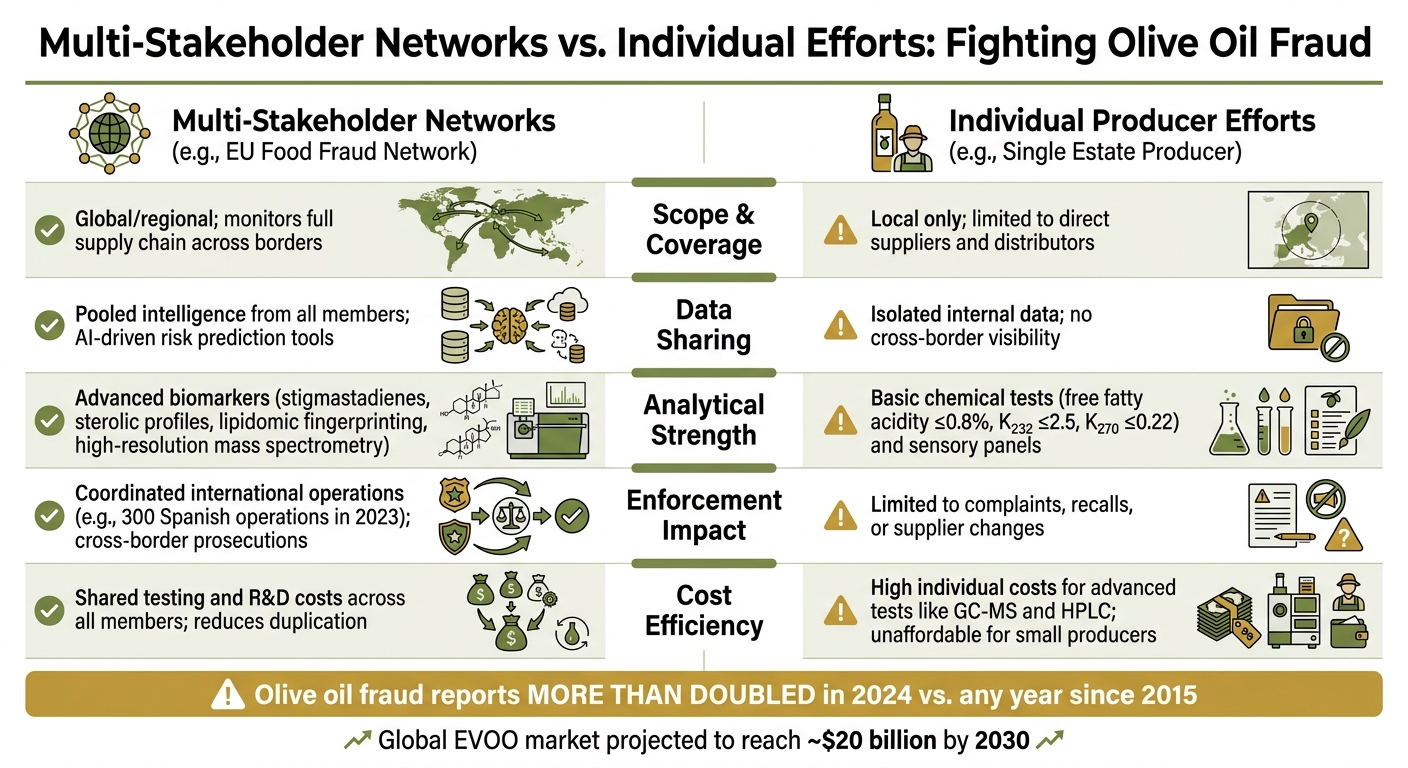
Multi-Stakeholder Networks vs. Individual Efforts: Fighting Olive Oil Fraud
Scope and Coverage
Multi-stakeholder networks, such as the EU Food Fraud Network, operate on a global scale, monitoring supply chains that cross borders. On the other hand, individual producers are limited to overseeing their immediate suppliers and distributors. Since fraud often spans multiple points in the supply chain, these networks are better suited to handle the complexities of cross-border operations. Their broader reach enables more comprehensive data collaboration, which is crucial for tackling fraud effectively. We'll dive into this collaborative advantage in the next section.
Data Sharing and Coordination
Individual producers generate data that is useful but typically confined to their internal operations. By contrast, networks pool information from various stakeholders and leverage AI-driven risk prediction tools to identify potential threats. This approach shines in enforcement scenarios. For example, in 2023, Spanish authorities carried out 300 operations in olive-growing regions to combat theft and fraudulent olive processing. A major fraud case in Spain, resolved in June 2025, involved selling sunflower and low-grade oils as "extra virgin" and "organic." This case, initially discovered in 2021, required extensive coordination between investigators and the legal system to secure a conviction.
"The oil is valuable, has multiple grades and variations that are difficult for most consumers to differentiate... making such dilutions very profitable and the addition of colourants making it hard to detect without expensive analytical tests." - Food Fraud Advisors
These collaborative networks not only improve fraud detection but also reduce the cost of individual testing by sharing resources.
Cost and Resource Efficiency
Advanced testing methods like GC-MS and HPLC are expensive, making them challenging for smaller producers to adopt independently. While individual producers benefit from localized control, networks spread testing and R&D costs across members, enabling more thorough and cost-effective fraud prevention. Smaller producers often can't justify the expense of advanced analysis, leaving gaps in their defenses. Networks also avoid duplication of effort - when one member identifies fraud, the insights benefit the entire group - an advantage not available to individual operators.
| Criteria | Multi-Stakeholder Networks | Individual Efforts |
|---|---|---|
| Scope & Coverage | Global/regional; full supply chain view | Local; limited to direct suppliers/distributors |
| Data Sharing | Pooled intelligence; AI risk prediction | Isolated data; internal use only |
| Analytical Strength | Advanced biomarkers (e.g., stigmastadienes, sterolic profiles) | Basic quality tests or sensory checks |
| Enforcement Impact | Coordinated international actions | Limited to complaints or returns |
| Cost Efficiency | Shared testing and R&D expenses | High individual costs for advanced tests |
This comparison highlights the strengths of multi-stakeholder networks in addressing fraud on a larger scale. While individual efforts provide quick, localized control, they lack the broader capabilities and cost-sharing benefits that networks bring to the table.
What This Means for Premium Brands Like Big Horn Olive Oil
For Big Horn Olive Oil, known for its Ultra Premium EVOO that's cold-pressed within two hours of harvest and delivered fresh, authenticity is at the heart of its identity. This positioning makes having robust traceability systems absolutely essential.
Connecting with Traceability Systems
Joining a traceability network gives premium producers access to tools and technologies they couldn’t achieve on their own. Take DNA fingerprinting, for example - it assigns a permanent genetic identity to specific olive varieties, making mislabeling or substitution virtually impossible. Blockchain technology takes this a step further by creating an unchangeable record of the product's journey, from the grove to the bottle. Each batch is linked to harvest dates, grove IDs, and lot numbers, ensuring a transparent chain of custody. These systems not only confirm authenticity but also instill confidence in consumers.
"DNA-based traceability and authentication offer is an indisputable and accessible source of information that assigns a genetic identity to any natural product." - ALLIANCE EU Project
One practical way to start is by running a pilot project. For instance, a brand could apply full traceability to a small selection of groves, tracking the process from harvest to bottle. This allows the company to assess the results and refine the system before committing to a larger rollout.
Building Consumer Trust
Being part of a traceability network shifts transparency from being self-reported to being third-party verified - a critical distinction for consumers who may be wary of marketing claims. Imagine a shopper scanning a QR code on a bottle and instantly accessing lab certificates and harvest data. That kind of verifiable proof can make all the difference.
"The need for a 'holy trinity' of transparency – traceability – authenticity, verifiable and immutable becomes an absolute necessity." - ALLIANCE EU Project
This level of trust is particularly important in a market where olive oil has been the most frequently reported adulterated food over the past 30 years, according to academic research. With the global EVOO market expected to hit nearly $20 billion by 2030, brands that can prove their authenticity - rather than just claiming it - are poised to win over consumers and stand out in an often-mistrusted industry.
How Premium Producers Can Get Involved
By joining shared networks, premium producers can leverage collective resources to maintain quality. For example, regional cooperatives or testing hubs allow smaller brands to share the costs of advanced testing methods like GC-MS and sensory analysis. These tests, which include stigmastadiene and sterolic profiling, would otherwise be too expensive for many smaller producers.
Membership in such networks also creates a system where fraud detection benefits everyone. If one producer identifies an issue, the entire network gains from that knowledge. For a brand like Big Horn Olive Oil, which prides itself on meeting verifiable quality standards, this shared intelligence adds a layer of security that no individual program could provide.
Conclusion
Internal quality controls - like monitoring acidity, peroxide levels, and sensory attributes - offer brands a quick way to tackle adulteration at the batch level. However, these measures alone fall short when it comes to detecting newer fraud methods or stopping compromised products from slipping into the supply chain. That’s where multi-stakeholder networks step in, filling the gaps that individual efforts can’t cover.
The scale of the problem is hard to ignore. In 2024, reports of olive oil fraud in the media more than doubled compared to any year since 2015. On top of that, widespread losses in olive tree populations and record-breaking wholesale prices - like the peak seen in January 2024 - create the perfect environment for fraud to thrive. No single brand, regardless of its internal safeguards, can tackle an issue of this magnitude alone. The numbers make it clear: isolated measures just aren’t enough.
"Fraudulent production practices need to be detected to preserve the beneficial health effects of EVOO and to avoid the potential risks associated with ingesting substandard oil." - Julián Lozano-Castellón, University of Barcelona
For companies like Big Horn Olive Oil, which specializes in cold-pressing its Ultra Premium EVOO with precision, combining strong internal controls with insights from collaborative networks is the way forward. Internal systems guard the product, while shared networks safeguard the entire market. Together, they create a level of trust that consumers can rely on.
This dual approach - where individual controls ensure quick, localized action and broader networks bring shared intelligence and coordinated enforcement - sets a higher standard. It’s not just about marketing claims anymore; it’s about proving quality through action. As tools like AI-driven fraud detection and biomarker-based traceability continue to evolve, this integrated strategy will become the benchmark for authenticity in the olive oil industry.
FAQs
What is a multi-stakeholder anti-fraud network?
A multi-stakeholder anti-fraud network brings together producers, regulators, law enforcement, and industry groups to tackle olive oil fraud. By pooling resources and expertise, these networks improve transparency and efficiency through shared information, coordinated efforts, and consistent quality controls. The primary aim is to address problems like mislabeling and adulteration, safeguarding the authenticity of olive oil and protecting consumer trust.
Why can’t producers stop olive oil fraud on their own?
Producers can't tackle olive oil fraud on their own because of several systemic hurdles. For starters, the U.S. depends heavily on imports - 96% of its olive oil comes from other countries - making oversight much harder. On top of that, fraudsters use increasingly sophisticated methods that are tough to detect, and testing resources are often limited. The high profits from fraudulent practices only add to the challenge.
Addressing this issue calls for a team effort. Governments, regulators, industry players, and even consumers all have a role in promoting transparency and ensuring traceability in the olive oil supply chain.
How can I avoid buying fake extra virgin olive oil?
To steer clear of fake extra virgin olive oil, start by checking for the 'extra virgin' label. Make sure the bottle also lists a harvest date - ideally within the past 12–14 months. Look for specifics about the oil's origin, including the region and olive variety, as these details often indicate authenticity. Certifications from organizations like COOC or IOC can provide extra confidence in the product's quality.
Genuine extra virgin olive oil typically has a bright, peppery flavor, while counterfeit versions may taste flat or greasy. For peace of mind, stick to well-known brands with transparent supply chains that clearly outline their sourcing and production processes.