

How Nanotechnology Reduces Olive Oil Wastewater
Nanotechnology helps olive mills cut wastewater volume, lower pollution, and recover water for reuse. In plain terms, it uses membranes, photocatalysts, and nano-adsorbents to separate water from OMWW, break down hard-to-treat compounds, and clean the leftover concentrate.
Here’s the short version:
- OMWW is hard to treat because it is acidic, dark, odorous, and often has COD above 120 g/L
- Three-phase mills can produce about 1,200 liters of OMWW per metric ton of olives
- Common methods like evaporation ponds, land spreading, and standard biological treatment often leave a lot of pollution behind or create another waste stream
- Nano-membrane systems can recover about 70% to 85% of water
- Photocatalysts can cut COD by about 88% and total phenols by about 92% in some cases
- Nano-adsorbents help polish the water before reuse or discharge
- Integrated systems can recover about 75.3% to 85% of water and shrink the final liquid waste stream
- The leftover concentrate may also hold hydroxytyrosol and tyrosol, which can be separated for later use
If I were to boil the whole article down to one point, it’s this: nanotechnology does more than clean olive oil wastewater - it also reduces how much liquid waste a producer has to store, move, and deal with.
Quick comparison:
| Method | What it does | Main limit |
|---|---|---|
| Evaporation ponds | Reduce water by evaporation | Pollution stays in sludge |
| Land spreading | Sends wastewater to soil | Risk to plants, soil, and groundwater |
| Standard biological treatment | Uses microbes to treat waste | Raw OMWW can inhibit treatment |
| Nano-membranes | Recover water and concentrate pollutants | Fouling control is needed |
| Photocatalysis | Breaks down phenols and cuts color/COD | Light, catalyst handling, and follow-up treatment matter |
| Nano-adsorbents | Remove leftover organics | Spent media still needs handling |
For U.S. producers, the main takeaway is simple: you still need testing, reuse checks, and discharge compliance before putting any system in place.
Revolutionizing Water Treatment with Nanotechnology: Dr. Nariman Yousefi's Cutting-Edge Research
sbb-itb-4066b8e
Why Conventional Treatment Often Falls Short
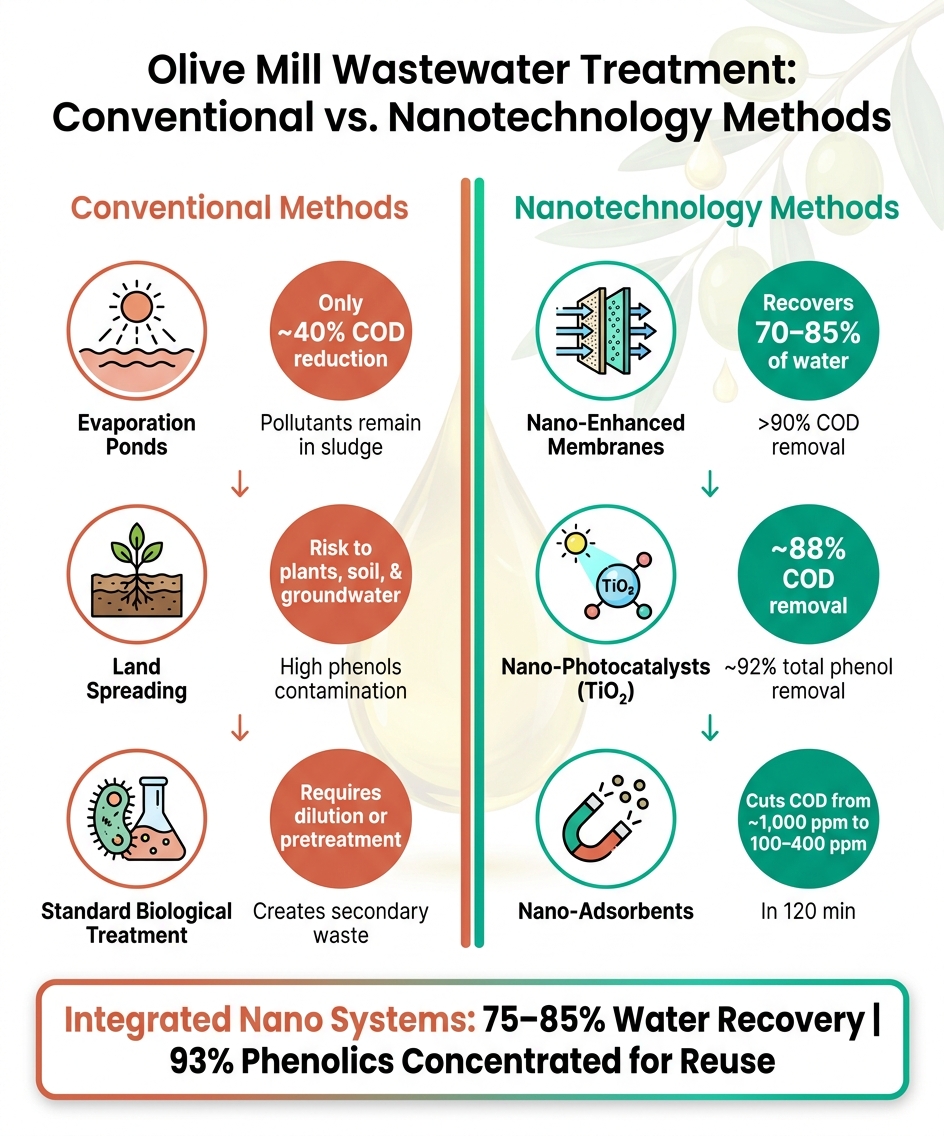
Olive Mill Wastewater Treatment Methods: Conventional vs. Nanotechnology
Many mills still rely on familiar, low-cost methods. The problem is simple: most of these methods shift pollution somewhere else instead of removing it. That’s why the push toward smaller-footprint, higher-recovery systems keeps growing.
Limits of Evaporation, Land Spreading, and Biological Treatment
Evaporation ponds are still common in many regions because they’re cheap and fairly simple to set up. The water slowly evaporates, which reduces liquid volume over time. But the pollutants stay behind. They end up more concentrated in the sludge and sediment at the bottom, and that material still has to be handled.
A case study in Sfax, Tunisia, followed five open-air ponds. After all five ponds, COD fell by only about 40% and BOD by 50%. That’s not nothing. But the effluent still held a heavy residual load, and the ponds needed a lot of land to get even that level of treatment.
Land spreading can add organic matter to soil, but high phenol levels can harm plants, increase salinity, and put groundwater at risk.
Standard systems like activated sludge, oxidation ponds, and trickling filters usually don’t work on raw OMWW unless the waste is diluted or pretreated first. Even fungus-based systems need tightly controlled operating conditions. And pretreatment has its own catch: it can remove solids, but it also creates sludge or a reject stream that still needs disposal.
What Producers Need from a Better System
The same problem shows up across all of these options: none of them recover reusable water. Most also need large land areas, create secondary waste, or only work after dilution.
For a quality-focused olive oil producer, that’s a serious operational issue. A better system has to do more than reduce pollution on paper. It needs to:
- lower COD and phenols
- reduce total waste volume
- produce water clean enough to reuse for non-product-contact jobs like cleaning or rinsing, where rules allow
- fit inside a compact footprint that works for a seasonal mill
- keep sludge output low
If a system just creates a new concentrated waste stream, it’s not solving much. It’s just kicking the can down the road. Those limits point straight to nanotechnology.
How Nanotechnology Reduces Olive Oil Wastewater
Nanotechnology cuts OMWW in three main ways: it separates water, breaks down pollutants, and cleans up the last concentrated fraction. The big win isn't only cleaner effluent. It's also less liquid to store, haul, or get rid of.
Nano-Enhanced Membranes Recover Water and Reduce Waste Streams
A membrane train usually begins with microfiltration (MF) or ultrafiltration (UF) to remove suspended solids and oil droplets. After that, it moves to nanofiltration (NF) or reverse osmosis (RO).
One integrated acid-cracking plus MF/UF/NF setup reached more than 90% COD removal and 78.3% phenolic compound removal in the NF stage alone. That's a strong cut, especially for a waste stream that's tough to treat.
Nano-enhanced NF systems can recover 70–85% of the water for reuse while pushing most pollutants into only 15–30% of the starting volume. Put plainly, you end up with less wastewater sitting around and more recovered water that can be used for jobs like equipment washing or floor cleaning. The leftover concentrate can then go to oxidation or adsorption instead of turning into a disposal headache.
Nano-Photocatalysts Break Down Tough Organic Compounds
Membranes pull water out. Photocatalysts go after what's still dissolved.
Nano-photocatalysts, including TiO₂-based composites, use light to oxidize phenolics and reduce color. In one case, graphene–TiO₂ under 300 W UV reached about 88% COD removal and 92% total phenol removal, while catalyst recovery stayed at 90–95% over multiple cycles.
The raw numbers matter, but the chemistry matters too. Photocatalysis can split stubborn organic molecules into smaller, more biodegradable fragments. That makes the treated stream easier to clean in the next step and moves it closer to reuse. In other words, downstream polishing has less heavy lifting to do.
Nano-Adsorbents Capture Pollutants Before Final Treatment
Nano-adsorbents work well as a polishing step. They pull phenols and other organics out of the liquid that remains before final discharge or reuse.
TiO₂ nanoparticles at only 1.0–2.0 g/L can cut COD from around 1,000 ppm to 100–400 ppm within 120 minutes. That's a sharp drop in a short time. Some composite sorbents, such as zeolite Y-supported TiO₂, combine adsorption with photocatalytic oxidation in a single step. That helps reduce sludge, since organics are mineralized instead of just shifted onto a solid material.
Used together, these steps create a compact treatment train that supports reuse rather than simple disposal. They can also increase water recovery and shrink the final concentrate even more.
Integrated Nano Systems and Water Reuse Options
Combined Treatment Sequences for Higher Water Recovery
When membrane, photocatalytic, and adsorption steps work together, plants can pull more water from the same stream. In practice, integrated nano systems often combine pretreatment with UF and NF/RO to cut fouling and improve water recovery.
The results can be strong. One integrated system recovered 75.3% of OMWW as treated water. Other UF/NF/RO sequences have reached about 85% water recovery and concentrated 93% of total phenolics in the NF stream.
After water quality is confirmed, that recovered water can be used onsite instead of going to waste. Recovered permeate may be used for equipment washing or non-contact cooling. If it meets state and federal reclaimed-water standards, it may also be used to irrigate olive groves or non-food crops. That said, reuse is not a free pass. It still calls for routine monitoring and has to match EPA and state reclaimed water rules.
Putting Concentrated Fractions to Better Use
The reject stream has value too. NF or RO concentrate is rich in phenolics and can retain hydroxytyrosol and tyrosol for valorization.
Data from multistage extraction shows how much can be recovered from OMWW concentrates. In one case, the process retrieved 80% of hydroxytyrosol and 61% of total phenols, while removing 88%–97% of carbohydrates and 97%–100% of proteins.
Commercial use takes more work. These fractions still need purification, and any food or supplement use in the United States must go through U.S. review. What remains after recovery does not have to be discarded outright. Residual fractions can be co-composted or sent to anaerobic digestion when site trials show the material is suitable for soil use.
What This Means for Producers and Key Takeaways
Implementation, Safety, and U.S. Compliance Considerations
Once the treatment train is set, the next step is putting it in place safely and legally.
Before you pick any nanotechnology treatment system, test the actual OMWW stream first. Measure COD, BOD, total suspended solids, pH, conductivity, phenolics, oils and grease, and flow rate. Those numbers shape the pretreatment plan and the size of the system.
Start with front-end cleanup, such as coarse screening, sedimentation, or microfiltration. OMWW carries solids, fats, and colloids that can foul membranes fast. Pulling those out early helps cut cleaning cycles and lowers replacement costs.
On the compliance side, U.S. reuse rules vary by state. Check local reclaimed water, irrigation, and discharge rules before finalizing the design. That way, material recovery and disposal are built into the system from day one instead of being treated like a last-minute fix.
Spent adsorbents and catalysts also need a clear handling plan. Treat them as controlled waste streams, and map out recovery, regeneration, disposal, and carryover testing before startup.
Conclusion: Nanotechnology Cuts Wastewater While Supporting Responsible Olive Oil Production
Nanofiltration, photocatalysis, and nano-adsorbents each address a different OMWW challenge. In practice, integrated systems usually give producers the best mix of pollutant removal and water recovery. For olive oil producers, using these methods ties directly to better resource use, stronger compliance planning, and a long-term approach to responsible production.
FAQs
How expensive is nanotechnology treatment?
The upfront cost can be steep. In many cases, it climbs into the hundreds of thousands of dollars because of advanced equipment and specialized setups.
Still, that cost can pay back over time. Producers may cut water use, spend less on waste disposal, and get more consistent product quality. Put together, those gains can make the operation less costly to run and easier to maintain over the long haul.
Can recovered water be reused on-site?
Yes. Nanofiltration can clean and recycle part of a mill’s process water on-site. It does this by removing suspended solids and oils from vegetation water and mill wash water.
The treated permeate can then be reused for non-critical jobs, such as washing olives and cleaning equipment. That means less fresh water is needed, and there’s also less wastewater left to treat.
What happens to the leftover concentrate?
The leftover concentrate from nanotechnology-based filtration is rich in useful compounds. Producers can process it further or feed it back into production to get more from the same input.
Depending on the extraction method, the remaining biomass may also go to energy recovery or be repurposed as biofertilizer, biopolymers, or compost. That helps cut waste and lower environmental impact.