

Olive Waste Valorization: Extraction Techniques
Olive waste is only waste if no one extracts from it. I’d boil this down to one simple point: the right method depends on which olive residue you start with and which compound you want to pull out.
If I were summarizing the full article in a few lines, I’d say this:
- Pomace, mill wastewater, and leaves each hold different compounds.
- Heat-heavy baseline processing still recovers residual oil, but it can waste energy and damage heat-sensitive compounds.
- Lower-heat methods like ultrasound, microwave, supercritical CO₂, pressurized liquid, and subcritical water can improve retention of polyphenols, oleuropein, tocopherols, and related extracts.
- Cleanup steps like filtration, concentration, and evaporation matter just as much as extraction.
- A 2026 Spanish plant upgrade cut thermal energy use by 50% and reduced emissions by about 440 CO2-equivalent per hour.
If you want the short answer: use mechanical and concentration steps for wet pomace, water-based or paired solvent systems for wastewater, and ultrasound or microwave routes for leaves. There isn’t one best method for every stream.
Quick comparison
| Waste stream | Main targets | Common fit |
|---|---|---|
| Olive pomace | Residual oil, antioxidants, tocopherols, mineral-rich concentrate | Mechanical recovery, evaporation, PLE, SFE |
| Olive mill wastewater | Hydroxytyrosol, oleuropein, polyphenols, organic acids | Concentration, filtration, subcritical water, water-based recovery |
| Olive leaves | Oleuropein, phenolics, flavonoids | UAE, MAE, NADES-based extraction |
So if I’m looking at olive waste extraction in plain terms, I focus on feedstock, target compound, heat level, and cleanup path first. Everything else comes after that.
Olive mill waste (OMW) management
sbb-itb-4066b8e
Conventional Extraction as the Baseline
Conventional extraction sets the upper limit that newer methods are trying to beat.
How Conventional Extraction Works
Conventional pomace processing usually begins with drying. Wet pomace goes into trommel-type driers, where high-temperature combustion gases remove moisture. After that, the dried pomace moves to solvent extraction so processors can pull out the residual oil that mechanical extraction at the mill left behind.
This setup has been around for a long time. But it comes with a clear downside: heat and vapor escape into the air instead of being reused. On top of that, solvent extraction of dried pomace is more and more seen as an old approach.
Where Conventional Methods Fall Short
The main issue is poor thermal efficiency. High-temperature drying burns through energy, vents vapor, and can damage polyphenols before they’re recovered.
That creates a much tighter recovery window. Heat-sensitive bioactives start to break down before processors can collect them, which means part of the value stays trapped in the waste stream instead of ending up in the final extract.
A 2026 retrofit at a major Spanish refinery helps show the scale of the problem. It cut thermal energy use by 50% and reduced emissions by about 440 CO2-equivalent per hour. Numbers like that help explain why lower-temperature green extraction methods are getting more attention.
Comparison Table: Conventional vs. Advanced Extraction
The gap shows up most clearly in energy use, emissions, extract quality, and what each method can recover.
| Feature | Conventional Methods | Advanced Methods |
|---|---|---|
| Energy Efficiency | Low thermal efficiency; heat and vapor are lost to the atmosphere | Up to 50% less thermal energy and 20% less electrical energy |
| Environmental Impact | High CO2 emissions and expensive gas cleaning are needed | Significant CO2 reduction, around 440 CO2-equivalent per hour |
| Extract Quality | Lower market value than mechanically extracted oil | Better bioactive retention |
| Resource Recovery | Focuses mainly on residual oil | Recovers antioxidants, potassium salts, and distilled water |
| Operational Continuity | Higher risk of fouling in traditional heat systems | Low fouling and less downtime for cleaning |
Green Extraction Techniques for Olive Waste
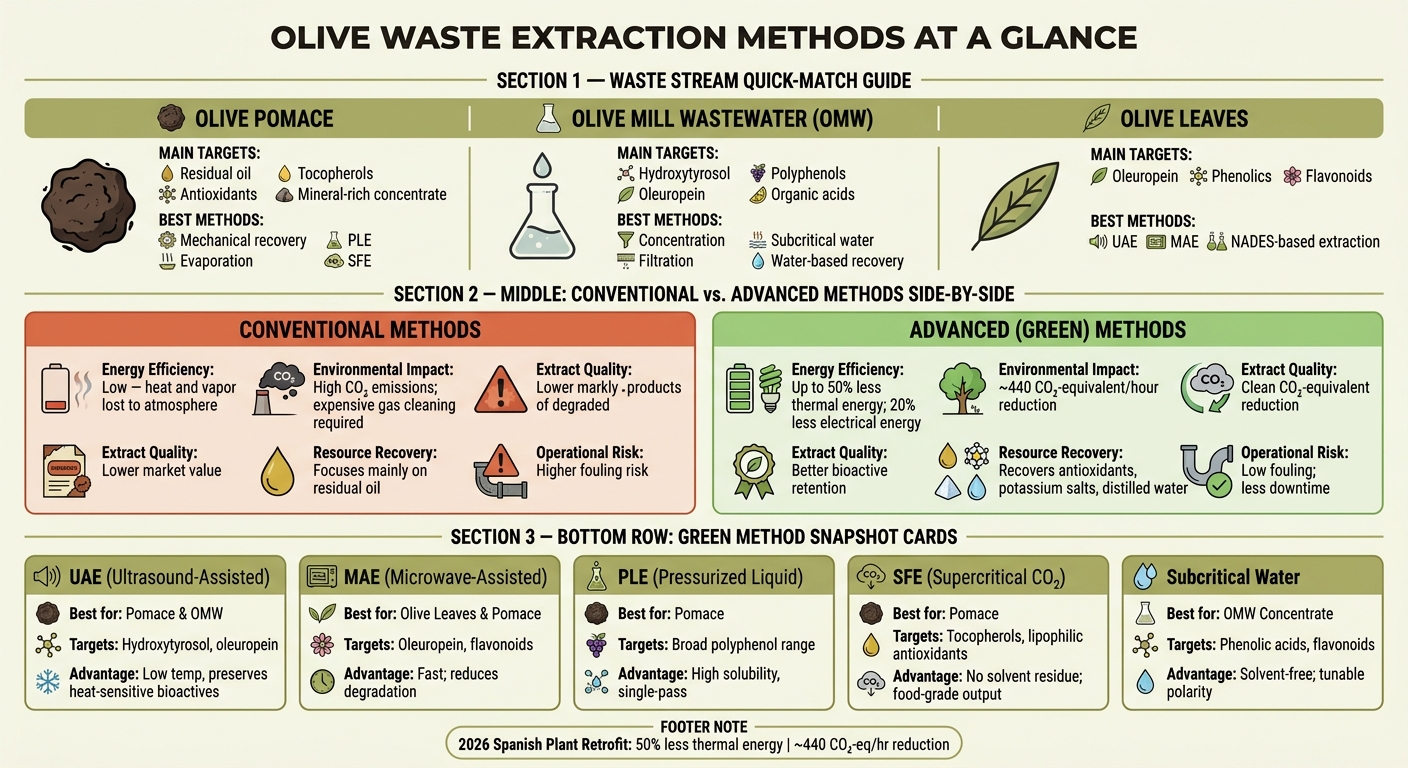
Olive Waste Extraction Methods: Green vs. Conventional Comparison
Compared with the old baseline, green extraction pulls compounds straight from wet olive residues with less heat and less solvent. That matters because these byproducts don’t all behave the same way. Olive mill wastewater (OMW) is a liquid stream rich in water-soluble bioactives, while olive pomace is a wet solid that still holds compounds worth recovering. So the main decision is simple: match the extraction method to the waste stream and the compound you want.
Ultrasound-Assisted and Microwave-Assisted Extraction
Ultrasound-assisted extraction (UAE) uses high-frequency sound waves to break down cell walls and release intracellular compounds into the solvent. That physical action boosts mass transfer without depending on high heat. As a result, UAE works well for heat-sensitive polyphenols such as hydroxytyrosol and oleuropein from both OMW and pomace.
Microwave-assisted extraction (MAE) takes a different route. It heats the solvent and the sample at the same time through microwave energy, which speeds up compound release in far less time than standard heating. MAE works especially well for olive leaves, where oleuropein levels are high and shorter extraction time helps cut degradation risk.
Both methods use less solvent and less processing time than conventional options. They also protect bioactives better than high-temperature drying.
Pressurized, Supercritical, and Subcritical Methods
Pressurized liquid extraction (PLE) pushes solvent through the sample at higher temperature and pressure, while keeping that solvent in liquid form above its normal boiling point. This boosts solubility and speeds diffusion, which helps recover a broader mix of compounds from pomace in a single pass.
Supercritical fluid extraction (SFE) uses CO₂ above its critical point as a tunable, non-toxic solvent. By changing pressure and temperature, operators can go after specific compound groups, such as lipophilic antioxidants and tocopherols from pomace, without leaving solvent residue behind. That makes SFE a lower-impact option than solvent-based recovery, and it can produce food- and supplement-grade extracts directly.
Subcritical water extraction uses water at temperatures between 212°F and 662°F (100°C and 350°C) under pressure. Under those conditions, water’s polarity shifts, so it can match a broader set of target compounds. In practice, that makes it useful for recovering phenolic acids and flavonoids from OMW concentrate without organic solvents.
Comparison Table: Green Extraction Methods Side by Side
The methods below vary in selectivity, energy use, and fit for wet or semi-solid material.
| Method | Best-fit feedstock | Target compounds | Key advantage |
|---|---|---|---|
| Ultrasound-Assisted (UAE) | Pomace, OMW | Hydroxytyrosol, oleuropein, polyphenols | Low temperature; preserves heat-sensitive bioactives |
| Microwave-Assisted (MAE) | Olive leaves, pomace | Oleuropein, flavonoids | Fast extraction; reduces degradation risk |
| Pressurized Liquid (PLE) | Pomace | Broad polyphenol range | High solubility; single-pass recovery |
| Supercritical CO₂ (SFE) | Pomace | Tocopherols, lipophilic antioxidants | No solvent residue; food-grade output |
| Subcritical Water | OMW concentrate | Phenolic acids, flavonoids | Solvent-free; tunable polarity |
Solvents, Purification, and Process Selection
Solvent choice and purification shape whether an extract ends up pure, stable, and ready for sale. After you pick the extraction method, the next big step is cleanup. That step has a huge effect on final extract quality. The best path changes based on the feedstock, whether you're working with aqueous wastewater, wet pomace, or leaf biomass.
Green Solvents and Compound Matching
For olive mill wastewater (OMW), water-based recovery is usually the best fit for hydroxytyrosol, oleuropein, and other polyphenols. It lines up well with the composition of the stream and keeps the process simple.
NADES are also a good match for olive leaves, especially when used with ultrasound or microwave extraction for phenolic compounds such as oleuropein. For wet olive pomace, the first move is different: recover pomace oil mechanically before concentration or purification.
Membrane Filtration and Purification Steps
Even when extraction works well, the output is still a mixed stream. That means it needs to be concentrated and cleaned before it can be used. Membrane filtration and evaporation are common ways to concentrate olive waste streams.
In wet olive pomace processing, forced recirculation evaporators can concentrate the liquid fraction into extracts rich in antioxidants, potassium salts, and fulvic acids. They also use 50% less thermal energy than traditional trommel driers. That concentrate can then be used in food, nutraceutical, or cosmetic products.
Decision Table: Matching Waste Stream to Technique
The table below pairs each waste stream with the most practical recovery route.
| Waste Stream | Target Bioactives | Suitable Extraction/Purification Route | Primary Application |
|---|---|---|---|
| Olive Pomace (Wet Husk) | Antioxidants, fulvic acids, potassium salts | Three-phase decanters (mechanical), forced recirculation evaporation | Cosmetics, pharmaceuticals, liquid fertilizers |
| Olive Leaves | Phenolic compounds, oleuropein | NADES, ultrasound-assisted extraction, microwave-assisted extraction | Nutraceuticals, functional ingredients |
| Olive Mill Wastewater (OMW) | Hydroxytyrosol, oleuropein, polyphenols, organic acids | Concentration, filtration, stabilization; NADES | Functional beverages, nutraceuticals |
Conclusion: Choosing the Right Extraction Strategy
The best method depends on the waste stream and the compound you want to recover. Wet pomace works best with three-phase decanters for dewatering and residual oil recovery. The liquid fraction, on the other hand, can be concentrated with forced recirculation evaporators to recover antioxidants, potassium salts, and fulvic acids. So the final call comes down to the same three variables used across this guide: waste stream, compound class, and extraction intensity.
A recent industrial deployment shows how this plays out at scale. In a 2026 Spanish installation processing wet husk at scale, operators cut thermal energy use by 50%, reduced emissions, and recovered distilled water for reuse. That’s the point where lower energy demand and higher recovery start to line up in a practical way.
In practice, the best strategy is the one that matches the feedstock, the target compound, and the cleanup step.
Key Takeaways
Olive waste valorization is a trade-off between yield, purity, energy, cost, and scale.
- Conventional extraction sets the baseline, but it falls behind advanced methods on energy use and selectivity.
- Green extraction techniques - UAE, MAE, SFE, and subcritical water - can improve bioactive retention when the method matches the waste stream and target compound.
- Purification steps such as membrane filtration and evaporation shape final extract quality and downstream use.
- No single technique fits every stream; the right choice depends on the residue, the compound, and the intended downstream use.
FAQs
Which extraction method is best for each olive waste stream?
The best method depends on the olive waste stream and your goals for efficiency, resource recovery, and environmental impact.
- Solid waste (pomace): Two-phase decanters are often the top choice. Multi-phase decanters can refine the solids even more, and anaerobic digestion is a good fit when the goal is energy recovery.
- Wastewater: Nanofiltration and reverse osmosis are the best options for water reuse and polyphenol concentration. Advanced oxidation is useful for heavily contaminated liquid waste.
Why are lower-heat extraction methods better for bioactives?
Lower-heat extraction methods help preserve bioactives because compounds like polyphenols and secoiridoids are very sensitive to heat. When processing temperatures climb, those compounds can start to break down. The result? You may end up with less of what makes the oil special, plus a weaker fresh flavor.
Research points in the same direction: longer malaxation times or higher temperatures can cut polyphenol levels by up to 70%. That’s a big drop. Using lower-heat, mechanical cold-press conditions helps keep more of these antioxidants and aromatic compounds in the oil.
What cleanup steps are needed after extraction?
Cleanup after olive oil extraction centers on two things: detoxification and resource recovery. The goal is simple - cut the impact on soil and water while getting more use out of what would otherwise become waste.
A big part of that work is removing harmful phenolic compounds. If left untreated, these compounds can end up in wastewater or solid waste streams and contribute to soil and water contamination.
Facilities also rely on Clean-in-Place systems to reduce water and detergent use during equipment cleaning. For wastewater, membrane filtration helps remove solids and recover water, which can then be reused for irrigation. Pomace, meanwhile, can be dried or sent through anaerobic digestion to produce biogas and fertilizer.