

Olive Mill Waste: Turning Byproducts into Bioactive Compounds
Olive mill waste is expensive to discard, but it still holds most of the olive’s phenolics. I’d sum it up like this: mills generate huge volumes of liquid and solid waste, standard disposal options waste usable compounds, and recovery methods like membranes, hydroalcoholic extraction, ultrasound, and adsorption can turn that waste into ingredients for food, cosmetics, nutraceuticals, farming inputs, and carbon materials.
Here’s the short version:
- For every 1 metric ton of olive oil from a three-phase system, mills can produce about 1.5 m³ of wastewater and 0.6 tons of solid residue.
- Olive mill waste adds up to more than 40 million tons per year worldwide.
- Only about 2% of olive fruit phenolics end up in the oil. The other 98% stay in the byproducts.
- OMWW can contain phenolics up to 10,000 mg/L and COD of 50 to 180 g/L, which helps explain why disposal is hard and costly.
- Disposal can cost about $8.70 to $10.90 per m³ when converted from €8 to €10 per m³ using a rough current exchange range.
- The main waste streams are OMWW, pomace, and stones/pits.
- The main compounds recovered include hydroxytyrosol, tyrosol, oleuropein, oleacein, caffeic acid, ferulic acid, luteolin, and apigenin.
- Batch quality can shift a lot based on cultivar, harvest date, and milling system.
- Wet streams usually fit membrane filtration best, while pomace often fits hydroalcoholic extraction, ultrasound-assisted extraction, or supercritical CO2 routes.
- After extraction, these compounds can be used in products like oxidation-control food ingredients, skin-care actives, biostimulants, and activated carbon.
If you’re looking at olive oil byproducts from a quality and cost point of view, the big idea is simple: waste is not just waste. It is also a raw material stream that can be sorted, processed, and sold instead of only stored, spread, burned, or dumped.
Olive mill waste (OMW) management
sbb-itb-4066b8e
The Compounds Worth Recovering from OMWW, Pomace, and Stones
The next step is figuring out what these byproduct streams actually contain. In practice, wastewater, pomace, and stones act like concentrated reservoirs of compounds that food scientists, cosmetic formulators, and agricultural researchers want to recover and use.
Key Molecules Found in Olive Mill Byproducts
Most of the attention goes to a few main groups of molecules: phenolic alcohols such as hydroxytyrosol and tyrosol, secoiridoids such as oleuropein and oleacein, phenolic acids such as caffeic and ferulic acid, and flavonoids such as luteolin and apigenin. But these compounds do not show up evenly across all streams. Each stream has its own profile, which matters a lot when you choose an extraction method.
OMWW stands out for its high levels of hydroxytyrosol, tyrosol, and oleacein, especially when it comes from early-harvest fruit. In OMWW from the Leccino cultivar, oleacein has been measured at up to 314.628 µg/mg in October, then fell to only 5.896 µg/mg by November. That's a 100-fold drop in one month.
Olive pomace also contains a strong share of hydroxytyrosol. In fact, hydroxytyrosol and comselogoside together make up about 80% of total pomace phenolics. Stone kernels are the most phenolic-dense solid byproduct. The Cobrançosa variety has reached total phenolic content of 86.116 mg GA/g DW. The hard olive stone or endocarp is a different story. It is made up mostly of cellulose, hemicellulose, and lignin, and its phenolic content is much lower, ranging from 6.5 to 9.3 mg GA/g DW.
Because polarity and concentration shift from one stream to another, extraction has to fit the material. A method that works well for OMWW may fall flat on pomace or stones.
Documented Bioactive Properties
These compounds are not just chemically interesting. They also show clear bioactive effects.
Hydroxytyrosol is a strong radical scavenger due to its catechol structure. Oleuropein and oleacein have shown anti-inflammatory activity, including inhibition of the COX-1 and COX-2 enzymes. In lab tests, OMWW extracts inhibited COX-2 by more than 80% at a concentration of 1 mg/mL.
Phenolic acids such as caffeic and ferulic acid have shown plant-growth effects, which makes them useful for agricultural uses. Flavonoids like luteolin and apigenin have also shown antimicrobial and anti-proliferative activity. That helps explain why nutraceutical and cosmetic formulators are among the main downstream buyers of these recovered compounds.
Why Composition Changes from One Batch to Another
Here’s where things get tricky. The chemistry can shift a lot from one batch to the next, and that makes recovery harder than it may seem on paper.
Cultivar sets the starting point. Frantoio olives can contain up to 10 times more oleuropein than Leccino. Harvest timing matters too. Phenolic levels peak in early-harvest fruit and then fall as the olives ripen.
The milling method changes where those compounds end up. Three-phase systems send more soluble phenols into the liquid OMWW stream. Two-phase systems keep more of those bioactives in the semi-solid wet pomace, often called alperujo. So even when the same fruit goes in, the byproduct profile can look very different coming out.
That kind of variation can be huge. In some cases, a single compound can swing by as much as 100-fold. For anyone trying to build a steady industrial recovery process, that inconsistency is one of the biggest headaches.
Why Standard Disposal Methods Fall Short
Even when the chemistry shifts by cultivar, harvest timing, and milling method, standard disposal still treats olive mill waste like a problem to get rid of, not a source of usable material. And that’s the core issue. Disposal doesn’t just cost money; it also throws away compounds that could be recovered. The same chemistry that makes waste hard to handle is also what makes recovery the smarter route.
Environmental Risks of Untreated Waste Streams
Untreated OMWW is hard to manage because it has a high organic load and a high phenolic content. It’s mostly water, but what’s left in that water can do a lot of damage. At these concentrations, phenols can harm plants and the soil microbes that help keep land productive.
If OMWW enters rivers, lakes, or other water bodies, its high organic load can strip out oxygen fast and damage aquatic ecosystems. Land spreading without careful control can acidify soil, build up salts, and contaminate groundwater as pollutants leach downward. Open evaporation ponds bring another set of problems, including foul odors and methane emissions.
That helps explain why many mills focus on cutting waste volume instead of trying to recover what’s inside it.
Low-Value Uses and Their Limits
Common disposal routes like land spreading, evaporation ponds, and direct combustion of pomace can shrink waste volume, but there’s a catch: they also destroy heat-sensitive compounds that may be worth recovering.
Pomace can be burned for energy, but moisture levels above 70% reduce efficiency and increase transport costs. On top of that, alkali metals such as potassium and sodium can lead to fouling and corrosion in boilers.
Land spreading has limits too. Applying 80 m³ of OMWW per hectare can add 3,000 to 6,000 kg of dry organic matter, which sounds useful at first glance. But its high acidity and phenolic load can still damage soil health if it is not handled with care. In plain terms, these routes manage the waste, but they don’t turn it into something worth more.
Even then, waste-to-value systems still have to make sense on cost, logistics, and scale.
Barriers to Recovery at Industrial Scale
Shifting from basic disposal to bioactive recovery is not easy, and the economics are a big part of the reason. Most small mills can’t cover the capital costs needed to build and run recovery systems on their own. That’s a major hurdle, especially since purified bioactive compounds such as hydroxytyrosol and squalene recovered from phenolic-rich waste streams can sell for €500 to €2,000 per kilogram.
The logistics are tough too. Olive mills are often small, seasonal, and spread across many locations, which means waste shows up in many places at the same time during harvest. Centralizing collection and processing adds transport and handling costs. And there’s no one-size-fits-all recovery system, because composition changes with cultivar, ripeness, and extraction method .
How Bioactives Are Extracted and Where They Are Used
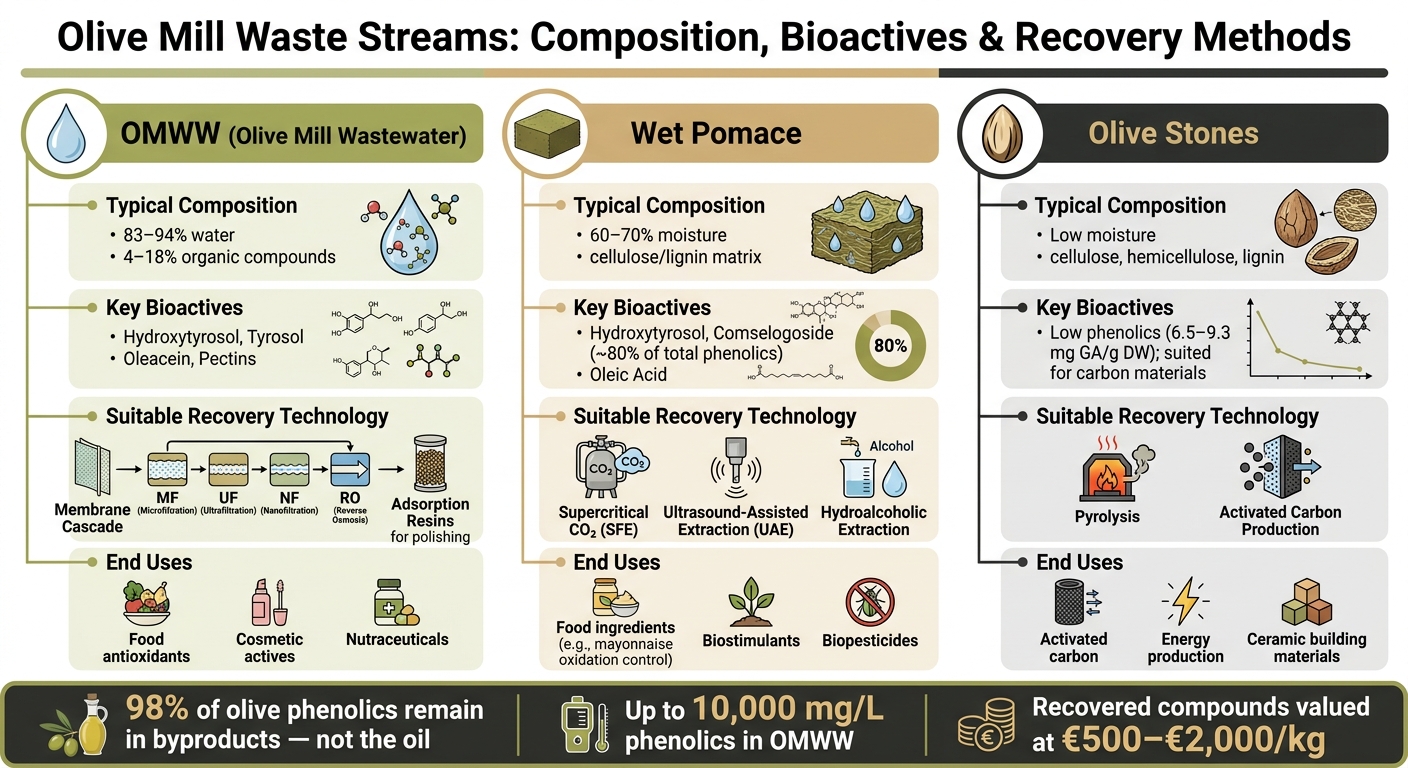
Olive Mill Waste Streams: Composition, Bioactives & Recovery Methods
With disposal limits already set, the next move is simple: get useful compounds back out of each waste stream. But there isn't one go-to method for everything. A watery stream like OMWW behaves very differently from wet pomace or olive stones, so the process has to match the material and the compound you want to pull out. Research and plant-scale work point to a few methods that already work at pilot or industrial scale, each handling a different piece of the job.
Membrane, Hydroalcoholic, Ultrasound, and Adsorption Methods
For liquid waste like OMWW, membrane systems are the most established industrial option. They scale well and do a good job separating phenols.
A common setup uses a step-by-step membrane cascade:
- Microfiltration (MF) removes suspended solids
- Ultrafiltration (UF) separates phenolic fractions and cuts COD
- Nanofiltration (NF) separates phenols from cations
- Reverse osmosis (RO) retains the remaining organic fraction and produces water that can be reused
Using MF together with membrane distillation, hydroxytyrosol in OMWW can be concentrated up to 8.16 g/L.
For solid streams like pomace, the playbook changes. Supercritical fluid extraction, or SFE, uses CO2 and sometimes adds water or ethanol to recover compounds such as hydroxytyrosol and oleuropein. This is a low-solvent route, which makes it appealing when solvent handling is a headache. Water can outperform ethanol as a co-solvent for oleuropein recovery because it swells the plant matrix and helps reach the target compounds more easily.
Two other methods show up often with pomace. Ultrasound-assisted extraction (UAE) helps break cell walls and release phenolics trapped inside the material. And hydroalcoholic extraction remains a practical and cost-friendly route for solid pomace at industrial scale.
Adsorption resins can also be added after membrane steps. That extra polishing step helps purify hydroxytyrosol-rich streams, improve purity, and push COD down even more.
| Method | Target Compounds | Solvent Use | Energy Demand | Scalability |
|---|---|---|---|---|
| Microfiltration (MF) | Suspended solids, large organics | None | Low | High |
| Ultrafiltration (UF) | Pectins, proteins, COD reduction | None | Medium | High |
| Nanofiltration (NF) | Small phenols, sugars | None | Medium–High | High |
| Supercritical CO2 (SFE) | Hydroxytyrosol, oleuropein | CO2 (recyclable) | High | Medium |
| Hydroalcoholic | Total phenols, flavonoids | Ethanol/Water | Medium | High |
| Ultrasound (UAE) | Intracellular phenolics | Low | Medium | Medium |
Matching Each Waste Stream to the Right Recovery Approach
The best setup comes down to three things: moisture, structure, and the compound you're after.
OMWW is mostly water, around 83% to 94%, and it carries 4% to 18% organic compounds. That makes membrane filtration a natural choice, especially for water-soluble phenols. Wet pomace from two-phase systems is a different beast. It can hold about 60% to 70% moisture, so it often needs drying or hydrothermal pretreatment before SFE or UAE works well. Olive stones, on the other hand, don't offer much for bioactive recovery. They're usually sent toward energy production or carbon-based uses instead.
| Waste Stream | Typical Composition | Main Bioactives | Preprocessing Needs | Suitable Technology |
|---|---|---|---|---|
| OMWW | 83–94% water, 4–18% organic compounds | Hydroxytyrosol, tyrosol, pectins | Clarification via MF | Membrane cascade (UF/NF/RO) |
| Pomace (wet) | 60–70% moisture | Hydroxytyrosol, comselogoside, oleic acid | Drying or hydrothermal | SFE, UAE, hydroalcoholic |
| Stones | Low moisture, cellulose/lignin | Low phenolics, carbon | Crushing, carbonization | Pyrolysis, activated carbon |
Even then, plants can't just assume every batch will behave the same way. Composition shifts with cultivar, ripeness, and milling method, so processors use rapid HPLC or MS checks to confirm extract consistency before running full processing steps.
End Uses in Food, Cosmetics, Agriculture, and Materials
Once these extracts are isolated, they don't just sit on a shelf. They move into food, personal care, agriculture, and material products.
In food, one 2021 Foods study found that adding 65–195 μg of hydroxytyrosol to 100 g of fresh mayonnaise improved hydrolytic stability and reduced oxidation by-products during four weeks of storage. That's a good example of how a waste-derived compound can end up doing a very practical job in a familiar product.
In cosmetics, phenolic extracts are used for anti-aging and antimicrobial effects. In agriculture, OMWW and pomace residues are turned into biostimulants and biopesticides. But there is a catch: lower-concentration application is the practical standard, because high phenolic levels can inhibit soil microbiome activity.
For materials, olive pomace has been mixed into ceramic brick paste to reduce density and thermal conductivity. Olive stones can also be converted into activated carbon, which gives a low-phenolic byproduct a much more useful second life.
Conclusion: From Waste Management Cost to Circular Economy Value
Taken together, the recovery methods above make one thing clear: olive mill waste is feedstock, not just a disposal problem. It still carries cost and handling burdens, sure. But it also holds material that can be put to work.
The bigger missed chance is the bioactives left behind. Most olive phenolics stay in the byproducts, not the oil. When producers recover them, they turn a disposal burden into economic value. In plain terms, the shift is from disposal to recovery.
Key Points to Take Away
These waste streams fit a circular model. Recover phenolics where possible, send the remaining material into energy or other material uses, and cut disposal impact along the way.
Methods like membrane filtration, hydroalcoholic extraction, ultrasound, and adsorption can recover compounds with use across:
- food
- cosmetics
- nutraceuticals
- agriculture
That same approach makes sense for producers who care about quality and want to get full use from the olive.
For Big Horn Olive Oil, responsible byproduct use fits a quality-first approach.
FAQs
Why do most olive phenolics remain in the waste instead of the oil?
Most olive phenolics don’t end up in the oil. During production, only about 2% transfers into the final product, while roughly 98% stays behind in mill by-products like olive pomace and wastewater.
That leaves these by-products as a major, and often underused, source of natural antioxidants.
Which olive mill waste stream is best for bioactive recovery?
There’s no one olive mill waste stream that wins every time for bioactive recovery. Both olive pomace and olive mill wastewater matter.
Olive pomace contains compounds such as hydroxytyrosol, tyrosol, oleuropein, and verbascoside. Olive mill wastewater is also a rich source of polyphenols with antioxidant and anti-inflammatory properties.
So which one is better? It depends on the extraction technology, the olive cultivar, and the intended end use.
What makes olive waste recovery hard to scale?
Scaling recovery is hard for a few plain reasons.
Olive mill waste is seasonal, mills are often scattered across different areas, and the waste itself is tough to handle. It’s complex, non-biodegradable, phytotoxic, and antimicrobial.
The makeup of this waste also shifts depending on the olive cultivar and the extraction system used. That means there isn’t one method that works across the board. Add in the high cost of current management, and it becomes clear why large-scale adoption still depends on more policy support and investment.