

NAOOA Seal Program: What You Need to Know
The short answer: if I see the NAOOA Certified seal, I can treat it as a basic check that the olive oil matched its labeled grade when tested from U.S. store shelves.
Here’s what matters most to me:
- The seal is tied to chemical and sensory testing
- Samples are bought from retail shelves, not just sent in by brands
- It covers whether the oil matches the stated grade, but not whether it is organic, single-estate, or recently harvested
- NAOOA says the seal appears on about 49% of branded olive oil sold in the U.S.
- NAOOA also says fewer than 1% of sampled U.S. retail oils showed signs of mixing with other oils
So when I shop, I use the seal as a starting point, not the whole answer. I still check the harvest date, origin, and storage details on the bottle.
If I want the simplest takeaway, it’s this: the seal can help narrow my choice, but it does not replace reading the label.
Standards Behind the NAOOA Seal
Quality and Authenticity Requirements
The NAOOA Seal relies on IOC-based chemical and purity standards to check what shoppers are buying. In some areas, NAOOA goes a step further. For example, it sets a 0.5% maximum free acidity limit for extra virgin olive oil.
These checks fall into two buckets. Quality markers show how well the olives were handled and processed. Authenticity markers look for mixing with refined olive oil or seed oils. An oil has to pass both to carry the seal.
Chemical and Sensory Testing
Lab work covers the chemical side, but taste and smell still count. Under IOC-based standards, an oil can pass every lab test and still fail if a trained sensory panel finds defects like rancidity or off flavors. If that happens, the oil cannot legally be labeled extra virgin.
The table below shows the main tests and what they mean when you're standing in the aisle:
| Test Parameter | What It Measures | What It Means for You |
|---|---|---|
| Free Fatty Acidity (FFA) | Fruit condition and handling quality | Lower values point to fresher, better-handled olives |
| Peroxide Value | Early-stage oxidation | Low numbers suggest the oil hasn't started turning rancid |
| UV Absorbance (K232, K270) | Advanced oxidation and possible refined oil mixing | Normal values suggest limited oxidation or refining |
| Authenticity Markers (sterols, waxes) | Presence of seed oils or refined olive oil | Confirms the oil is olive-based and not adulterated |
| Sensory Panel Result | Flavor, aroma, and absence of defects | Confirms the sensory profile of extra virgin olive oil |
NAOOA does not rely on hand-picked samples from brands. Samples are taken straight from retail shelves and tested at least twice a year in independent, IOC-recognized laboratories. So the bottle being checked is the same kind of bottle a shopper would buy. That's a big deal, because the seal depends on both lab results and what shows up in stores.
Organic Claims and Labeling Documentation
Organic claims are a separate issue. They require USDA-accredited certification, and the NAOOA Seal does not certify organic status.
NAOOA also reviews labels before approval. That review checks a few key things:
- Whether grade names like extra virgin are used the right way
- Whether origin claims are backed by traceability records
- Whether any organic terms have proper certification
If a label doesn't pass that review, it doesn't get the seal. And if the packaging changes, it will usually need another review. Even after approval, labels can still be tied to shelf testing.
sbb-itb-4066b8e
NAOOA Webinar
How the NAOOA Seal Program Works
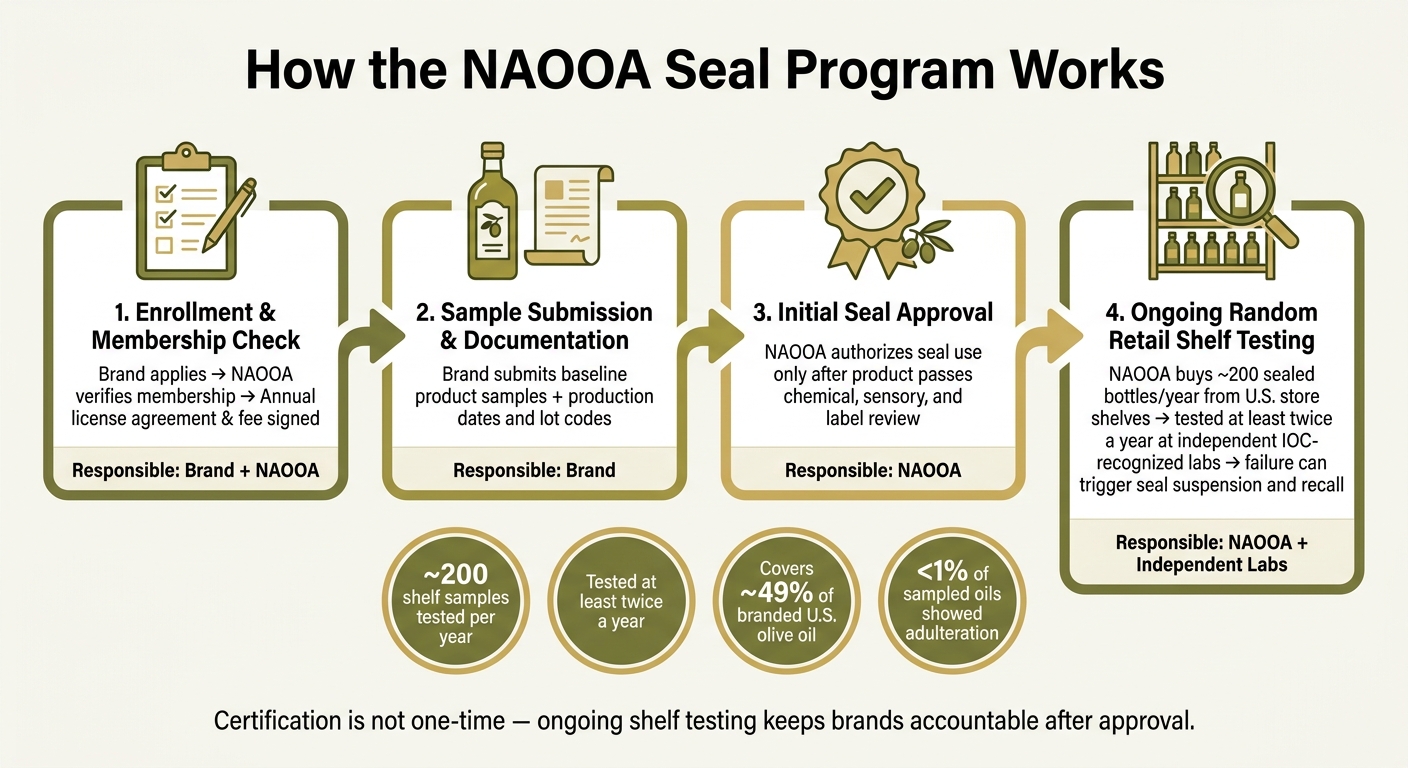
How the NAOOA Seal Program Works: From Enrollment to Shelf
Once a product meets NAOOA standards, the work doesn't stop there. The seal program keeps checking products through enrollment, label review, and shelf testing. So getting the NAOOA Seal isn't a one-time application. It begins with enrollment and keeps going with shelf testing after approval.
Eligibility, Enrollment, and Label Review
Only NAOOA member companies in good standing can apply. Before approval, a company signs an annual license agreement and pays an annual participation fee. After that, the brand submits initial product samples and supporting documentation, such as production dates and lot codes. NAOOA approves seal use only after the product passes testing.
| Step | What Happens | Who Is Responsible |
|---|---|---|
| Enrollment & Membership Check | Company applies; NAOOA verifies membership and eligibility and issues licensing terms | Brand + NAOOA |
| Sample Submission & Documentation | Brand submits baseline samples and required documents | Brand |
| Initial Seal Approval | NAOOA authorizes seal use for labels that pass review | NAOOA |
| Ongoing Random Retail Sampling | NAOOA or third parties buy sealed bottles off U.S. store shelves and retest | NAOOA + Independent labs |
Random Retail Shelf Testing
NAOOA buys sealed bottles straight from retail shelves, which means it tests what shoppers in the U.S. actually buy, not just samples sent in by producers. Brands agree ahead of time to this unannounced, repeat sampling as part of the seal program. NAOOA tests about 200 shelf-bought samples each year.
If a product fails, NAOOA can suspend seal rights and require a recall. That puts real pressure on brands to keep quality steady over time. It's the part of the program that gives the seal weight once the bottle is on the shelf.
What the NAOOA Seal Means When You Shop
For shoppers, the seal turns technical testing into a quick check at the shelf. The NAOOA Certified seal gives you a fast signal that the bottle has gone through third-party review.
How to Read the Seal on a Bottle
Look for the seal on the front label or around the neck of the bottle. It usually shows up as a circular or badge-style emblem that says "NAOOA Certified" or "NAOOA Certified Quality," often with an olive branch graphic.
What matters here is simple: this is a certification mark, not just a marketing line. The seal means the oil passed third-party chemical and sensory testing under IOC standards, and it can still be pulled for random retail shelf testing later.
At the same time, the seal doesn't tell you everything. It does not confirm that the oil is organic, single-estate, or tied to one harvest. If those claims appear on the bottle, you still need to check them on their own.
A seal confirms certification, but it doesn't replace the rest of the label. You should still look at origin, harvest date, and any organic certification.
Use the seal as your starting point, then read the rest of the bottle for the details that matter to you.
Other Label Details Worth Checking
The seal is a good first filter, but a few other label details deserve a close look:
- Harvest date: This matters most. Aim for oil harvested within the last 12–18 months. Treat the best-by date as a backup, not your first guide.
- Origin: Clear country, region, or estate labeling helps link flavor to place and shows traceability.
- Storage: Check whether the label mentions protection from light and heat.
When the Seal Is Most Useful
The seal helps most when the bottle's price or purpose makes the choice feel a little bigger. If you're paying more, it's a useful way to check whether that higher price has some backing. And if you're buying a finishing oil for salads, bread dipping, or other dishes where flavor is front and center, the sensory testing part matters. It means the oil has been checked for defects like rancidity or mustiness.
It's also handy when you're giving olive oil as a gift. A visible certification mark gives the bottle a clear quality signal without making the recipient do detective work in the aisle.
This seal also becomes more useful when you're trying a brand for the first time. If you don't already know the producer, the NAOOA Certified mark works like a shortcut. It tells you the oil has been checked against international standards and is still monitored over time. For a premium bottle, that gives you a firmer reason to choose one over another.
Key Takeaways on the NAOOA Seal Program
The NAOOA Certified Seal is an ongoing third-party verification program based on retail shelf samples.
Treat the seal as a basic trust signal, not a full quality profile. It does not confirm organic status, single origin, or freshness at the time you buy the bottle or open it.
No seal does not mean low quality. It only means the bottle is not NAOOA-certified.
Market testing backs up that limited role. Recent NAOOA testing suggests the market is mostly authentic, with fewer than 1% of sampled U.S. retail olive oils showing evidence of adulteration.
For a quick last check, look at the seal alongside the harvest date and origin.
FAQs
Does the seal guarantee freshness?
Not completely.
The NAOOA seal helps verify freshness through chemical testing, including peroxide values and free fatty acids. Those checks can show oxidation and give you a sense of storage quality.
So yes, the seal gives shoppers more confidence that the oil meets strict quality and purity standards. But it works best alongside one more check: look for a clear harvest date on the bottle.
Why might a good olive oil not have the seal?
A high-quality olive oil may not have a certification seal because the process is voluntary.
Some producers skip it because testing takes time and costs money. Others trust their own quality checks and the reputation they’ve built with buyers over the years.
There’s also a timing issue. Certification can slow down a product launch, so some producers pass on it to get fresh oil to market sooner.
What happens if a certified oil fails testing later?
If an olive oil with the NAOOA Quality Seal is later found to be inauthentic during routine off-the-shelf testing, it faces a mandatory recall from North American retailers.
To back up the seal, the NAOOA runs unannounced, random testing throughout the year. The goal is simple: make sure products on store shelves still meet purity and quality standards.