

How Neighborhoods Manage Olive Oil Waste
Each year, olive oil production generates 40 million tons of waste, which, if mismanaged, can pollute water, clog sewers, and harm ecosystems. However, communities are turning this waste into resources like compost, biodiesel, and renewable energy.
Key points:
- Household waste: Used cooking oil clogs pipes and pollutes water. Collect it in containers for recycling.
- Production waste: Olive mills produce wastewater and pomace. These can be treated for irrigation, composted, or converted into energy.
- Unharvested olives: Fallen olives harm soil and attract pests but can be repurposed into bioenergy or compost.
Solutions:
- Set up oil collection systems (drop-off or curbside).
- Create bottle refill stations to reuse containers.
- Organize olive harvesting programs for public or neglected trees.
- Use composting and anaerobic digestion to recycle byproducts.
- Partner with farms, nonprofits, and local governments to enhance efforts.
These steps improve waste management while reducing pollution and creating valuable resources for communities.
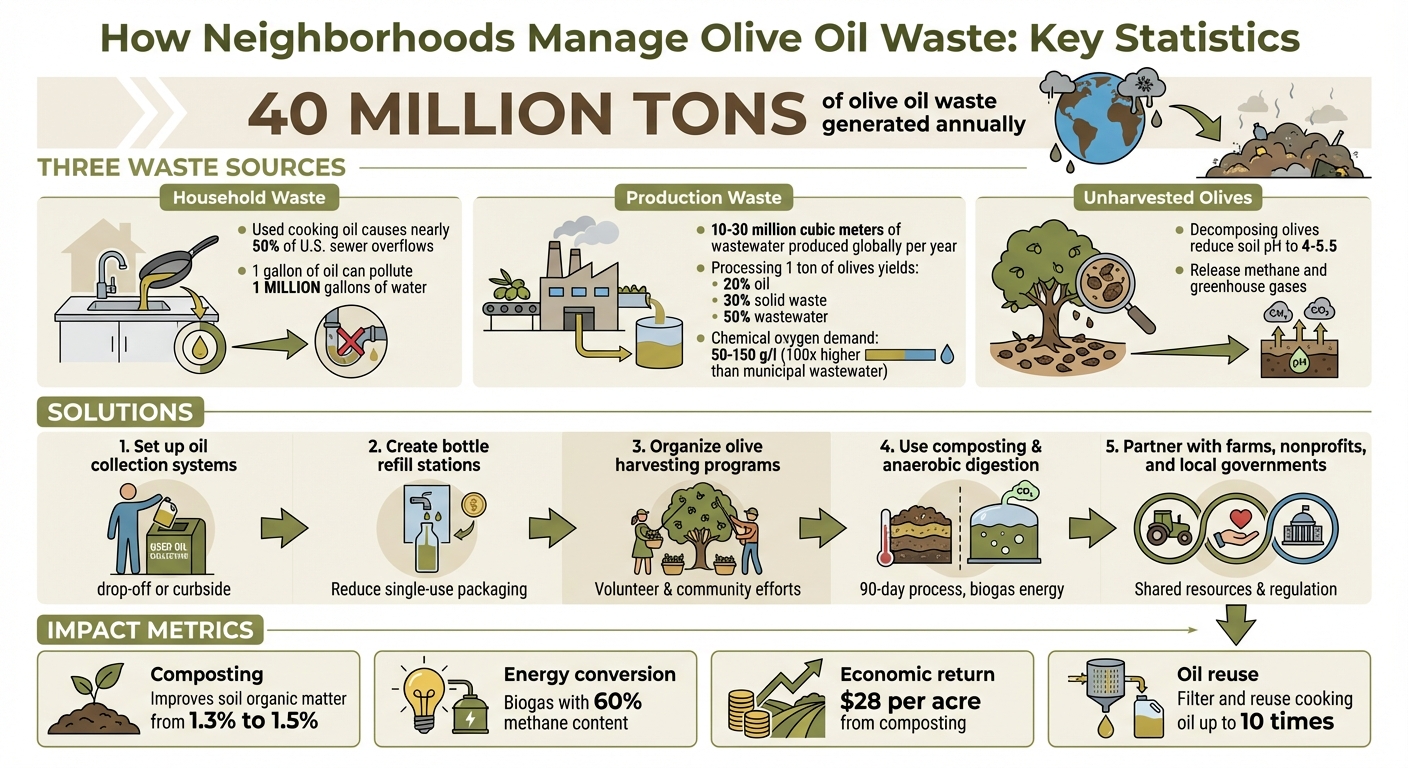
Olive Oil Waste Sources and Management Solutions by the Numbers
Engineer recycles olive pomace into fuel pellets
Where Olive Oil Waste Comes From
Understanding the origins of olive oil waste is key to developing effective ways to manage it. The waste comes from three main sources: household kitchens, production facilities, and local olive trees. Each source presents unique challenges and requires specific strategies for recycling or repurposing.
Used Cooking Oil from Homes
When households pour used cooking oil down the drain, it can solidify into fats, oils, and grease (FOG), leading to clogged pipes, damaged pumps, and even sewer overflows. The U.S. Environmental Protection Agency (EPA) emphasizes:
Fats, oils, and grease (sometimes referred to as 'FOG') can clog pipes and pumps both in the public sewer lines and in wastewater treatment and water resource recovery facilities.
The impact extends beyond plumbing. If oil waste reaches rivers or lakes, it can fuel microbial growth that depletes oxygen levels in the water. Combined with excess phosphorus, this can lead to eutrophication, a process that harms aquatic ecosystems. Instead of dumping oil down the sink, households should collect it in sturdy containers and reach out to local rendering companies, many of which offer free pick-up services for repurposing.
Waste from Olive Oil Production
Olive oil production creates two primary waste products: olive mill wastewater (OMWW) and solid pomace. OMWW is a dark, highly concentrated liquid made up of plant water, washing water, and dissolved compounds like sugars and organic acids. Its chemical oxygen demand (COD) is alarmingly high - 50 to 150 g/l, which is about 100 times more than municipal wastewater. Meanwhile, solid pomace consists of organic material, cellulose, and lignin.
In traditional three-phase extraction systems, processing 1 ton of olives yields only 20% oil but produces 30% solid waste and 50% wastewater. Globally, olive mills generate between 10 and 30 million cubic meters of wastewater every year. Catherine Hansen from EcoMENA highlights the risks:
Even a small quantity of olive wastewater in contact with groundwater has the potential to cause significant pollution to drinking water sources.
The phenolic compounds in this waste can also react with chlorine during water treatment, forming chlorophenols - substances that are highly toxic to human health.
Uncollected Olives from Local Trees
When olives are left unharvested on trees or the ground, they release phytotoxic phenolic compounds that are tough to break down. As they decompose, these compounds can harm nearby plants and disrupt soil ecosystems. The rotting fruit also adds a heavy organic load to the soil, increases acidity (pH levels between 4 and 5.5), and introduces salts that degrade soil quality over time. During anaerobic decomposition, the olives emit methane and other greenhouse gases, contributing to environmental concerns. Additionally, uncollected olives attract pests and produce unpleasant odors, reducing the quality of life in surrounding areas.
However, these fallen olives don’t have to go to waste. They can be collected and used for compost, bioenergy, or extracting bioactive compounds. As Iosif E. Kapellakis from Neapolis University Pafos suggests:
The wastewater produced by an olive tree during its olive fruit processing should return directly to that olive tree.
Setting Up Neighborhood Recycling Programs
Once you understand where olive oil waste comes from, it’s time to set up recycling programs tailored to your community. The best programs rely on clear planning, accessible collection options, and active community involvement.
Creating Used Oil Collection Systems
Start by appointing a recycling coordinator - this could be a paid staff member or a dedicated volunteer. Their job is to manage logistics, track the program’s progress, and act as the main point of contact. The coordinator should also connect with local used cooking oil (UCO) haulers and negotiate the terms for pickups.
Next, decide between drop-off centers or curbside collection. Drop-off centers are typically less expensive to set up and can operate 24/7, but they depend on residents transporting the oil themselves, which may lower participation rates. On the other hand, curbside collection is more convenient and tends to recover more oil, but it requires specialized trucks and additional labor. If you choose drop-off centers, placing them at staffed locations can help reduce issues like illegal dumping.
Education plays a key role in making these systems work. Residents need to know not to mix used oil with substances like gasoline, solvents, or pesticides, as contamination makes the oil unsuitable for recycling. Use clear signage to explain the program’s purpose, procedures, and pickup schedules. Public education efforts can significantly boost participation - studies show they can even triple recycling rates. Lastly, keep detailed records of the oil collected to evaluate the program’s success and identify areas for improvement.
Starting Bottle Refill Stations
To further reduce waste, consider setting up bottle refill stations where residents can reuse their olive oil containers. Partner with local retailers or community groups to establish these stations in high-traffic, supervised locations like farmers markets or community centers. Supervision helps ensure the process stays clean and safe.
Make sure there are clear guidelines for bottle preparation. Residents should clean and dry their empty containers thoroughly before refilling. Provide educational materials to explain the process and highlight the environmental benefits - such as preventing water contamination, since just one gallon of used oil can pollute a million gallons of water. To encourage participation, you could offer discounts or coupons through local businesses for those who use the refill stations regularly.
Organizing Olive Harvesting Programs
Another way to engage the community is by organizing olive harvesting programs, which turn unused resources into valuable products. If your area has olive trees on public or neglected land, a community harvest could make a big impact. For example, a program in Italy brought together hundreds of volunteers to harvest olives, resulting in a significant boost to local oil production and community well-being.
Cristina Degasperi, Secretary of Educational and Environmental Policies in Desenzano, shared her perspective:
The idea of a community-driven olive harvest activity came up during the peak of the Covid-19 pandemic... it could benefit our trees while also supporting our citizens.
To get started, create a map of harvestable trees and assign clear roles to volunteers to manage logistics. Limit the number of trees each household can harvest - anywhere from 5 to 25 trees - to ensure everyone has a chance to participate. Make sure all volunteers sign liability waivers and follow safety guidelines. Finally, work with local olive mills to process the harvested fruit into oil, which can be used personally, sold within the community, or donated to food banks. Setting up a consistent weekly drop-off schedule will also simplify transportation and processing.
sbb-itb-4066b8e
Repurposing Olive Oil Byproducts
Olive oil production generates a surprising amount of waste, but instead of discarding it, communities can turn these byproducts into useful resources. Two effective methods include composting olive pomace and converting waste into renewable energy. Both approaches not only reduce waste but also contribute to local sustainability efforts.
Using Olive Pomace for Compost
Olive pomace, the solid residue left after extracting oil, is a valuable material for composting when combined with other organic matter. To put it into perspective, producing one ton of olive oil leaves behind about 0.6 ton of pomace. Composting requires mixing the pomace with nitrogen-rich materials like chicken or rabbit manure, or even urea. Adding bulking agents such as wheat straw or olive leaves helps maintain airflow and prevents the mixture from compacting. Moisture levels should stay above 50%, and the compost pile needs to be mechanically turned every six days to ensure proper decomposition.
The composting process takes roughly 90 days. This includes a 60-day active thermophilic phase, where temperatures range between 122°F and 131°F, followed by a 30-day maturation period. By the end, the carbon-to-nitrogen ratio stabilizes from initial values of 21.4–28.2 down to 12.9–15.1, producing compost that can enhance soil organic matter from 1.3% to 1.5%.
In May 2025, researchers Abdulaziz Alharbi and Mohamed Ghonimy demonstrated this method in Saudi Arabia's Al-Jouf region, using approximately 4.3–4.5 tons of olive biomass per acre (converted from 10.7–11.2 t/ha). The project not only improved soil quality but also generated an economic return of about $28 per acre. This locally produced compost supports community gardens and urban farming, making it a win-win for both the environment and local agriculture.
Converting Waste into Energy
While composting deals with solid residues, anaerobic digestion offers a way to turn olive waste into renewable energy. This process uses bacteria to break down organic waste in an oxygen-free environment, producing biogas with around 60% methane content. The resulting biogas can then be used to generate electricity and heat.
To prepare olive waste for digestion, it must first be treated to reduce toxicity. This involves diluting the waste, aerating it for 5–7 days, and adjusting the pH to around 7.0 using calcium hydroxide. Adding nitrogen-rich materials like animal manure or wheat bran further stabilizes the mixture.
A practical example comes from the Frantoio Oleario Domenico Cassese olive mill in Grottaglie, Italy. In August 2021, the mill operated a 100 kWe anaerobic digestion plant that processed over 3,000 tons of pitted pomace and vegetable water annually. Using a two-stage digestion process with a 40-day retention time, the facility produced biogas at a rate of 51–52 cubic meters per hour. The thermal energy generated was recovered as hot water, which provided heating for the extraction plant and nearby households during winter. Antonia Tamborrino from the University of Bari Aldo Moro explained:
The thermal energy of the engine is recovered in the form of hot water, used for the thermostatic control of the digestion system... as well as for the needs of the olive oil extraction plant and the households during the winter months.
For areas without access to on-site digestion facilities, local wastewater treatment plants might offer a solution. For instance, the East Bay Municipal Utility District in Oakland, California, became the first wastewater treatment plant in the U.S. to convert food scraps into energy. By capturing methane from the digestion process, the facility powers itself and repurposes leftover digestate as a natural fertilizer. This approach not only supports local energy independence but also reduces reliance on external power grids.
Working with Local Organizations
Managing olive oil waste effectively at the neighborhood level often hinges on teaming up with local organizations. By working with farms, nonprofits, and municipal agencies, communities can create systems that benefit both people and the environment.
Connecting with Farms and Olive Mills
Local farms and olive mills are key players in handling olive oil waste. Many mills already use technologies like gasifiers or anaerobic digesters to transform used cooking oil into bioenergy or biochar. These facilities are well-equipped to process waste efficiently.
Farms can also collaborate with neighborhoods through programs like gleaning and harvesting. For instance, residential olive trees that often go unharvested can become a valuable resource for mills. This not only keeps yards and streets tidy but also creates a circular system where olives from homes are turned into commercial products. Byproducts like biochar can then be returned to local gardens to enrich the soil. These efforts pave the way for broader community partnerships.
Collaborating with Nonprofits and Food Banks
Nonprofits play a significant role in advancing waste management initiatives. They often organize collection drives and ensure olive oil reaches families in need. Bringing together communities, industries, and NGOs through stakeholder forums helps tailor waste management solutions to local needs. This approach, often called Industrial-Urban Symbiosis, focuses on transforming waste streams - such as industrial wastewater or municipal waste - into energy.
Food banks can also incorporate olive oil into their distributions, offering a vital source of nutrition to families dealing with food insecurity.
Getting Support from Local Government
Grassroots recycling efforts gain strength when backed by local government support. Subsidies, infrastructure investments, and regulatory frameworks can all help bolster neighborhood waste management programs. For example, in January 2026, the City of San Diego introduced a subsidy program to assist property owners facing new trash fees. Spearheaded by Jeremy Bauer, assistant director of the Environmental Services Department, the initiative allocated $3 million in budget funds and $60,000 in donations to assist around 7,000 households. The program was administered by the nonprofit Metropolitan Area Advisory Committee on Anti-Poverty. Bauer explained:
Supported by city leaders, strengthened by customer donations, and administered by a nonprofit with deep local knowledge, the program is designed to provide meaningful assistance while reaching as many qualifying households as possible.
Cities also invest in community-led environmental projects through grant programs. In 2025, Pompeian, Inc., an olive oil manufacturer based in Baltimore, teamed up with the Healthy Harbor Initiative to launch a $25,000 Community Cleanup and Beautification grants program. This initiative offers grants of up to $5,000 for projects like school composting systems and alley revitalizations. Adam Lindquist, Director of the Healthy Harbor Initiative, shared:
With Pompeian's support we can build upon our longstanding commitment to the communities in East Baltimore by helping to bring creative, community-led projects to life that will beautify neighborhoods and improve water quality.
Community leaders can also keep an eye on local ballot measures that impact waste service funding. By joining forces with municipal staff, they can better align neighborhood priorities with city resources. Additionally, many cities provide in-person assistance at libraries and community centers to help residents apply for waste-related support programs.
Conclusion
Handling olive oil waste at the community level calls for thoughtful collection, proper storage, and creative recycling efforts, all while collaborating with local organizations. By storing used oil in sealable containers rather than pouring it down the drain, residents can prevent clogs that account for nearly half of sewer overflows in the U.S.. Recycling initiatives turn this waste into useful products - used cooking oil is transformed into biodiesel, a cleaner-burning alternative to fossil fuels, while olive pomace is repurposed into nutrient-rich compost, perfect for community gardens. These approaches not only simplify waste management but also strengthen community ties and resilience.
Even small actions can make a big difference. Reusing filtered cooking oil up to ten times significantly cuts down on waste, and setting up local collection points makes recycling more accessible. These straightforward measures contribute to cleaner neighborhoods, healthier waterways, and stronger communities that embrace environmental care and efficient resource use.
FAQs
What’s the best way for households to dispose of used cooking oil safely?
To properly dispose of used cooking oil, start by letting it cool completely. Once cooled, transfer the oil into a sealed, non-recyclable container and place it in the trash. If you’re dealing with smaller amounts, simply wipe it up with paper towels, and if your local composting program permits, you can compost them. Avoid pouring cooking oil down the drain at all costs - it can lead to clogged pipes and environmental damage. Additionally, some areas have recycling programs specifically for used cooking oil. Check with your local waste management services to see if this option is available near you.
What are the environmental benefits of recycling olive oil waste?
Recycling olive oil waste offers numerous benefits for the environment. It cuts down on organic pollution and keeps harmful substances from contaminating soil and water systems. Plus, it contributes to a circular economy by transforming waste into valuable products like bioenergy, compost, or soil conditioners.
By finding new uses for this waste, communities can reduce their ecological footprint and encourage practices that protect local ecosystems and pave the way for a healthier planet for future generations.
How can neighborhoods organize successful olive harvesting programs?
Neighborhoods can come together to create effective olive harvesting programs by uniting local farmers, community members, and authorities under a well-thought-out plan. Start with clear objectives - like deciding on harvesting timelines and organizing community events for collective picking. These steps can boost efficiency and ensure top-notch results.
Engage the community by promoting awareness about sustainable harvesting methods and the advantages of producing olives locally. To make the process smoother, set up user-friendly systems, such as drop-off locations or scheduled collection times. You can also embrace eco-conscious practices, like composting olive waste, to enrich soil and reduce environmental impact. With teamwork, organization, and active involvement, neighborhoods can build a successful and environmentally friendly harvesting initiative.