

Olive Oil Bread in Provence: Festive Recipe
You can make this Provençal holiday bread with a short ingredient list, one rise, a flat shape, and a few slits on top. The main points are simple: use 3 3/4 to 4 1/4 cups flour, 2 1/4 teaspoons yeast, 1/2 to 3/4 cup extra virgin olive oil, 3/4 to 1 cup warm water, citrus zest, and a little orange blossom water, then bake until the center hits 190–195°F.
If I wanted the short version, this is it:
- Use olive oil, not butter
- Keep the dough soft, not stiff
- Let it double before shaping
- Cut 5 to 7 slits and pull them open
- Bake until golden and lightly springy
- Tear it by hand to serve
A few details matter most. The dough usually needs 60 to 90 minutes for the first proof in a warm spot, then 30 to 45 minutes after shaping. Bake a thicker loaf at 325–340°F for 25 to 35 minutes, or a thinner one at 350–375°F for 18 to 25 minutes. If the loaf turns out dense, dry, or dull in taste, the usual causes are too much flour, short proofing, overbaking, or oil that tastes old.
This bread is tied to the thirteen desserts served in Provence at Christmas, and it sits in the middle of the table as a shared loaf. In this guide, I’d focus on the steps that matter most: ingredient balance, shaping, bake time, serving, and simple fixes if the loaf goes off track.
Ingredients and Olive Oil Selection
Core Ingredients for a Traditional-Style Dough
Once the holiday setting is in place, the dough itself is pretty simple. For one large loaf, use 3 3/4 to 4 1/4 cups flour, 1 packet (about 2 1/4 teaspoons) instant or active dry yeast, 1/4 to 1/2 cup granulated sugar, 1 to 2 teaspoons fine salt, 1/2 to 3/4 cup extra virgin olive oil, and 3/4 to 1 cup warm water (105–110°F). For that classic Provençal scent, add 1 to 3 tablespoons orange blossom water and the finely grated zest of 1 large orange, or orange zest with a little lemon zest.
Some bakers also add one egg to the dough, or brush the loaf with an egg wash, for a richer crumb and deeper color.
How to Choose a Fruity Extra Virgin Olive Oil
The olive oil matters more than you might think. A stale or rancid oil won’t hide in the dough - it’ll show up in the final loaf. Go for a fresh, fruity EVOO with aromas like ripe olive, apple, or light grass. If the oil smells flat, musty, or rancid, skip it. Those off notes carry straight into the bread.
It also helps to check the label for a harvest date or a “best by” date. Dark glass bottles or tins are a better bet too, since they help shield the oil from light. Big Horn Olive Oil's Ultra Premium EVOO is a good fit for this bread.
Comparison Table: Robust vs. Delicate EVOO and Egg vs. No-Egg Dough
| Variable | Option | Effect | Use When |
|---|---|---|---|
| EVOO intensity | Robust (e.g., Picual, Coratina) | Strong olive, herbal, and peppery notes; a more savory edge even in a sweet loaf | You want the olive oil to be the star |
| EVOO intensity | Delicate (mild, fruity blends) | Soft fruitiness, minimal bitterness; citrus and orange blossom come forward | You want a dessert-style loaf with a gentler olive presence |
| Egg in dough | With egg | Richer, more brioche-like crumb; more golden color; stays soft a bit longer | You prefer a more indulgent, tender texture |
| Egg in dough | No egg | Lighter, more bread-like crumb; dairy-free; closer to a simpler, more traditional version | You want a simpler, more traditional version |
With the ingredients set, it’s time to mix and knead the dough.
sbb-itb-4066b8e
🌿 Stop Buying Bread! Make This Easy Provençal Fougasse at Home🥖✨
How to Make Olive Oil Bread Step by Step
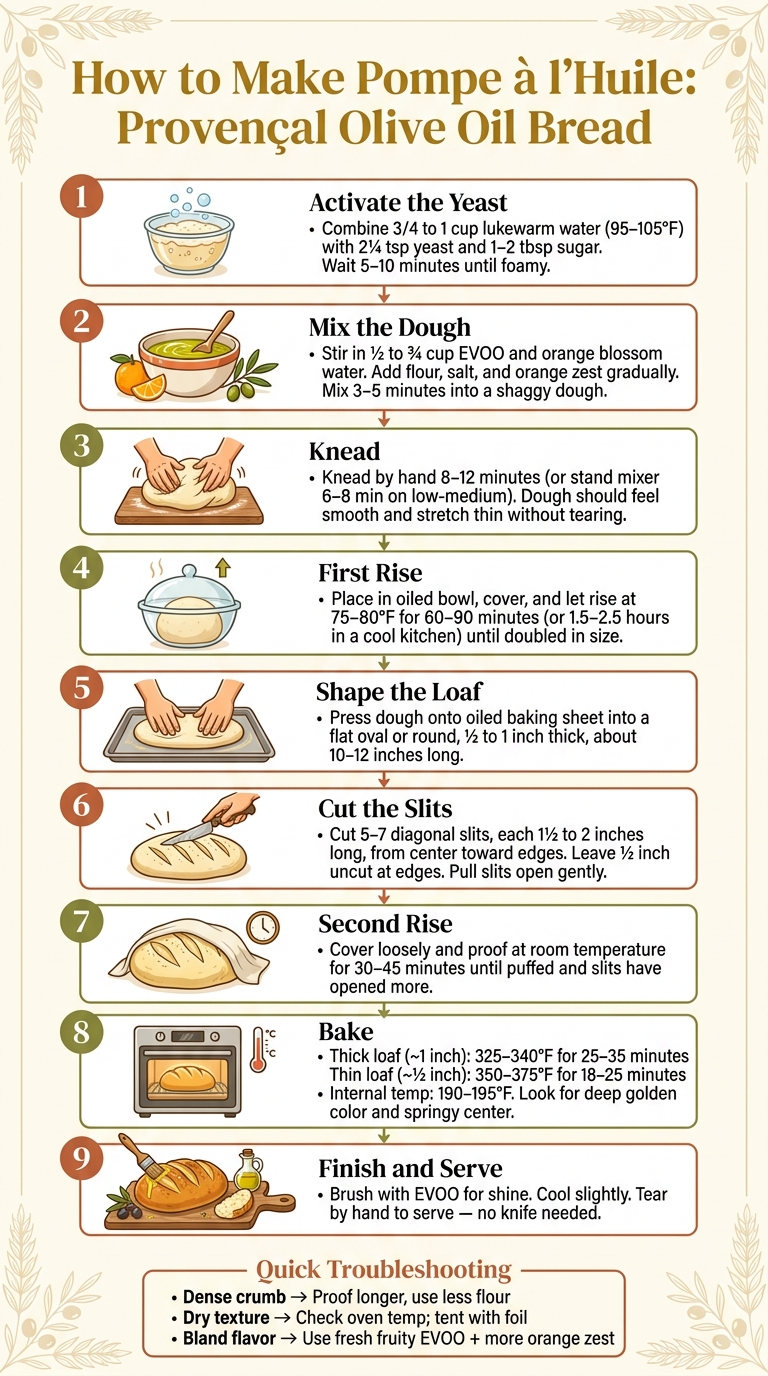
How to Make Provençal Olive Oil Bread (Pompe à l'Huile): Step-by-Step Guide
Mix, Knead, and Complete the First Rise
Once your ingredients are measured, start with the yeast. In a large bowl, combine 3/4 to 1 cup lukewarm water (95–105°F), 2 1/4 teaspoons active dry yeast, and 1 to 2 tablespoons sugar. Let it sit for 5 to 10 minutes until it turns foamy. If nothing happens and the mixture stays flat, toss it and start again with fresh yeast.
When the yeast is foamy, stir in the extra virgin olive oil and orange blossom water. In a separate bowl, whisk the flour, salt, and orange zest. Then add the dry mixture little by little, mixing until you get a shaggy dough. That usually takes 3 to 5 minutes.
Once the dough starts pulling away from the sides of the bowl, move it to a lightly floured surface and knead it for 8 to 12 minutes by hand with a simple push, fold, and turn motion. If you're using a stand mixer with a dough hook, 6 to 8 minutes on low to medium speed usually does the job. You want the dough to feel smooth with a slight satin look. It should also stretch thin without tearing.
Put the dough in an oiled bowl, cover it, and let it rise at 75–80°F until doubled in size. That usually takes 60 to 90 minutes if you want a light, tender crumb. In a cooler kitchen, it may need 1.5 to 2.5 hours. One handy trick is to set the covered bowl in the oven with only the oven light on. Go by how much the dough has grown, not the clock.
Shape the Loaf and Cut the Traditional Slits
After the dough has doubled, gently press it down with your fingertips to let some of the gas out. Transfer it to a lightly oiled baking sheet and pat it out by hand into a flat oval or round, about 1/2 to 1 inch thick and roughly 10 to 12 inches long. That helps keep the classic pompe à l'huile shape. Press from the center outward so the thickness stays even.
To make the slits, use a sharp knife or kitchen scissors lightly coated with oil. Cut 5 to 7 diagonal slits, each about 1 1/2 to 2 inches long, running from the center toward the edges. Leave about 1/2 inch uncut at the edge so the loaf stays in one piece while baking. Then gently pull each slit open with your fingers so it doesn't seal back up during proofing.
Bake Until Golden and Lightly Springy
Cover the shaped loaf loosely with lightly oiled plastic wrap and let it proof at room temperature for 30 to 45 minutes, until it looks puffed and the slits have opened more. While that's happening, preheat the oven.
For a thicker loaf, around 1 inch, bake at 325–340°F for 25 to 35 minutes. For a thinner loaf, around 1/2 inch, bake at 350–375°F for 18 to 25 minutes.
Look for a deep golden color and a center that feels lightly springy. It should bounce back a bit when pressed and shouldn't feel doughy. If you're checking with an instant-read thermometer, the center should read 190–195°F. Brush the loaf with a little extra virgin olive oil for shine, then let it cool slightly before serving.
Serving, Variations, and Troubleshooting
How to Serve It for a Provençal-Style Holiday Table
Once the loaf is cool enough to pull apart, bring it straight to the table. In Provence, pompe à l'huile is one of the centerpieces of the treize desserts - the thirteen desserts that stay on the table so guests can sample each one. To bring that same feel to a U.S. holiday table, set the loaf on a large wooden board or platter and surround it with dried figs, dates, raisins, walnuts, almonds, pieces of white and black nougat, and fresh oranges or tangerines. Serve it with dried figs, walnuts, and citrus.
Skip the knife. Tear it by hand so the bread feels shared and relaxed, not stiff. Put the whole loaf in the middle of the table and let guests pull off pieces as they like. Fruit preserves, citrus marmalade, and a small dish of extra virgin olive oil for dipping all work well here.
If you want to keep the loaf close to the classic version, make only small changes.
Simple Variations That Stay Close to Tradition
The simplest tweak is to increase the sugar a little - from about 1/4 cup to 1/3 cup. That makes the bread slightly sweeter without turning it into something cake-like.
If you want a richer crumb, add 1 whole egg per loaf and cut back the water a bit so the dough stays soft. You’ll get a softer interior and a richer feel. Just keep an eye on the loaf, because egg-enriched dough browns faster.
If orange blossom water is hard to find, use more orange zest instead. Add 1 to 2 more teaspoons, plus a small amount of lemon zest. A 1/2 teaspoon of pure vanilla extract can add warmth, but it nudges the flavor toward an American-style sweet bread instead of a Provençal one. Think of that as a variation, not the classic.
If the loaf doesn’t come out the way you hoped, these fixes can help.
Troubleshooting Table: Dense Dough, Dry Texture, and Weak Flavor
| Problem | Likely Cause | Fix |
|---|---|---|
| Dense, heavy crumb | Underproofing, too much flour, or not enough kneading | Proof until nearly doubled; add flour little by little; knead until smooth |
| Dry, crumbly texture | Overbaking or an oven that runs hot | Use an oven thermometer; start checking the loaf 5–10 minutes early; if it browns too fast, lower the oven to 350°F and bake a few minutes longer; tent loosely with foil near the end |
| Bland or flat flavor | Stale or low-quality EVOO; too little salt or zest | Use a fresh, fruit-forward EVOO; use 1 to 1.5 teaspoons of fine sea salt for a medium loaf; add more orange zest |
Store it at room temperature in an airtight container for 24 to 48 hours. To warm it back up, heat it at 300°F for 5 to 10 minutes. You can also freeze it for up to 1 month, then thaw and warm it briefly in the oven.
Conclusion: Key Steps for a Successful Festive Loaf
Once the dough is mixed, shaped, and baked, pompe à l'huile becomes what it’s meant to be: a Provençal holiday bread made for sharing. It belongs in the middle of the table, broken by hand, not sliced.
What matters most is balance. Use a good olive oil, keep the citrus in check, and give the dough time to rise well. Fresh, fruity EVOO makes a big difference - Big Horn Olive Oil's Ultra Premium EVOO fits nicely here, helping the citrus and floral notes stay bright. Add plenty of citrus zest, go light on the orange blossom water, and wait until the dough has fully doubled before shaping and baking it until the loaf is golden and springy.
After it cools, serve it the Provençal way: set the loaf at the center of the table and break the first piece by hand. That small act turns the bread into part of the celebration.
FAQs
Can I make this dough ahead?
The available information does not say whether this specific olive oil bread dough can be made ahead.
The source material does not include make-ahead instructions.
What if I don’t have orange blossom water?
You can simply leave it out. Provençal bread often has that floral note, but the recipe will still turn out beautifully without it.
For the best flavor, put your focus on a fresh, high-quality Extra Virgin Olive Oil, like one from Big Horn Olive Oil.
How do I know when the dough is proofed enough?
Add a short proofing cue where the dough first rests and where the shaped dough does its final rise.
Use plain, easy-to-check signs like these:
- During the first rise: the dough should look puffy and about doubled in size.
- During the final proof: gently press the dough with a floured finger. If the indent springs back slowly and leaves a slight mark, it's ready to bake. If it springs back right away, it needs more time. If the dent stays deep and the dough sags, it may have gone too far.
That kind of note helps readers know what to look for instead of relying only on the clock.