

Olive Oil Color: Role of Chlorophyll and Carotenoids
Olive oil color tells you more about pigments than about quality. Green oil usually has more chlorophyll-related pigments. Golden oil usually shows a stronger carotenoid share. But color alone cannot tell you if an oil is high grade.
Here’s the short version:
- Chlorophylls and pheophytins push oil toward green
- Carotenoids like lutein and beta-carotene push it toward yellow and gold
- Ripeness shifts oil from greener to more golden tones
- Cultivar, milling, heat, light, and oxygen change pigment levels
- Storage can dull color fast, with chlorophyll sometimes dropping from 6.91 mg/kg to 3.77 mg/kg in 3 months
- Labs use HPLC, UV-Vis, and color tests to check pigment changes
- Markers like pyropheophytin a (PPP) can point to age or heat damage
If I were buying olive oil, I would treat color as a clue only. I would pay more attention to the harvest date, bottle type, and storage, because a deep green oil is not always better than a pale gold one.
| Main factor | What it usually does |
|---|---|
| More chlorophyll | Makes oil look greener |
| More carotenoids | Makes oil look more yellow-gold |
| Earlier harvest | Often leads to greener oil |
| Later harvest | Often leads to more golden oil |
| Light and heat | Break pigments down and dull the color |
| Dark glass or tin | Slows pigment loss |
Bottom line: olive oil color is a pigment signal, not a scorecard. This article explains what those pigments are, how they change, and what lab data can and cannot tell you.
The Pigments Behind Olive Oil Color
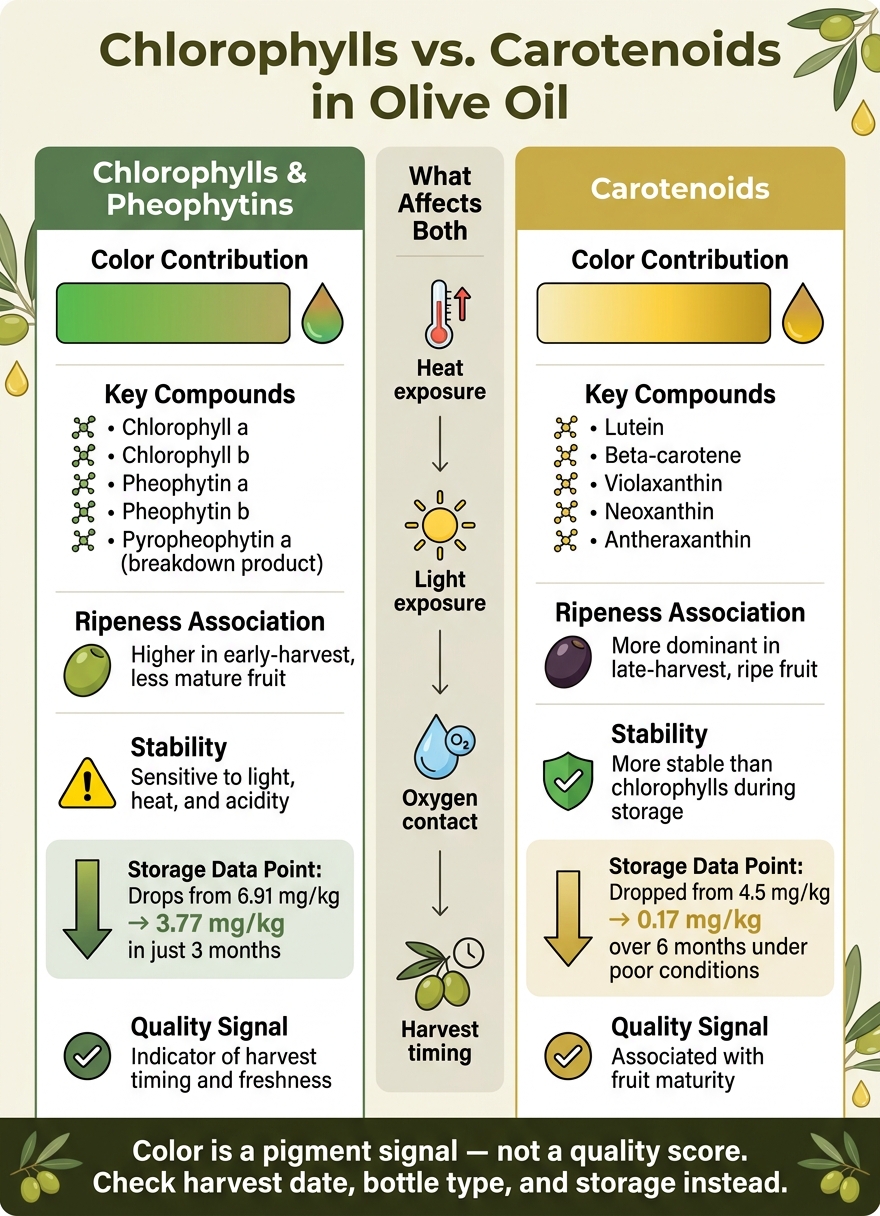
Chlorophylls vs. Carotenoids in Olive Oil: Color, Stability & Quality Signals
Olive oil gets its color from two pigment groups: chlorophylls and carotenoids. Chlorophylls push the oil toward green. Carotenoids move it toward yellow and gold. The final color depends on the balance between those two groups, not on quality alone.
Chlorophylls, Pheophytins, and Green Hues
Olive oil begins with two native chlorophylls: chlorophyll a and chlorophyll b. These pass into the oil during milling.
Then chemistry steps in. Heat and acidity during milling and malaxation change chlorophylls into pheophytins by removing magnesium. In finished oil, pheophytin a is often the main chlorophyll-derived pigment.
Pheophytins still give the oil green to green-yellow tones, but the color is less bright than it is with native chlorophylls. As the oil ages, pheophytins break down into pyropheophytins, which makes the color look duller. That’s why a bright green oil often points to higher chlorophyll levels and an earlier harvest.
Carotenoids then pull the color in the other direction, from green toward gold.
Carotenoids, Lutein, Beta-Carotene, and Yellow-Gold Tones
The main carotenoids in olive oil are lutein and beta-carotene. Smaller amounts of violaxanthin, neoxanthin, and antheraxanthin are there too.
These pigments absorb blue-violet light, which is why the oil appears yellow to gold. Studies show that lutein and beta-carotene account for meaningful portions of total pigments, though the exact share changes by variety and harvest timing. As olives ripen, chlorophyll levels drop and carotenoids become more dominant. That shift moves the oil from green toward gold.
Chlorophylls vs. Carotenoids: A Side-by-Side Comparison
| Feature | Chlorophylls & Pheophytins | Carotenoids |
|---|---|---|
| Typical color contribution | Green to green-yellow | Yellow to golden-orange |
| Common compounds | Chlorophyll a, Chlorophyll b, Pheophytin a, Pheophytin b | Lutein, beta-carotene, violaxanthin, neoxanthin, antheraxanthin |
| Ripeness association | Higher in early-harvest, less mature fruit | More dominant in late-harvest, ripe fruit |
| Stability | Sensitive to light, heat, and acidity | More stable than chlorophylls during storage |
| Quality relevance | Indicator of harvest timing and freshness | Associated with fruit maturity |
That balance keeps shifting with ripeness, cultivar, and storage. Next, ripeness, cultivar, and storage decide which pigment group stays in front.
How Variety, Ripeness, and Storage Affect Color
After milling, the pigment mix doesn't stay fixed. It keeps changing, and ripeness, cultivar, and storage have a big effect on how much green or gold you see in the bottle.
How Ripeness Shifts Oil Color from Green to Gold
The biggest reason olive oil changes color is ripeness. Early-harvest olives - green or just starting to turn - tend to produce oils with more chlorophyll and carotenoids. As the fruit matures, both pigments decline. But chlorophyll falls faster, so the oil shifts from green toward yellow-gold.
One study found chlorophyll dropped from 4.99 to 2.41 mg/L and carotenoids from 3.17 to 1.49 mg/L as olives moved from lemon-green to full maturity. Another found chlorophyll fell from 7.80 to 2.96 mg/kg as the maturity index increased from 0 to 6. That same drop in pigment also helps explain why oils from the same harvest can still look different once variety and storage come into play.
How Cultivar and Harvest Conditions Shape Pigment Levels
Ripeness isn't the whole story. Variety matters on its own. Different olive cultivars start with different pigment levels, so two oils picked at the same maturity stage may still have different color.
Research comparing several varieties found that Manzanilla olives at the lemon-green stage produced oils with the highest chlorophyll content, while Pendolino at the ripe stage ranked among the lowest. Studies on Chetoui and Chemlali Sfax also found highly significant differences in total chlorophyll based on both cultivar and ripening stage, with some cultivars holding onto more green pigment later into harvest.
Processing can shift the final look too. Higher malaxation temperatures and longer processing times may break down pigments before bottling, which can leave the oil paler. In practice, controlled milling - moderate temperatures and less air exposure - helps keep more of the pigments that were in the olives to begin with.
How Storage Breaks Down Pigments Over Time
Once the oil is bottled, pigment loss keeps going. Light, heat, and oxygen drive most of it, and chlorophylls are hit harder than carotenoids. One storage study recorded chlorophyll falling from 6.91 mg/kg to 3.77 mg/kg in only three months, even when the oil was stored in the dark at room temperature. Add light exposure, and that decline moves even faster.
As chlorophylls turn into pheophytins and then keep breaking down under heat or light, pyropheophytin a slowly builds up. Because it is absent in fresh oil, it works as a dependable chemical sign of age or poor storage conditions. That is why cool, dark storage and opaque or dark glass bottles matter so much. They slow pigment loss and help the oil keep its color and antioxidant content longer. These pigment shifts also give researchers a way to read freshness and check authenticity.
sbb-itb-4066b8e
What Color Reveals About Quality and Authenticity
Color is easy to spot. But when researchers want to judge freshness, stability, or whether an olive oil is genuine, they don’t rely on appearance alone. They look at pigment profiles and chemical markers instead.
Freshness and Stability Signals in Pigment Profiles
Fresh extra virgin olive oil contains native chlorophylls, along with only small amounts of breakdown compounds like pheophytins and pyropheophytins. As the oil gets older or is exposed to heat, chlorophyll starts to break down into pyropheophytins, or PPP. So when PPP levels go up, that usually points to aging or heat damage.
Studies also show that PPP reacts to temperature shifts above 77°F (25°C) more readily than secondary oxidation indices. That makes it a useful early signal for heat exposure during storage or shipping. PPP reflects degradation, but it does not measure flavor on its own.
Pigment Ratios Used in Authenticity Research
PPP is only part of the picture. Researchers also compare pigment ratios to see whether an oil lines up with a genuine EVOO profile. These ratios can help flag adulteration or mislabeling.
Some proposed reference points include:
- A total chlorophylls-to-total carotenoids ratio close to 1 in authentic virgin oils.
- A minor carotenoids/lutein ratio around 0.5 in authentic virgin oils.
If an oil drifts far from those numbers, it may point to non-virgin quality, adulteration, or an unusual storage history. Still, context matters.
Carotenoid isomer patterns add one more clue. As oils age or face heat exposure, lutein and other carotenoids isomerize in ways researchers can track. That means higher lutein Z-isomers or neochrome can serve as added freshness markers.
These ratios work best as part of a broader testing panel, not as stand-alone proof. Researchers often read them alongside PPP percentages, DAG profiles, sterol composition, and fatty acid data. A 2023 study also found that pigment composition could feed a machine-learning model that classified EVOO samples adulterated with other edible oils.
| Pigment Marker | What It Signals | Typical Range in Fresh EVOO |
|---|---|---|
| Pyropheophytin a (PPP %) | Heat exposure, aging, potential refining | Often around or below a few percent in fresh, well-stored oil |
| Total chlorophylls / total carotenoids | Cultivar, ripeness, processing authenticity | Around 1 in authentic virgin oils |
| Minor carotenoids / lutein | Degradation history, origin authenticity | Around 0.5 in authentic virgin oils |
| Lutein / β-carotene | Ripeness and storage stability | 0.15 to 5 in genuine EVOO |
Why Color Alone Should Not Drive Buying Decisions
A deep green oil is not automatically better than a golden one. Early-harvest oil can look intensely green because it has more chlorophyll. Later-harvest oil from another cultivar may look pale gold and still be fresh and high quality.
There’s also a catch with chasing that green color. Chlorophyll can act as a pro-oxidant when exposed to light, so a highly pigmented oil in clear glass may break down faster than a paler oil stored in dark packaging. That’s why appearance can mislead.
What matters more is freshness you can verify:
- A harvest or crush date within the past 12 to 18 months
- Dark glass or tin packaging
- Proper storage
Researchers back up these patterns with pigment testing and color analysis. And those markers only mean something when they’re measured in a consistent way, which is why labs use HPLC, UV-Vis, and colorimetry.
How Researchers Measure Pigments and What the Findings Show
To move from visible color to verified chemistry, researchers measure olive oil pigments directly.
Research Methods: HPLC, UV-Vis, and Color Measurement
Researchers rely on three main methods to check both pigment chemistry and the color people see in the bottle.
| Method | What It Measures | Main Strengths | Main Limitations |
|---|---|---|---|
| HPLC | Individual pigments such as lutein, pheophytin a, and β-carotene | Identifies specific compounds and degradation products with high precision | Expensive, time-consuming, requires specialized equipment |
| UV-Vis Spectroscopy | Total chlorophyll and total carotenoid concentrations | Fast, cost-effective, useful for routine screening | Cannot distinguish between specific pigment derivatives or isomers |
| Colorimetry (CIELAB) | Perceived color (green vs. yellow-gold appearance) | Directly reflects visible bottle color | Provides no data on actual pigment chemistry |
Each method tells a different part of the story.
HPLC breaks pigments apart into individual compounds, which makes it useful for precise quality and authenticity testing. UV-Vis offers a fast, low-cost screen by estimating total pigments from absorbance near 470 nm and 670 nm. Colorimetry records the visual outcome, but it can't tell you why the oil looks green, yellow, or brownish.
That matters because visible color alone can be misleading. These tools help researchers sort out which pigment changes come from ripeness, storage, or heat.
Patterns That Appear Consistently Across Studies
The measured results line up with the chemistry: pigment loss tracks aging and handling.
Across studies, maturity, storage, and heat all reduce pigment levels, and chlorophyll tends to break down faster than carotenoids. In one study following Chemlali olive oil over 6 months, chlorophylls fell from about 1.53 mg/kg to just 0.01 mg/kg, while carotenoids dropped from 4.5 mg/kg to 0.17 mg/kg. The amount of loss changed based on the container and storage conditions.
Heat makes the drop even steeper. In another study, chlorophyll content declined by up to about 90% at 122°F (50°C), while carotenoids fell by up to 85% at the same temperature.
Conclusion: Key Points About Olive Oil Color
Olive oil color is a pigment story, not a quality score. Chlorophylls and carotenoids explain most of what you see in the bottle, but cultivar, harvest timing, and storage conditions all shape the final appearance. Color is a clue, not a quality score.
For home cooks, the practical takeaways are simple:
- Buy oil with a clearly marked harvest date.
- Choose dark glass or tins.
- Store it in a cool, dark place away from heat and light.
If a bottle that started bright green turns dull or brownish over time, that's a sign of pigment degradation. It's worth noticing, even though color by itself never tells the whole story.
Pigment analysis works best alongside other quality tests. Used together, HPLC, UV-Vis, and colorimetry help separate appearance from chemistry.
FAQs
Does green olive oil mean better quality?
Not necessarily. Green olive oil is often tied to when the olives were picked and how the oil was processed, not quality by itself.
Its color mostly comes from chlorophyll and carotenoid pigments. If you want to judge quality, look instead for low acidity, no sensory defects, and a recent harvest date.
Why does olive oil turn less green over time?
Olive oil gets less green over time mostly because chlorophyll starts to break down. Light, especially UV rays, kicks off photo-oxidation, and that makes the green color fade.
Heat and oxygen push this along, too. As that happens, the oil can lose some of its brightness and start to look duller. Big Horn Olive Oil helps protect these natural pigments with dark glass packaging and careful storage.
What should I check besides olive oil color?
Color alone won't tell you much about olive oil quality.
A better way to judge it is to look for a few clear signs:
- a harvest date, not just a best-by date
- the country of origin and any certification seals
- dark glass or opaque packaging, which helps protect the oil
Once you're home, use your nose. Good olive oil should smell fresh and fruity. If it smells like wax, paint, or stale nuts, skip it.
Storage matters too. Keep it in a cool, dark place, away from heat and air.