

Ancient Greek Olive Oil vs. Modern Production
If I had to sum it up in one line: modern olive oil wins on control, yield, and shelf life, while ancient Greek methods show where the core quality rules began.
If you want fresh harvest extra virgin olive oil, I’d look at harvest timing, how fast olives reach the mill, extraction temperature, and storage. That’s the whole story. Ancient Greek producers knew early-picked olives and careful handling led to better oil. Modern mills do the same job with enclosed machines, centrifuges, and sealed steel tanks, which helps keep acidity lower and reduces damage from heat, light, and oxygen.
Here’s the short version:
- Ancient Greece: hand picking or pole beating, stone crushing, woven mats, gravity settling, clay storage
- Modern production: mechanical harvest support, milling within 4 to 24 hours, cold extraction under 80.6°F, centrifuges, stainless steel storage
- Main quality gap: less delay, less oxygen exposure, and cleaner equipment
- Main numbers to know: Extra virgin olive oil must stay under 0.8% free acidity; some top-tier oils aim for 0.1% to 0.3%
- Main tradeoff: early harvest gives more polyphenols but less oil volume
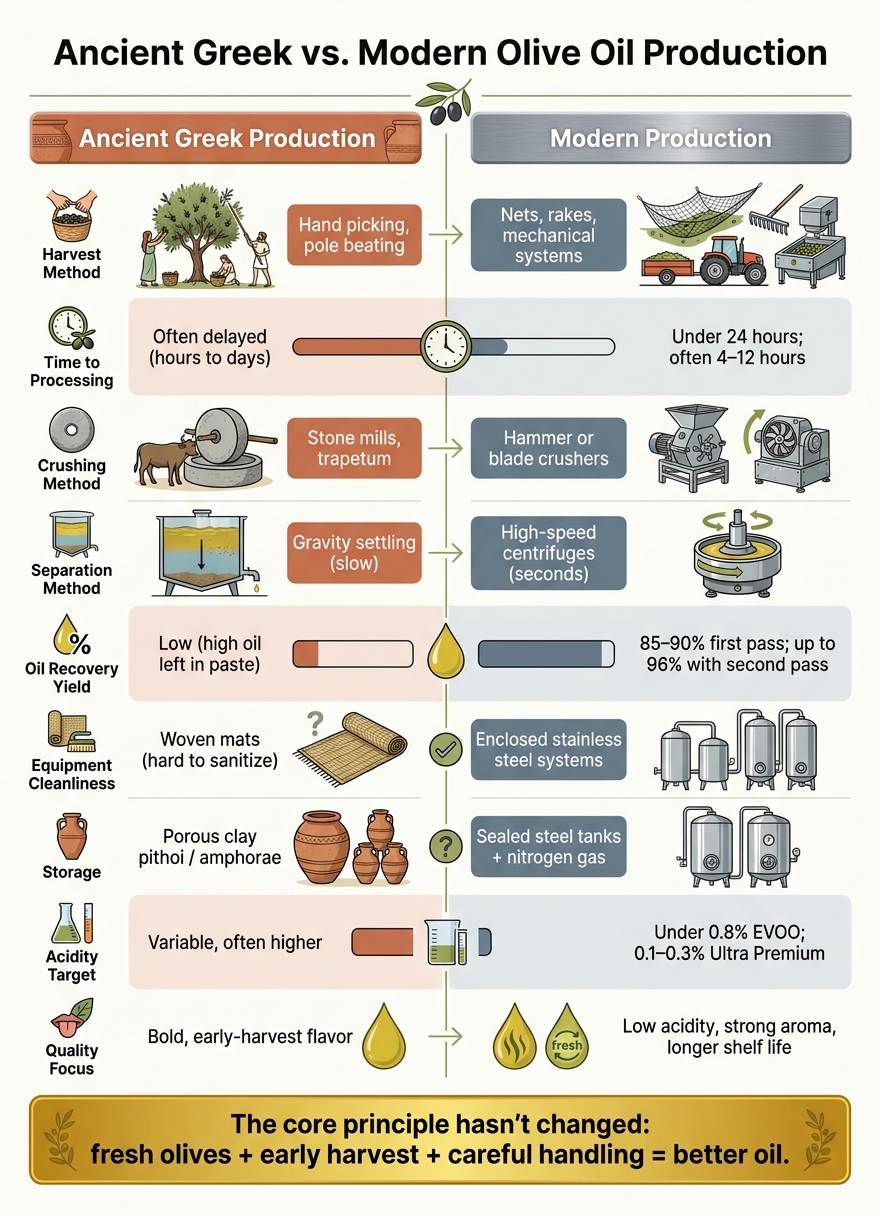
Ancient Greek vs. Modern Olive Oil Production: Key Differences
The Olive Oil Revolution: From Ancient Greece to Modern Health
sbb-itb-4066b8e
Quick Comparison
| Criteria | Ancient Greek Production | Modern Production |
|---|---|---|
| Harvest method | Hand picking, pole beating | Nets, rakes, mechanical systems |
| Time to processing | Often delayed | Often under 24 hours, sometimes 4 to 12 hours |
| Crushing method | Stone mills, trapetum | Hammer or blade crushers |
| Separation method | Gravity settling | High-speed centrifuges |
| Pressure/yield | Lower pressure, less oil recovered | About 85% to 90% first-pass recovery; up to 96% with a second pass |
| Cleanliness | Woven mats could hold residue | Enclosed stainless steel systems |
| Storage | Clay pithoi and amphorae | Sealed steel tanks, often with nitrogen |
| Quality target | Bold, early-harvest oil | Low acidity, strong aroma, longer shelf life |
My takeaway: the tools changed, but the big idea did not. Good olive oil still depends on good fruit, early handling, and careful storage.
Ancient Greek Olive Oil Production
Hand Harvesting and Slow Processing
Ancient Greek olive harvesting used two main methods: workers either picked olives by hand or struck branches with long wooden poles to knock the fruit down. Hand-picking was gentler on the olives. Pole beating moved things along faster, but it also bruised the fruit.
That damage mattered. Once olives were bruised, they started to break down much sooner. Acidity went up, fermentation could start before the olives even made it to the mill, and oil quality took a hit. And because ancient mills couldn't handle large harvests fast, delays were common.
Stone Mills, Manual Presses, and Clay Vessel Settling
After harvest, the olives were washed and crushed in stone basins or rotary mills. One more specialized tool was the trapetum, a rotary stone mill built to crush the olive flesh without breaking the pit. People at the time believed broken pits could change the flavor.
Next, workers packed the olive paste into woven mats and pressed it with manual lever and screw presses.
Those presses did the job, but not very well by modern standards. Ancient equipment usually ran at only 1 to 4 kg/cm² of pressure, so a lot of oil stayed trapped in the paste. The woven mats also posed another problem: they were hard to clean fully, which opened the door to contamination and fermentation.
After pressing, the oil-and-water mix went into vats and sat until the liquids separated by gravity. This took time. It also left the oil in contact with oxygen, which sped up oxidation. That's one of the big weak spots in the old system. Modern production cuts many of these losses by getting olives from harvest to processing much faster.
Storage and Shelf Life
The oil was stored in clay pithoi or amphorae. Jars buried in the ground stayed cooler, which helped. But clay is porous, so oxygen could still seep in over time and shorten shelf life.
That gap - slow handling plus more oxygen exposure - is where modern mills get one of their biggest advantages.
Modern Olive Oil Production
Fast Harvest-to-Mill Handling
Modern mills deal with the same basic problem the Greeks faced: fresh olives start to break down fast. For producers who care about quality, time is the enemy. That’s why many mills try to process olives within 12 to 24 hours of harvest, and often in under 6 hours.
Harvesting is more controlled now, too. Workers use nets to keep olives off the ground, which cuts down on contamination. Vibrating rakes and mechanical harvesters also speed up collection compared with ancient pole-beating.
Mechanical Mills, Centrifuges, and Stainless Steel Storage
Once olives reach the mill, hammer or blade crushers turn them into paste fast while limiting oxygen exposure. The paste is then malaxed for 20 to 45 minutes at under 27°C (80°F) to qualify as cold-pressed. After that, centrifuges spin the paste at high speed to separate oil from water and solids in seconds. Compared with woven mats, this enclosed setup lowers the chance of fermentation and the off-flavors that can come with it.
Storage is another big step forward. Modern stainless steel tanks are sealed and filled with inert gas such as nitrogen to push out oxygen and slow rancidity. Producers also keep them around 57°F to 64°F (14°C to 18°C) to help protect sensory quality.
Extra Virgin Standards and the Ultra Premium Category
Not every bottle labeled "extra virgin" performs at the same level. To qualify as extra virgin, the oil must be extracted by mechanical means only, with no chemical solvents or high heat, and its free fatty acid level must stay below 0.8%. It also has to pass a sensory panel, which means no rancid, fermented, or musty notes.
Ultra Premium producers push those controls even tighter. These oils often aim for acidity between 0.1% and 0.3%, move olives from harvest to mill in 4 to 12 hours, and keep extraction temperatures between 20°C and 22°C (68°F to 72°F). That tighter process helps hold on to volatile aromas and heat-sensitive antioxidants like oleocanthal.
Big Horn Olive Oil works in this Ultra Premium category, focusing on fast cold-pressing and nitrogen-sealed storage to keep the oil fresh and nutritionally dense.
| Feature | Standard EVOO | Ultra Premium |
|---|---|---|
| Acidity (FFA) | < 0.8% | 0.1% – 0.3% |
| Extraction Temp | < 27°C (80.6°F) | 20°C – 22°C (68°F – 72°F) |
| Harvest-to-Mill | Within 24 hours | 4 – 12 hours |
| Storage | Stainless steel | Stainless steel + nitrogen gas |
| Sensory Profile | No defects; fruity | Intense peppery, grassy, and fruity notes |
That’s why modern olive oil is generally cleaner, fresher, and more consistent than the oil made in ancient times.
Ancient Greek Olive Oil vs. Modern Production: Quality and Efficiency
The biggest gap between ancient and modern olive oil production comes down to control. Ancient producers understood that fresh olives made better oil. But modern mills can control the whole process with much tighter precision. Timing, heat, sanitation, and oxygen exposure are watched far more closely now. And that shows up in the oil itself: flavor, freshness, and shelf life all change.
How Production Methods Affect Flavor, Antioxidants, and Shelf Life
Modern extraction uses much more force and pulls out more oil in less time. Decanter centrifugation can recover 85–90% of the oil in the first extraction and as much as 96% with a second pass. That’s a huge shift from older methods.
There’s also a cleanliness issue that mattered more than ancient producers could fully solve. Woven fiber mats were hard to sanitize, so leftover olive paste could sit between batches, ferment, and pass off-notes into the next pressing. Modern stainless steel crushers and centrifuges cut that risk sharply.
The payoff is easy to see in the finished oil. Modern production tends to deliver more steady fruitiness, bitterness, and pungency. It also does a better job holding onto polyphenols. Add dark packaging and inert-gas storage, and the oil keeps its quality for longer. Those gains don’t just affect taste. They also change the amount of work each batch needs.
Labor, Yield, and Environmental Tradeoffs
Ancient olive oil production was seasonal and labor-heavy. People and animals handled each step, from harvest to crushing to settling, and yields per batch were often modest and uneven.
Modern mills work very differently. Electric motors and automated lines let producers process much more fruit with far fewer workers for the same amount of oil. In plain terms, modern systems do more, faster, with less hands-on effort.
Ancient producers wasted little. They reused the watery residue known as amurca as a pesticide or lubricant, and they burned solid pomace for fuel. Modern scale improves output, but it also brings a harder cleanup job, especially when it comes to wastewater and pomace disposal.
Conclusion: What Modern Olive Oil Still Owes to Ancient Greece
Ancient Greece didn’t just make olive oil. It set the bar for what good olive oil should be.
The Greeks understood a few things that still matter now: oil should be fresh, olives should be picked early, and extraction should rely on mechanical methods, not harsh processing. Those same ideas still separate a great bottle from an average one. Today, that standard shows up in faster milling, cleaner storage, and tighter oxygen control.
Modern production improved the process with better precision. Stainless steel replaced clay, and centrifuges replaced stone mills. That leads to more consistent oil, along with better flavor and stronger polyphenol retention.
Ancient producers aimed for fresh, early-harvest oil with low acidity and bold flavor. That’s still the target behind today’s Ultra Premium EVOO category: early-harvested olives, cold extraction below 80.6°F, and careful work to preserve antioxidants.
That freshness-first mindset is the clearest link between ancient practice and modern premium olive oil. Big Horn Olive Oil fits neatly into that line of thinking, with oils made through the same freshness-first approach and fast cold-pressing after harvest. The best olive oil still starts with respect for the fruit.
FAQs
Why does faster milling improve olive oil quality?
Faster milling helps preserve extra virgin olive oil quality by limiting oxidation. Once olives are picked, they start to break down, and contact with air kicks off reactions that can hurt flavor, aroma, and composition.
Modern milling cuts the time olive paste spends exposed to air. That helps prevent fermentation and keep freshness, a clean flavor profile, and low acidity intact.
Does early harvest make olive oil healthier or just stronger-tasting?
Early harvest makes olive oil healthier and stronger-tasting.
Olives picked while they're still green, or just starting to change color, contain more polyphenols. Those compounds are what give the oil its peppery, bitter bite. They’re also linked to anti-inflammatory and antioxidant effects.
There’s a trade-off, though. Harvesting at this stage yields less oil than waiting for fully ripe fruit. But what you lose in volume, you gain in chemical profile.
How can I tell if olive oil was stored properly?
Proper olive oil storage is pretty simple: keep it in a temperature-controlled space, away from light and oxygen. That’s why many high-end producers store olive oil in stainless steel tanks until it’s time to bottle it.
When that doesn’t happen, problems show up fast. If olives sit out too long, or if the oil is handled the wrong way, it can oxidize or go rancid. The result? Unpleasant odors, weaker flavor, and lower overall quality.