

How Olive Oil Producers Test for Pesticides
Olive oil producers face strict regulations to ensure their products are free from harmful pesticide residues. Testing is essential to meet safety standards, protect consumer health, and maintain product quality. Here's how producers address this:
- Why It Matters: Pesticides can concentrate in olive oil during extraction, potentially compromising its health benefits. Regulatory limits, like the EU's 0.01 mg/kg threshold, are stringent.
- Key Testing Steps:
- Rapid Screening: Biosensors offer quick, cost-effective preliminary checks but require chromatography for detailed analysis.
- Challenges: Producers must navigate varying global standards and ensure thorough documentation to avoid recalls or export bans.
Testing ensures olive oil retains its purity and meets safety requirements, reflecting a commitment to quality. Below, we explore the methods, tools, and best practices in detail.
Pesticide Residues in Olive Oil: What Producers Need to Know
Pesticide residues are tiny amounts of chemical substances that remain on olive crops and can transfer into the oil during cultivation. These substances are typically used to manage pests and diseases but don’t always break down completely before harvest - even when applied properly. Because olive oil has a high-fat content and a complex oil matrix, these residues often concentrate in the oil during extraction instead of being left behind in the water fraction. This makes them particularly difficult to detect and eliminate. As a result, thorough testing protocols are a must.
Residues can undermine the health benefits that make premium olive oil so desirable, such as its antioxidant and heart-healthy properties. Professor Nikolaos S. Thomaidis from the National and Kapodistrian University of Athens highlights the risks:
"The extensive use of these chemicals and the non‐compliance to good agricultural practises may endanger human health safety."
To regulate this, Maximum Residue Levels (MRLs) set legal thresholds for pesticide residues. For olive oil, these limits are based on raw olive standards but adjusted to account for how residues behave during milling and extraction. In the European Union (EU), the default MRL for any pesticide not specifically listed is 0.01 mg/kg (10 μg/kg) - a very strict standard. Regulatory bodies like the EU and the Codex Alimentarius Commission oversee these limits, while testing protocols follow detailed analytical guidelines, such as SANTE/12682/2019 and SANTE/11312/2021. Together, these measures highlight the challenges producers face in meeting compliance.
However, the lack of global consistency in residue limits poses additional hurdles. A product that meets EU standards might still face challenges in other markets like China, Australia, Chile, Argentina, or Turkey, each of which enforces its own regulations. With over 1,000 pesticides listed in the EU database alone, comprehensive screening is critical for producers aiming to sell internationally.
Failing to meet these standards can lead to serious consequences, including product recalls, rejected shipments, export bans, and long-term reputational harm. For producers like Big Horn Olive Oil, keeping pesticide residues well below legal limits - or ideally at undetectable levels - is a key factor in delivering a truly premium product.
How to Collect and Prepare Samples for Testing
Accurate pesticide testing relies on careful handling at every stage - starting from collection to preparation. These steps are crucial for ensuring reliable results and meeting regulatory requirements.
How to Collect Representative Samples
For trustworthy pesticide testing, your sample must reflect the entire production lot. A single scoop from one batch won't cut it. Instead, collect composite samples by taking portions from multiple points across the production lot - this could include samples from various tanks, batches, or stages of the milling process. This method accounts for natural variations in the oil and ensures the sample represents the entire volume being tested.
Storing and Labeling Samples Correctly
How you store and label samples can make or break their integrity. Use screw-capped amber or dark glass vials to shield samples from light, which can degrade them. Keep them away from heat to maintain chemical stability.
For storage, follow these guidelines:
- Room temperature: Store samples for up to 15 days.
- Freezing: If analysis will take longer than 15 days, freeze samples at 0°F to -4°F (-18°C to -20°C).
Here’s a quick summary of storage conditions:
| Item | Storage Temperature | Max Duration | Container |
|---|---|---|---|
| Olive Oil Samples | Room temperature | 15 days | Glass vials |
| Olive Oil Samples | 0°F to -4°F (-18°C to -20°C) | Long-term | Glass vials |
| Pesticide Standards | -4°F (-20°C) | 24 months | Dark glass vials |
Proper labeling is equally critical. Each container should include:
- Lot number
- Collection date
- Collection point
- Name of the person collecting the sample
This documentation is crucial for maintaining a clear chain of custody, especially if results are ever challenged.
Once samples are securely stored and clearly labeled, the next step is preparing them for analysis.
Sample Preparation Methods
Before analysis, raw olive oil must be cleaned to eliminate interferences and ensure precise detection of pesticide residues. The go-to method for this is QuEChERS (Quick, Easy, Cheap, Effective, Rugged, and Safe). This process starts with a liquid-liquid partition using acetonitrile, followed by dispersive solid-phase extraction (d-SPE) to remove matrix interferences.
For olive oil and other fatty matrices, EMR-Lipid (Enhanced Matrix Removal-Lipid) is the preferred clean-up sorbent. It removes lipids effectively without affecting the target pesticides. A 2023 validation study by Konstantina Iosif and Ioannis Konstantinou at the University of Ioannina demonstrated that EMR-Lipid achieved pesticide recoveries of 70–113% for 95% of analytes, with an average relative standard deviation as low as 4%. As Iosif explained:
"The EMR-lipid sorbent showed better clean-up capacity (i.e., less matrix effects and lower variability in extraction recoveries) and validation parameter values for more analytes."
For even better results, consider adding a freeze-out step before the d-SPE clean-up. Using dry ice at -76°C (approximately -105°F) for 5 minutes significantly improves fat removal from the extract. This extra step can enhance the quality of your data.
Testing Methods: Chromatography and Mass Spectrometry
Once the sample preparation process is complete, the actual analysis begins. For detecting pesticides, professional labs rely heavily on two key instruments: Gas Chromatography–Mass Spectrometry (GC-MS) and Liquid Chromatography–Tandem Mass Spectrometry (LC-MS/MS). Each serves a unique purpose, targeting different pesticide types. Using both methods together ensures a more thorough analysis.
Gas Chromatography–Mass Spectrometry (GC-MS)
GC-MS is the preferred tool for analyzing volatile and semi-volatile pesticides with low to intermediate polarity. This includes compounds like endosulfan, cypermethrin, and deltamethrin. The technique works by vaporizing the sample to separate compounds, then identifying each one based on its distinct mass signature. Modern systems often use APCI (Atmospheric Pressure Chemical Ionization), a soft ionization method that reduces fragmentation.
"GC-MS targets semi-volatile compounds, while LC-MS/MS is optimal for polar and thermally unstable pesticides." - Sofia K. Drakopoulou et al., National and Kapodistrian University of Athens
However, the high fat content in olive oil can complicate GC-MS analysis. As noted by Carmen Ferrer and her team at the University of Almería, removing fats is essential for accurate results. They explain that "the preparation of oil samples for the determination of pesticides by GC requires the complete removal of the high-molecular-mass fat from the sample". This is where an effective EMR-Lipid clean-up process becomes critical.
While GC-MS is highly effective for certain pesticides, LC-MS/MS is needed to address its limitations.
Liquid Chromatography–Tandem Mass Spectrometry (LC-MS/MS)
LC-MS/MS excels at detecting polar, non-volatile, and thermally unstable pesticides, such as dimethoate, diuron, and simazine. Unlike GC-MS, it uses a liquid mobile phase to separate compounds before they are analyzed in the mass spectrometer. The system employs Electrospray Ionization (ESI) in Multiple Reaction Monitoring (MRM) mode, which allows for precise tracking and identification of compounds.
The performance data speaks volumes. In a study analyzing 105 pesticides, LC-MS methods achieved detection limits below 10 µg/kg for over 85% of the analytes. Additionally, LC-ESI has demonstrated greater sensitivity compared to GC-APCI, delivering lower quantification limits in 83% of the compound comparisons.
| Feature | GC-MS | LC-MS/MS |
|---|---|---|
| Target Compounds | Volatile, semi-volatile, non-polar | Polar, non-volatile, thermally unstable |
| Ionization Method | APCI or Electron Ionization (EI) | Electrospray Ionization (ESI) |
| Common Pesticides | Endosulfan, Cypermethrin, Deltamethrin | Dimethoate, Diuron, Simazine |
| Sensitivity for Polar Compounds | Lower | High |
By combining these methods, labs can provide a comprehensive analysis of pesticide residues. For example, a 2024 study from the National and Kapodistrian University of Athens used both LC-(ESI)-QTOF MS and GC-(APCI)-QTOF MS to screen 771 pesticides in 20 Greek olive oil samples. This dual approach identified residues like lambda-cyhalothrin, chlorpyrifos, phosphamidon, pirimiphos-methyl, and esprocarb at low ng/g levels. Recovery rates ranged from 70% to 120% for 40% of the validation set, with Relative Standard Deviations (RSDs) below 20% for 92% of analytes.
Quality Control in Lab Testing
Accurate results hinge on strict quality control at every stage. One essential practice is matrix-matched calibration, where calibration standards are prepared in a blank olive oil extract rather than a plain solvent. This step is crucial because olive oil’s fat content can distort detector signals - about 88% of pesticides analyzed via LC/GC-HRMS experience signal suppression due to the oil matrix.
Another critical step is recovery checks. Labs spike blank samples with known pesticide concentrations to verify accuracy for each batch. Acceptable recovery rates range between 70% and 120%, while precision (measured as RSD) should not exceed 20%.
Reliable identification also requires meeting four criteria: retention time, mass accuracy (typically under 5 mDa), isotopic pattern, and MS/MS fragmentation. These rigorous checks ensure that the testing process produces dependable results every time.
sbb-itb-4066b8e
Rapid Pesticide Screening with Biosensor Technologies
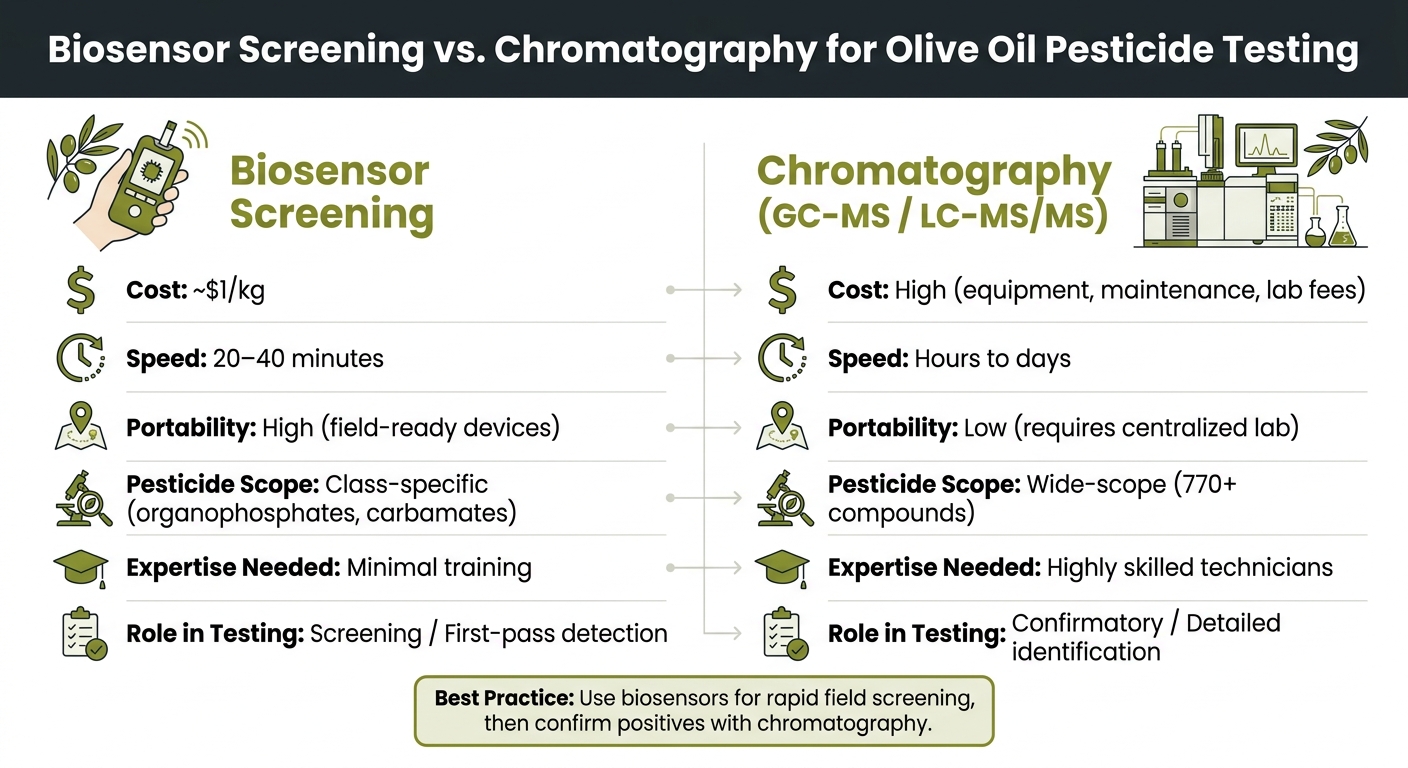
Biosensor Screening vs. Chromatography for Olive Oil Pesticide Testing
Biosensor technologies are changing the game for pesticide testing, offering a much faster alternative to traditional chromatography methods. While chromatography remains the gold standard for detailed pesticide analysis, it can be time-consuming and expensive. For olive oil producers who need quick answers - whether during harvest or when receiving shipments - biosensors provide a reliable first step, delivering results in just 20 to 40 minutes instead of hours or even days.
How Biosensors Detect Pesticides
Biosensors for olive oil testing often rely on enzyme inhibition. Specifically, cholinesterase enzymes like acetylcholinesterase (AChE) or butyrylcholinesterase (BChE) react predictably with organophosphate and carbamate pesticides. When these pesticides are present, they bind to the enzyme, blocking its ability to process the substrate. The greater the enzyme activity drop, the higher the pesticide concentration.
The biosensor measures this change electrically, using screen-printed electrodes (SPEs) enhanced with nanomaterials like carbon black (CB) or gold nanoparticles (AuNPs). These materials help improve electron transfer and make the sensors more sensitive. For example, in December 2016, a research team led by Fabiana Arduini at the University of Rome "Tor Vergata" developed a portable BChE biosensor using carbon black-modified SPEs. This biosensor detected paraoxon in extra virgin olive oil at levels as low as 6 ppb.
Another method involves Molecularly Imprinted Polymers (MIPs), which function like synthetic antibodies. In this approach, a polymer is created around a target pesticide molecule. Once the molecule is removed, the remaining cavity selectively binds the pesticide. This technique has shown the ability to detect fenthion at concentrations as low as 0.05 mg/kg, far below the international Maximum Residue Limit (MRL) of 1–2 mg/kg.
"The simplicity and reliability of this biosensor along with the advantages of fast response and extended storage stability... make this analytical system very attractive for pesticide detection in olive oil." - Fabiana Arduini, Department of Chemical Science and Technologies, University of Rome "Tor Vergata"
Step-by-Step Biosensor Screening Workflow
Understanding how biosensors work is just the start. Since olive oil is made up of 98–99% triglycerides, it must first undergo an extraction process to make it compatible with enzyme-based biosensors. Here’s the typical workflow:
- Extraction: Combine 2 g of olive oil with 10 mL of acetonitrile.
- Clean-up: Use dispersive solid-phase extraction (PSA/C18) to eliminate fatty acids and pigments.
- Reconstitution: Evaporate the solvent and dissolve the residue in phosphate buffer (pH 7.4).
- Baseline Measurement: Establish the enzyme’s baseline activity by introducing a substrate to the biosensor.
- Inhibition: Incubate the biosensor in the prepared sample for 20–30 minutes.
- Final Reading: Measure the residual enzyme activity. A drop in activity indicates pesticide concentration.
For best results, keep the acetonitrile concentration in the testing buffer under 10% (v/v), as higher levels can denature the enzyme and cause false positives. Another tip: after incubation, rinse the biosensor with distilled water and measure it in clean phosphate buffer. This step minimizes interference from the olive oil matrix.
"The benefit is that, as QuEChERS is the same method exploited for standard analysis, only samples that are positive for the presence of pesticides should be further analyzed with chromatographic techniques." - Fabiana Arduini, Department of Chemical Science and Technologies
Biosensor Screening vs. Chromatography: Pros and Cons
Biosensors and chromatography complement each other well. Biosensors quickly identify potential contamination, while chromatography confirms and identifies the specific compounds. Here’s a quick comparison:
| Feature | Biosensor Screening | Chromatography (GC-MS / LC-MS/MS) |
|---|---|---|
| Cost | Low (≈$1/kg) | High (equipment, maintenance, lab fees) |
| Speed | 20–40 minutes | Hours to days |
| Portability | High (field-ready devices) | Low (requires centralized labs) |
| Pesticide Scope | Class-specific (organophosphates, carbamates) | Wide-scope (770+ compounds) |
| Expertise Needed | Minimal training | Highly skilled technicians |
| Role in Testing | Screening | Confirmatory |
One limitation of biosensors is their specificity - they identify pesticide classes but not individual compounds. A positive result means pesticides are present, but chromatography is needed to pinpoint the exact substance. However, biosensors are incredibly practical for initial checks. For instance, BChE-based biosensors can retain their effectiveness for up to 60 days at room temperature if stored properly.
"Biosensors have been shown to be very promising due to their simplicity and cost effectiveness compared to conventional techniques." - Idriss Bakas, University of Perpignan
Adding Pesticide Testing to a Quality Assurance Program
Chromatographic methods play a key role when integrated into a strict quality assurance (QA) program. As discussed earlier, practices like careful sample handling and lab testing are essential to maintaining product integrity. For producers striving to meet Ultra Premium EVOO standards, pesticide testing must be conducted on time, meticulously documented, and followed by immediate corrective measures if results exceed permissible limits.
When to Test During the Production Cycle
Timing pesticide tests throughout the production cycle is crucial. Residues from pesticides follow a predictable path from the field to the final product. Testing at four specific stages provides a clear and thorough assessment:
| Testing Point | Purpose | Relevant Standard |
|---|---|---|
| Pre-Harvest | Assess risk from agrochemicals applied in the field | Good Agricultural Practices (GAP) |
| Raw Olives | Establish baseline residue levels before processing | EU Regulation (EC) No. 396/2005 |
| Native Oil | Confirm the safety of the processed product | Codex Alimentarius MRLs |
| Bottled EVOO | Final quality check for retail and certification | EU Multiannual Control Program |
One key point to remember is that Maximum Residue Levels (MRLs) are typically set for raw olives, not the extracted oil. To calculate the legal limit for processed oil, producers need to apply a processing factor (PF) using the formula:
MRL(oil) = MRL(olive) × Processing Factor.
The European Food Safety Authority (EFSA) provides a database of these factors for "olives for oil production" and "native oil".
"MRLs can be applied to processed foods using appropriate processing factors which are based on studies which take into account the effect of processing on the food as traded." - Sofia K. Drakopoulou et al.
Seasonal monitoring is another critical component. European multiannual control programs monitor between 185 and 260 different pesticide molecules during each EVOO testing cycle, underscoring the extensive testing required.
Documentation and Certification Requirements
Testing results are only as useful as the records that accompany them. Under Commission Implementing Regulation (EU) 2026/765 - effective January 1, 2027 - every sample must include a formal sampling report completed by a designated sampling officer. This report should detail the lot's origin, olive variety, producer, and production timeline to ensure complete traceability.
For certification, sample labeling must include both barcodes and alphanumeric identifiers to link physical samples to digital records seamlessly. Laboratories conducting pesticide analysis must adhere to the Guidance Document on Analytical Quality Control and Method Validation Procedures for Pesticide Residues Analysis in Food and Feed (SANTE/11312/2021 v2026), which outlines strict standards for recovery rates, precision, and measurement uncertainty.
Participation in external proficiency tests can further enhance credibility. For instance, in 2023, the International Olive Council conducted a proficiency test (COIPT-23) where 39 laboratories across the Mediterranean and Europe analyzed spiked EVOO samples for unknown pesticide residues. Proper documentation ensures traceability, allowing producers to quickly address any non-compliance issues.
Steps to Take When Results Exceed Legal Limits
If pesticide residues exceed established MRLs, the first step is to isolate the affected lot immediately. Producers should then trace the contamination back to its source in the field to identify the pesticide application responsible and revise field practices as needed.
On the analytical side, if a compound fails to meet recovery and precision criteria, it should either be excluded from certification or the extraction method must be adjusted before retesting. Ignoring method performance issues can lead to unreliable data, jeopardizing compliance.
"Determining pesticide residues in matrices with high oil contents and low to moderate water contents poses a challenge due to signal suppression in chromatographic analysis, often resulting in poor recovery." - Iwona Wenio, Voivodship Sanitary and Epidemiological Station
For producers like Big Horn Olive Oil, having documented corrective action protocols is key. These protocols set proactive operations apart from reactive ones, ensuring that every bottle of Ultra Premium EVOO maintains its integrity and quality.
Conclusion: Keeping Olive Oil Pure and High Quality
Pesticide testing plays a crucial role in setting premium olive oil apart. With the extensive list of pesticides in the EU database, no single test can detect every residue. This is why producers rely on a combination of methods, including modern High-Resolution Mass Spectrometry (HRMS), to achieve thorough testing coverage.
HRMS stands out with its ability to perform retrospective analysis using stored digital data, making it a powerful tool for long-term quality assurance. By investing in such advanced testing techniques, producers ensure that their efforts continue to pay off as analytical methods improve over time. These technologies not only improve detection capabilities but also highlight a producer's dedication to maintaining the highest standards.
"The proposed methodology is an important tool towards pesticides control and health protection, providing a comprehensive picture of the exposure to pesticides over time." - Sofia K. Drakopoulou et al., National and Kapodistrian University of Athens
For producers like Big Horn Olive Oil, this rigorous testing process is key to delivering Ultra Premium Extra Virgin Olive Oil (EVOO). From cold pressing olives within just two hours of harvest to maintaining purity throughout production, every step reflects their commitment to quality.
FAQs
How often should olive oil be tested for pesticides?
Producers aren't required to follow a fixed schedule for routine pesticide testing. However, once a sample is taken, it needs to be tested within 15 days to guarantee accurate results. Big Horn Olive Oil takes quality seriously, using advanced analytical techniques to identify pesticide residues. This commitment ensures their Ultra Premium Extra Virgin Olive Oils and Balsamic Vinegars maintain their quality, freshness, and health benefits.
Can pesticides increase during olive oil extraction?
Yes, pesticide residues can become more concentrated during the olive oil extraction process if appropriate testing and controls are not implemented. Since the extraction process can amplify any residues present in the olives, rigorous testing is crucial to maintain both the safety and quality of the final product.
What should a producer do if a test fails an MRL?
If a test shows residue levels above the Maximum Residue Limit (MRL), the product is considered non-compliant. To ensure precise results, producers should rely on labs accredited under ISO/IEC 17025:2017. It's also crucial to account for the transformation factor (Pf) - a measure of how residues can become more concentrated during the oil extraction process. Even when field treatments meet compliance standards, residue levels in the final olive oil might still exceed acceptable limits.